Breakfast

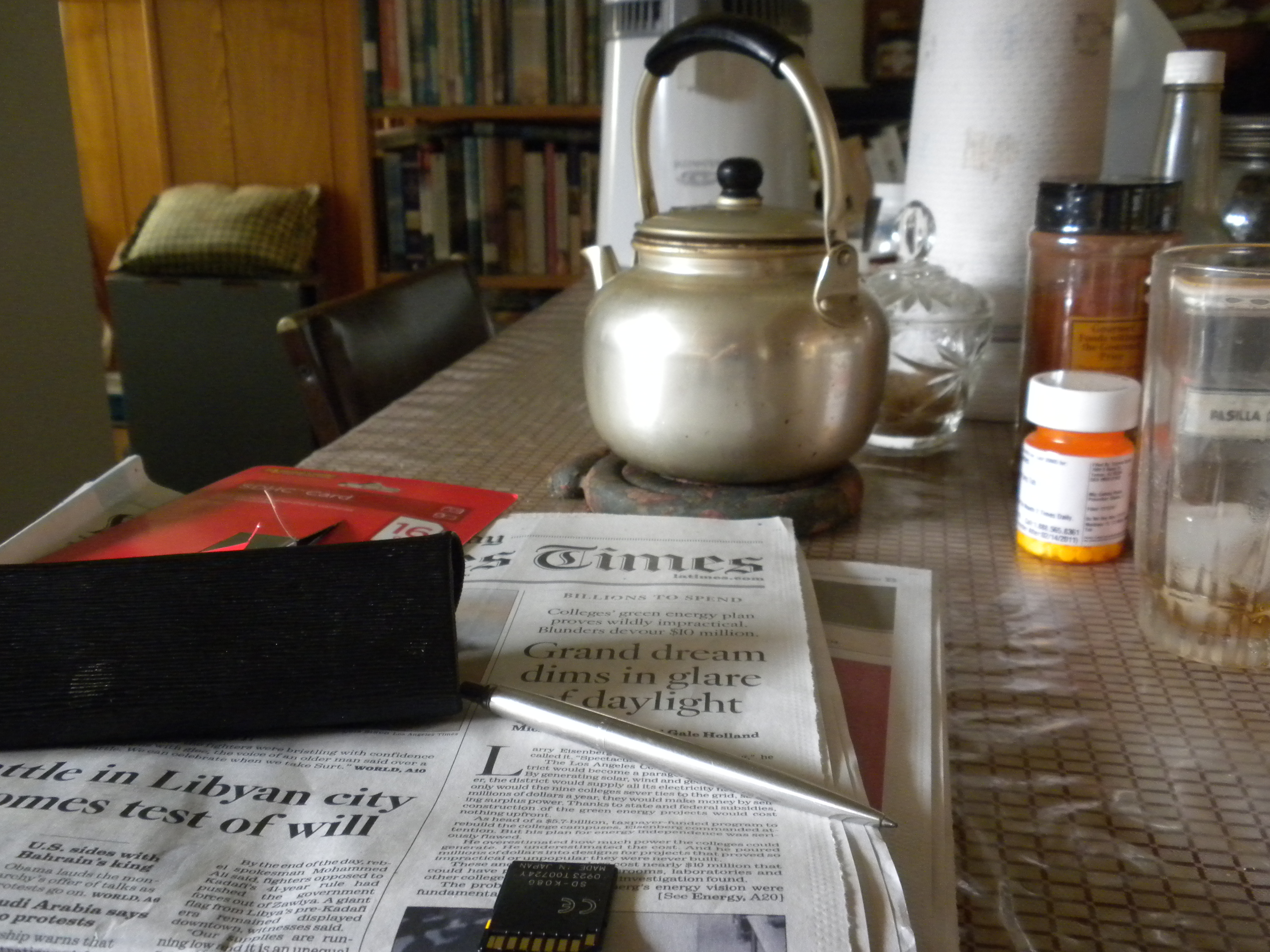
Our Dinner Table in 2011

My main meal of the day is breakfast; and the most important component of my breakfast is a fresh pot of tea. The above photo was taken nine years ago, but I am using the same cheap metal Japanese teapot. I like it because it has a removable insert which captures all the tea leaves so I don’t end up pouring any in my cup. Visible in the upper left of the photo is a green and grey houndstooth-checked tea cosy, which I hardly use any more. After breakfast, I let my tea cool and, for lunch and dinner, pour the cold tea into a glass and add ice cubes. If I want to be fancy, I could also add Splenda, a little splash of dark rum, and a squeeze of lemon or lime.

My tea preference is almost always an Indian black, consisting of Ahmad of London’s loose teas, sometimes a mix of Darjeeling, Ceylon, Assam, and Brooke Bond Red Label tea. Right now, I am drinking pure Darjeeling, which I consider the best of Indian teas. When the coronavirus eventually subsides, I will shop for a high-quality Chinese Oolong from Ten Ren Tea Company for occasional entertaining.

At present, I add a bit of Mesquite Honey to the tea in my cup and a squeeze of lime.

Along with the tea, I rotate between steel-cut oatmeal with dried cranberries; grits with sausage, butter, and pepper; scrambled eggs with Serrano chiles; onion or sesame bagel with butter and cream cheese; my own kind of Welsh Rarebit on a sourdough English muffin with sharp Cheddar cheese and spicy red chile powder; crunchy peanut butter and jelly sandwich; sausage and biscuit; or, if I am pressed for time, just buttered toast.

It’s not much, but it makes an excellent start to my day. Martine and I usually eat breakfast separately, so I usually read the Los Angeles Times, concentrating on the comics, Sudoku and Kenken games, and (finally) the news.

Deatinations: Baja

Suddenly, in My Quarantined Stupor, Baja California Looked Better and Better

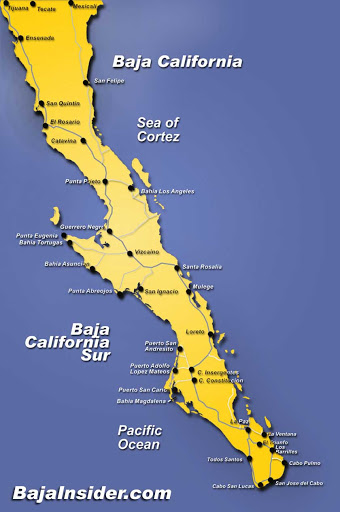
Next to my seat at the kitchen table sits a stack of Lonely Planet and Moon travel guides. Of late, the top volume in the stack has been the Moon Baja guide. I have nibbled at the edges of the 775-mile (1,274 km) peninsula several times: once to Cabo San Lucas for several days, once to Ensenada for three days, once to Tijuana on a day trip, and once to Mexicali.

What begins to interest me of late is a drive on Mexica Route 1 from Tijuana all the way to Cabo San Lucas. If I went by bus, it would be a 24-hour ride. If I went by car, it would be much longer, because there are a number of towns along the way at which I’d like to stop for several days, and a number of side trips to the old Jesuit missions which are the Mexican equivalent of the Serra’s missions in my State of (Alta) California.

Mapa of the Baja California Peninsula

I am not much of a beach person, but I do love the desert—but never during the heat of summer. I see myself visiting missions, Indian cave paintings, taking pangas to se the Grey Whales, eating fish tacos and drinking good Mexican beer. I want to see the desert full of strange Boojum Trees (Fouquieria columnaris), which look as if they could have been invented by Dr. Seuss.

Paging Dr. Seuss

The damnable thing is that Baja is so close to Los Angeles. It would take me maybe three hours to drive to the border. I would prefer to rent a car, but I don’t like the idea of driving from TJ to Los Cabos and back again. I’ll have to see if some special arrangement could be made for me to fly back after dropping the car off.

Well, it’s maybe just a pipe dream; but it could happen.


Toenails and Teeth

My Own Toenails Don’t Look Anywhere Near So Good

I am happy to say that basically I am in good health, even though I have lived three quarters of a century. Of course, I still don’t have a pituitary gland (and never will), and my Type II Diabetes, though under control, doesn’t show signs of leaving.

Of late, my major complains have to do with my ingrown toenails and my teeth, both problems I inherited from my father. My father also had Diabetes, and suffered from the pain of excruciating neuropathy. Back in his day, though, I don’t think that his doctors really understood Diabetes. Neither did anyone in my family. The word for Diabetes in Hungarian is cukor (pronounced TSOO-khor), the same as the word for sugar. Naturally, people believed that if you switched from sugar to saccharin, everything would be A-OK.

This week I have been soaking my toes in warm water with Epsom Salts, applying triple antibiotic ointment to two ingrown nails, and bandaging them—with Martine’s help. Tomorrow, I see the podiatrist who will past judgment on how strictly I’m going to have to care for them.

I have bad teeth, but much of the problem is my own fault. I have generally avoided brushing my teeth; consequently, plaque ran wild, caused cavities, and in general undermined my crowns. Only recently, I bought an electric rotary toothbrush (Oral B) and began the long slow process of undoing a whole lot of negligence. Medicare takes care of my toes, but teeth are an entirely different matter. As things stand, I could easily spend $20,000 or more in the next two years on my teeth—and I can’t really afford that.


My Musical Career

I Thought It Would Be a Neat Idea, But What Did I Know?

One of the problems of being the firstborn son of poor parents is that you are elected to fulfill their unfulfilled wishes for their own lives. When I was nine years old, they decided that I should play a musical instrument. That sounded fine to me; it’s just that I didn’t realize the extent to which the hook was baited.

For some reason, I wanted to play a trombone. At the music store, my mother and father got the salesman to point out that my teeth weren’t right for playing the trombone. They both suggested I play the saxophone instead. I didn’t even know what a saxophone was. So I foolishly said, okay. Before I could say “Help: Get me out of here!” I had a music teacher downtown who would teach me the ways of the alto saxophone.

What follows resembles an episode of Leave It to Beaver. Each Saturday morning, I had to take the 56A bus downtown to Prospect and Ontario, from where I trudged with my instrument case to East 3rd Street where Mr. Jack Upson tried to make a musician out of me. The lessons were okay, I suppose, but the daily practice sessions were, quite simply, horrible. When I wanted to go outside to play, I was sternly reminded that I had roped my family into buying me a saxophone, which they couldn’t afford; and I had damned well sit down for an hour and practice. My mom’s favorite song was “Londonderry Air,” which she knew as “Danny Boy.” Just to make things totally untenable, my little brother Dan would show up for the song and grin while I tootled away while staring daggers at him.

At Chanel High School, I joined the Firebirds marching band. Just imagine what it was like to take the field at halftime and do formations with only twenty-odd instruments. All anyone in the stands ever heard was the booming of the drums.

This nonsense continued until I went away to college. Although I showed up for several Dartmouth band practices, I immediately saw that I was among people who knew how to play their instruments and who loved performing. I quietly left the band before the first football game and never picked up my saxophone again. After all, in Hanover, New Hampshire, there was no one to make me practice—and several classmates who would have tarred and feathered me if I had.


Tiger Hunting

Jim Corbett with Man-Eating Tiger

There are relatively few tigers left in the world today; but, a hundred years ago, there were individual tigers who were responsible for the deaths of hundreds of villagers in the northwest Indian region of Kumaon, just west of Nepal. Perhaps the most famous of the “white hunters” of these man-eating tigers was Edward James Corbett, better known as Jim Corbett (1875-1955).

Now what am I doing talking about a killer of endangered tigers? Surprisingly, Corbett himself was a naturalist:

A tiger’s function in the scheme of things is to help maintain the balance in nature and if, on rare occasions, when driven by dire necessity, he kills a human being or when his natural food has been ruthlessly exterminated by man he kills two percent of the cattle he is alleged to have killed, it is not fair that for these acts a whole species should be branded as being cruel or bloodthirsty.

Corbett is as famous for photographing and preserving the tiger population as he is for hunting them. In the introduction to his most famous book, Man-Eaters of Kumaon, he writes:

When, therefore, a tiger is suffering from one or more painful wounds, or when its teeth or missing or defective and its claws worn down, and it is unable to catch the animals it has been accustomed to eating, it is driven by necessity to killing human beings.

I was surprised how well-written his book is. He is able to produce an elegant word picture of the circumstances of each hunt. Because of the strength and agility even of man-eating tigers, one rarely has time to reload if one misses. Even if he shoots his prey in the head, the tiger can survive long enough to make a meal of his hunter.


Plague Diary 29: Corona Cooking

The Mafia Cooking Hour

During my months-long quarantine, I have been sustained by five things:

  1. My relationship with Martine
  2. Playing chess with the computer
  3. Reading
  4. Watching movies on TV and my computer
  5. Cooking

That last item deserves some explanation. I have always enjoyed cooking, but I never was able to give it the attention it deserved. When I was working, I cooked good food, but I shied away from recipes that required some sophistication and a lot of time. Now that I am retired and quarantined, I am able to take the time to make some really good meals.

Mostly for Martine’s benefit, I got my hands on a cookbook by a convicted mafioso, Henry Hill, featuring the Italian cooking of the New York/New Jersey area: The Wiseguy Cookbook. Although Martine was born in France, she was mostly raised in Northern New Jersey (in Oceanport). As a child, it was New Jersey Italian food that she loved most. That was before she came out to Los Angeles and fell for Hungarian food.

For myself, I have become more interested in the vegetarian cuisine of India. Fortunately, Youtube has some excellent and very authentic recipes by Indians, Pakistanis, and others featuring Indian cuisine. This week, I made the following:

Manjula presents us here with a recipe for Chick Pea Pulav (aka Chole Biryani). The followed the recipe exactly, except that I added half a chopped onion and some extra hot Indian red chile powder. The only change I would suggest is to use one cup of water rather than a cup and a half. The dish is superb.

Fortunately, there is a nearby Indian foods store in Culver City called Indian Sweets and Spices. In better times, there is a little café on the premises with vegetarian-only curries; but there is also an excellent selection of teas and such hard-to-find items as mango powder, foenugreek leaves, garlic/ginger paste, and asafoetida.

Born in Cleveland

Sci-Fi Writer Harlan Ellison (1934-2018)

The city of my birth—Cleveland, Ohio—has given birth to few celebrities. Among actresses, there were the meltingly lovely Halle Berry and Dorothy Dandridge. Among literary figures, there was only one: Science Fiction author Harlan Ellison. During his career, Ellison has won eight Hugo Awards, four Nebula Awards, five Bram Stoker Awards, and two Edgar Awards.

More to the point, he has written some of the most striking and memorable stories in the sci-fi, horror, and mystery genres. These include “’Repent, Harlequin!“ Said the Tick-Tock Man” (1965) and “I Have No Mouth, and I Must Scream” (1968). He edited two famous sci-fi collections of stories in Dangerous Visions (1967) and Again, Dangerous Visions (1972). And he wrote what was probably the most remembered episode of the original “Star Trek” series entitled “The City on the Edge of Forever” (1967).

Most of his oeuvre consists of short stories which are as eye-popping today as when they first came out. I am slowly working my way through these stories.

This afternoon, I saw a 2007 film by Erik Nelson about the writer entitled Harlan Ellison: Dreams with Sharp Teeth, which includes multiple instances of the author’s abrasive style. During his heyday, that abrasiveness won him many enemies. In the end, however, what will be remembered are his stories.

It’s good to know that at least one great writer came from my home town.


The Disunited States of America

The Fracture Lines Are Becoming More Evident

At some point in the last few decades, it appeared that the people of the United States of America could not agree on much of anything. Does water flow uphill? Is a fetus worth more than an actual human being? Did the Confederacy actually win the Civil War? Did the moon landing really take place? Can we fight the coronavirus by injecting bleach into our veins? Does the Hollywood QAnon child sex ring exist? Is the Earth flat?

All these questions which to me represent the pinnacle of stupidity seem to have large numbers of adherents—people who are angry with Liberals who have ignored them as inhabitants of “Flyover Country,” made fun of their strange religious practices, and insisted that they conform to scientific principles that are somehow unfriendly to them. These people are seriously pissed off, to the extent that they will stridently and repeatedly deny home truths believed by their adversaries.

Will the USA eventually fragment itself into agglomerations of states such as the map shown below?

One of Many Possible Variations

I was discussing the matter with my friend Bill Korn this evening. We both agreed that we were mistaken in thinking that a real existential crisis would bring us together. Well, coronavirus is nothing if not an existential crisis, and we are finding millions of people who are saying, “F—k it! Let’s go back to normal and ride it out!” Them’s brave words, but I would not trade my life for a chance to go to a bar or patiently listen to an unmasked person ranting in my general direction.

Perhaps I am timorous because I am:

  • Diabetic
  • Overweight
  • Asthmatic
  • Blood Type A

That makes me a four-time loser if I get the ’Rona. Thanks, but I’ll watch all you fine folks self-destruct from the sidelines.


Catholic School

Dominican Sisters Wearing Traditional Habits

When we lived in the Buckeye Road Hungarian neighborhood, I didn’t do well in school. It started in Kindergarten when my friend András and I started kicking our teacher in class for being angry with us because we didn’t speak English. What in blue blazes was this English? Everyone on Buckeye Road spoke the Magyar tongue, and Harvey Rice Elementary School was in the middle of Buckeye Road. Was our teacher stupid or something?

My mother and father understood the problem. My little brother Daniel had just been born when they decided we would have to move to a white bread Anglo neighborhood, which we did in the summer of 1951. Being born in January, I had just finished the first half of first grade when—poof!—I started second grade in September at a new Catholic school, Saint Henry, where I was taught by Dominican sisters (and some lay teachers). Fortunately, by this time I had some notion of the English language, but was still thought of as being a tad slow. My teacher, Sister Frances Martin, would sneak up behind me in class, pull my ears, and call me “cabbagehead.”

In fact I was just an average student, and a bit of a disciplinary problem, until I reached fifth grade. By then, I started getting the hang of things. Unfortunately, that’s also the time my pituitary tumor started bothering me with frequent severe frontal headaches. I was now a whiz kid, but looked very young for my age.

Saint Peter Chanel

After eighth grade, I got a tuition-free scholarship to attend Chanel High School in nearby Bedford, Ohio. The school was named after a missionary from the Marist order of priests who taught me, one St. Peter Chanel, who was martyred for his faith in Polynesia. (Coco Chanel came from the same family.) I got the idea from somewhere, though I’ve never been able to confirm it, that St. Peter Chanel was cooked and eaten by the savages he was trying to convert.

Anyhow, I was considered a whiz kid at Chanel and was always on top of the honor roll. I graduated as class valedictorian and received the Mr. Chanel award for being the best all-round student at the school, despite the fact that I was too sickly for sports. I lettered in band and academic achievement, which made me the natural enemy of those students who toiled for the letters on the sports field. So it goes.

Although I am no longer a practicing Catholic, I have nothing but respect for the sisters, priests, and lay teachers who taught me. I was never an abused altar boy: In fact, I was never even an altar boy. The idea of getting up at 5 am to serve Mass was not my cup of tea, though my brother did it for several years.


Construction/Destruction

Why Is There So Much Construction Going On in L.A.?

What with the plague raging in the streets, I continue to be surprised how much commercial and residential construction is going on. It is as if, when the coronavirus finally goes away (if it ever really goes away), there will be people to fill those new offices, apartments, and condominiums for whatever top dollar figure the owners intend to charge. There will be talk of the city insisting on affordable units, but we all know that no one wants to build affordable units. My fearless prediction is that there will be a large number of vacancies and —given that the homeless population is growing by leaps and bounds—there will be a big problem with squatters.

Mayor Gil Garcetti of Los Angeles is being either naive, or is selling out to real-estate interests—a time-honored Southern California practice. In West Los Angeles, I see scores of new buildings going up, side by side with scores of old buildings that have been red-tagged and scheduled for the wrecking ball, and, in the meantime, occupied by bums.

Another interesting point: I do not see any corresponding effort to accommodate the increased traffic flow that will result if the new building space is occupied. My feeling is that the mayor feels that the construction of the Expo Light Rail Line will solve all problems. I don’t mind taking public transportation, but I am very clearly in the minority. Most people I know think that terrible things happen on those trains. Even Martine is hesitant to ride them. Me, I have no problems.

Also, Garcetti thinks that the thousands of homeless will be delighted with the housing the city will supposedly furnish for them (by reconverting old motels, hotels, etc.). But most of the homeless are not interested in following any rules such as not drinking, taking drugs, or smearing shit all over the walls.

Interesting times lie ahead.