Tropical Paradise?

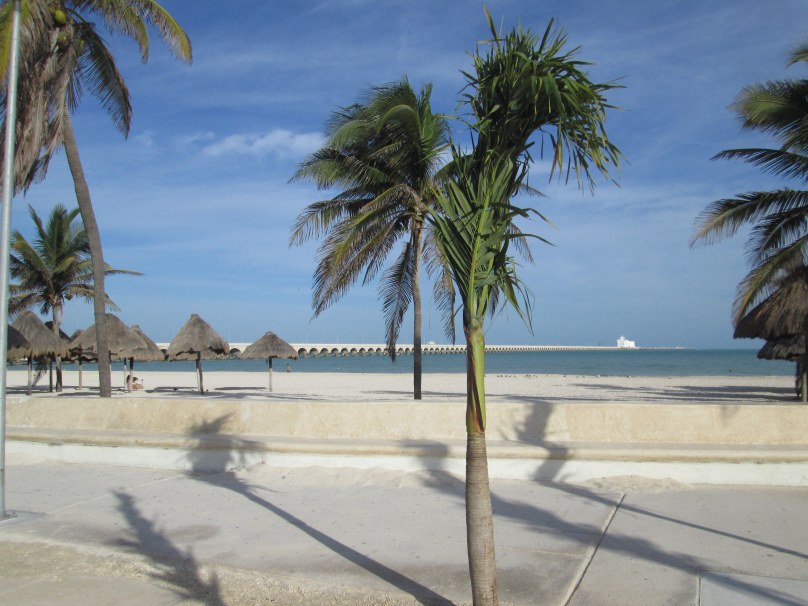
The Beach at Progreso, Yucatán

We have become accustomed to thinking of tropical beaches as some sort of paradise. When I first came to Southern California, I thought that way too. I used to go to the beach at Santa Monica which was within walking distance of the ocean. I would take a book with me and unroll my towel by Lifeguard Station #12. When it got too hot, I would run into the water and allow myself to be buffeted by the waves. I never learned to body surf, so sometimes I got tumbled around a bit.

Generally, I stayed for only an hour or two to avoid getting sunburned. As I was by myself, there was no one to spread suntan lotion on my back. After a few years, I would go to the beach only before the crowds showed up, around nine in the morning. Then I stopped going altogether.

Why? I really wasn’t that interested in frolicking in the water. Reading on the sand wasn’t that comfortable because it was usually too bright. I wound up falling asleep on my towel and waking up with a sunburn.

The upshot is that, although I visited a number of beach destinations in Mexico, such as Cozumel, Progreso, Mazatlán, Cabo San Lucas, and Puerto Vallarta, it wasn’t the beach that interested me. Frankly, I enjoyed the culture and cuisine more. I could get more reading done in my hotel room than on the beach, where there were vendors, sand flies, broken glass, and discarded plastic straws.

Maybe I’m a bit of a stick in the mud, but my last beach experience was typical. It was January 2000. Covid 19 was just beginning to be noticed. After visiting a number of Maya ruins (Izamál, Uxmal, Kabah, Labna, Sayil, Xlápak, Edzna, Ek Balam, and Dzibilchaltún), I decided to spend a few days in Progreso. Now Progreso is no Caribbean resort: It’s on the Gulf of Mexico and is the seaport for Mérida. The beachgoers were more likely to be locals escaping the heat inland.

The water is more green than blue, and the waves tend to be smallish. As I wandered along the beach, the vendors who set up places in the shade approached me and asked if I wanted a beach umbrella. I shook my head and said I desired sombre (shade) and not sol (sun). Instead, I found a bench in deep shade under the long pier pictured above, which extends 4 miles (6.5 km) out to sea. There, I sat back and read Paul Theroux’s Figures in a Landscape for a couple of hours until it was time for me to find some filete de huachinángo al mojo de ajo. That’s red snapper sautéed in a garlic sauce.
Crossing Nation

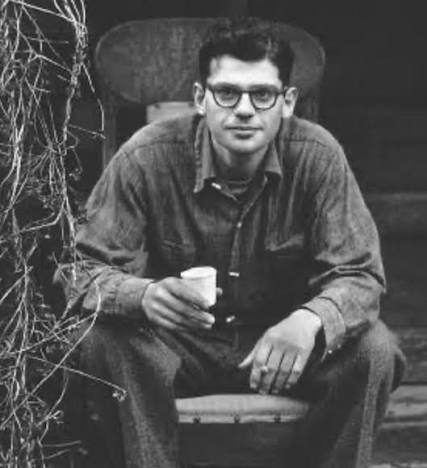
Poet Allen Ginsberg (1926-1997)

Here is a poem by Allen Ginsberg which memorializes an entire era, from Timothy Leary to Jerry Rubin to Leroi Jones to Benjamin Spock and Joan Baez.

Crossing Nation

Under silver wing
San Francisco’s towers sprouting
thru thin gas clouds,
Tamalpais black-breasted above Pacific azure
Berkeley hills pine-covered below—
Dr Leary in his brown house scribing Independence
Declaration
typewriter at window
silver panorama in natural eyeball—

Sacramento valley rivercourse’s Chinese
dragonflames licking green flats north-hazed
State Capitol metallic rubble, dry checkered fields
to Sierras- past Reno, Pyramid Lake’s
blue Altar, pure water in Nevada sands’
brown wasteland scratched by tires

     Jerry Rubin arrested!  Beaten, jailed,
            coccyx broken—

Leary out of action—“a public menace…
persons of tender years…immature
judgement…psychiatric examination…”
i.e. Shut up or Else Loonybin or Slam

Leroi on bum gun rap, $7,000
lawyer fees, years’ negotiations—
SPOCK GUILTY headlined temporary, Joan Baez’
paramour husband Dave Harris to Gaol
Dylan silent on politics, & safe—
having a baby, a man—
Cleaver shot at, jail’d, maddened, parole revoked,

Vietnam War flesh-heap grows higher,
blood splashing down the mountains of bodies
on to Cholon’s sidewalks—
Blond boys in airplane seats fed technicolor
Murderers advance w/ Death-chords
Earplugs in, steak on plastic
served—Eyes up to the Image—

What do I have to lose if America falls?
my body? my neck? my personality?

The Most Wonderful Railroad in the World

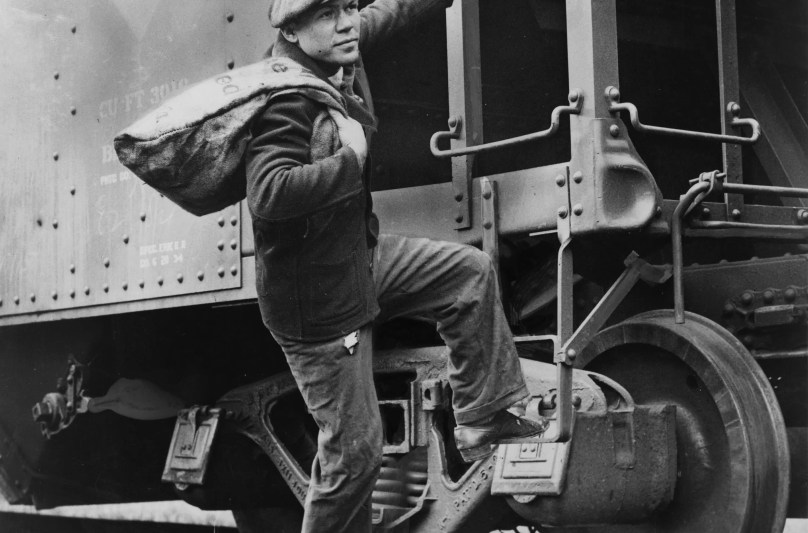
Hobo Hopping onto a Freight Train

I am currently reading Jack Kerouac and Allen Ginsberg: The Letters. It is such a pity that people don’t write letters any more. And they don’t read much either. (In fact, is anybody even reading this?) Here, in a 1948 letter to his friend Allen Ginsberg, Jack reminisces about his enjoyment hopping freight trains between Los Angeles and San Francisco.

The Southern Pacific is the most wonderful railroad in the world incidentally . . . on a Sunday morning, riding down through the sunny San Joaquin Valley of grapes and women-with-bodies-like-grapes, I reclined on a flatcar reading the Sunday funnies with the other boys, and the brakemen smiled at us and waved cheerful. It is the hobo’s favorite road. Anybody with any sense in California can ride between Frisco and LA endlessly on that road, once a week if they want to, and nobody will ever bother them. When the train stops at a siding, you can jump off and help yourself to fruit if you’re near a field. So wonderful Neal [Cassady] is working for a wonderful railroad, in the [William] Saroyan country . . . (if there’s any beastly murderousness it’s not my fault or Neal’s or Saroyan’s.) The Santa Fe brakemen will kill you if they catch you and if they have enough clubs. But not the SP.

Neal Cassady is a good buddy of Kerouac’s, and William Saroyan was an Armenian-American author of novels and short stories living in Fresno.

Looking Past Volodya

Does Putin See What Is Ahead for Russia?

When we look at Russia today, do we see past Putin at all? Or has his iron will and determination proved to be an impenetrable veil which prevents us from seeing Russia as it actually is?

Vladimir (Volodya is the common Russian nickname for Vladimir) Putin has been the face of Russia as seen by our news outlets. It’s a pity because there is so much more to Russian civilization than the face of a dour tyrant who is probably even now entering the endgame of his life.

As an Eastern European myself, I have made a point of familiarizing myself with Russian literature, music, and history. What I find when I look there are many admirable things. The one thing which is not admirable is that the nation has not, by and large, been ruled by leaders who have benefited their people. The autocratic czars were replaced by equally autocratic commissars.

The result was a brave and talented people who were constantly being suppressed. That led to such strange scenes as a purge of army generals by Stalin just when Hitler decided to invade. And, when Stalin lay on the floor dying in 1953, his own associates were afraid of calling in a doctor, because the medical profession was undergoing a purge for their “disloyalty” to the régime.

To get a feeling for the absurdity of it all, see the 2017 movie The Death of Stalin, whose far-out humor is not far from the truth.

I like the Russian people that I have met. They tend to be friendly, talented, and hard-working. I enjoy reading Russian literature. My current read is the fourth novel (of six) in the Night Watch series, entitled Last Watch by Sergei Lukyanenko.

In the near future, I hope to do a post entitled “Looking Past the Donald.”

Hope Begins to Dawn

Ever since Donald Trump began his “Revenge Tour” in January 2025, I have avoided discussing politics with my friends. Trump’s presidency depressed me to the extent that I began to distrust the American voters: How could they elect someone who was so evidently in it for himself only? Someone who was so obviously mendacious and corrupt? The only solution was to break the man—but that was something beyond my power to effect. I could vote, and I did vote; but I saw that mere complaining was only going to upset me.

Above all, I had to keep myself in one piece. Parochial political discussions were useless.

With the 2026 midterm election, I see the first glimmerings of hope. It will take time to heal, and I don’t entirely trust the Democrats either. They can still emerge as the circular firing squad they used to be over the last several decades. Or they could rise to the occasion.

As usual, I was not completely satisfied with the election (I never am). I was against many of the Propositions that passed. And I was dismayed that Brian Goldsmith will be my State Senator. Well, I have been represented before by jackals in the halls in Sacramento and Washington, DC. That’s nothing new.

A Poem for November

I thought I would mark the eleventh month of 2026 by posting a poem from Emily Dickinson called, simply, “November”:

November

Besides the autumn poets sing,
A few prosaic days
A little this side of the snow
And that side of the haze.

A few incisive mornings,
A few ascetic eyes, —
Gone Mr. Bryant’s golden-rod,
And Mr. Thomson’s sheaves.

Still is the bustle in the brook,
Sealed are the spicy valves;
Mesmeric fingers softly touch
The eyes of many elves.

Perhaps a squirrel may remain,
My sentiments to share.
Grant me, O Lord, a sunny mind,
Thy windy will to bear!

Needless to say, this is a portrait of a fall day in the poet’s native Amherst, Massachusetts. Things are a little more mixed up in Southern California, where I remember seeing snow at ground level only once in sixty years. And, of course, it melted before it was able to accumulate.

I remember the autumns of my four years at Dartmouth College in New Hampshire, a place which Emily would have recognized.