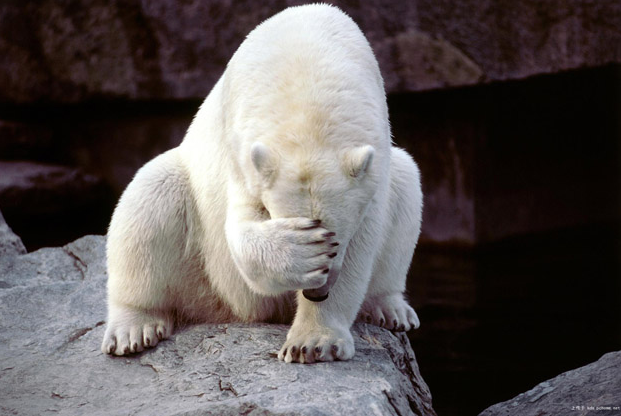
Serendipity: On Dealing With Disappointment

It’s Not Always a Bad Thing

It’s Not Always a Bad Thing

The following insight comes from Tibetan Buddhist teacher Chögyam Trungpa Rinpoche in his book Cutting Through Spiritual Materialism:

We must surrender our hopes and expectations, as well as our fears, and march directly into disappointment, work with disappointment, go into it and make it our way of life…. If we can open, then we suddenly begin to see that our expectations are irrelevant compared with the reality of the situations we are facing. This automatically brings disappointment. Disappointment is the best chariot to use on the path of the dharma. It does not confirm the existence of our ego and its dreams.

This, along with hundreds of other interesting quotes from Tibetan Buddhist teachers, can be found in Reginald A. Ray’s The Pocket Tibetan Buddhism Reader, a shirt-pocket-sized paperback from Shambala.

Lions and Bulls, Oh My!

A Frequent Theme in Roman Mosaic Art?

A Frequent Theme in Roman Mosaic Art?

At our visit to the Getty Villa on Wednesday, I was surprised to see so many works depicting lions eating other large, powerful beasts. There was a special exhibit entitled “Roman Mosaics Across the Empire.” (Follow the link and you will see a lion biting into a surprisingly nonchalant horse.) The image that caught my eye, however, was the one above, in which a lion is chasing what looks like a Brahma bull.

Roman mosaics can be stunningly beautiful. I remember a show at the Los Angeles County Museum of Art years ago which included various objects retrieved from the ruins at Pompeii and Herculaneum. The mosaics in this exhibit, taken from the Naples Museum of Archaeology, were particularly beautiful—probably because the Romans during that period were more advanced in their art than those of the later Empire, from which most of the works in this special exhibit were drawn.

There were numerous lions, particularly in funerary monuments. Although I do not recall reading anything about lions during Roman times, I am surprised that they appear prominently in so many mosaics and pieces of statuary.

A Pot To Piss In

Greek Reveler Draining His Lizard

Just because they wore togas and spoke Classical Greek, that doesn’t mean that the ancient Greeks were all that high and mighty. One of the more amusing exhibits at the Getty Villa that Martine and I saw yesterday afternoon illustrated a different and more down to earth use for an amphora.

A bibulous reveler is shown urinating into the amphora (or, more technically, a chous) held up by his slave boy while continuing to declaim his sodden oration.

The closer one gets to the ancient Greeks and Romans, the more we see people very much like ourselves. The conditions of their lives were radically different, but they were recognizably human in he same way we are. Read the letters of Cicero or Pliny the Younger and you will enter a whole new world peopled with recognizable characters.


Feathered Glory

Roman Statue Depicting Leda and the Swan

Roman Statue at the Getty Villa Depicting Leda and the Swan

Today, Martine and I spent most of the day at the Getty Villa in Pacific Palisades visiting their collection of ancient Greek, Roman, and Etruscan art. One of the pieces is a statue depicting the rape of Leda by Zeus in the form of a swan.

I cannot think of the subject without recalling William Butler Yeats’s poem, “Leda and the Swan”:

A sudden blow: the great wings beating still
Above the staggering girl, her thighs caressed
By the dark webs, her nape caught in his bill,
He holds her helpless breast upon his breast.

How can those terrified vague fingers push
The feathered glory from her loosening thighs?
And how can body, laid in that white rush,
But feel the strange heart beating where it lies?

A shudder in the loins engenders there
The broken wall, the burning roof and tower
And Agamemnon dead.
Being so caught up,
So mastered by the brute blood of the air,
Did she put on his knowledge with his power
Before the indifferent beak could let her drop?

According to Greek mythology, the children born of that rape were Polydeuces and Helen of Troy. The latter was responsible for the Trojan War when she was willingly abducted by Paris (no relation). Her half-sister was Clytemnestra, daughter of Leda’s legitimate husband Tyndareus. She was traumatized by the god’s rape of her mother. And Clytemnestra, of course, murdered her own husband Agamemnon when he returned from Troy. All this makes Yeats’s poem a wry comment on the inter-relatedness of history.

Dreaming of … London?

50327110. Tulum, QRoo.- Los voladores de Papantla y los Guerreros Mayas, dan la bienvenida a los más de dos mil turistas locales, nacionales y extranjeros, que día a día visitan la zona arqueológica, que es de un kilómetro, donde algunos prefirieren hacerlo caminando o existe a su disposición un pequeño transporte en forma de tren. NOTIMEX/FOTO/FRANCISCO GÁLVEZ/COR/ACE/

Totonac Voladores at El Tajin

Last night I had particularly vivid dreams. Was it because I had eaten watermelon before going to bed? If so, I might be in for more dreams tonight.

Martine and I were in London at a large museum. I noticed that a number of English dressed in red “Beefeater” costumes were flying in the air by their feet just like the Totonac voladores at the ruins of El Tajin in Mexico’s State of Veracruz. I mentioned to Martine that it must be a traditional English Maypole ceremony—though, God knows, the real Maypole does not involve anything quite so spectacular.

At the same time, I noticed that several large buildings in London were aflame. Since the fires were several blocks away, I didn’t particularly care. I was slightly miffed that Martine, as usual, was being too slow and meticulous about seeing all the exhibits. I, on the other hand, wanted to catch a particular train to the north.

Somewhere along the line, my desire to go was also to visit a particular bookstore. At that point, I woke up.


Will China Overtake the U.S.?

Daniel Rohr of Morningstar Thinks Not

Daniel Rohr of Morningstar Thinks Not

The following article was published in March by Morningstar on the subject “What Will China Look Like in 2025?” I was rather surprised by its findings and would like to share it with you.

China’s faltering economy has sent shivers through the global markets in 2016, and for good reason. As the world’s second-largest economy and leading source of global growth for the past decade, China matters more than ever. Guessing what comes next for China and the implications for the rest of the world is an exercise fraught with uncertainty, but we believe China’s arrival at two major and near-certain inflection points will alleviate some of that uncertainty. First is China’s economic rebalancing. As we’ve argued for the past five years, excess capacity across broad swaths of the economy and mounting bad debt will force a transition to consumption-led growth. The second inflection point concerns China’s demographics. The country’s working-age population will shrink by 43 million by 2030, by which time China will have more seniors than the European Union, Japan, and the United States combined. These two inflection points shape much of our long-term outlook, which we’ve summarized here with 10 predictions for the next 10 years.

First, we expect China’s GDP growth to slow to less than half the pace of the past 10 years. The historical experience of economies making the transition from investment-led to consumption-led growth shapes much of this outlook. In every case, the rebalancing economy experiences not only a sharp deceleration in investment growth, but also weaker consumption growth. Historical precedent also suggests magnitude matters; the bigger the boom, the weaker the ensuing GDP growth. China’s boom has been greater in magnitude and duration than anything that has come before. In our view, consensus expectations, while moderated, remain too optimistic in the 5%-6% range. We expect GDP growth to average 1.5%-4.5% in the next 10 years. Attaining the upper end of that range would require major reforms to unleash household consumption, reallocate credit from the state to the private sector, and boost productivity at China’s bloated state-owned enterprises.

Second, we believe reforms are likely to disappoint, making even 4.5% GDP growth a challenge. Our skepticism is rooted in the inherent conflict between key reforms and Beijing’s two overriding political aims: control and stability. For example, we think it is unlikely Beijing will allow the major defaults that would be necessary to eliminate state-owned enterprises’ preferential credit access and reallocate credit to more productive borrowers. Doing so would risk massive social disruption and diminish the state’s control over capital allocation. For similar reasons, we doubt meaningful interest rate liberalization is a near-term prospect, as many state-owned borrowers would be unable to afford market-set interest rates. Consequently, the implicit wealth transfer from household savers to state-owned borrowers is likely to persist, hindering consumption growth.

Third, stimulus is likely to prove ineffective at best. Questions of whether Beijing will go back to its old growth playbook overlook evidence that the government has been trying to stimulate the economy since November 2014. Multiple interest rate cuts and reductions to the portion of deposits that banks must hold in reserve haven’t delivered the sort of boost they did in prior years. This is partly because of borrowers’ unwillingness to invest amid a deteriorating economic outlook, a reticence reflected in all-time low readings on the central bank’s loan demand survey. It’s also because of capital outflows from China, which we estimate at roughly $640 billion in 2015. The case against stimulus extends beyond doubts over its efficacy. Many of the problems China is dealing with today, from excess capacity to bad debt to falling prices, are the consequences of too much stimulus. At this point, stimulus is a shot of whiskey to cure a hangover.

Fourth, despite looser family-planning laws, we expect births to fall by 25 million versus the past 10 years. The female population of child-bearing age will fall by 50 million by 2025, with 41 million of that decline concentrated in women with the highest fertility rates: those ages 20-29. Assuming no change in age-specific fertility rates, births would decline 30% by 2025. A comparison of Chinese fertility rates versus those of neighboring countries at similar points in their economic development suggests economic and cultural factors account for China’s low birth rate, not government policy.

Fifth, China’s urban population growth will fall by nearly half. Over the past 10 years, as China urbanized roughly 200 million people, it traversed the steep portion of the urbanization-to-income curve we observe globally. Looking ahead, that curve will flatten considerably, with lower urbanization growth for each percentage point of GDP growth. Moreover, China will be moving along that curve at a slower pace because of weaker GDP growth. We forecast China will urbanize 115 million over the next 10 years. While this would mark a significant deceleration, it would nonetheless see China add the equivalent of Japan’s entire urban population.

Sixth, we believe the yuan will fall 20% against the U.S. dollar. Defending the de facto dollar peg amid massive capital outflows has cost the People’s Bank of China billions in foreign exchange. Unless the underlying causes of capital flight are addressed, including expectations of falling interest rates and a weaker yuan, we see little reason for those outflows to end. By devaluing the yuan to a level approximating market expectations, Beijing would reduce a major incentive for capital to leave China. A fair value estimate that draws on the global relationship between market exchange rates and purchasing power parity exchange rates across income levels suggests that level is roughly CNY 8 per $1.

Seventh, we expect China’s economic rebalancing to trigger another “Dark Age” for industrial commodities such as copper, coal, and steel. China is the dominant consumer of industrial commodities and has accounted for the overwhelming majority of global demand growth in the past decade. We forecast China’s industrial commodity demand to decline in the next several years as investment growth wanes. As a result, demand growth globally is likely to expand far more slowly than global GDP. Historically, sub-GDP demand growth has been associated with falling real commodities prices, a situation that prevailed in the decades before China’s investment boom.

Eighth, we doubt India will fill China’s shoes as far as commodity demand is concerned. India is the only country that can match China’s demographic heft. The fact that Indian GDP per capita now approximates that of Chinese GDP per capita 10 years ago has led many to suggest that Indian commodity demand is on the verge of takeoff. This line of thinking confuses the origins of China’s commodity demand growth. It wasn’t so much China’s level of development a decade ago nor the economic growth it registered in subsequent years that led to the country’s insatiable appetite for commodities. Rather, it was the heavy investment orientation of the Chinese economy. Unless India duplicates China’s growth model, India will not deliver the same boost to global commodity demand. Because of India’s pluralistic political structure and because New Delhi lacks Beijing’s tools to shape economywide capital allocation, we doubt India’s growth pattern is likely to follow that of China.

Ninth, we believe China’s health spending will more than double. We expect healthcare outlays to grow far faster than GDP for a couple of broad reasons. First is the tendency of healthcare to claim a larger share of total spending as incomes rise. This trend is evident globally and within China itself. Second is the fact that China is aging at an incredible pace. China’s population 65 and older will be 50% larger by 2025 and 130% larger by 2030, by which time it will have more seniors than the EU, U.S., and Japan combined. China will be an “old” country by middle-income standards, and we expect it to spend proportionately more on healthcare than the typical middle-income country.

Tenth, despite many high-profile predictions that China will overtake the U.S. as the world’s largest economy in the relatively near future, we don’t see that happening in the next decade. At prevailing exchange rates and assuming the U.S. musters 2.2% annual GDP growth (in line with the International Monetary Fund’s forecast) while China grows at 4.5% (the upper end of our 10-year forecast), the U.S. economy would be roughly 30% larger than China’s by 2025.

Viejo Cuba

Our Boutique Hotel in Quito

Our Boutique Hotel in Quito: El Viejo Cuba

For almost forever, I have been in charge of planning the vacations for Martine and myself. My brother Dan knew that, so I thought I’d let him have the upper hand. As we tend to think alike on most issues, that will be no problem.

We will be in Ecuador together for two weeks, then he will return to L.A. by himself because of business obligations. I will have an additional week in Southern Ecuador all alone. For those last seven days, I will do all my own planning as before. I think that’s a good compromise.

One thing that will be different is that Dan wants to rent a car and drive. That gives us a much broader choice of places to stay and allows us a lot of flexibility. I keep thinking of the three all-night bus rides I took in Argentina and Chile. Although I rather enjoyed them, I don’t think that Dan would quite so much.

That puts me in the role of navigator, which is a role I enjoy. Whenever, as a child, I went anywhere with our family, I was the one hunched over a map and dictating directions.

Our first stop in Ecuador will be the Hotel Viejo Cuba (illustrated above).  It’s a few blocks north of the popular Mariscal Sucré neighborhood, named after Bolivar’s favorite general.

This trip will be different, but I like the way it’s shaping up.

Serendipity: The More Things Change …

Greek Ruins at Agrigentum in Sicily

Greek Ruins at Agrigentum in Sicily

It was the Sixth Century BC, and Phalaris, the Greek Tyrant of Agrigentum, described a voting public not so different from our own:

The people, as a whole, are undisciplined, senseless, unmanageable, very ready to be turned in any direction whatsoever, faithless, fickle, passionate, treacherous, mistaken, a mere useless noise, and easily swayed toward praise and toward anger.

δῆμος ἄπας ἄτακτος, ἄνους, ἄπρακτος, ἑτοιμότατος ἐφ’ ὅ τι ἂν τύχῃ μεταχθῆναι, ἄπιστος, ἀβέβαιος, ὀξύς, προδοτιχός, ἐψευσμένος, φωνὴ μόνον ἀνωφελής, καὶ πρὸς ἔπαινον καὶ πρός ὀργὴν εὐχερής.

The odd thing was that Phalaris is remembered primarily for his cruelty. He built a hollow brass bull in which he roasted his enemies alive. No less a poet than Pindar described his atrocities a hundred years later.

I owe this quote to my favorite source of the thinkers of past times, especially the Greek and Roman classics, namely: Laudator Temporis Acti.

FlubFlubFlub

Normal Eardrum

Normal Eardrum

The human body is a mysterious instrument. Whenever new symptoms arise—however innocuous they may appear—I try to determine their cause, if possible.

You can say it’s the influence on me of Leo Tolstoy’s The Death of Ivan Ilyich, in which the hero dies horribly after a trivial household mishap. (The link is to the excellent Louise and Aylmer Maude translation, which you can read if you feel that things are going too well for you.)

About two weeks ago, I detected what appears to be my left eardrum pulsating in a kind of rapid-fire flubflubflub with occasional pauses in between bursts. It does not seem to correlate with my pulse (which the physician requested that I check), and comes and goes at random intervals. Needless to say, it didn’t act up in the doctor’s office.

The good news is that it is not associated with any pain, and it does not seem to affect my hearing. The hearing in both ears is symmetrical, with me hearing all the low frequency sounds normally, but not the very high frequency sounds. So don’t attempt to summon me with a dog whistle.

Thus far, the only anomaly is that my left eardrum is slightly pushed in compared to my right eardrum. My guess is that all this is nothing to worry about, but I’d like to be sure.


Cut Back

A Step Closer to Retirement

A Step Closer to Retirement

Friends have been asking me when I’m planning to retire. A step toward that has been made for me: I am now working two days a week. The choice was not mine, but I realize that my accounting firm will probably not last much more than another year.

Today was my first day off under the new setup. I think Martine will have a harder time dealing with the situation than I will. Instead of hanging around all day, I plan to be on the go doing things, including (perhaps) lining up another part-time gig. I even checked the local Employment Development Department to see if I qualify for some unemployment compensation. (I don’t: I’ll still be making more than $600 a week.)

I have a number of pipe dreams I’m thinking of looking into, such as doing some teaching. My first goal in life was to be a college professor. Although I lack the academic credentials for that, I can possibly be a substitute high school teacher teaching English or even personal accounting.

Of course, Dan and I are still going to Ecuador this fall. This last weekend, we booked flights on Copa Airlines, a Panamanian carrier, from Los Angeles to Quito (via Panama City) and back.