Looking back over the past year, there are a lot of persons, places, and phenomena I would gladly not have to confront in 2024—indeed, ever again.
First and foremost is America’s mumbling incompetent dictator-in-waiting. Currently, he is attempting to turn the death of a thousand cuts in court into victories. They aren’t and never will be. That goes for all his minions, those drooling red-hatted loons seated behind him at his rallies.
Mega-Billionaires, especially those in the tech sector, who want to enrich themselves by making everyone else miserable with their social media or artificial intelligence.
Time to shitcan crypto-currency once and for all. A form of anonymous, unregulated currency, it is of use only to evil dark web goons.
Quasi-celebrity influencers who foment flash mobs and twonky fashions. Like Paris Hilton, who in today’s issue of the Los Angeles Times is quoted as saying: “I also like butter and strawberry jelly on toast, then sometimes toasted bagels with strawberry cream cheese, which I’m like obsessed with.” If you come across something of that ilk in this blog, you are justified in disemboweling me.
And that’s only the beginning, but space is limited and I want to get to bed before midnight. I wish for you and yours a tolerable New Year. (Let’s not kid ourselves.)
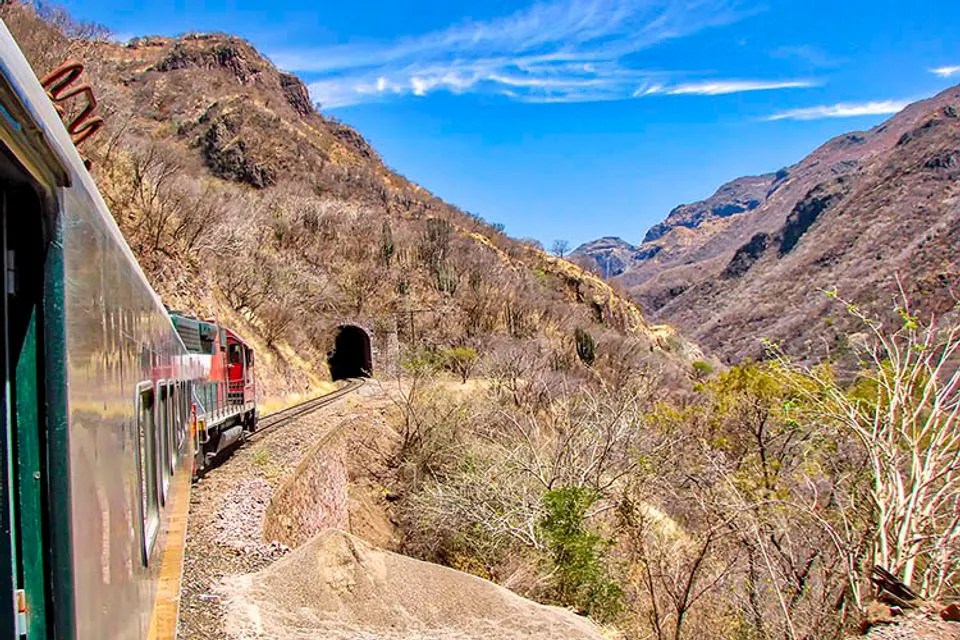
It has been almost forty years since i took the Ferrocarril Chihuahua al Pacifico (now known as El Chepe) from Los Mochis in Sinaloa to Divisadero high in the Sierra Madre Occidental. It was one of the most fantastic train rides of my life, going where there are no roads other than a single track between Chihuahua and Los Mochis.
American engineers were consulted by the Mexican government to map out a rail route over the Sierra Madre Occidental, but they came back and said it just wasn’t feasible. So Mexican engineers went and built it anyway, all the way from Constitutión across the Rio Grande from Presidio, Texas, to the port of Topolobambo on the Sea of Cortez. Now the train runs a shorter route, but it includes 100% of the fantastic mountain scenery.
I went only as far as Divisadero, where at the time a lone motel stood next to the edge of a junction of three canyons, each of which was reputedly as deep as Arizona’s Grand Canyon. And there wasn’t just Copper Canyon, but altogether six canyons along the route.
One Slip and You’re Toast
Standing at the edge by Divisadero, I was amazed to see eagles flying over a thousand feet below me.
Altogether I spent two nights at Divisadero, and on the return trip spent a night at Bahuichivo. That was only the beginning of a long trip which included Mazatlán, Durango, Guanajuáto, Querétaro, Patzcuaro, Uruapán, Guadalupe, and Puerto Vallarta. As I recall, I was traveling around by bus and train for a whole month on that trip.
Some people talk about the wonderful gifts they got for Christmas. Me, I woke up on Christmas morning with a stiff neck. For the last three days, it has constantly reminded me of its presence, especially when I am turning my neck while driving.
I probably should have been applying heat or ice packs to the neck, but for some reason I didn’t. Now i find that this has benefits mainly in the first two days of the neck pains. I guess I’ll just have to exercise my neck through the twinges and maybe take some Ibuprofen.
Most likely (I hope), the whole thing will disappear within a few days.
Now if only my Niagara of a sinus would do the same!
The period between Christmas and New Years Day has always been strange. Even among the ancient Mayans, the last five days of the 365-day Haab calendar were called Uayeb, just to fill out the remainder of the year after the 18 months of 20 days each had transpired.
In much of the English-speaking world—but not the United States—today is Boxing Day. It has nothing to do with pugilism and is more a commemoration of certain Victorian practices regarding gifting servants.
It’s also Kwanzaa, a made-up holiday for African-Americans to celebrate their origins and serve as an alternative to that White persons’ holiday known as Christmas.
I was delighted to find a Scottish poem that also celebrates (or debunks) this period. It is “The Daft Days” by Robert Fergusson (1750-1774), written in a broad Scots dialect:
The Daft Days
Now mirk December’s dowie face Glowrs owr the rigs wi sour grimace, While, thro’ his minimum of space, The bleer-ey’d sun, Wi blinkin light and stealing pace, His race doth run.
From naked groves nae birdie sings, To shepherd’s pipe nae hillock rings, The breeze nae od’rous flavour brings From Borean cave, And dwyning nature droops her wings, Wi visage grave.
Mankind but scanty pleasure glean Frae snawy hill or barren plain, Whan winter, ‘midst his nipping train, Wi frozen spear, Sends drift owr a’ his bleak domain, And guides the weir.
Auld Reikie! thou’rt the canty hole, A bield for many caldrife soul, Wha snugly at thine ingle loll, Baith warm and couth, While round they gar the bicker roll To weet their mouth.
When merry Yule-day comes, I trou, You’ll scantlins find a hungry mou; Sma are our cares, our stamacks fou O’ gusty gear, And kickshaws, strangers to our view, Sin fairn-year.
Ye browster wives, now busk ye braw, And fling your sorrows far awa; Then come and gie’s the tither blaw Of reaming ale, Mair precious than the well of Spa, Our hearts to heal.
Then, tho’ at odds wi a’ the warl’, Amang oursels we’ll never quarrel; Tho’ Discord gie a canker’d snarl To spoil our glee, As lang’s there’s pith into the barrel We’ll drink and ‘gree.
Fidlers, your pins in temper fix, And roset weel your fiddle-sticks; But banish vile Italian tricks Frae out your quorum, Not fortes wi pianos mix – Gie’s Tulloch Gorum.
For nought can cheer the heart sae weel As can a canty Highland reel; It even vivifies the heel To skip and dance: Lifeless is he wha canna feel Its influence.
Let mirth abound, let social cheer Invest the dawning of the year; Let blithesome innocence appear To crown our joy; Nor envy wi sarcastic sneer Our bliss destroy.
And thou, great god of Aqua Vitae! Wha sways the empire of this city, When fou we’re sometimes capernoity, Be thou prepar’d To hedge us frae that black banditti, The City Guard.
My computer was down last week, so I was consequently unable to post. It’s been patched up for now, and a new computer is on order. After all, I’ve had this Dell Optiplex 9010 for ten years, so it’s about time to replace it.
In the meantime, Merry Christmas to all my readers. Oh, and I think I’ll also add a “bah humbug!” for good measure.
My dentist always twits me about my chewing my teeth into oblivion. I do not think I grind my teeth at night, but she thinks I do. And there are the ruined sites of three of my long lost upper teeth. two bicuspids and a molar. She also thinks I live on a diet of jalapeño chile peppers.
In truth, there is something violent about my visage. Take my sneezes: They are so powerful that I have to be prepared to go to the bathroom after a sneezing fit. I find facial tissues to be useless, as I tend to blow them to smithereens. Like my father, I frequently rupture a capillary when I erupt. In my case, it’s usually in my left nostril.
Then there are my sinuses. Whenever there is a major change in the weather (which in L.A. means just about always), I turn into mucus man. I frequently wake Martine up with my snorting, sneezing, and nose-blowing. As she has a tendency to be insomniac, she usually requests that I transfer my drainage to the couch in the living room.
Then, too, my eyelids are constantly irritated with blepharitis. In certain times of the year, usually winter, spring, summer, and fall, my eyelids itch and generate an annoying discharge.
What’s next for me? Great gobs of earwax sticking out of my ears? Saliva that roars like a waterfall? Is my head just too damned loud?
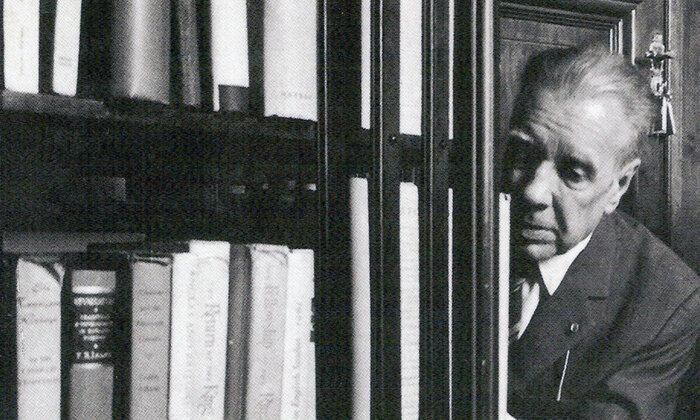
Argentinian Writer and Poet Jorge Luis Borges (1899-1986)
Just as he was descending into blindness, Jorge Luis Borges was appointed director of the Argentine National Library. He wrote a poem about how he, as a lifelong bibliophile, felt about being in charge of so many books he could no longer read. In the last stanza, he mentions Paul Groussac, a previous director of the Library in the 1920s, who was also blind and, like Borges, also a distinguished writer.
Poem About Gifts
Let none think I by tear or reproach make light Of this manifesting the mastery Of God, who with excelling irony Gives me at once both books and night.
In this city of books he made these eyes The sightless rulers who can only read, In libraries of dreams, the pointless Paragraphs each new dawn offers
To awakened care. In vain the day Squanders on them its infinite books, As difficult as the difficult scripts That perished in Alexandria.
An old Greek story tells how some king died Of hunger and thirst, though proffered springs and fruits; My bearings lost, I trudge from side to side Of this lofty, long blind library.
The walls present, but uselessly, Encyclopedia, atlas, Orient And the West, all centuries, dynasties, Symbols, cosmos, and cosmogonies.
Slow in my darkness, I explore The hollow gloom with my hesitant stick, I, that used to figure Paradise In such a library’s guise.
Something that surely cannot be called Mere chance must rule these things; Some other man has met this doom On other days of many books and the dark.
As I walk through the slow galleries I grow to feel with a kind of holy dread That I am that other, I am the dead, And the steps I make are also his.
Which of us two is writing now these lines About a plural I and a single gloom? What does it matter what word is my name If the curse is indivisibly the same?
Groussac or Borges, I gaze at this beloved World that grows more shapeless, and its light Dies down into a pale, uncertain ash Resembling sleep and the oblivion of night.
The News Has Not Always Been a Major Part of Our Lives
When I was growing up, the news on television was not the major production it is today. There were Walter Cronkite, John Cameron Swayze, John Chancellor, Dan Rather, and a handful of other mostly White males who spent thirty to sixty minutes telling us what was happening around the world.
Now the news is televised 24 hours a day on several channels. We are lured in with graphics indicating Breaking News, even when it isn’t. Watch a news channel for an hour, and what you get in thin gruel with one major component: F-E-A-R.
If you watch the news shortly before going to bed, you will have a difficult time falling asleep. There will be dire suppositions and wild guesses. I am reminded of these lines from Macbeth in which the uneasy king speaks:
          I had else been perfect,
Whole as the marble, founded as the rock,
As broad and general as the casing air.
But now I am cabined, cribbed, confined, bound in
To saucy doubts and fears.
To which I reply with a quote from Calvin Coolidge, which I use frequently: “If you see ten troubles coming down the road, you can be sure that nine will run into the ditch before they reach you.” If the various news media took that to heart, they would lose most of their viewers. Instead, they are in the business of magnifying our fears and even creating new ones.
Just imagine how many stressors they have at their command: Iran, Russia, China, Israel, the Middle East, North Korea, Cuba, Venezuela, global warming, drought, floods, tsunamis, earthquakes, volcanic eruptions, tornadoes, hurricanes, typhoons, cryptocurrencies, immigration, Covid-19, Trump, Biden, tomorrow’s rain, traffic, and so on ad infinitum.
Even the newspapers will scare you with a story. What you think happened in your town actually happened in (frantically skip to page 8) Somalia.
What is the best way to cope with the news? My suggestion is never to watch the news on TV in the evening. Rather, read about it using the Internet and print media during the earlier part of the day. After all, it is a lot better to go to sleep with a smile on your face than shaking with dread.
This short tale by Jorge Luis Borges (1899-1986) is, to my mind, the most incredible tale ever told about the power of poetry. It is told here in its entirety. It and many equally wonderful poems and stories can be found in Dreamtigers (in Spanish, El Hacedor).
That day, the Yellow Emperor showed the poet his palace. They left behind, in long succession, the first terraces on the west which descend, like the steps of an almost measureless amphitheater, to a paradise or garden whose metal mirrors and intricate juniper hedges already prefigured the labyrinth. They lost themselves in it, gaily at first, as if condescending to play a game, but afterwards not without misgiving, for its straight avenues were subject to a curvature, ever so slight, but continuous (and secretly those avenues were circles). Toward midnight observation of the planets and the opportune sacrifice of a turtle permitted them to extricate themselves from that seemingly bewitched region, but not from the sense of being lost, for this accompanied them to the end. Foyers and patios and libraries they traversed then, and a hexagonal room with a clepsydra, and one morning from a tower they descried a stone man, whom they then lost sight of forever. Many shining rivers did they cross in sandalwood canoes, or a single river many times. The imperial retinue would pass and people would prostrate themselves. But one day they put in on an island where someone did not do it, because he had never seen the Son of Heaven, and the executioner had to decapitate him. Black heads of hair and black dances and complicated golden masks did their eyes indifferently behold; the real and the dreamed became one, or rather reality was one of dream’s configurations. It seemed impossible that earth were anything but gardens, pools, architectures, and splendrous forms. Every hundred paces a tower cleft the air; to the eye their color was identical, yet the first of all was yellow, and the last, scarlet, so delicate were the gradations and so long the series.
It was at the foot of the next-to-last tower that the poet—who was as if untouched by the wonders that amazed the rest—recited the brief composition we find today indissolubly linked to his name and which, as the more elegant historians have it, gave him immortality and death. The text has been lost. There are some who contend it consisted of a single line; others say it was a single word. The truth, the incredible truth, is that in the poem stood the enormous palace, entire and minutely detailed, with each illustrious porcelain and every sketch on every porcelain and the shadows and the light of the twilights and each unhappy or joyous moment of the glorious dynasties of mortals, gods, and dragons who had dwelled in it from the interminable past. All fell silent, but the Emperor exclaimed, “You have robbed me of my palace!” And the executioner’s iron sword cut the poet down.
Others tell the story differently. There cannot be any two things alike in the world; the poet, they say, had only to utter the poem to make the palace disappear, as if abolished and blown to bits by the final syllable. Such legends, of course, amount to no more than literary fiction. The poet was a slave of the Emperor and as such he died. His composition sank into oblivion and his descendants still seek, nor will they find, the one word that contains the universe.
This happened at some point during my high school years, sometime between 1958 and 1962. I had a cavity that needed to be filled, so my parents took me to see Doctor K who had an office at the Southgate Shopping Center at the corner of Libby and Northfield Roads. My parents sat patiently in the waiting room while Dr. K drilled away at my tooth.
The time was late afternoon. Doctor K put the suction tube in my mouth and stepped out. For a very long time. In fact he left the office and went to dinner while all the moisture in my body was being sucked through the tube. He must have taken another exit, because my parents didn’t see him leave.
When he returned an hour later, there were sand dunes and cacti in my mouth. He calmly finished drilling and filled the cavity. When I stepped into the waiting room, my father and mother were annoyed at the time it took. When I told them Doctor K had left the office for an hour, my father told him he could whistle all the way to Warrensville if he wanted to be paid for his rudeness.
We never went back to Doctor K. I was all right with that.







You must be logged in to post a comment.