The year was around 1950. I was a five-year-old boy living at 2814 East 120th Street in Cleveland, right in the middle of the Hungarian neighborhood. All the houses on the street were two-family homes in which the upper story was rented. It was around then that I met the love of my life, Joycey, who was my age.
We did all the usual things: played doctor and looked at each other with moonstruck eyes. What I loved most about Joycey was, to be precise, the back of her knees. The picture above is of a grown-up woman, because I could not find the same picture for a little girl. I would probably have been arrested if I tried.
Although her name sounds vaguely Anglo, Joycey spoke Hungarian just like me. I don’t remember exactly how our “relationship” ended, though it was probably in 1951 when two major events happened:
My brother Dan was born and
We moved out of the Hungarian neighborhood because the teachers were complaining that I couldn’t speak English
I don’t think I ever knew Joycey’s last name. It was like we were two ships passing in the night. But it was nice while it lasted.
When I was a student at Dartmouth, we all made fun of the local New Hampshire employees, whom we called emmets. The most typical speech mannerism was the same as the title of this posting. At the time, I never realized the irony of that phrase.
After I graduated from college, and days before I was to head out for graduate school in Los Angeles, I got the mother of all headaches and lapsed into a coma. It turns out that I had a pituitary tumor, called a chromophobe adenoma. Making the right diagnosis in 1966 was a flipping miracle: Remember that MRIs and CAT Scans weren’t around then. All they had to go on were fuzzy X-Rays, and sheer deduction based on miscellaneous hard-to-interpret factors.
With luck, I not only survived, but I made medical history. The only problem is that I paid for it with a scarred urethra caused by some ICU staffer who forced a catheter up my urethra at a time when, groggy with drugs, I thought I was being attacked and resisted what I perceived was violence.
Well, boy Jeezus it was a pissah! For several years, my scarred urethra tended to shut down, forcing a procedure variously called a dilation or a cystogram tray. I have undergone that procedure about eight times over the last fifty-five years, and I’m going to have to undergo it again on Tuesday because I currently am recovering from a urinary tract infection.
This weekend, I leaked so bad I went around in Depends adult diapers. I either peed into the diaper, or had to carefully aim my instrument at the toilet while the stream tried to go in every which direction. The dilation will be a sort of quick fix, but it will result in copious if painful urination for about two weeks until the urethral scars tend to close up again.
There is no pain I have endured in this life compared to a dilation. It’s like fifteen or twenty minutes of being whipped with a cat-o-nine tails.
With luck, the pain will eventually go away, and the urethra will open up slightly … until the next time.
Los Angeles Central Library at 5th and Flower Streets
Today I took the train in to Downtown Los Angeles (or DTLA, as it is also known) to return some library books and pick up the next batch. For the first time in almost a year and a quarter, I was able to enter the library, hand my returns to a human being, and pick up the next batch. The last time, I had to call on my cell phone and have a librarian come out with the bagged books I had put on hold.
Now the ground floor of the library is open. This includes the book check-in and check-out and the international languages department—oh, and the restrooms. For any other books, I still have to put them on hold using the library’s website.
With my books in hand, I took the Dash Bus B to Chinatown and looked for a promising Chinese restaurant that was open to indoor dining. My old standby, the Hong Kong Barbecue, was still take-out only; but I found a good option in the Hop Woo Chinese Seafood Restaurant, just a few doors down, where I had rock cod in black bean sauce.
On the way back to Union Station, I bought my usual small bag of limes from an elderly woman (only $1 for about eight limes). As the weather grows warmer, I am addicted to fresh-squeezed lime juice with a slight splash of tequila.
I still had to wear a face mask on the train and the bus, resulting in fogged-up glasses, but I am encouraged that sometime soon we will be able to dispense with them. My second Pfizer Covid-19 vaccination was two months ago, so I am hopeful that the worst is past.
I have been set musing by watching Satyajit Ray’s film Aparajito, with its hero Apu who goes off to school in Calcutta, leaving his widowed mother alone with a relative in rural Bengal. When I left home to go away to college, it was because my parents’ marriage appeared to be heading for the rocks; and I didn’t want to have to be in the middle of it. Plus, of course, I was proud to have a full scholarship to an Ivy League school.
When school started in the fall, my parents drove me to Dartmouth College and would stay for several days at the Chieftain Motel which was situated north of Hanover on the banks of the Connecticut River. But for the most part, I took public transportation to and from Hanover, New Hampshire, where my college was located.
There were three legs to the journey:
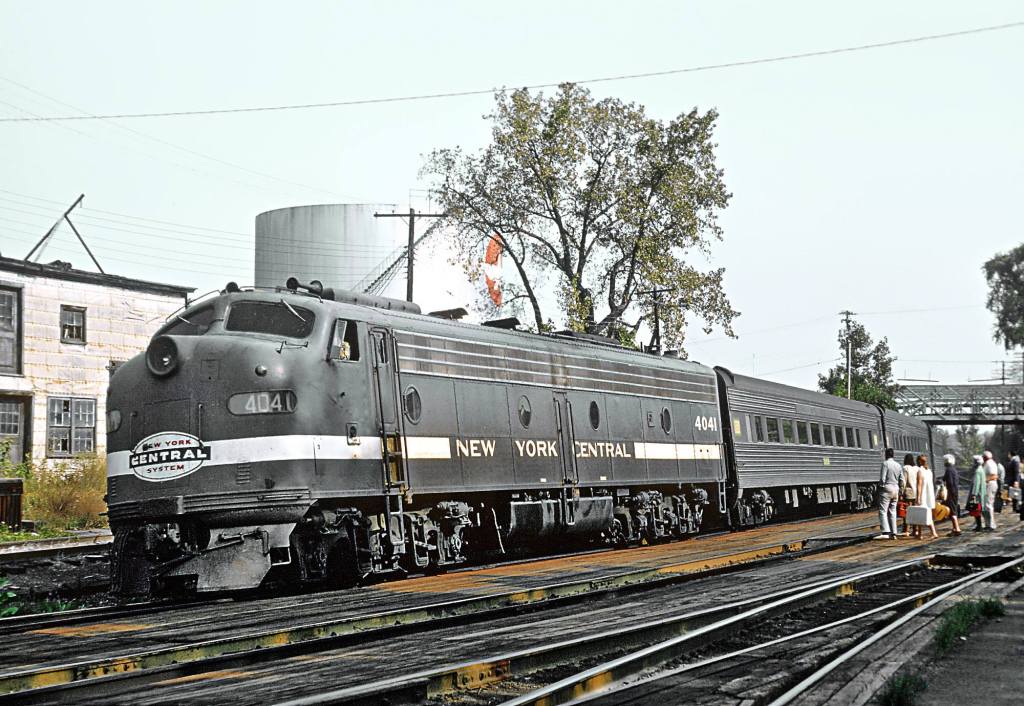
Between Cleveland and Albany, New York, I took a New York Central train called the Cleveland Limited Train #57 (Westbound) and #58 (Eastbound), which was all coach.
Between Albany and Rutland, Vermont, I took a Vermont Transit bus that originated in New York or Burlington, Vermont.
Between Rutland and Hanover, I took two White River Coaches, one to White River Junction, Vermont, and the other to Hanover, a scant five miles farther on.
In both directions, the Cleveland Limited was an overnighter. It was fiercely uncomfortable, especially in the winter when the same coach could be blisteringly hot and freezingly cold on the same trip. It was impossible to get a good night’s rest, because of the lights and noise whenever the train stopped at Utica, Rochester, Syracuse, Buffalo, and wherever else it stopped.
In Albany, I had to wait (in both directions) for several hours at the once grandiose Union Station. I remember writing a poem in which I called it “oldgold in decrepitude.” There was no place to get a meal at the station, so I had to munch on candy bars and drink sodas.
The Vermont Transit bus was a nice ride, except for its passage through Troy, New York, which I then thought was the ugliest city I had ever seen. And that from a resident of Cleveland!
There was a much better connection at Rutland to the White River Coach, which went along the banks of the Ottauqueechee River to White River Junction and with a quick transfer to Hanover.
I would travel both ways during my Christmas vacation (which lasted 2½-3 weeks) and the spring break (about 1½ weeks). If I was lucky, we would see the sun in Cleveland for upwards of twenty minutes during the whole vacation.
“Richmond, Virginia, USA – June 18th, 2012: Cancelled Stamp From Jamaica Featuring Elizabeth II And The West Indies.”
1958 Jamaican Stamp Honoring the West Indies Federation
As a young lad, I was a devoted collector of stamps. All those countries, colonies, and protectorates fascinated me. And it was around then that the rush to independence began with the Gold Coast becoming Ghana in 1957. But all the newly independent states lacked one thing: The portrait of the young and beautiful monarch of Britain, Queen Elizabeth II.
Oh, I know that the Queen is approaching her 96th birthday, and she looks it, waddled in her neon-colored cloth coats and matching outfits. But at one time, Elizabeth was a real looker, such that I would look for televised broadcasts in which she appeared.
Bechauanaland Protectorate
The Bechuanaland Protectorate morphed into the independent nation of Botswana. When it became independent, it lost not only the queen, but its unpronounceable name.
I regarded Britain as cooler because it had such a cute queen. In contrast, when Germany had several colonies in Africa prior to the First World War, all they could display on their postage stamps was Kaiser Wilhelm’s yacht, the SMY Hohenzollern. B-o-r-i-n-g. I guess that’s why they lost their colonies in the war.
Just to give you an idea of just how cute the young Queen Elizabeth II really was, here is an old Pathé news video from YouTube:
One would think that I would praise the Los Angeles Museum of Art to the skies. I don’t. (Too much non-representational modern garbage.) Instead, I think back to the Cleveland Museum of Art as reflected in the lovely lagoon which leads to the main entrance. It was surrounded by two universities which have since joined into one: Case Western Reserve University used to be the Case Institute of Technology and Western Reserve University.
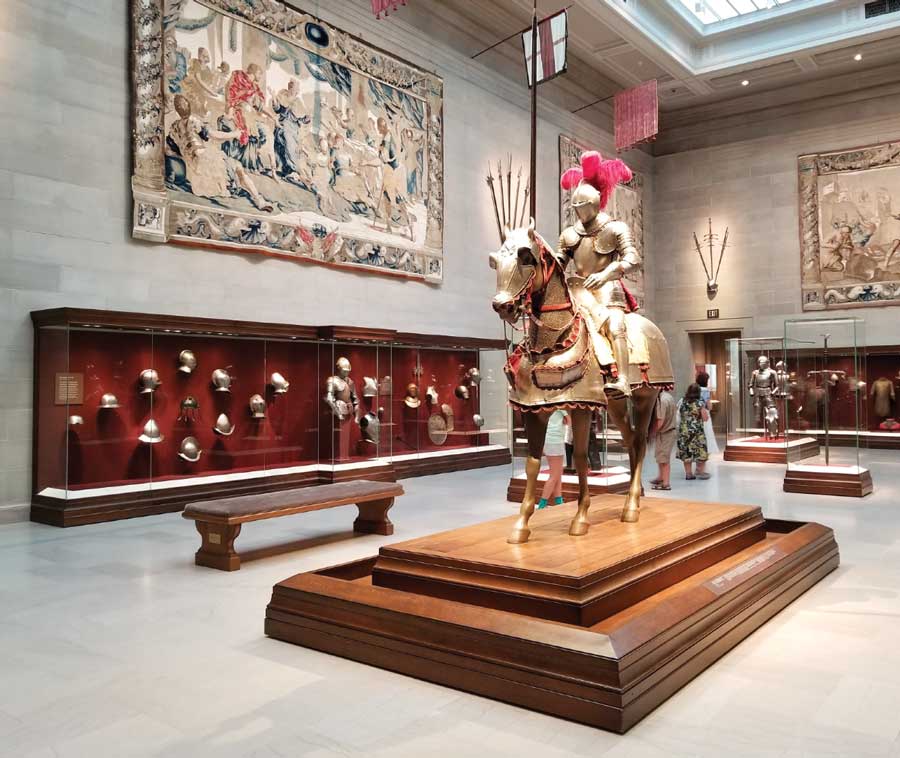
As a high school student, I used to take the bus down to University Circle and take an art appreciation class taught by the museum staff. After each class, I would stroll around the galleries, especially the one dedicated to the French Impressionists. There was a particularly beautiful Van Gogh there. And, as a kid, I loved the medieval armor gallery, the like of which I have never seen in any other art museum.
The Armor Court at the Cleveland Museum of Art
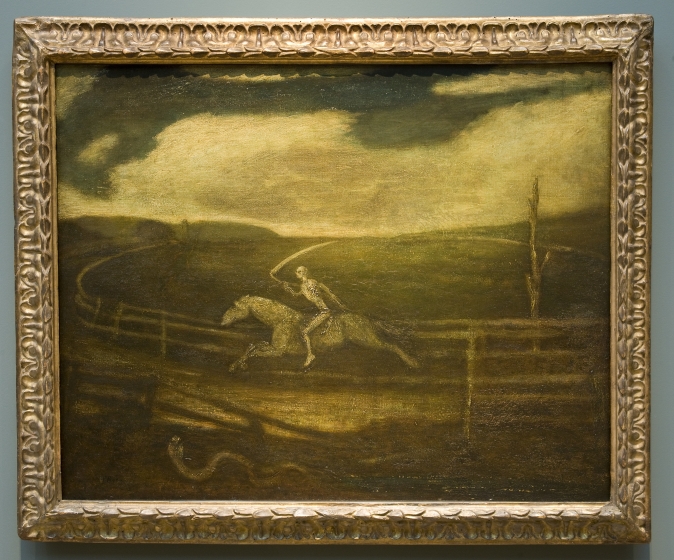
There wasn’t a whole lot of abstract expressionism around, though I suspect there is more now. The closest I came to liking modern art was a moody painting by the American Albert Pinkham Ryder (1847-1917). It was called “Death on a Pale Horse.” I am happy to hear the painting is still there.
“Death on a Pale Horse” by Albert Pinkham Ryder
Each time I went to the museum, I would have lunch at a soda fountain by East 105th Street, always ordering a lime rickey, which was pretty much like a lemonade except it was made with lime. Back then, I thought of lime as an exotic fruit instead of an accompaniment to my tequila.
Places like the Museum meant a great deal to me. It was a way I could get away from home on a Saturday and enjoy myself and learn something at the same time.
To begin with, I have no problem about getting from 9 to 9½ hours of sleep. In fact, during the last year I have slept better than at any other time in my life. I wake at 9 or 9:30 am, stumble out into the living room to say good morning to Martine, who always wakes up before me, and take my pills, give myself a shot of insulin, and perform a finger-prick test for my sugar level. Only then am I ready for breakfast.
Almost all mornings, I make a pot of hot tea, the current choice being Ahmad of London’s Darjeeling. It is usually accompanied by scrambled eggs with chiles, oatmeal, toast, a fried egg sandwich on a muffin, or grits and sausage. While I breakfast, I always read the Los Angeles Times, devoting particular attention to the KenKen and Sudoku puzzles and the comics page.
By the time I am finished, it is close to noon; so I futz around on the computer for a while, either playing chess with the computer at Chess.Com or one of the free games on Arkadium.Com.
Lunch is not usually a big meal for me, so I delay it into the early afternoon, after which I either see a movie on TCM’s website or Amazon Prime Videos, or I read a book. My current read is Paul Theroux’s Sir Vidia’s Shadow: A Friendship Across Five Continents, which is about the author’s long friendship with V. S. Naipaul (1932-2018). Both are among my favorite authors.
At supper, we usually have a hot home-cooked meal. Today, it was turkey burgers with steamed carrots. Tomorrow, I’ll have to shop for and prepare another meal, about which I must first consult with Martine. She’s the one with the trick digestive system. Last week, we have baked ziti with Italian sausage—one of my better efforts.
After we’ve eaten, Martine washes the dishes while I repair to my library with my current book, where I both read and talk to friends on the phone until about 9 pm. That’s the hour when I write my book reviews for Goodreads.Com and my blogs for WordPress.Com.
By the time I am done, I watch TV until shortly before midnight, concentrating on such shows as Carol Burnett (MeTV), Bill Maher and John Oliver (HBO), Trevor Noah’s “The Daily Social Distancing Show” on Comedy Central, and the opening monologue on Steven Colbert (CBS).
Martine has a much more difficult time of it than I do. She either takes long walks or sleeps while playing an AM talk radio station. She goes to bed for the night much later than I do and wakes up earlier, as she is bedevilled by a bad case of nerves. As I always tell her, nerves are a bad business; so I don’t have any.
This weekend I will drive out to the Coachella Valley to see my brother. It won’t be long before the temperature goes up to 100° F (37° Celsius) and over each day. Although Dan has air conditioning at his place, I don’t want to step outside only to be instantly dehydrated.
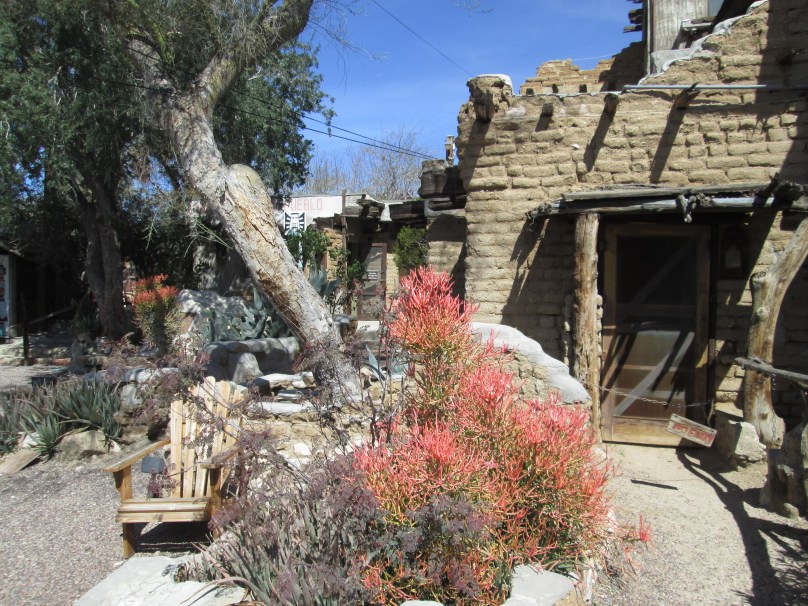
At this time of year, the desert can be beautiful. Alas, it has been a dry year, and thus not a great time for wildflowers. I remember times when I visited the desert in February and March to find it filled with uncounted millions of wildflowers, ranging from tiny blossoms to large cactus flowers.
Consequently, I will not post again until Monday, March 1. I hope to take a lot of pictures to use in next week’s posts.
Szent Erzsébet (Saint Elizabeth) Church, Where I Was Baptized
I have written before about my formative years living in Cleveland’s Buckeye Road Hungarian neighborhood. (See the links below.) For some reason, Cleveland was for many years—and still might be, for all I know—the most Hungarian city in America. Well before the Second World War, it became a magnet for Magyar immigrants. On Buckeye Road, there were Hungarian churches, butcher shops, bakeries, bars (Oroszláni’s tavern was at our corner of East 120th and Buckeye), and restaurants. The ,most famous was the Gypsy Cellar, which I never went to because it didn’t cater to children, followed by Settlers’, which I saw only years after I had left Cleveland for good.
The Gypsy Cellar Restaurant on Buckeye Road
In the late 1940s-early 1950s, Buckeye Road was a safe neighborhood and remained so until it was “blockbusted” by unscrupulous realtors in the 1960s trying to precipitate white flight by selling properties to black families. Today, it is a largely black neighborhood. When I visited with my father in the 1960s, a big Irish cop warned us to leave the area before the “niggers started waving their spears.”
We moved out in 1951, the year my brother was born. I had been having trouble in school, because it seems I didn’t understand English very well and caused a ruckus with my friend András by kicking our kindergarten teacher, Mrs. Idell in the ankles. By that time, my Dad felt more financially secure, so he bought a bungalow on East 176th Street in the Lee-Harvard area, just one block away from his twin brother.
I’ve always been afraid to go back to Buckeye Road because I never really finished first grade at Harvey Rice School. I was pulled out after one semester and immediately started Catholic school at Saint Henry’s in second grade. I paid a price for that, being considered something of a dunce and troublemaker until I made it to fourth grade.
This Is a Book I Need to Find
In the above photo, you can see the Regent Theater, where I was taken by my parents to see movies. Actually, I just ran up and down the aisles and messed around with the soda machine. At my age, there I was no way I could sit through an entire movie. That was a few years in the future.
The circumstances behind my seeing the Dalai Lama in April 1991 are indelibly etched in my memory. I arranged to first meet my friend George Hoole at his girlfriend’s apartment in Santa Maria, and then we would both go to the University of California at Santa Barbara to see the Dalai Lama give a speech.
I had only been driving for six years at the time, and I did something that killed the engine on my 1985 Mitsubishi Montero. Instead of staying on U.S. 101, I decided to take San Marcos Pass to Solvang, where I would have lunch before making my way back to the 101. Unfortunately, I drove up the pass in second gear. By the time I got to the top of the pass, my engine was a smoking ruin. I arranged to have the car towed back to Santa Monica Mitsubishi for repair, which was no easy thing as ’85 Monteros with automatic transmissions were a rarity.
George came to pick me up in Solvang and I was his passenger for the weekend. We heard the Dalai Lama give a great talk in his broken English … and this turned out to be the beginning of a difficult period for me. I teamed up with George to start a new company called Desktop Marketing Corporation, along with several of my co-workers from Urban Decision Systems, where I had been working since 1971.
It never took off, and I had to live on my savings for over a year, Ultimately, I left Desktop Marketing and managed to get a job in a Westwood accountancy firm called Lewis, Joffe & Company. Plus I had to shell out several thousand dollars for a new Montero engine.
Things don’t always tend to go your way. The early 1990s were a time of career change and retrenchment for me. But I never regret seeing the Dalai Lama in person. There is perhaps no religious figure I respected more, not even Pope John Paul II. There was something about the twinkle in his eyes which helped see me through a difficult period in my life.
I’d see him again if I could, but I would definitely avoid San Marcos Pass.
You must be logged in to post a comment.