The Selkirk Grace

Here is a very short poem by Scottish poet Robert Burns (1759-1796) just in time for Thanksgiving. The “Selkirk Grace,” as it is known, is usually recited before the first course is served at a Burns Night celebration.

Some hae meat and canna eat,
And some wad eat that want it;
But we hae meat, and we can eat,
Sae let the Lord be thankit.

You might want to say these words at your own Thanksgiving feast as you remember those whose hunger continues unabated, holiday or not.

This Be the Verse

English Poet Philip Larkin (1922-1985)

The reputation of Philip Larkin seems to grow year by year, to the extent that he is considered one of the best British poets of the last century. Here is one of my favorites among his poems:

This Be the Verse

They fuck you up, your mum and dad.   
    They may not mean to, but they do.   
They fill you with the faults they had
    And add some extra, just for you.

But they were fucked up in their turn
    By fools in old-style hats and coats,   
Who half the time were soppy-stern
    And half at one another’s throats.

Man hands on misery to man.
    It deepens like a coastal shelf.
Get out as early as you can,
    And don’t have any kids yourself.

Neither Wrong Nor Right

I have always loved this poem by Robert Frost:

Acquainted With the Night

I have been one acquainted with the night.
I have walked out in rain - and back in rain.
I have outwalked the furthest city light.

I have looked down the saddest city lane.
I have passed by the watchman on his beat
And dropped my eyes, unwilling to explain.

I have stood still and stopped the sound of feet
When far away an interrupted cry
Came over houses from another street,

But not to call me back or say good-bye;
And further still at an unearthly height,
One luminary clock against the sky

Proclaimed the time was neither wrong nor right.
I have been one acquainted with the night. 

“The Absence”

From French surrealist poet Paul Éluard comes this lovely poem called “The Absence.”

The Absence

I speak to you across cities
I speak to you across plains 

My mouth is upon your pillow 

Both faces of the walls come meeting
My voice discovering you 

I speak to you of eternity 

O cities memories of cities
Cities wrapped in our desires
Cities come early cities come lately
Cities strong and cities secret
Plundered of their master’s builders
All their thinkers all their ghosts 

Fields pattern of emerald
Bright living surviving
The harvest of the sky over our earth
Feeds my voice I dream and weep
I laugh and dream among the flames
Among the clusters of the sun 

And over my body your body spreads
The sheet of is bright mirror.

Saving the Day

Crows in a Tree

Apparently Robert Frost liked crows as much as I do. His poem, which follows, is called “Dust of Snow”:

Dust of Snow

The way a crow
Shook down on me
The dust of snow
From a hemlock tree

Has given my heart
A change of mood
And saved some part
Of a day I had rued.

Simple and elegant. One of the reasons I love Frost.

“In the Desert”

American Writer Stephen Crane (1871-1900)

One of the great “What Ifs” of American literature is what we would have had if Stephen Crane had not died at the age of 28. As it is, we had a great novel (The Red Badge of Courage), an interesting novelette (Maggie: A Girl of the Streets), and two great short stories (“The Open Boat” and “The Bride Comes to Yellow Sky”). Here is a short poem from Crane, the last two lines of which were used by Joyce Carol Oates as the title for one of her early novels:

In the Desert

In the desert
I saw a creature, naked, bestial,
Who, squatting upon the ground,
Held his heart in his hands,
And ate of it.
I said, “Is it good, friend?”
“It is bitter—bitter,” he answered;

“But I like it
“Because it is bitter,
“And because it is my heart.”

Sonnet 129

The Waikiki Malia Hotel in Waikiki

It was our second night in Honolulu. We had a room on the 12th floor of the Waikiki Malia Hotel’s Malia Tower. The next room away from the elevator was occupied by a couple of young women who were entertaining young male guests. Because the two rooms were connectable by a locked door, we could hear pretty much everything that was said.

Martine and i were pretty tired by 10 pm, because that was the same as 1 am Los Angeles time. Still we were entertained by the goings-on next door. All four were obviously on on liquor and possibly worse, and the girls were doing a major snow job on the guys. After three quarters of an hour, all four left to go out; but before long one of the couples returned to have very noisy sex.

After about ten minutes, the sounds from the other room were of conflict. The guy was complaining that his driver’s license was missing. After the act, there appeared to be no love lost between the two. As I lay in bed, I could easily have predicted this. After the guy left in a huff, everything went quiet; and we dropped off to sleep.

I was reminded of Shakespeare’s famous Sonnet #129 on the subject of lust:

Th’ expense of spirit in a waste of shame
Is lust in action; and, till action, lust
Is perjured, murd’rous, bloody, full of blame,
Savage, extreme, rude, cruel, not to trust;
Enjoyed no sooner but despisèd straight;
Past reason hunted, and no sooner had,
Past reason hated as a swallowed bait
On purpose laid to make the taker mad,
Mad in pursuit and in possession so;
Had, having, and in quest to have, extreme;
A bliss in proof and proved a very woe;
Before, a joy proposed; behind, a dream.
    All this the world well knows, yet none knows well
    To sun the heaven that leads men to this hell.


“A Toad Can Die of Light”

I can never tire of Emily Dickinson’s poems. Short though they may be, they resonate far beyond their few lines. I love the last two lines about “the gnat’s supremacy.”

A toad can die of light!
Death is the common right
Of toads and men,--
Of earl and midge
The privilege.
Why swagger then?
The gnat's supremacy
Is large as thine.

Acquainted With the Night

Poet Robert Frost (1874-1963) with Dog

I was privileged to attend one of Robert Frost’s last poetry readings at Dartmouth College’s Hopkins Center. Let me tell you something about Frost: He was no doddering sweet old man. His mind was sharp, and he have the appearance of knowing exactly what he was doing. He had attended Dartmouth College in his youth, but dropped out.

Acquainted With the Night

I have been one acquainted with the night.
I have walked out in rain—and back in rain.
I have outwalked the furthest city light.

I have looked down the saddest city lane.
I have passed by the watchman on his beat
And dropped my eyes, unwilling to explain.

I have stood still and stopped the sound of feet
When far away an interrupted cry
Came over houses from another street,

But not to call me back or say good-bye;
And further still at an unearthly height,
One luminary clock against the sky

Proclaimed the time was neither wrong nor right. 
I have been one acquainted with the night.

His poems sound so simple at first, but look again ….

History of the Night

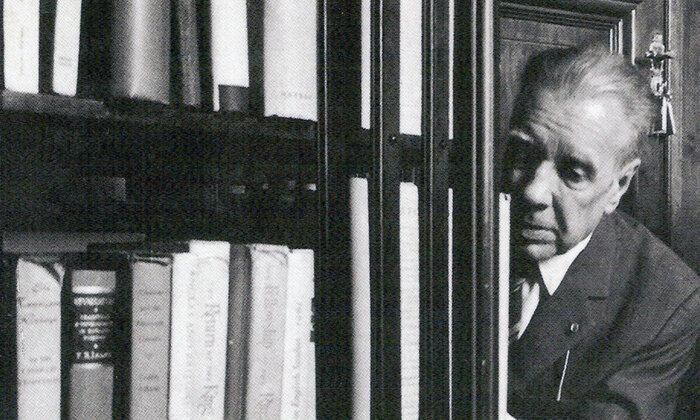
Argentinian poet Jorge Luis Borges was well acquainted with the night, especially when he lost his sight in the 1950s. It is best to remember that fact as one reads his poem “History of the Night.”

History of the Night

Throughout the course of the generations
men constructed the night.
At first she was blindness;
thorns raking bare feet,
fear of wolves.
We shall never know who forged the word
for the interval of shadow
dividing the two twilights;
we shall never know in what age it came to mean
the starry hours.
Others created the myth.
They made her the mother of the unruffled Fates
that spin our destiny,
they sacrificed black ewes to her, and the cock
who crows his own death.
The Chaldeans assigned to her twelve houses;
to Zeno, infinite words.
She took shape from Latin hexameters
and the terror of Pascal.
Luis de Leon saw in her the homeland
of his stricken soul.
Now we feel her to be inexhaustible
like an ancient wine
and no one can gaze on her without vertigo
and time has charged her with eternity.


And to think that she wouldn't exist
except for those fragile instruments, the eyes.