Serendipity: Camus on Travel

Albert Camus

Albert Camus

The text below is from his posthumously published Literary and Critical Essays:

Without cafés and newspapers, it would be difficult to travel. A paper printed in our own language, a place to rub shoulders with others in the evenings enable us to imitate the familiar gestures of the man we were at home, who, seen from a distance, seems so much a stranger. For what gives value to travel is fear. It breaks down a kind of inner structure we have. One can no longer cheat — hide behind the hours spent at the office or at the plant (those hours we protest so loudly, which protect us so well from the pain of being alone). I have always wanted to write novels in which my heroes would say: “What would I do without the office?” or again: “My wife has died, but fortunately I have all these orders to fill for tomorrow.” Travel robs us of such refuge. Far from our own people, our own language, stripped of all our props, deprived of our masks (one doesn’t know the fare on the streetcars, or anything else), we are completely on the surface of ourselves. But also, soul-sick, we restore to every being and every object its miraculous value. A woman dancing without a thought in her head, a bottle on a table, glimpsed behind a curtain: each image becomes a symbol. The whole of life seems reflected in it, insofar as it summarizes our own life at the moment. When we are aware of every gift, the contradictory intoxications we can enjoy (including that of lucidity) are indescribable.


Serendipity: The Ombú

Ombú Tree in Recoleta, Buenos Aires

Ombú Tree in Recoleta, Buenos Aires

I first grew curious about the Ombú trees of the Pampas when I read W. H. Hudson’s Tales of the Pampas. Following is the beginning of his short story entitled “The Ombú”:

IN ALL THIS DISTRICT, though you should go twenty leagues to this way and that, you will not find a tree as big as this ombú, standing solitary, where there is no house; therefore it is known to all as “the ombú,” as if but one existed; and the name of all this estate, which is now ownerless and ruined, is El Ombú. From one of the higher branches, if you can climb, you will see the lake of Chascomus, two thirds of a league away, from shore to shore, and the village on its banks. Even smaller things will you see on a clear day; perhaps a red line moving across the water—a flock of flamingos flying in their usual way. A great tree standing alone, with no house near it; only the old brick foundations of a house, so overgrown with grass and weeds that you have to look closely to find them. When I am out with my flock in the summer time, I often come here to sit in the shade. It is near the main road; travellers, droves of cattle, the diligence, and bullock-carts pass in sight. Sometimes, at noon, I find a traveller resting in the shade, and if he is not sleeping we talk and he tells me the news of that great world my eyes have never seen.

They say that sorrow and at last ruin comes upon the house on whose roof the shadow of the ombú tree falls; and on that house which now is not, the shadow of this tree came every summer day when the sun was low. They say, too, that those who sit much in the ombú shade become crazed. Perhaps, sir, the bone of my skull is thicker than in most men, since I have been accustomed to sit here all my life, and though now an old man I have not yet lost my reason. It is true that evil fortune came to the old house in the end; but into every door sorrow must enter—sorrow and death that comes to all men; and every house must fall at last.

Do you hear the mangangá, the carpenter bee, in the foliage over our heads? Look at him, like a ball of shining gold among the green leaves, suspended in one place, humming loudly! Ah, sefior, the years that are gone, the people that have lived and died, speak to me thus audibly when I am sitting here by myself. These are memories; but there are other things that come back to us from the past; I mean ghosts. Sometimes, at midnight, the whole tree, from its great roots to its topmost leaves, is seen from a distance shining like white fire. What is that fire, seen of so many, which does not scorch the leaves? And, sometimes, when a traveller lies down here to sleep the siesta, he hears sounds of footsteps coming and going, and noises of dogs and fowls, and of children shouting and laughing, and voices of people talking; but when he starts up and listens, the sounds grow faint, and seem at last to pass away into the tree with a low murmur as of wind among the leaves.

As a small boy, from the time when I was able, at the age of about six years, to climb on to a pony and ride, I knew this tree. It was then what it is now; five men with their arms stretched to their utmost length could hardly encircle it. And the house stood there, where you see a bed of nettles—a long, low house, built of bricks, when there were few brick houses in this district, with a thatched roof.

The ombú in the photograph stands in front of La Biela, an old café that Jorge Luis Borges and his friend and collaborator Adolfo Bioy Casares used to frequent. It is on Plaza Francia not far from the entrance to Recoleta Cemetery.

.

Serendipity: Summoning Up the Genie

César Aira

César Aira

I have written before a couple of times about Argentinian author César Aira, the man from Coronel Pringles (not related to the potato chip). Today, in the August 13, 2015 issue of The New York Review of Books, I finally read an article that seems to understand him. It is called “Staggering Local Wonderlands” and written by Geoffrey O’Brien, For your delectation, here are the concluding paragraphs of the article:

Finally one sticks around because of the tantalizing possibility that Aira may yet get to the bottom of something that seems to have no bottom. He is the master of a method whose application and ultimate purpose remain in perpetual doubt. He might be a rationalist demonstrating the irrationality of what is; a naturalist of the impossible; a maker of allegories, or of parodistic pastiches of allegories, of parables whose precise lessons deliberately elude clarification. He is just as likely demonstrating that such forms as allegory and parable are no more than imperfect attempts to capture a reality more elusive—“real reality, so distinct from the pale fantasies of reason” (The Miracle Cures of Dr. Aira, 2002). Aira seeks to improve on such earlier, approximate methods by means of his mad-scientist investigation into the neurology of story-making.

The act of storytelling is nowadays conventionally prized for its universal, ageless, benevolent associations. It is our shared heritage of magic; it is a defining human trait. With Aira we are just as aware of the essential cruelty of storytelling—or rather its cosmic indifference, an indifference only partly disguised in the oldest myths and legends and fairy tales. Finally there is nothing to cling to. Emotions are free-floating, personhood itself is free-floating—a state of affairs only thinly masked by the reassuring “thereness” of the voice-over commentary. The stories here do have a life of their own, and it is a life offering much surprise, much humor, much brilliance of observation and invention, but little in the way of even momentary consolation. They summon up a genie who can do everything but fulfill our wishes.

The reader feels at moments as if he has washed up in some successor state of literature, in which outward forms, characteristic tropes and techniques, are carefully maintained, but where former purposes have given way to some new and not yet decipherable intent. Yet in such a situation the old forms are perhaps more potent than ever: they regain the mystery of the incomprehensible that stories are always promising, in vain, to explicate. One of the stories in The Musical Brain begins: “Circumstances had reduced me to begging in the street”: a perfect narrative set-up for The Arabian Nights, that most wonderful, as well as supremely cruel, work. Aira’s reconceiving of such a compendium of all possible stories might be called an Arabian Nights of the corner drugstore; but then it is fair to say that The Arabian Nights itself was an Arabian Nights of the corner drugstore.

Serendipity: A Yellow Rose

Italian Poet Giambattista Marino (1569-1625)

Italian Poet Giambattista Marino (1569-1625)

Over the last couple of days, I have been re-reading Jorge Luis Borges’s A Personal Anthology. For the nth time, I was struck by this short piece, which I reproduce here in its entirety. It is called “A Yellow Rose.” The Translation is by Anthony Kerrigan.

The illustrious Giambattista Marino, whom the unanimous mouth of fame—to use an image dear to him—proclaimed the new Homer and the new Dante, did not die that afternoon or the next. And yet, the immutable and tacit event that happened then was in effect the last event of his life. Laden with years and glory, the man lay dying in a vast Spanish bed with carved bedposts. It takes no effort to imagine a lordly balcony, facing west, a few steps away, and, further down, the sight of marble and laurels and a garden whose stone steps are duplicated in a rectangle of water. A woman has placed a yellow rose in a vase. The man murmurs the inevitable verses which—to tell the truth—have begun to weary him a little:

Blood of the garden, pomp of the walk,
gem of spring, April’s eye …

Then came the revelation. Marino saw the rose as Adam might have seen it in Paradise. And he sensed that it existed in its eternity and not in his words, and that we may make mention or allusion of a thing but never express it at all; and that the tall proud tomes that cast a golden penumbra in an angle of the drawing room were not—as he had dreamed in his vanity—a mirror of the world, but simply one more thing added to the universe.

This illumination came to Marino on the eve of his death, and, perhaps, it had come to Homer and Dante too.


Serendipity: The Burning Coal, A Zen Tale

“A Buddhist Parable”

“A Buddhist Parable”

This passage comes from p. 182 of Thomas Pynchon’s Bleeding Edge. It’s not a bad description of some people I know.

Shawn tells her the Buddhist Parable of the Burning Coal. “Dude is holding this burning hot coal in his hand, obviously suffering a lot of pain. Somebody comes by—‘Whoa, excuse me, isn’t that a burning hot coal in your hand, there?’

“Ooh, ooh, ow, man, yes and like, like it really hurts, you know?’

“I can see that. But if it’s making you suffer, why do you keep holding on to it?’

“‘Well, duh-uhh? ’cause I need to, don’t I—aahhrrgghh!’

“You’re … into pain? you’re a nutcase? what is it? Why not just let it go?’

“‘OK, check it out—can’t you see how beautiful it is? lookit, the way it glows? like, the different colors? and aahhrrhh, shit …’

“‘But carrying it around in your hand like this, it’s giving you third-degree burns, man, couldn’t you like set it down someplace and just look at it?’

“‘Somebody might take it.’

“So forth.”

“So,” Maxine asks, “what happens? He lets go of it?”

Shawn gives her a nice long stare and with Buddhist precision, shrugs. “He lets go of it, and he doesn’t let go of it.”


Serendipity: “Nothing Perishes”

C. K. Scott Moncrieff, Translator

C. K. Scott Moncrieff, Translator (Painting by Edward Stanley Mercer)

This is a translation of a passage by the Roman poet Ovid from The Metamorphoses. The remarkable thing is that is was made by a thirteen-year-old boy who later grew up to translate Marcel Proust’s multi-volume masterwork, In Search of Lost Time:

Everything is changed but nothing perishes. The spirit wanders, going hence, thither, coming thence, hither and takes possession of any limbs it pleases. With equal ease it goes from beasts into human bodies and from us into beasts, nor in any length of time does it fail. And as wax is easily moulded in new shapes, nor remains as it had been before, nor keeps the same form, but is yet itself the same; so do I teach that the soul is ever the same, but migrates into different shapes.

Although many think that Scott Moncrieff’s translations are growing a little long in the tooth, there is no doubt of their excellence. As Walter Kaiser wrote in The New York Review of Books (June 4, 2015):  “Not surprisingly, Scott Moncrieff’s translations from Latin and Greek in the examination that year [1903] were awarded higher scores than anyone else’s, for it turns out that the astutely ingenious, poetic use of language for which he is celebrated in his great translation of Proust was his from an early age.”


Serendipity: Calvino’s Ersilia

Giorgio di Chirico’s “Italian Plaza with a Red Tower”

Giorgio di Chirico’s “Italian Plaza with a Red Tower”

I have been reading Italo Calvino’s masterful Invisible Cities, inspired in equal part by Marco Polo’s Travels and the paintings of Giorgio di Chirico. In turn, it inspired Geoff Dyer’s The Search.

Picture to yourself Marco Polo describing to Kublai Khan the cities he has passed through to reach the Celestial Kingdom. Each city is more fanciful than the next. Here, for instance, is Ersilia:

In Ersilia, to establish the relationships that sustain the city’s life, the inhabitants stretch strings from the corners of the houses, white or black or gray or black-and-white according to whether they mark a relationship of blood, of trade,  authority, agency. When the strings become so numerous that you can no longer pass among them, the inhabitants leave: the houses are dismantled; only the strings and their supports remain.

From a mountainside, camping with their household goods, Ersilia’s refugees look at the labyrinth of taut strings and poles that rise in the plain. That is the city of Ersilia still, and they are nothing.

They rebuild Ersilia elsewhere. They weave a similar pattern of strings which they would like to be more complex and at the same time more regular than the other. Then they abandon it and take themselves and their houses still farther away.

Thus, when traveling in the territory of Ersilia, you come upon the ruins of abandoned cities, without the walls which do not last, without the bones of the dead which the wind rolls away: spiderwebs of intricate relationships seeking a form.

Serendipity: Roman Street Scenes

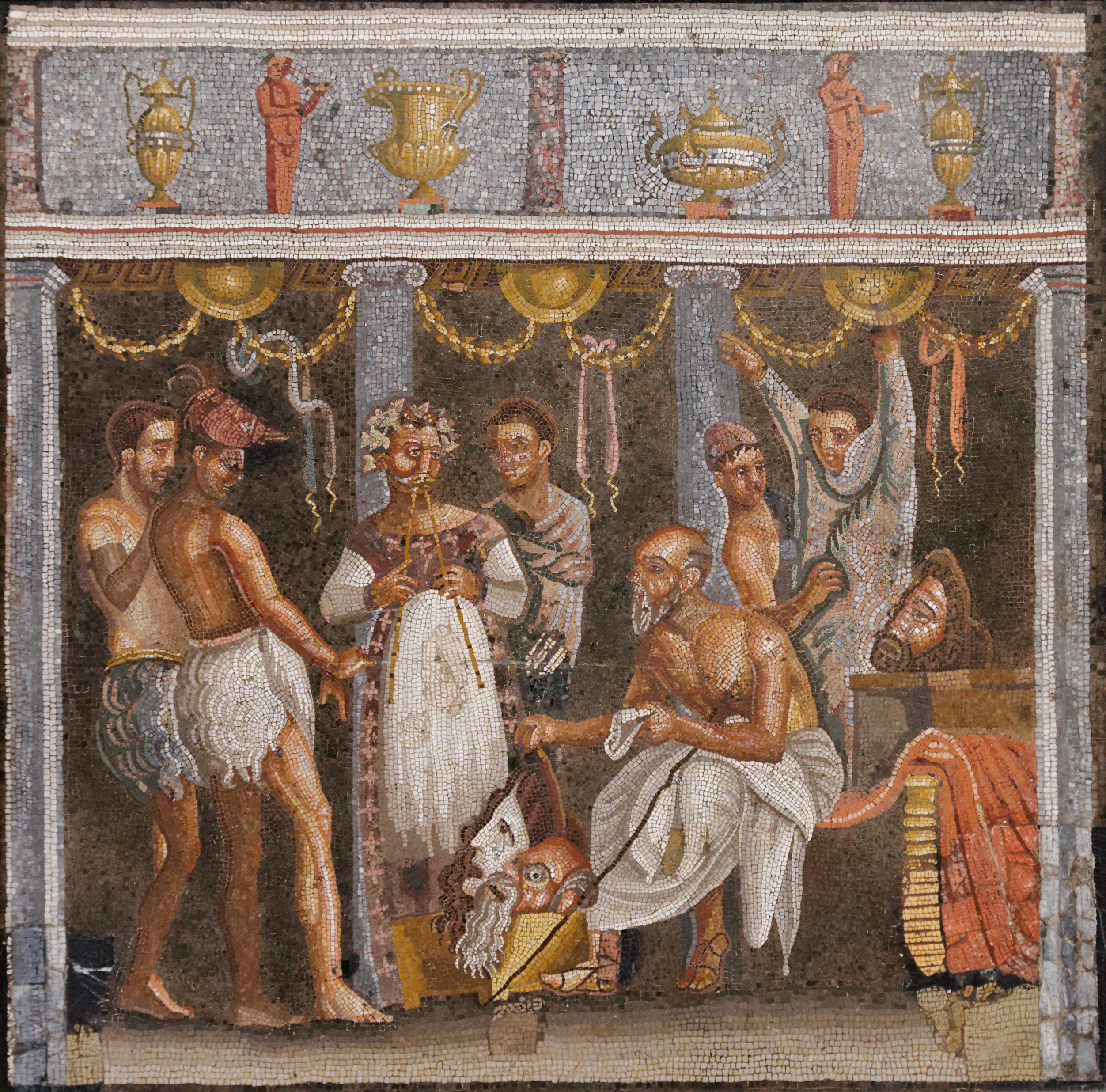
Scene from Ancient Roman Drama

Scene from Ancient Roman Drama

I was surprised as I read Juvenal’s Third Satire how vivid the ancient Roman street became. When we think of the ancients, we don’t usually see them in any way as if they could be our contemporaries. Here the satirist says goodbye to a Rome which he feels is going to the dogs as a result of corruption:

So farewell Rome. I leave you
To sanitary engineers and municipal architects, men
Who by swearing black is white land all the juicy contracts
Just like that—a new temple, swamp-drainage, harbour-works,
River-clearance, undertaking, the lot—then pocket the cash
And fraudulently file their petition in bankruptcy.

What is worse, those wily Greek immigrants are taking over everywhere:

One small dose of venom
(Half Greek, half personal) dropped in that ready ear
And I’m out, shown the back-door, my years of obsequious
Service all gone for nothing. Where can a hanger-on
Be ditched with less fuss than in Rome?

During the ten hours after sunrise, carts were forbidden to drive through the streets of the city. During the night, however, it is a different matter: The streets are also crawling with lowlifes:

But for me, a lonely pedestrian, trudging home by moonlight
Or with hand cupped round the wick of one poor guttering candle,
He has no respect whatever. This is the way the wretched
Brawl comes about (if you can term it a brawl
When you do the fighting and I’m just cast as punchbag).
He blocks my way. “Stop,” he says. I have no option
But to obey—what else can one do when attacked
By a huge tough, twice one’s size and fighting mad as well?
“Where have you sprung from?” he shouts. “Ugh, what a stench
Of beans and sour wine! I know your sort, you’ve been round
With some cobbler-crony, scoffing a boiled sheep’s head
And a dish of spring leeks. What? Nothing to say for yourself?
Speak up, or I’ll kick your teeth in! Tell me, where’s your pitch?
What synagogue do you doss is?” It makes not a jot of difference
Whether you try to answer, or back away from him
Without saying a word, you get beaten up just the same—
And then your irate “victim” takes you to court on a charge
Of assault and battery. Such is the poor man’s “freedom”:
After being slugged to a pulp, he may beg, as a special
Favour, to be left with his last few remaining teeth.

Juvenal shows us it’s not all togas and decorum. His Rome reeks of boiled sheep heads and spring leeks.


Serendipity: “Nothing Is Ever Repeated”

Juan José Saer (1937-2005)

Juan José Saer (1937-2005)

This is how I find new authors: Sick with a miserable cold, I go to Yamadaya Ramen in Westwood and while snarfing down a premium shio with extra bamboo shoots, I read the November 20, 2014 edition of The New York Review of Books and find a review by David Gallagher of an Argentinean author I would very much like to read, Juan José Saer. Here he talks about La Grande, Saer’s unfinished novel that has recently been published by Open Letter:

On a long, meditative bus ride from Rosario back to Santa Fe, Tomatis concludes that even the most familiar objects in his house change all the ti9me. “When we return to the kitchen from the dining room, or to the dining room from the kitchen, in the time it takes to find a clean knife in the utensil drawer, everything has changed,” he muses, and in the manner of the Colastiné Indians, he wonders if his house or town will still be there when he gets back. Nula is fascinated with the notion that no two instances are alike, and he obsesses about it on the most unlikely occasions, as when he kisses for the first time a girl called Virginia, with whom he is about to have a one-night stand. In his car, on their way to a motel he reflects that no two kisses are the same. With Virginia by his side he somehow has the time and the inclination to tell himself that

although everything is alike, nothing is ever repeated, and that since the beginning of time, when the great delirium began its expansion, … every event is unique, flaming, unknown, and ephemeral: the individual does not incarnate the species, and the part is not a part of the whole, but only a part, and the whole in turn is always a part; there is no whole; the goldfinch that sings at dawn sings for itself; … and its previous song, which even it does not remember singing, and which seems so much like the one before, if one listened carefully, would clearly be different.


Serendipity: Ishmael and Queequeg

The “Cannibal” Queequeg

The “Cannibal” Queequeg

Today, I found myself waiting in the library of Loyola Marymount University for several hours while Martine did her errands. So I went over to the bookstore and bought the Norton Critical Edition of Herman Melville’s Moby-Dick and began my third reading of the classic. To my surprise, it didn’t take long into the book before I found the perfect paradigm of the United States in dealing with the rest of the world.

At the Spouter Inn in New Bedford, Massachusetts, Ishmael can have a place to sleep only if he shares a bed with the harpooner who rents the room. According to the landlord, he is out trying to “sell his head.” Ishmael tries sleeping on a downstairs bench that is too narrow and too short, but finally decides to take a chance. His awakening when the harpooner stumbles in in the middle of the night is a classic:

Lord save me, thinks I, that must be the harpooneer, the infernal head-peddler. But I lay perfectly still, and resolved not to say a word till spoken to. Holding a light in one hand, and that identical New Zealand head in the other, the stranger entered the room, and without looking towards the bed, placed his candle a good way off from me on the floor in one corner, and then began working away at the knotted cords of the large bag I before spoke of as being in the room. I was all eagerness to see his face, but he kept it averted for some time while employed in unlacing the bag’s mouth. This accomplished, however, he turned round—when, good heavens! what a sight! Such a face! It was of a dark, purplish, yellow colour, here and there stuck over with large blackish looking squares. Yes, it’s just as I thought, he’s a terrible bedfellow; he’s been in a fight, got dreadfully cut, and here he is, just from the surgeon. But at that moment he chanced to turn his face so towards the light, that I plainly saw they could not be sticking-plasters at all, those black squares on his cheeks. They were stains of some sort or other. At first I knew not what to make of this; but soon an inkling of the truth occurred to me. I remembered a story of a white man—a whaleman too—who, falling among the cannibals, had been tattooed by them. I concluded that this harpooneer, in the course of his distant voyages, must have met with a similar adventure. And what is it, thought I, after all! It’s only his outside; a man can be honest in any sort of skin. [Italics mine] But then, what to make of his unearthly complexion, that part of it, I mean, lying round about, and completely independent of the squares of tattooing. To be sure, it might be nothing but a good coat of tropical tanning; but I never heard of a hot sun’s tanning a white man into a purplish yellow one. However, I had never been in the South Seas; and perhaps the sun there produced these extraordinary effects upon the skin. Now, while all these ideas were passing through me like lightning, this harpooneer never noticed me at all. But, after some difficulty having opened his bag, he commenced fumbling in it, and presently pulled out a sort of tomahawk, and a seal-skin wallet with the hair on. Placing these on the old chest in the middle of the room, he then took the New Zealand [shrunken] head—a ghastly thing enough—and crammed it down into the bag. He now took off his hat—a new beaver hat—when I came nigh singing out with fresh surprise. There was no hair on his head—none to speak of at least—nothing but a small scalp-knot twisted up on his forehead. His bald purplish head now looked for all the world like a mildewed skull. Had not the stranger stood between me and the door, I would have bolted out of it quicker than ever I bolted a dinner.

Little by little, Ishmael and Queequeg (for such is his name) warm up to each other. Returning from the famous sermon in the Whaleman’s Chapel, Ishmael encounters Queequeg again at the Spouter Inn:

With much interest I sat watching him. Savage though he was, and hideously marred about the face—at least to my taste—his countenance yet had a something in it which was by no means disagreeable. You cannot hide the soul. [Italics mine] Through all his unearthly tattooings, I thought I saw the traces of a simple honest heart; and in his large, deep eyes, fiery black and bold, there seemed tokens of a spirit that would dare a thousand devils. And besides all this, there was a certain lofty bearing about the Pagan, which even his uncouthness could not altogether maim. He looked like a man who had never cringed and never had had a creditor. Whether it was, too, that his head being shaved, his forehead was drawn out in freer and brighter relief, and looked more expansive than it otherwise would, this I will not venture to decide; but certain it was his head was phrenologically an excellent one. It may seem ridiculous, but it reminded me of General Washington’s head, as seen in the popular busts of him. It had the same long regularly graded retreating slope from above the brows, which were likewise very projecting, like two long promontories thickly wooded on top. Queequeg was George Washington cannibalistically developed.

As I read this, I thought that Melville was a man who was comfortable in his own skin and who understood the world—understood it far better than those police in Missouri and New York who killed out of fear, understood it far better than George Zimmerman who “stood his ground” because of his fear.

Fear is not only a mind killer, it is also a killer of otherwise innocent black people who are confronted with very limited white people who don’t know how to take them.