Serendipity: David Stofsky Talks with God

To Me, This Was the Highlight of John Clellon Holmes’s Go

To Me, This Was the Highlight of John Clellon Holmes’s Go

In the book, David Stofsky is Beat poet Allen Ginsberg. His poet and dope fiend friend Ancke (Herbert Huncke) is staying with him and has just been tucked him for the night. The chapter continues:

But that night he had a dream, without trappings, without symbols; a dream of extraordinary clarity while he dreamt it, but which he could not remember at all clearly when he awoke.

He walked down an inky corridor, which like one of those in [his friend] Waters’ building or in his own, and he was out of breath, as if he had come up many long and tiring flights. The door at the end of that corridor did not surprise him, nor, when he opened it without knocking, did the large and shadowy hall beyond it; a hall such as one can rent for fifteen dollars a night in Harlem brownstones; long, the fancy moldings, and dusty crepe streamers giving it a pathetic and abandoned appearance. Nor was he surprised by the throne at one end of it, a throne that was not surrounded by an ambient light, or even very clean and polished, but still somehow regal and entirely proper to the figure sitting there: an aging man of once powerful physique, now vaguely weary, His untrimmed beard fanned out in white folds upon His chest, His eyes shining with muted brightness as only an old man’s eyes can shine out of the limpid stillness of an old face. God.

Stofsky approached, without fear or excitement, and found himself on his knees, looking up, still conscious of his breathlessness. He paused for an instant, peering at the face, realizing an old, skeptical curiosity concerning it which he somehow knew would be tolerated; noting the wrinkles, the faint pink glow of the cheeks, the expression of weary passivity.

Then he began to tell all that had happened since [he had] the visions, endeavoring to stick close to the facts and keep the report brief and accurate. All the same, it seemed to him to take an inexcusable time to go through it all. Finally, reaching Ancke and mentioning his worry over his future, he came to the end.

“I should have had you here before, I know,” God said with an audible sigh. “But then…” And He looked down at Stofsky with an expression of such sadness and such resignation that Stofsky was actually embarrassed to have been the cause of such a look on God’s face.

“But what am I do do next, Sir?” he managed to say.

At that, he thought that God might lean forward and touch his head with one of those large, veinless hands, so gentle and sorrowful was the light which bathed His Face. But He did not.

“How shall I help them now? You see, I’m so confused and tired—,” forgetting that God must know everything.

“You must go back, and even doubt,” God said after a moment’s pause, ”and remember none of this. There’s an end which you shall discover. It waits there for you. Without you, it cannot happen. And it must.”

“But what shall I do?”, wanting, with childlike earnestness, some sign to guide him, to make acceptance easier.

“Being saved is like being damned,” God said with thoughtful simplicity, as though it was one of the unutterable secrets of the universe given to Stofsky now because he had been patient, because he had come so far.

Then God did lean forward until His beard fell straight down into His lap and Stofsky could see the wet brilliance of His large eyes. “You must go,“ He said, “Go, and love without the help of any Thing on earth.”

For a second, Stofsky seemed to recall the words; then remembered a line like that in [the poems of William] Blake, and thought that perhaps this was not God at all, but Blake himself. But then, looking closer, he knew it was God, and thought it wonderful and just that God should quote Blake, too.

As he was about to rise, however, a question rose in his mind, something almost irreverent and certainly mortal, and even though he suspected that he had no right to ask it, he could not let the opportunity pass somehow.

“Things are so terrible,” he began. “The violence, misery, the hate … war and hopelessness … I wonder,” and he gave one fearful and yet challenging glance into Those Eyes. “Why can’t You help all that? Do You know how human beings suffer? … Can you help them, Sir?” [Ellipses are in the original]

God’s face grew dim and drawn, as though the question gave Him pain He knew there was no sense to feel, but pain He took upon Himself in spite of that. He seemed for that moment a majestic and lonely man in His rented hall, on His dusty throne, who had received too many petitioners, too long, and understood too much to speak anything but the truth, even though it could not help.

“I try,” He replied simply. “I do all I can.”

Then Stofsky woke, and it was still dark.He could remember most of it, as though it had just happened, and felt a kind of heavy peace. But very soon he fell off to sleep again, and dreamt no more, and had forgotten when the morning came.
 

Serendipity: A Dog, a Cat, and a Mouse

St. Martin de Porres

St. Martin de Porres

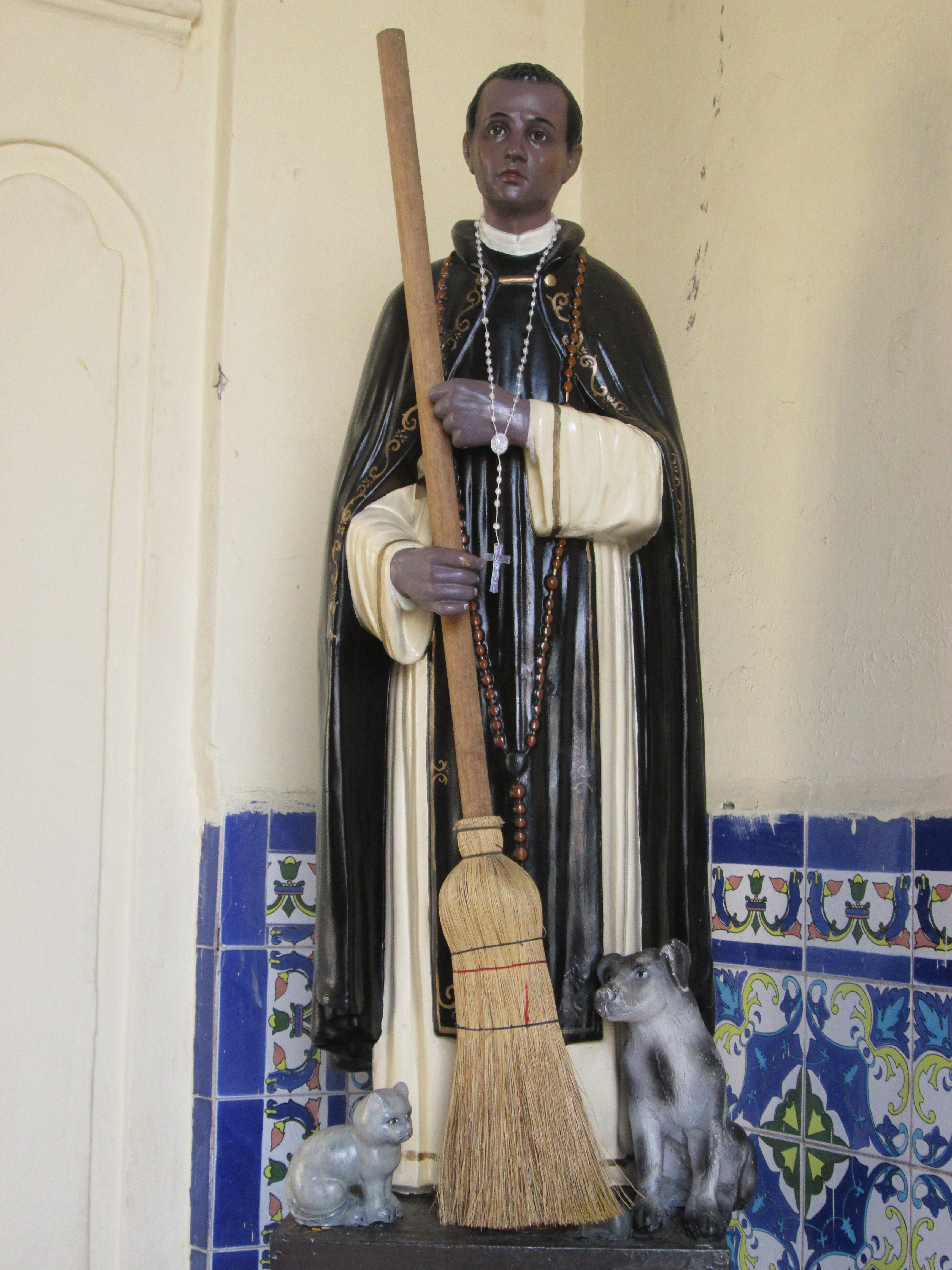
He is usually depicted in the garb of a Dominican lay brother, holding a broom, and with a dog, a cat, and a mouse at his feet. St. Martin de Porres is one of my favorite saints. My memories of him go back to grade school, years before Pope John XXIII canonized him in 1962.

The following is taken from Ricardo Palma’s Peruvian Traditions and tells the story of his three pets:

And from the same dish
ate a dog, a cat and a mouse.

With this couplet we come to the end of an account of the virtues and miracles attributed to Friar Martín de Porres. It was actually a broadside that was circulated in Lima about the year 1840 for the purpose of celebrating in our cultured and very religious capital city the solemn activities related to the beatification of this miracle worker.

This holy man, Friar Martín, was born on December 9, 1579, the natural son of the Spaniard Don Juan de Porres, Knight of Alcántara, and of a Panamanian slave. When he was still very young little Martín was taken to Guayaquil, where in a school in which the teacher made good use of the whip, he learned to read and write. Two or three years later his father and Martín returned to Lima and the boy was placed as an apprentice, learning the trade of barber and bloodletter in a barbershop on Malambo Street.

Martín wasn’t very adept with the razor and the lancet and this kind of work didn’t appeal to him so he opted for another career—that of sainthood, for in those days the career of a saint was just as legitimate a profession as any other. He took the habit of a lay brother at the age of twenty-one in the Monastery of San Domingo and remained there until he died in the odor of sanctity on November 3, 1639.

While he lived, and even after death, our countryman Martín de Porres performed miracles on a wholesale scale. He performed miracles as easily as others compose verses. One of his biographers (I don’t remember if it is Father Manrique or Doctor Valdés) says that the Prior of the Dominicans had to prohibit his continuing to perform miracles or milagrear (forgive me the use of the word). And to prove how deeply rooted in Martín the spirit of obedience was, on one occasion while he was passing a mason working on some scaffolding the worker fell a distance of some twenty-five to thirty feet. But while he was still in mid-air Martín stopped his fall—and there was the man suspended above the ground. The good Friar shouted, “Wait a moment, brother,” and the mason remained in the air until Martín returned with permission from his superior to complete the miracle.

That’s a doozy of a little miracle, don’t you agree? Well, if you think that one is great, wait until you read the next one.

The Prior sent the extraordinary lay brother on an errand to purchase a loaf of sugar for the infirmary. Perhaps he didn’t give Martín sufficient money to buy the white refined type so he returned with a loaf of brown sugar.

“Where are your eyes, Brother Martín,” said the Father Superior. “Can’t you see that it is so dark that it’s more like unrefined sugar?”

“Don’t get upset, Reverend Father,” answered Martín slowly. “All we have to do is wash this loaf of sugar right away and everything will be fine.”

Without allowing the Prior to argue the point the Friar submerged the loaf of sugar in the water in the baptismal font, and when he pulled it out it was white and dry.

Hey! Don’t make me laugh! I have a split lip!

Believe it or make fun of it. But let it be known that I don’t put a dagger at anyone’s breast forcing him to believe. Freedom must be free, as a newspaperman of my country once said. And here I note that because I had intended to speak of mice under Martín’s jurisdiction, I went off on a tangent and forgot what I was doing. That’s enough for the prologue; let’s get right down to business and see what happened to the mice.

* * *

Friar Martín de Porres had a special predilection for mice, unwelcome guests who came for the first time, it appears, with the Conquest, because until the year 1552 no mention of them was made. They arrived from Spain in a boat carrying codfish that had been sent to Peru by a certain Don Gutierre, Bishop of Palencia. Our Indians gave them the name hucuchas, which means creatures that came from the sea.

During the time that Martín was serving as a barber a mouse was still considered a curiosity, for the mouse population had just begun to multiply. Perhaps it was during that period that he began to concern himself with the welfare of the little animals, seeing in them the handiwork of God; that is to say he could see a relationship between himself and these small beings. As a poet put it:

The same time that God took to create me
He also took to create a mouse,
or perhaps two, at the most.

When our lay brother served as a male nurse in the Monastery the mice overran everything and made a nuisance of themselves in the cells, the kitchen and the refectory. Cats, which made their presence known in 1537, were scarce in the city. It is a documented fact that the first cats were brought by Montenegro, a Spanish soldier who sold one in Cuzco for 600 pesos to Don Diego de Almagro, the Elder.

The friars were at their wits’ end with the invasion of the little rodents and invented various kinds of traps to catch them, but with little success. Martín put a mouse trap in the infirmary and one rascal of a mouse who was inexperienced, attracted by the odor of some cheese, found himself trapped. The lay brother freed him from the trap, and then placing him in the palm of his hand said to him, “On your way, little brother, and tell your companions not to bother the friars in their cells. From now on all of you stay in the garden and I promise to take food to you every day.”

The ambassador complied with his mission and from that moment the mob of mice abandoned the cloister and took up residence in the garden. Of course Martín visited them every morning carrying them a basket of leftovers and other food and they would come to meet him as if they had been summoned by a bell.

In the cell Martín kept a cat and a dog. Through his efforts he had succeeded in having them live together in fraternal harmony, to such an extent that they both ate from the same dish.

One afternoon he was watching them eat in holy peace when suddenly the dog growled and the cat arched its back. What had happened was that a mouse had dared to stick its nose outside of its hole, attracted by the smell of the food in the dish. When Martín saw the mouse he said to the dog and cat, “Be calm, creatures of God. Be calm.” He then went over to the hole in the wall and said, “Come on out, brother mouse, have no fear. It appears that you are hungry; join in with the others. They won’t hurt you.” And speaking to the dog and cat he added, “Come on, children, always make room for a guest; God provides enough for the three of you.”

And the mouse, without being invited, accepted the invitation, and from that day on it ate in love in the company of the cat and dog.

And…, and…, and… A little bird without a tail? What nonsense!

Serendipity: Dreams of Prisons

One of Giambattista Piranesi’s Carceri Prints

One of Giambattista Piranesi’s Carceri, or Prison Etchings

I am currently reading Thomas De Quincey’s Confessions of an English Opium-Eater (1822). Although I remember starting it some twenty years ago, I never finished it. Turning to it once again, I am delighted by his elegant prose combined with his large-scale surrealistic dreams as a result of ingesting opium. At the same time, I love what he has to say about Giambattista Piranesi (1720-1778), whose etchings of vast imagined prisons are among my favorite prints.

When I started at UCLA in 1967 as a graduate student in the film program, I rented one of the originals of the above print for three months as part of a special program. (I can’t imagine anything so valuable being rented out to students under present circumstances.)

Here is what De Quincey wrote:

Many years ago, when I was looking over Piranesi’s, Antiquities of Rome, Mr. Coleridge, who was standing by, described to me a set of plates by that artist, called his Dreams, and which record the scenery of his own visions during the delirium of a fever.  Some of them (I describe only from memory of Mr. Coleridge’s account) represented vast Gothic halls, on the floor of which stood all sorts of engines and machinery, wheels, cables, pulleys, levers, catapults, &c. &c., expressive of enormous power put forth and resistance overcome.  Creeping along the sides of the walls you perceived a staircase; and upon it, groping his way upwards, was Piranesi himself: follow the stairs a little further and you perceive it come to a sudden and abrupt termination without any balustrade, and allowing no step onwards to him who had reached the extremity except into the depths below.  Whatever is to become of poor Piranesi, you suppose at least that his labours must in some way terminate here.  But raise your eyes, and behold a second flight of stairs still higher, on which again Piranesi is perceived, but this time standing on the very brink of the abyss.  Again elevate your eye, and a still more aërial flight of stairs is beheld, and again is poor Piranesi busy on his aspiring labours; and so on, until the unfinished stairs and Piranesi both are lost in the upper gloom of the hall.  With the same power of endless growth and self-reproduction did my architecture proceed in dreams.  In the early stage of my malady the splendours of my dreams were indeed chiefly architectural; and I beheld such pomp of cities and palaces as was never yet beheld by the waking eye unless in the clouds.  From a great modern poet I cite part of a passage which describes, as an appearance actually beheld in the clouds, what in many of its circumstances I saw frequently in sleep:

The appearance, instantaneously disclosed,
Was of a mighty city—boldly say
A wilderness of building, sinking far
And self-withdrawn into a wondrous depth,
Far sinking into splendour—without end!
Fabric it seem’d of diamond, and of gold,
With alabaster domes, and silver spires,
And blazing terrace upon terrace, high
Uplifted; here, serene pavilions bright
In avenues disposed; there towers begirt
With battlements that on their restless fronts
Bore stars—illumination of all gems!
By earthly nature had the effect been wrought
Upon the dark materials of the storm
Now pacified; on them, and on the coves,
And mountain-steeps and summits, whereunto
The vapours had receded,—taking there
Their station under a cerulean sky.  &c. &c.

The quoted poem is from William Wordsworth’s “The Excursion.”


Serendipity: Master of Five Willows

Master of Five Willows

Master of Five Willows

From Tau Ch’ien (365-427) comes this memorable portrait:

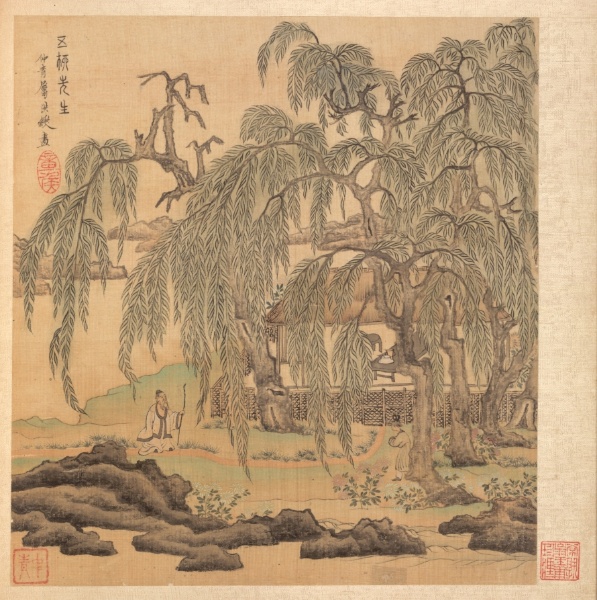
No one knows where he came from. His given and literary names are also a mystery. But we know there were five willows growing beside his house, which is why he used this name. At peace in idleness, rarely speaking, he had no longing for fame or fortune. He loved to read books, and yet never puzzled over their profound insights. But whenever he came upon some realization, he was so pleased that he forgot to eat.

He was a wine-lover by nature, but he couldn’t afford it very often. Everyone knew this, so when they had wine, they’d call him over. And when he drank, it was always bottoms-up. He’d be drunk in no time; then he’d go back home, alone and with no regrets over where things are going.

In the loneliness of his meager wall, there was little shelter from wind and sun. His short coat was patched and sewn. And made from gourd and split bamboo, his cup and bowl were empty as often as Yen Hui’s. But he kept writing poems to amuse himself, and they show something of who he was. He went on like this, forgetting all gain and loss, until he came naturally to his end.

In appraisal we say: Ch’ien Lou said Don’t make yourself miserable agonizing over impoverished obscurity, and don’t wear yourself out scrambling for money and honor. Doesn’t that describe this kind of man perfectly? He’d just get merrily drunk and write poems to cheer himself up. He must have lived in the most enlightened and ancient of times. If it wasn’t Emperor Wu-huai’s reign, surely it was Ko-t’ien’s.

Serendipity: A Re-Discovery

Loren Eiseley (1907-1977)

Loren Eiseley (1907-1977)

Have you ever laid something precious aside and, years later, suddenly be reminded of it? Then, going back to it, you find it was not only as good as you ever thought it was, but even better.The last book I read by Loren Eiseley was The Man Who Saw Through Time, about Sir Francis Bacon, back in 1990. Then I saw a blog by Fred Runk, whose perceptive comments you may have encountered in this space, quoting and commenting on a poem by Eiseley. It seemed as if a vortex formed around my head, in which I saw the waste of nearly a quarter century without once having encountered one of my favorite writers. I am making up for lost time by reading The Star Thrower, his last book, with essays on nature and science and a few of his early poems.

There is something small and humble about Eiseley as he examines nature and our place in it. Survival of the fittest?

A major portion of the world’s story appears to be that of fumbling little creatures of seemingly no great potential, falling, like the helpless little girl Alice, down a rabbit hole or an unexpected crevice into some new topsy-turvy realm…. The first land-walking fish was, by modern standards, an ungainly and inefficient invertebrate. Figuratively, he was a water failure who had managed to climb ashore on a continent where no vertebrates existed. In a time of crisis he had escaped his enemies…. The wet fish gasping in the harsh air on the shore, the warm-blooded mammal roving unchecked through the torpor of the reptilian night, the lizard-bird launching into a moment of ill-aimed flight, shatter all purely competitive assumptions. hese singular events reveal escapes through the living screen, penetrated, one would have to say in retrospect, by the ‘overspecialized’ and the seemingly ‘inefficient,’ the creatures driven to the wall.

In another essay, he talks about how life on our planet would have failed if it weren’t for the birth of flowers and everything that came in their train. At another time, we see him playing with an unafraid young fox with a pile of bones and selecting one and handing it to him. In yet another essay, we see him watching while an unusual squirrel manages to climb a post that had a wrap-around funnel protecting the food left for birds.

This is not BIG nature. It is all little nature with a lot of very BIG implications. Eiseley is a wonderful essayist and poet, deserving not only of scientific fame, but literary fame as well. It is no accident that the Introduction to The Star Thrower was written by an admirer named W. H. Auden.

In future, I will write more about Eiseley. Having rediscovered him, I cannot let him down.

Serendipity: The Singing Letter

Mural of Inca Indians

Mural of Incas and Spanish

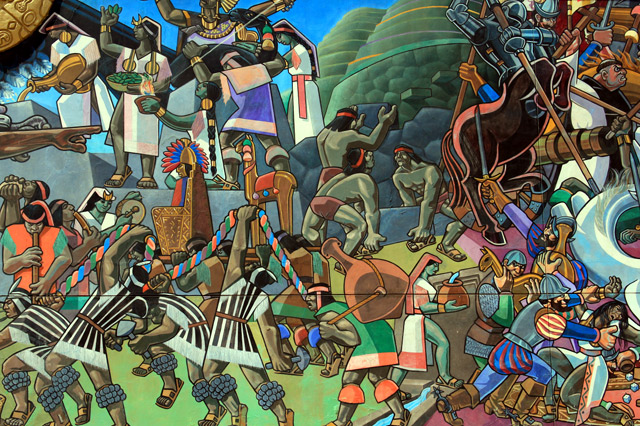
I have read some experts that say that the Incas had possessed a form of phonetic writing with knotted cords called quipus, whereas others say that these cords were used only for inventories and such—much as the Minoan Linear A and B was used in Ancient Crete. Last night, I ran into a tale from around 1541 quoted by Peruvian writer and antiquarian Ricardo Palma, which sheds some light on the whole issue:

The time came when the first harvest of melons was taking place in the Barranca melon fields and that marks the beginning of our story.

The overseer selected ten of the best melons, packed them in two boxes and put them on the shoulders of two of the Indians serving there and gave them a letter for the master.

The two Indians had carried the melons a few leagues when they sat down to rest near a wall. As one would expect, the aroma of the fruit awakened the curiosity of the Indians and a battle began between fear and their appetite.

“Do you know something, brother?” said one of them to the other in his Indian dialect. “I have discovered a way to eat some melons without anyone finding out. All we have to do is hide the letter behind the wall. It won’t be able to see us eat so it won’t be able to accuse us of anything.”

The naiveté of the Indians attributed to writing a diabolical and marvelous prestige. They didn’t believe that the letters were only symbols but that they were spirits, which functioned not only as messengers but also as watchmen or spies. [Italics Mine]

The second Indian thought that his companion’s idea was a very good one, so without saying a word, he placed the letter behind the wall, put a rock on top of it and then the two proceeded to devour, not eat, the inviting and delicious fruit.

As they were nearing Lima the second Indian gave himself a blow to the head and said, “Brother, we are making a big mistake. We need to make our burdens equal, because if you carry four and I carry five our master will suspect something.”

“Well said,” replied the other Indian.

And so once again they hid the letter and then they ate a second melon, that delicious fruit that according to the saying is gold before breakfast, silver at noon and death in the evening, for it is true that there is nothing more indigestible and causes more upset stomachs after a full meal.

After the Indians arrived at Don Antonio’s home they delivered to him the letter that announced the fact that the overseer was sending ten melons.

Don Antonio, who had promised to give some of the first melons of the harvest to the archbishop and several other individuals, began to examine what the Indians had brought.

“What do you think you are trying to do, you good-for-nothing thieves?” bellowed the irate landowner. “The overseer sent ten melons and two are missing.” Whereupon Don Antonio read the letter once more.

“There were only eight, master,” protested the two Indians.

“The letter says ten and you have eaten two of them on the road. You over there! Give these scoundrels a good beating—a dozen blows for each one.”

And the poor Indians, after receiving a thorough thrashing, sat in the corner of the patio gloomily considering what had happened to them.

Then one of them said, “You see, brother? The letter sings.”

Don Antonio happened to hear what the Indian had said, whereupon he shouted, “Yes, you rascals. And you better watch your step and not try any more funny business because now you know the letter sings.”

And Don Antonio related the incident to his friends at the next tertulia. The saying became popular and eventually made its way to the Mother Country.

The quote is from Palma’s Peruvian Traditions (1872-1910).

Can It Ever Get This Bad Here?

Mariano Melgarejo, Dictator of Brazil 1864-1871

Mariano Melgarejo, Dictator of Bolivia 1864-1871

I have just finished re-reading Eric Lawlor’s In Bolivia. In the process, I found a political leader who was probably the most incompetent, yet tyrannical ever to rule outside of North Korea. I am referring to General Mariano Melgarejo (1829-1871), the 18th President of Bolivia. Following are a few anecdotes about his rule—some of which may be apocryphal—but all with enough truth in them to be believable.

At a diplomatic function in 1867, the British ambassador refused to drink a glass of chicha, a cloudy but potent drink made of fermented maize. This incensed Melgarejo so much that he made him drink a whole bowl of liquid chocolate and then had him mounted ass-backwards and naked on a donkey and paraded three times around the Plaza Murillo, afterwards ordering him back to London. When the ambassador explained to Queen Victoria how he was treated, Her Majesty promptly ordered the British fleet to shell La Paz, the capital. Fortunately, someone in the Admiralty had the good sense to remind Her Majesty that Bolivia was a landlocked country, and that his ships’ projectiles could not penetrate that far. Whereupon, good Queen Vicky asked for a map of South America and drew a big letter “X” over it, declaring, “Bolivia does not exist.” In fact, diplomatic relations were not restored until 1910.

During the Franco-Prussian War in 1870, Melgarejo wished to come out on the side of Napoleon III and the Second Empire. Unfortunately, he had no idea where France was located, so he sent his army marching eastward. When some brave soul on his general staff commented that the army would have to cross the Atlantic Ocean, the generalissimo shot back, “Don’t be stupid! We’ll take a short cut through the brush!”

In another version of this story, which sounds equally apocryphal, the Bolivian army sent to relieve France ran into some rainy weather. As Lawlor tells it, “Melgarejo, jealous of his comfort, ordered his soldiers back to their barracks.” The rest is history: The Germans overran France and sent Napoleon III packing.

Lawlor continues:

Another told of Melgarejo returning to La Paz after touring the provinces to discover that a former president, Manuel Isidoro Belzú, had deposed him. Anticipating trouble, Belzú had filled Plaza Murillo with thousands of his followers. But Melgarejo was not cowed so easily. Drawing his pistol, he strode into the presidential palace and shot the interloper dead.

The gun still smoking in his hand, Melgarejo then addressed the mob. “Belzú is no more,” he said. “Who rules Bolivia now?” The crowd pondered the question but a moment. “Viva Melgarejo!,” it called back. “Viva la patria!

From the comfort of our couches, we can laugh at Bolivia; but remember it could get that bad over here. If some miserably ignorant Tea Partier ever got to be president, we would have to look away from Kim Kardashian’s ass for a second to consider how far we have sunk.

Serendipity: A “Miraculous” History

Vikings: The Stereotype

Vikings: The Stereotype

Right under the dedication of his book Feud in the Icelandic Saga, Jesse L. Byock includes this incredible quote from an almost forgotten book written a century ago:

The whole of Icelandic history is miraculous. A number of barbarian gentlemen leave Norway because the government there is becoming civilized and interfering: they settle in Iceland because they want to keep what they can of the unreformed past, the old freedom. It looks like anarchy. But immediately they begin to frame a Social Contract and to make laws in the most intelligent manner: a colonial agent is sent back to the Mother Country to study law and present a report. They might have sunk into mere hard work and ignorance, contending with the difficulties of their new country; they might well have become boors without a history, without a ballad. In fact the Icelandic settlers took with them the intellect of Norway; they wrote the history of the kings and the adventures of the gods. The settlement of Iceland looks like a furious plunge of angry and intemperate chiefs, away from order into a grim and reckless lank of Cockayne. The truth is that those rebels and their commonwealth were more self-possessed, more clearly conscious of their own aims, more critical of their own achievements, than any polity on earth since the fall of Athens. Iceland, though the country is large, has always been like a city-state in many of its ways; the small population, though widely scattered, was not broken up, and the four quarters of Iceland took as much interest in one another’s gossip as the quarters of Florence. In the Sagas, where nothing is of much importance except individual men, and where all the chief men are known to one another, a journey from Borg to Eyjafirth is no more than going past a few houses. The distant corners of the island are near one another. There is no sense of those impersonal forces, those nameless multitudes, that make history a different thing from biography in other lands. All history in Iceland shaped itself as biography or as drama, and there was no large crowd at the back of the stage.

Whew! Years ago, I had read the book from which this long quote is excerpted: W. P. Ker’s The Dark Ages (1904). I have not been able to locate my copy, but was delighted to find that the book is available free of charge in a number of formats, including Kindle.

We should by no means denigrate books like Ker’s just because they were written decades ago. Sometimes those old historians and critics had a lot more on the ball than our contemporaries.


Serendipity: The Janissaries

At One Time, They Were Feared by the Enemies of the Ottoman Empire

At One Time, They Were the Most Feared Infantry in Europe

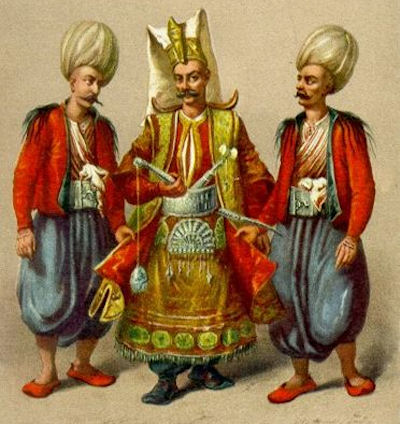
They look rather silly, don’t they? But in the 15th and 16th centuries, they were the elite infantry of the Ottoman Empire. The Janissaries conquered the Balkans, much of the Black Sea coast, and Hungary. Little known to most people is that they were almost exclusively Christians, who were either kidnapped or bought from their parents by recruiters under the empire’s devshirme system. But, like many things that were once a good idea, it didn’t look so good any more by the time the 1800s rolled around.

The following discussion comes from David Brewer’s excellent book The Greek War of Independence: The Struggle for Freedom from Ottoman Oppression and the Birth of the Modern Greek Nation:

The Sultan’s problem within his borders lay, as it had done before, with the corps of janissaries. They were now practically useless as a military force, and [the Sultan] Mahmoud had to fight his wars with mercenaries and with troops raised by local pashas. The janissary regiments in the provinces drew pay and rations in idleness, while those in the capital were an unruly menace, as a contemporary visitor described. “Lords of the day,” he wrote,

they ruled with uncontrolled insolence in Constantinople, their appearance portraying the excess of libertinism; their foul language; their gross behaviour; their enormous turbans; their open vests; their bulky sashes filled with arms; their weighty sticks; rendering them objects of fear and disgust. Like moving columns, they thrust everybody from their path without any regard of age or sex, frequently bestowing durable marks of anger or contempt.

In 1807 Mahmoud’s predecessor Selim III had tried to bring the janissaries under control by incorporating them into his so-called Army of the New Order. The janissaries reacted violently, the New Army was formally abolished and Selim lost his throne. In the following year, the first of Mahmoud’s reign, his grand vizier publicly advocated reforming the janissaries and curbing their abuses, but lost his life in the ensuing janissary revolt.

In the space of some four hundred years, the janissaries went from an elite military force to a kind of mafia, with members of the corps selling “protection” to merchants. They acted as the firemen of Constantinople, but it was also widely believed that they set the fires in the first place.

For a delightful novel about the decay of the janissary corps, I recommend Jason Goodwin’s The Janissary Tree, a 19th century mystery whose “detective” is a eunuch connected with the Sublime Porte. In 1826, the Sultan could take no more and began arresting and executing the remnants of the corps. In Ottoman history, the persecution is referred to as the “Auspicious Event.”

By the way, Jason Goodwin not only writes entertaining detective stories set in the Ottoman Empire, but he is also a historian whose Lords of the Horizons is perhaps the best introduction to the Empire.

Spirit Voices

Gobi Desert

Gobi Desert

When a man is riding through this desert by night and for some reason—falling asleep or anything else—he gets separated from his companions and wants to rejoin them, he hears spirit voices talking to him as if they were his companions, sometimes even calling him by name. Often these voices lure him away from the path and he never finds it again, and many travelers have got lost and died because of this…. Even by daylight men hear these spirit voices, and often you fancy you are listening to the strains of many instruments, especially drums, and the clash of arms. For this reason bands of travelers make a point of keeping very close together. Before they go to sleep they set up a sign pointing in the direction in which they have to travel, and round the necks of all their beasts they fasten little bells, so that by listening to the sound they may prevent them from straying off the path.—Marco Polo, Travels