Semuc Champey: “Where the River Hides Under the Stones”

A Land Bridge With Pools Under Which the River Flows

My niece Hilary has been to Guatemala a few years back. When I talked to her a couple of weeks ago, I asked which place impressed her the most. Her answer sent me to the index of my guidebook. It was Semuc Champey in the department of Alta Verapaz. This is what I found in my Moon Guatemala guide from 2015:

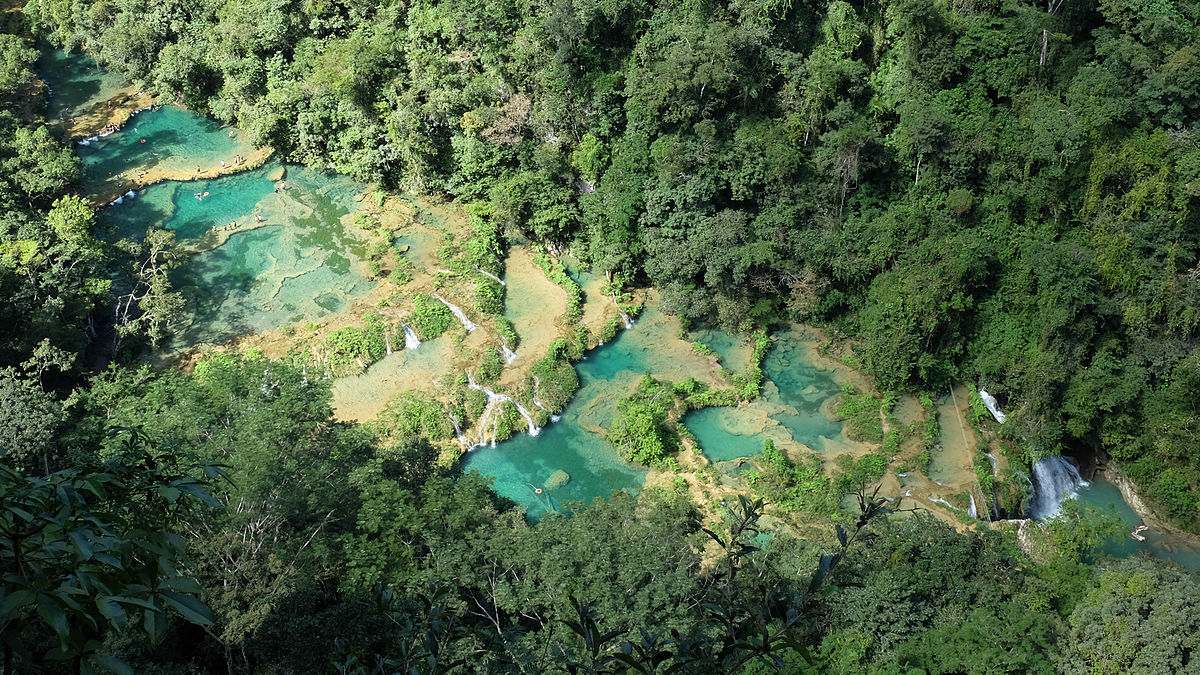
A giant, 300-meter-long limestone bridge forms the backbone for the descending series of pools and small waterfalls that makes up Semuc Champey. The water that fills the pools is the product of runoff from the Río Cahabón, churning as it plunges into an underground chasm from where it reemerges downstream at the end of this massive limestone overpass.

One can swim in these pools—it does look refreshing considering the surrounding jungle. There are also trails to a lookout point (from which the above photo was probably taken) and down to another point where the river plunges into an underground cavern. Sounds like Coleridge’s Xanadu:

In Xanadu did Kubla Khan
A stately pleasure-dome decree:
Where Alph, the sacred river, ran
Through caverns measureless to man
Down to a sunless sea.

The only problem is that Semuc Champey is not really on the road to anywhere. My first reaction to that, though, is “sounds like fun.” I may just decide to take my swimsuit and try a dip in the waters.


Looking South to Guatemala

Temple I at Tikal in the Petén

It’s time to resume visiting Mayan ruins, after a hiatus of twenty-five years. It was in 1992 that I went to Yucatán with Martine and several friends from work. For years I had wanted to see the ruins in Guatemala, but there was something like a civil war going on under the dictatorship of Efraín Ríos Montt, whose “Evangelical” regime was slaughtering the Mayans. For most of the 1980s, the U.S. State Department recommended that Americans stay out of Guatemala.

Later this year, I hope to visit the ruins of Tikal and Quiriguá in Guatemala and hop over the border into Honduras to see the ruins of Copán. Half the trip will be devoted to ruins, and the other half to visiting picturesque Highland Mayan towns like Antigua, Huehuetenango, Chichicastenango, and Panajachel. It would be nice if I could talk someone into accompanying me, but even at my advanced age, I am too adventurous for most of my friends.

I am starting my planning early, because I have a lot of reading to do before the rainy season ends in Central America.


The Great God Chac

Chac Masks at Uxmal

From my trips to Yucatán, I became impressed with the one dominant image of Yucatec Mayan art: The face of Chac (pronounced CHOCK), the rain god. You see, Yucatán is a land without surface rivers. Oh, there is plenty of flowing water underground, but none of it breaks the pitted limestone surface of the peninsula. In areas several hundred feet above sea level, such as in the Puuc Hills, the water that sustained the ancient Mayans came from chultunes, underground cisterns. In some years, the cisterns were full; in others, there was pitifully little to sustain the cornstalks that fed the people.

When one visits Yucatán, particularly in Puuc Hill sites such as Uxmal, Kabah, Labna, Sayil, and Xlapak, the dominant image is that of hundreds of Chac masks acting as façades of the Chenes-style buildings.

After the rainy winter Southern California had last year, I was hoping for a repeat, but so far this rainy season, we haven’t received anywhere near an inch, or even a centimeter, of the wet stuff. We have rain forecast for next week, but my fingers are crossed. So often the winds just blow the clouds inland where they go to water the desert.

I am thinking, perhaps, of going to Yucatán again this year. There are a number of Mayan sites I have yet to visit, such as Coba in the State of Quintana Roo and Edzna and Xpujil in the State of Campeche. Despite the heat and humidity of the great limestone block that is the peninsula, it is a fascinating tourist destination, well developed with reasonable accommodations and good food. In addition to Yucatec cuisine, which is quite distinctive with its reliance on achiote, bitter oranges, and Habanero chiles, there are Syrian restaurants (the merchant class of 150 years ago was heavily Middle Eastern), plus the standard Mexican antojitos.

If I go, it will be toward the end of the year, after the rainy season which is also super hot and sticky.


On the MV Lady Rose

A Cruise on the MV Lady Rose in 2004

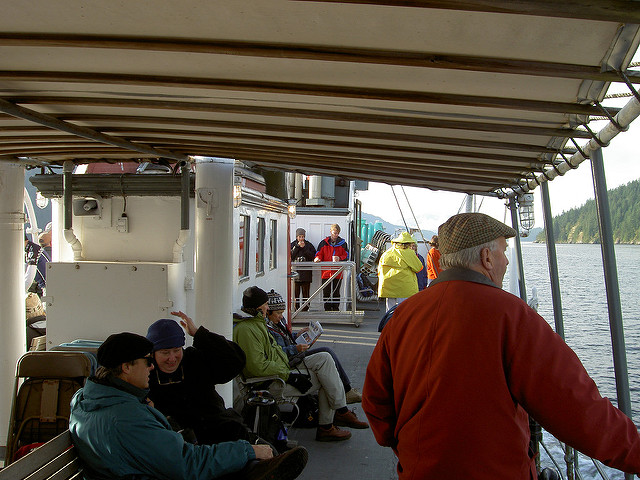
I am thinking back to a daylong cruise I took in 2004 between Port Alberni on Vancouver Island and Bamfield and back again. The little packet freighter we were on, the MV Lady Rose, is no longer in service, built was a fun ride. The Alberni inlet is a wild place, with dense forests, a few logging camps, lots of wildlife, and very few roads, if any. We saw bears along the edge of the inlet.

Vancouver Island in British Columbia is one of my favorite travel destinations, from Victoria to Nanaimo, Port Alberni, Ucluelet, and especially Tofino. There is one place in Tofino I always wanted to stay. During the month of January, powerful lightning storms assault the Pacific Coast of the island; and the Wickaninnish Inn just south of Tofino is an ideal place to watch all the action. It costs a bundle of money, but it would be worth it.

Failing that, the Tofino area is rich in things to do and places to see, including temperate rainforest hikes, whale cruises, and boat rides to watch bears feeding along the numerous islets surrounding the town.

In the past, I stayed at the Whalers on the Point Guesthouse, a better than average youth hostel within easy walking distance of restaurants and the Tofino Bus stop. (I do not like to rent cars when I am traveling alone.)

Mad About Travel

Crescent Lake Oasis Near Dunhuang, China

Immanuel Kant was a great philosopher, but I have no desire to emulate him. According to an editorial in Philosophy Now:

A curious case, this Kant. They say that travel broadens the mind, but Kant never in his whole life travelled more than ten miles from his home city of Königsberg (now Kaliningrad). He scraped a living for years as a private tutor before eventually becoming a hardworking professor at the university. He lived a life of disciplined regularity, taking the same walk around Königsberg at the same time each day, with such regularity that it was said that the inhabitants set their watches by him.

Living in Cleveland in the 1950s and 1960s, I desired more than anything else to travel. Even when I came out to California and got a job, it was a full seven years before I could afford to go anywhere but Cleveland. And when I did, my parents were appalled. “Why don’t you come to Cleveland?” Mom wheedled. “I’ll cook my favorite dishes for you.” That’s all I needed—to get even fatter.

I started out with baby steps, going to Mexico and traveling all around the country by bus and train (back when there were trains). I went to England and Scotland, too, and even joined my parents in 1977 to visit Hungary and Czechoslovakia.

In 2001, I went to Iceland; and, in 2006, I discovered South America. Now my desire for travel is insatiable. On the left corner of my kitchen table is a collection of travel guides from Lonely Planet and moon. While waiting for my morning paper to be delivered, I can read about the Trans-Siberian Railroad (2 guides), Iceland, Bolivia, Ecuador, and New Mexico while sipping a cup of hot tea.

December 29 is the last day of my working career, so I may not be able to afford some more distant locations; but Mexico and Guatemala continue to beckon. If I should win the lottery (hah!) I will try for the Trans-Siberian Railroad between Moscow and Vladivostok, though maybe diverting through Mongolia to Beijing. I can always dream, can’t I?


7 Things You’ll Never Catch Me Doing on My Vacations

Caribbean Cruise Ship

Since I am something of what Spiro T. Agnew called a “nattering nabob of negativity,” I thought of concentrating on travel activities that I would avoid like the plague:

  1. Speaking of the plague, going on a large cruise ship ranks right up there. I don’t know which is worse, catching Legionnaires’ Disease or equivalent rot when cooped up with several thousand upscale vacationers, or pretending to be friends with said vacationers when I have zilch in common with them.
  2. Ziplining or bicycling, not recommended for someone with an artificial hip or panhypopituitarism.
  3. Staying at a luxury hotel or resort and spending hundreds of dollars a night for a bed and a lot of snooty attitude.
  4. Skiing because of its demogaphic profile, high costs, and high potential rate of injury. (Okay, so I’m a wuss. Is that OK?)
  5. Traveling in the jungle, as I am mosquito-phobic. I’ve got to this age without contracting any tropical diseases, and I want to keep it that way.
  6. I don’t make friends with other American tourists: I travel to interact with the natives of the country I am visiting. If you see me on my travels, don’t talk to me in English, because I will answer you in Hungarian. The only exception: I belong to The English Group of Buenos Aires (TEGOBA) and enjoy attending their Friday meetings.
  7. Visiting wineries, as I am diabetic, and alcohol turns to sugar in the body. Besides, I don’t even like wine.

Within these boundaries, I manage to have a great time when I travel. My next travel post will emphasize the things I love about travel.


Midnight in Iceland

My Room on the Top Floor of the Guesthouse Óðinn at Midnight in June 2013

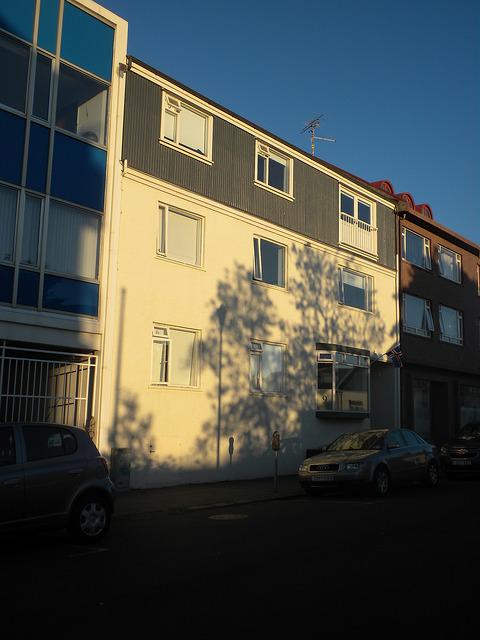
Now that we are fast approaching the darkest time of the year, my mind turns to my visit to Iceland in June 2013. In that Land of the Midnight Sun, I stayed out until midnight. When I returned to the Guesthouse Óðinn in Reykjavík around midnight, I snapped this picture. I was afraid I wouldn’t be able to sleep with all the light, but fortunately the guesthouse had good blackout curtains (which you can see on the upper left of the third floor in the above photo).

My first day in Reykjavík was a long one. My Icelandair flight from Toronto arrived early in the morning. I had to busy myself for eighteen straight hours before turning in. Otherwise, I would have awakened in the middle of the night—rarin’ to go. That way I managed to minimize the jet lag which otherwise would have bedeviled me. It was a good thing, too, because the next day I had an all day tour of the Golden Circle (Þingvellir, Gullfoss, Geyser, and the geothermal power plant at Hellisheiði on the return to Reykjavík.).


The Tomb of the Hero

Honor Guard at the Tomb of José de San Martín in Buenos Aires

The liberators of South America from the Spanish are honored throughout South America. One keeps running into the names of Bolivar, San Martin, Sucré, and O’Higgins again and again. The honor guard at the Metropolitan Cathedral on the north side of the Plazo de Mayo in Buenos Aires is dressed in the uniforms of the early 19th century, with swords drawn and standing at rigid attention.

Even Jorge Luis Borges, who never served in any country’s military, bragged of being descended from Colonel Manuel Isidoro Suárez, hero of the Battle of Junín in far-off Peru back in 1824. Many of his poems refer to this ancestral hero. Here is the last stanza of “A Page to Commemorate Manuel Suárez, Victor at Junín”:

His great-grandson is writing these lines
and a silent voice comes to him out of the past,
out of the blood:
“What does my battle at Junín matter if it is only
a glorious memory, or a date learned by rote
for an examination, or a place in the atlas?
The battle is everlasting and can do without
the pomp of actual armies and of trumpets.
Junín is two civilians cursing a tyrant
on a street corner,
or an unknown man somewhere, dying in prison.

I have read biographies of Bolivar and San Martín—as well as Gabriel García Márquez’s excellent The General in His Labyrinth, about the former—only to find that the heroes are more honored today than they were in their lifetimes. San Martín became so disgusted with his fellow Argentines that he moved to France. Only many years later did the Argentines invest him with the sanctity he wears today like an uneasy crown.


TEGOBA

That’s Short for “The English Group of Buenos Aires”

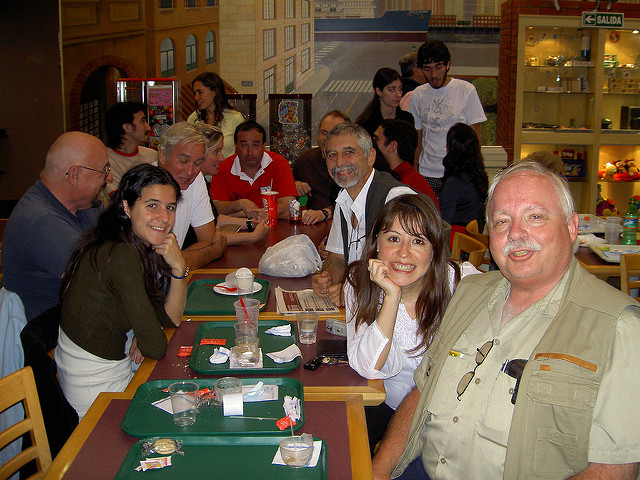
Each time I have gone to Buenos Aires—that’s now three times in all—I have gone to one of the weekly meetings of TEGOBA, The English Group of Buenos Aires. At leastsince 2006, it has been meeting on Friday nights at a cafeteria in the upscale Belgrano suburb of B.A. called FAME, located on Cabildo across the street from the Congreso de Tucuman SUBTE stop.

The above picture was taken in 2006, when I was quite a few pounds heavier. (I’m the walrus at the far right.) At my left is Marta Viajera, who is the coordinator for the group. The others are a combination of Argentinian professionals and visiting Americans, Brits, and others who want to socialize in English over a nice meal.

A few days after this picture was taken, I broke my right shoulder in a blizzard that struck Tierra del Fuego. I slipped on some ice at the corner of Magallanes and Rivadavia and smashed my shoulder into a high curb. Usually, that would make someone turn sour on a place. Instead, I decided I loved Argentina and its people, and I resolved to return. And I did, twice so far. I hope I have it in me to back back at least one more time.

And, to be sure, i will join the group at Avenida Cabildo 2921 for another meeting of TEGOBA.

The World’s Highest Capital City

La Paz, Bolivia, at Night

If you want to land in a capital city so high up that you will get an immediate nosebleed and tumble headfirst down the steps of the airplane, you would pick La Paz, Bolivia. The average altitude of El Alto, where the airport is located, is 13,615 feet (or 4,150 meters). The city itself is about 2,000 feet lower, about the same altitude of Lhasa, Tibet.

In The Old Patagonian Express, Paul Theroux talks about his accident-proneness at high altitude. Taking some aspirin in his hotel room, he drops the water tumbler into the sink. Trying to pick up the pieces, he cut himself badly and decided to seek medical attention:

But I had not gone two blocks when the new towel I had wrapped around my hand was soaked with blood. It did not hurt, but it looked dreadful. I hid it under my arm so as not to alarm pedestrians. Then the blood dripped on the sidewalk and I thought: God damn. It was deeply embarrassing to be walking through this large gray city with a blood-soaked towel on my hand. I began to wish I had tried the rubber band. I left spatters of blood on the crosswalk, and more spatters on the plaza. I asked directions to the pharmacy and saw, when I looked back, that there was a pool of blood where I had paused, and a horrified Bolivian watching me. I tried not to run: running makes your heart beat faster and you bleed more.

Of course, if Theroux had been trying to cope with the altitude by taking aspirin, his blood was not likely to clot soon. He should have chewed coca leaves with an alkaloid, or drank some mate de coca tea. But then, this was the 1970s, and this was not generally known to gringo travelers.

Bolivia has had a violent political history, with presidents changing office approximately once a year—or even more often. In 1948, some angry rebels yanked President Gualberto Villaroel from the balcony of his palace and proceeded to lynch him from a lamppost in the plaza. Fortunately, the present government is a little more stable