Parable of the Palace

The Forbidden City in Beijing

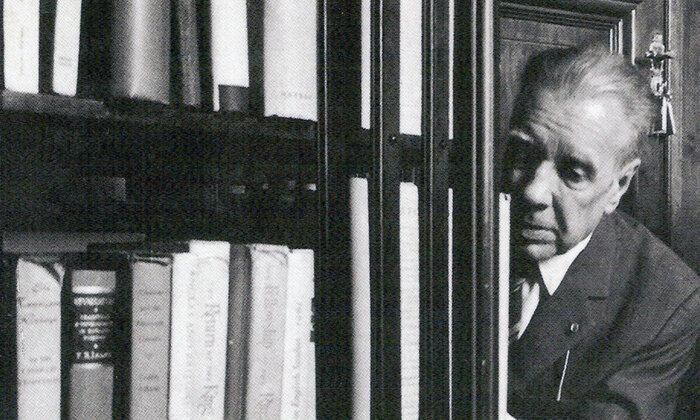
This short tale by Jorge Luis Borges (1899-1986) is, to my mind, the most incredible tale ever told about the power of poetry. It is told here in its entirety. It and many equally wonderful poems and stories can be found in Dreamtigers (in Spanish, El Hacedor).

That day, the Yellow Emperor showed the poet his palace. They left behind, in long succession, the first terraces on the west which descend, like the steps of an almost measureless amphitheater, to a paradise or garden whose metal mirrors and intricate juniper hedges already prefigured the labyrinth. They lost themselves in it, gaily at first, as if condescending to play a game, but afterwards not without misgiving, for its straight avenues were subject to a curvature, ever so slight, but continuous (and secretly those avenues were circles). Toward midnight observation of the planets and the opportune sacrifice of a turtle permitted them to extricate themselves from that seemingly bewitched region, but not from the sense of being lost, for this accompanied them to the end. Foyers and patios and libraries they traversed then, and a hexagonal room with a clepsydra, and one morning from a tower they descried a stone man, whom they then lost sight of forever. Many shining rivers did they cross in sandalwood canoes, or a single river many times. The imperial retinue would pass and people would prostrate themselves. But one day they put in on an island where someone did not do it, because he had never seen the Son of Heaven, and the executioner had to decapitate him. Black heads of hair and black dances and complicated golden masks did their eyes indifferently behold; the real and the dreamed became one, or rather reality was one of dream’s configurations. It seemed impossible that earth were anything but gardens, pools, architectures, and splendrous forms. Every hundred paces a tower cleft the air; to the eye their color was identical, yet the first of all was yellow, and the last, scarlet, so delicate were the gradations and so long the series.

It was at the foot of the next-to-last tower that the poet—who was as if untouched by the wonders that amazed the rest—recited the brief composition we find today indissolubly linked to his name and which, as the more elegant historians have it, gave him immortality and death. The text has been lost. There are some who contend it consisted of a single line; others say it was a single word. The truth, the incredible truth, is that in the poem stood the enormous palace, entire and minutely detailed, with each illustrious porcelain and every sketch on every porcelain and the shadows and the light of the twilights and each unhappy or joyous moment of the glorious dynasties of mortals, gods, and dragons who had dwelled in it from the interminable past. All fell silent, but the Emperor exclaimed, “You have robbed me of my palace!” And the executioner’s iron sword cut the poet down.

Others tell the story differently. There cannot be any two things alike in the world; the poet, they say, had only to utter the poem to make the palace disappear, as if abolished and blown to bits by the final syllable. Such legends, of course, amount to no more than literary fiction. The poet was a slave of the Emperor and as such he died. His composition sank into oblivion and his descendants still seek, nor will they find, the one word that contains the universe.

A Few Days in Uruguay

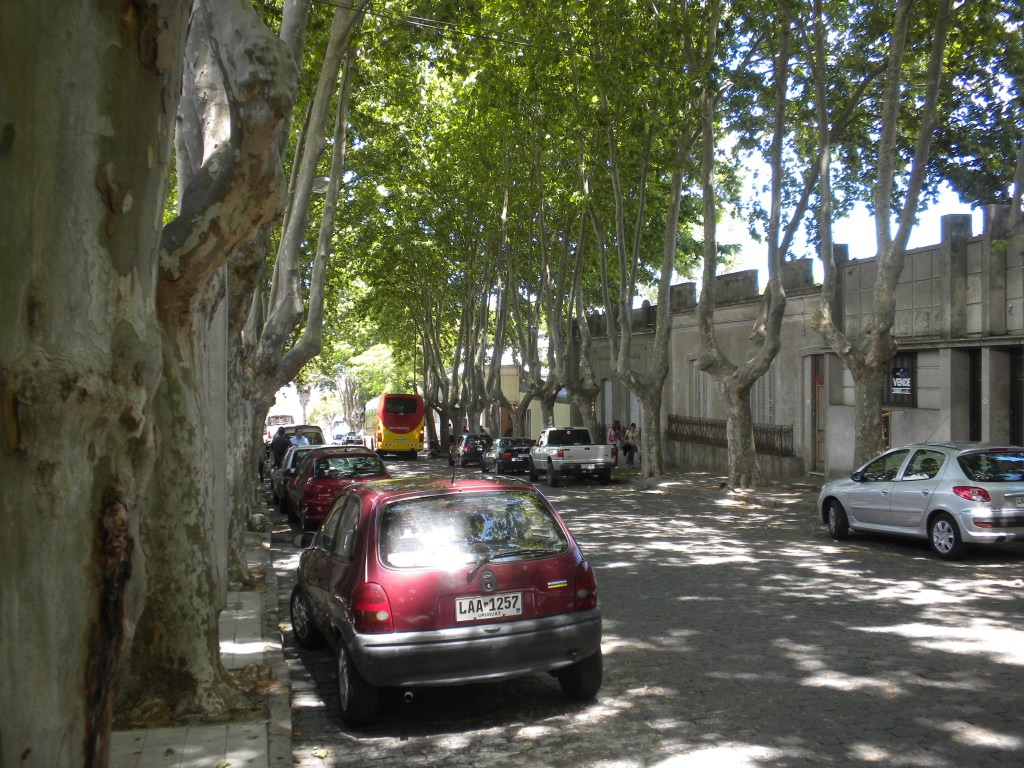
Street Scene in Colonia del Sacramento, Uruguay

In November 2011, Martine and I spent two and a half weeks in Argentina, plus a few days in Colonia del Sacramento, just across the River Plate from Buenos Aires. With a population of three and a half million people, Buenos Aires was at times a bit much for Martine, especially when she had to ride the crowded buses and subways.

So I planned in advance for a mini-vacation from the crowds of Buenos Aires by taking a ferry across the Plate to Colonia del Sacramento in nearby Uruguay. Colonia is, in fact, where Porteños (that’s what the residents of Buenos Aires call themselves) go when the big city is too much for them.

With only 27,000 people, Colonia is a 17th century town founded by Brazil. The streets are mostly all cobblestone, and there are a half dozen small pokey museums that are good for about an hour each.

A Tasty Restaurant Within Sight of the Atlantic

As a getaway, Colonia del Sacramento was a roaring success. We stayed at an old bed & breakfast that was at least three hundred years old. We lazily trod the cobblestones going from sight to sight, and eating some tasty steak dinners. We went back to Buenos Aires for one day before catching a flight to Patagonia, which is an entirely different story.

New Year’s Resolutions?

At this time when we are supposedly making up New Year’s resolutions, I am reminded of this poem by Jorge Luis Borges, the great Argentinian poet who died not long after his poem “Instants” was written.

Instants

If I could live again my life,
In the next - I'll try,
- to make more mistakes,
I won't try to be so perfect,
I'll be more relaxed,
I'll be more full - than I am now,
In fact, I'll take fewer things seriously,
I'll be less hygenic,
I'll take more risks,
I'll take more trips,
I'll watch more sunsets,
I'll climb more mountains,
I'll swim more rivers,
I'll go to more places - I've never been,
I'll eat more ice creams and less (lime) beans,
I'll have more real problems - and less imaginary ones,
I was one of those people who live
prudent and prolific lives -
each minute of his life,
Of course that I had moments of joy - but,
if I could go back I'll try to have only good moments,

If you don't know - that's what life is made of,
Don't lose the now!

I was one of those who never goes anywhere
without a thermometer,
without a hot-water bottle,
and without an umbrella and without a parachute,

If I could live again - I will travel light,
If I could live again - I'll try to work bare feet
at the beginning of spring till
the end of autumn,
I'll ride more carts,
I'll watch more sunrises and play with more children,
If I have the life to live - but now I am 85,
- and I know that I am dying . . .  

Watching Sports on TV

Messi and Teammates Celebrating After World Cup Victory

I woke up too late on Sunday morning to watch all of the Argentina-France World Cup Final. But I did see the second half, followed by the two overtime periods and the penalty kicks. And that hour and a half or so was the most exciting sports event I ever saw on television.

Now that pretty much everyone has weighed in on the game and Lionel Messi’s triumph and Kylian Mbappé’s stoic loss, I thought I would say a few words about the act of watching sports event. I am uniquely qualified inasmuch as I rarely watch sports events and have no clearcut team identification in any sport. Moreover, when I was growing up, my father would get so teed off when one of the Cleveland teams lost—and in those years they lost with amazing frequency—that I would have to go into hiding to avoid the paternal wrath.

It is only recently that I have come to love watching two types of sports events which, coincidentally, occur at four-year intervals. I am referring to World Cup Football (men and women) and the Summer Olympics. (The Winter Olympics—Meh!.) I have little interest in baseball, which typically involves a few minutes (if any) of intense action stretched out over several hours. American football, to me, is characterized by lots of starts and stops, followed after the so-called two-minute warning, by another hour or so of play.

Basketball has a lot of action, but there’s a lot of starts and stops there, too, as if the sport were devised with advertisers in mind. As for hockey, I find it too hard to follow the puck across the ice. All I see is the mayhem.

Only soccer football has continuous action, except for times when a player is injured or pretends to be injured. The final on Sunday built up to a pitch of excitement such that I have never experienced with any other sport. There was so much skill spread among so many players that it was a pity that someone had to lose. I would have been equally happy for either France or Argentina to win the game.

The Other Football

Argentine Footballers Celebrating After Scoring Against Poland

Yesterday, I watched the World Cup match between Argentina and Poland. Unlike most viewers, there are a whole lot of teams I like. I realize that the United States is still new at this game and can be upset by the likes of Liechtenstein or Moldova. A generation from now, I suspect that what we call soccer will be more prevalent, if for no other reason that parents won‘t want their sons growing up brain-damaged like Herschel Walker.

In yesterday’s game, I liked both Argentina (as I’ve visited their country three times) and Poland (because I’m Eastern European myself). Argentina won the game 2-0, but both Argentina and Poland advanced to the quarter finals. I think it was because the sum of the team members’ jersey sizes was a prime number.

The announcers kept talking about how surreal the end of the game was because so many teams were still in play, irrespective of their win/loss standings. Also considered in the standings were scores for remembering to say “please” and “thank you”; the number of syllables in the first stanza of their respective national anthems; the teams’ overall dental hygiene; and how well the teams could pronounce the name of the country they were in. (I think the latter is something like “Catarrh”, no?)

Argentina dominated the game, but the poles had one real hero in their goalie, Wojciech Szczesny. (Gesundheit!) For the entire first half, he batted away everything the Argentinians could throw at him, including soccer balls, off-color epithets, and one extremely rusted steam locomotive. Only in the second period did two goals get by him.

The Star of the Polish Team: Goalkeeper Wojciech Szczesny

Although soccer football does have its problems, such as the higher mathematics involved in calculating who gets to move on to the quarter finals and the treatment of draws. In American sports, there are a lot of stops and starts to allow for advertisers to plug their products and services. Soccer football games stop only for injuries, and then they add a mysterious number of make-up minutes after the regulation ninety minutes. I guess Americans will just have to get used to all that intensity and uncertainty. The rest of the world seems to have.

Ruta Cuarenta

The Other Great North/South Road in South America

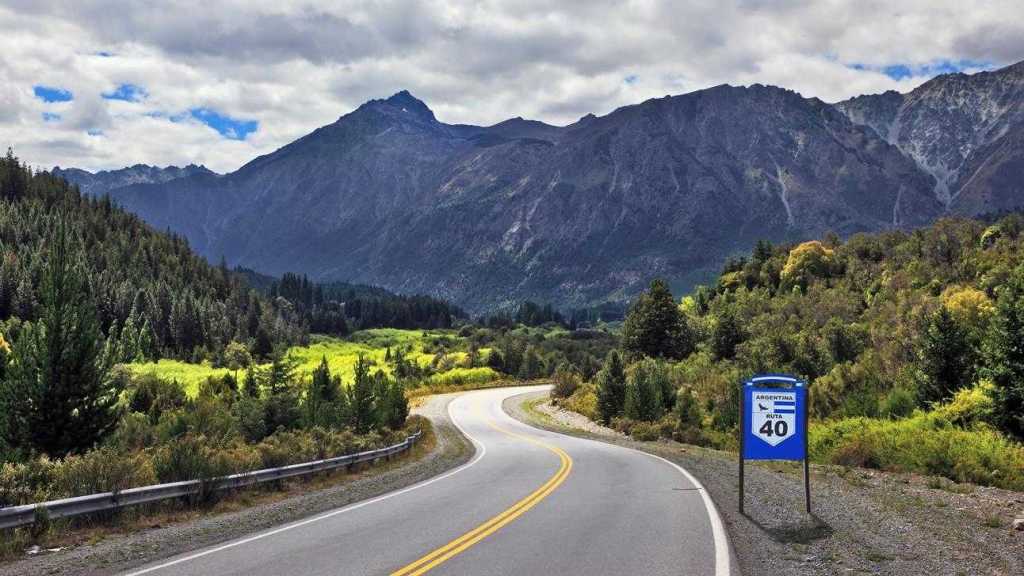
Like the Chile’s Carretera Austral, Argentina’s Ruta Cuarenta (Route 40) is another of the great South American highways. It runs for 3,246 miles (5,224 km) from the northern tip of Argentina where it meets the altiplano of Bolivia all the way to Cabo Virgenes, the most southerly point on the South American mainland. It doesn’t include Tierra del Fuego which is on an island.

Although I have never been on the Carretera Austral, I have ridden Ruta 40 between Neuquén and San Carlos Bariloche in 1995. Both highways are practically up against the Andes. Where Coyhaique is the only large town on the Chilean highway, Ruta 40 goes through Cafayate, Mendoza, San Carlos Bariloche, Esquel, Rio Turbio, and Rio Gallegos on its way to the large Magellanic Penguin sanctuary by Cabo Virgenes. To go further south in Argentina, one has to take a Chilean ferry across the Straits of Magellan before crossing over to Ruta 3 to Rio Grande and Ushuaia.

There are stretches of the highway south of Rio Negro Province that are not yet paved, being the windy deserts of Patagonia. Even so, a good part of the southern highway is the only land route from Chile’s Villa O’Higgins to Puerto Natales. In addition, there are Argentinian buses plying the route

I would love to take Ruta 40 along its entire length, but I would require an SUV, at least two spare tires, and an auto mechanic. Oh, and for certain areas, a guide. Alas, I am too old and poor to be able to indulge in this travel dream of mine.

The Carretera Austral

One of the World’s Most Scenic Highways

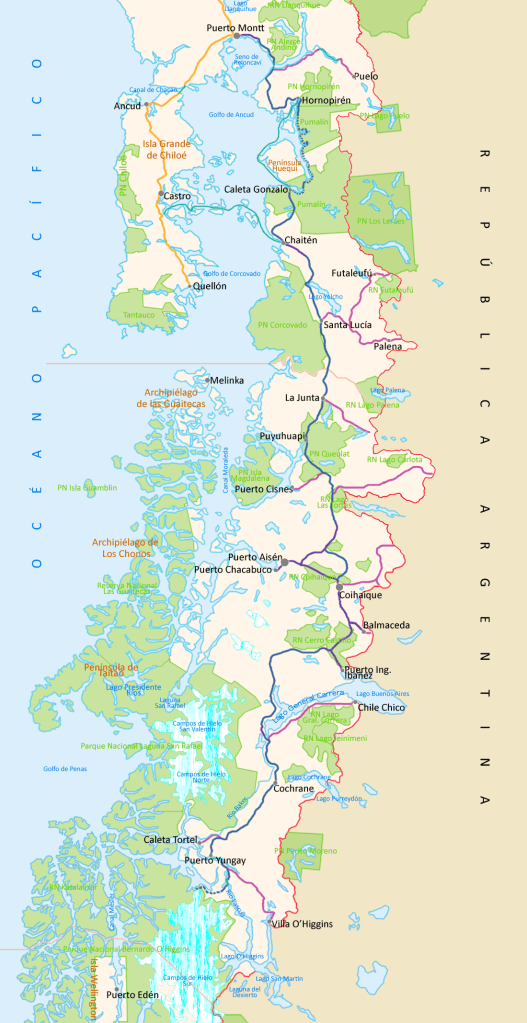
It bears several names: Route 7, the Augusto Pinochet Highway (because it was completed during that dictator’s presidency), and the Carretera Austral , the Great Southern Highway. It runs for 770 miles (1,240 km) from Puerto Montt to Villa O’Higgins. At that point, no roads go farther south. According to Wikipedia:

Carretera Austral has a strategic meaning due to the difficult access by land to a significant portion of Chile’s southern territory. This area is characterized by thick forests, fjords, glaciers, canals and steep mountains. Access by sea and air is also a complex task due to extreme winter weather conditions. For decades, most of the land transportation had to cross the border to Argentina in order to reach again Chile’s Patagonia. These difficulties were deepened during the 1970s due to the Beagle Conflict crisis. In order to strengthen the Chilean presence in these isolated territories and ensure the land connection to the rest of the country, the government planned the construction of this road, which was executed by the Chilean Army’s Engineering Command. More than 10,000 soldiers worked on its construction.

South of Villa O’Higgins is Punta Arenas, Puerto Natales and the Torres del Paine, the FitzRoy Massif, and Chilean Tierra del Fuego—but only after a gap of 225 miles (363 km) of dense forests, raging rivers, and high mountains. Eventually, Chile plans to extend the Carretera Austral south to Puerto Natales, but it will take years. Until then, vehicles have to cross over into Argentina and take Route 40 (“Ruta Cuarenta”) through the windy wastes of Patagonia.

I would love to take the Carretera Austral, but even though the road is paved, many of the rivers (such as the Rio Baker) are unbridged and require time-wasting ferry crossings. Add to that the fact that there are no large cities (except Coyhaique with 45,000 population) along the route if something were to happen to your car.

There’s nothing to stop me from dreaming.

Glacier Tourism

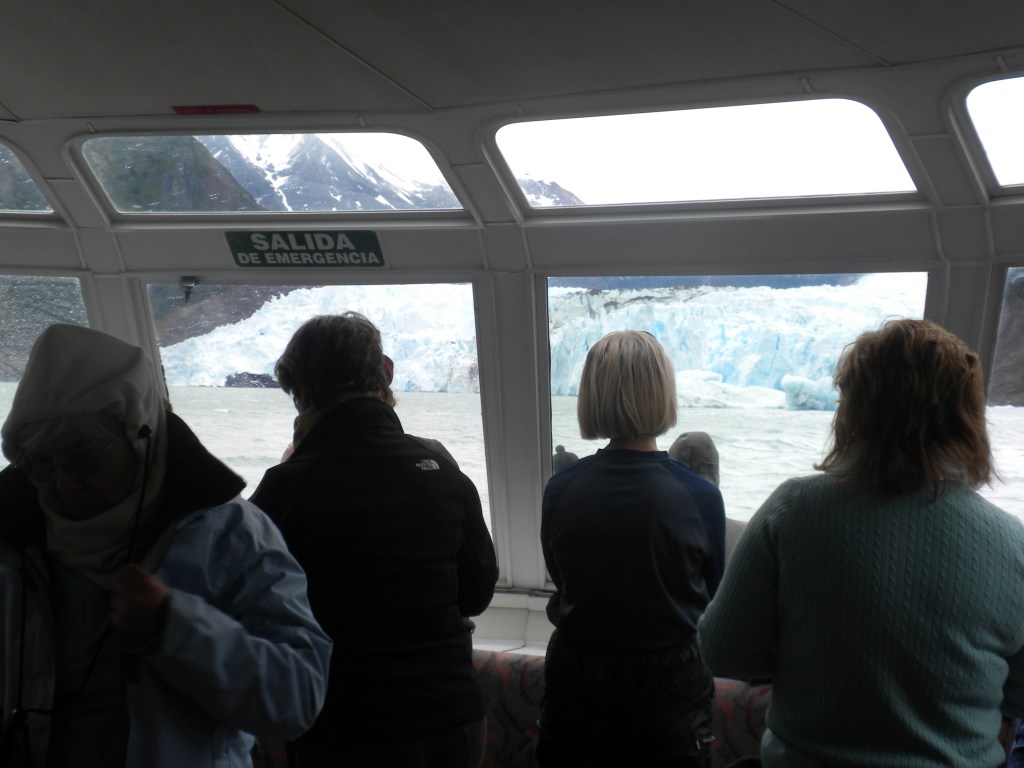
Spegazzini Glacier in Argentina’s Los Glaciares National Park (2011)

As the Earth continues to heat up, I can foresee that more and more tourists will try to see fewer and fewer glaciers. Martine and I have been atop Canada’s Athabasca Glacier in Alberta and in Southern Argentina we have visited the Perito Moreno, Spegazzini, and Upsala Glaciers. By myself, I have ridden a Ski-Doo on Iceland’s giant Vatnajökull Glacier. I hope I can rustle up enough cash to go with Martine to visit the most spectacular glaciers in the U.S., all of which are in Alaska.

It is amazing to think that, at one time, glaciers covered much of the lower forty-eight states and most of Canada, as shown in the following map:

It is possible that in the lives of your children, or of your children’s children, the glaciers will no longer be around. Not only that, but parts of the U.S. coast will be under water, particularly Florida. And as the ocean levels continue to rise, I would not be surprised that some of the most beautiful beaches in the world will disappear under water.

I remember my visit to Iceland in 2001. I stayed at a hotel on the edges of Skaftafell National Park. I walked on a trail as close as I could get to Skaftafell Glacier. As I neared the front edge of the glacier, I saw numerous pools of water and heard a groaning sound as the glacier pushed forward millimeter by millimeter. It was an awe-inspiring experience.

See it while you can.

Ushuaia

Looking Up Rivadavia

Ushuaia, Argentina is the southernmost city on Earth. There is one town which is further south by a few miles: Puerto Williams, Chile, which is mostly a Chilean naval base. I have never been to Puerto Williams, but I did pass by it on a boat ride on the Beagle Channel to Estancia Harberton. Below is as close as I could get to Puerto Williams without going through Chilean customs:

Puerto Williams from the Beagle Channel

The whole Tierra Del Fuego area, both in Argentina and Chile, is endlessly fascinating. That’s where the Andes comes to an end, sputtering out by Ushuaia and the Dientes de Navarino in Chile. In the above picture, thee are high mountains behind Puerto Williams that are mostly hidden in cloud, though you could make out the rough outline of their summits.

Mark Twain once wrote, “If you don’t like the weather in New England, wait a few minutes.” That is even more true of Tierra Del Fuego. After all, my last day in Ushuaia in 2006 (it was November 15 to be exact), dawned fair and turned into a blizzard. You may say, “Well, it was November, after all!” We were, however, in the Southern Hemisphere, so it was supposed to be like May in the Northern Hemisphere. The truth is, it can snow on any day of the year in Ushuaia.

There are compensations. The cuisine includes king crab (centolla), which is widely available at reasonable prices. The city is chock full of museums, most prominently the so-called Maritime Museum, which was built as a prison to house Argentina’s most dangerous criminals, including Simon Radowitzky, the anarchist responsible for killing a ranking police officer. Ushuaia was for many years Argentina’s Alcatraz.

Ushuaia was where I broke my shoulder in a blizzard. (That’s why I remember November 15, 2006.) The location was the corner of Magallanes and Rivadavia, where I slipped on ice and fell hard with my shoulder on a high curb. They have since put up a traffic signal there, so it is easier to cross the road.

In Patagonia

Guanacos by the Fitzroy Massif

Of all the places I have visited on my travels, I think the most spectacular was Argentinian Patagonia from El Chaltén south to Tierra del Fuego. Twice I have traveled that route, once in 2006 (when I had my trip cut short by a broken shoulder) and once in 2011 with Martine. Although both my finances and remaining years are dwindling, I would like to take another stab at it.

I would like to fly into Ushuaia and take buses north all the way to Buenos Aires. To my right would be the South Atlantic and to my left the windy plains of Patagonia with glimpses of the Andes in the distance.

Argentina is not a destination beloved by North American travelers. The country is full of mostly Spanish-speaking Italians with pockets of Welsh and Croatians. Its main export used to be wool centered in large estancias held by British landowners, but it has become more diversified over time, especially with oil being discovered there.

Near El Calafate there are numerous glaciers originating on the eastern slope of the Andes. Martine and I visited the Perito Moreno, Upsala, and Spegazzini glaciers. As the world warms up, many of these glaciers will not be around for the next generation. But it was nice seeing them while we could.