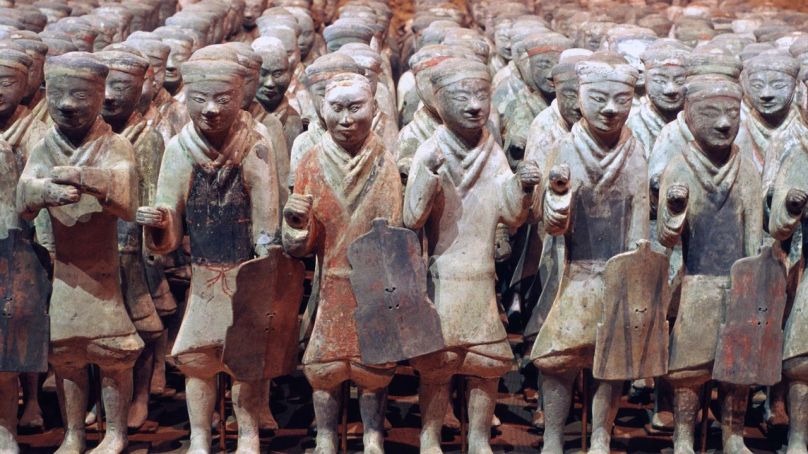
Chinese Soldiers Around Time of Tu Fu (8th Century)
Two of the greatest poets who have ever lived are Li Po and Tu Fu (a.k.a. Du Fu), who not only lived around the same time in China but who knew each other. Here is a heartbreaking poem by Tu Fu about coming back home after the wars to find his home has changed irrevocably.
A Homeless Man’s Departure
After the Rebellion of 755, all was silent wasteland, gardens and cottages turned to grass and thorns. My village had over a hundred households, but the chaotic world scattered them east and west. No information about the survivors; the dead are dust and mud. I, a humble soldier, was defeated in battle. I ran back home to look for old roads and walked a long time through the empty lanes. The sun was thin, the air tragic and dismal. I met only foxes and raccoons, their hair on end as they snarled in rage. Who remains in my neighborhood? One or two old widows. A returning bird loves its old branches, how could I give up this poor nest? In spring I carry my hoe all alone, yet still water the land at sunset. The county governor’s clerk heard I’d returned and summoned me to practice the war-drum. This military service won’t take me from my state. I look around and have no one to worry about. It’s just me alone and the journey is short, but I will end up lost if I travel too far. Since my village has been washed away, near or far makes no difference. I will forever feel pain for my long-sick mother. I abandoned her in this valley five years ago. She gave birth to me, yet I could not help her. We cry sour sobs till our lives end. In my life I have no family to say farewell to, so how can I be called a human being?
Although the Chinese language is a formidable obstacle to understanding the poetry written in it, there are some Chinese poets whose thoughts nonetheless ring clear. Such is Du Fu (aka Tu Fu), who wrote some thirteen hundred years ago. The name of the poem in today’s blog is:
Restless Night
As bamboo chill drifts into the bedroom, Moonlight fills every corner of our Garden. Heavy dew beads and trickles. Stars suddenly there, sparse, next aren’t.
Fireflies in dark flight flash. Waking Waterbirds begin calling, one to another. All things caught between shield and sword, All grief empty, the clear night passes.
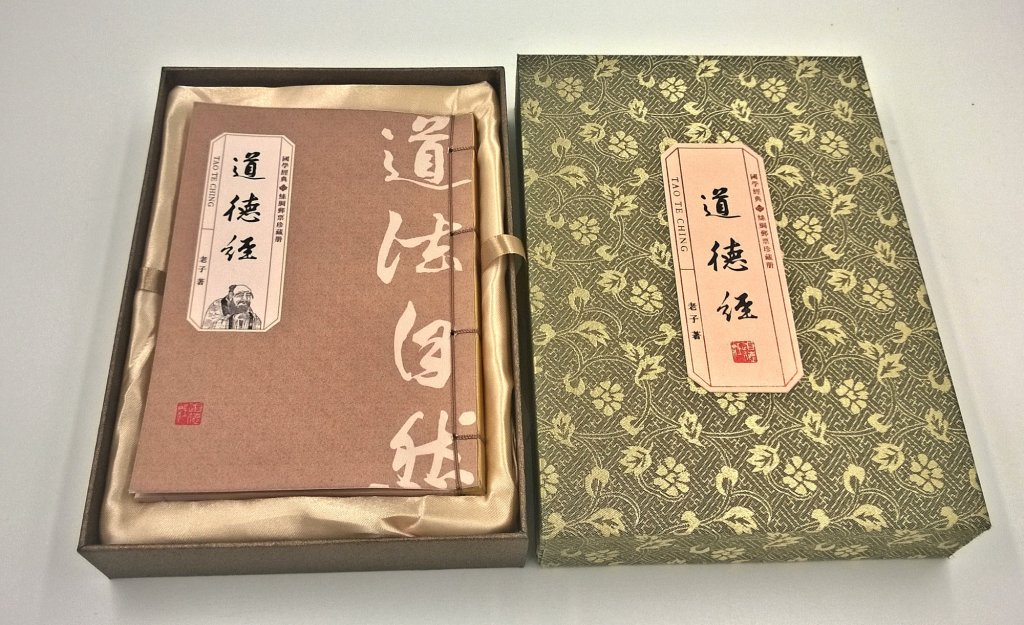
The Taoist sage Lao Tzu (floruit BCE 500), author of the Tao Te Ching, is one of those figures at the nexus of three great religions: Taoism, Buddhism, and Confucianism. Below is Sam Hamill’s translation of the second section of the Tao Te Ching, as printed in the Shambala Library edition of The Poetry of Zen:
Beauty and ugliness have one origin. Name beauty, and ugliness is. Recognizing virtue recognizes evil.
Is and is not produce one another. The difficult is born in the easy, long is defined by short, the high by the low. Instrument and voice achieve one harmony. Before and after have places.
That is why the sage can act without effort and teach without words, nurture things without possessing them, and accomplish things without expecting merit:
only one who makes no attempt to possess it cannot lose it.
Du Fu (aka Tu Fu) was born in AD 712 and died in 770. The following poem is from Kenneth Rexroth’s One Hundred Poems from the Chinese. It is a great favorite of mine.
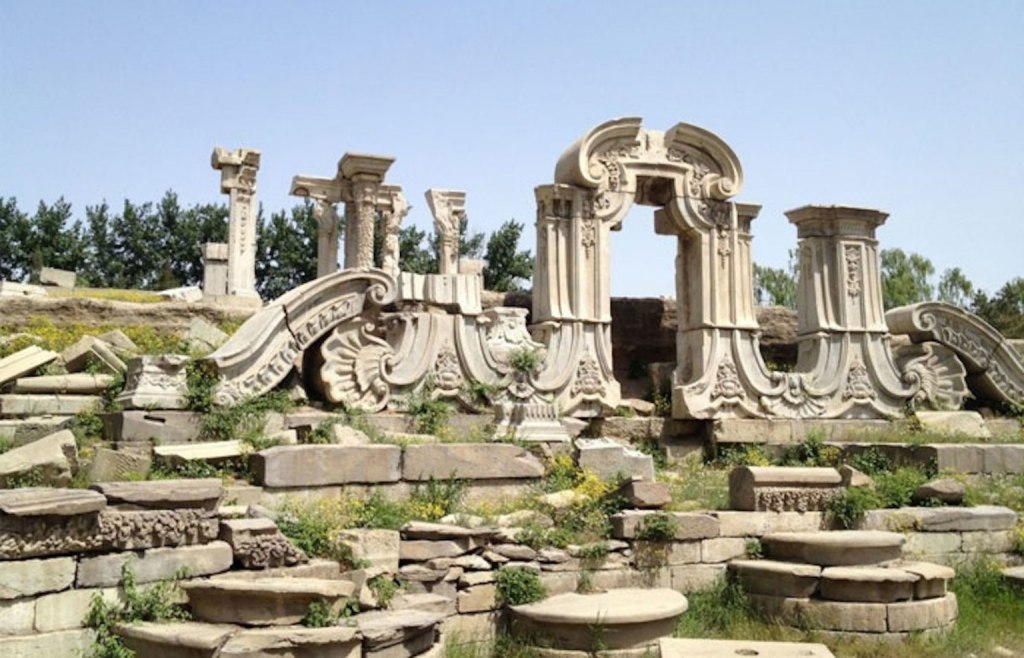
Jade Flower Palace
The stream swirls. The wind moans in The pines. Grey rats scurry over Broken tiles. What prince, long ago, Built this palace, standing in Ruins beside the cliffs? There are Green ghost fires in the black rooms. The shattered pavements are all Washed away. Ten thousand organ Pipes whistle and roar. The storm Scatters the red autumn leaves. His dancing girls are yellow dust. Their painted cheeks have crumbled Away. His gold chariots And courtiers are gone. Only A stone horse is left of his Glory. I sit on the grass and Start a poem, but the pathos of It overcomes me. The future Slips imperceptibly away. Who can say what the years will bring?
This short tale by Jorge Luis Borges (1899-1986) is, to my mind, the most incredible tale ever told about the power of poetry. It is told here in its entirety. It and many equally wonderful poems and stories can be found in Dreamtigers (in Spanish, El Hacedor).
That day, the Yellow Emperor showed the poet his palace. They left behind, in long succession, the first terraces on the west which descend, like the steps of an almost measureless amphitheater, to a paradise or garden whose metal mirrors and intricate juniper hedges already prefigured the labyrinth. They lost themselves in it, gaily at first, as if condescending to play a game, but afterwards not without misgiving, for its straight avenues were subject to a curvature, ever so slight, but continuous (and secretly those avenues were circles). Toward midnight observation of the planets and the opportune sacrifice of a turtle permitted them to extricate themselves from that seemingly bewitched region, but not from the sense of being lost, for this accompanied them to the end. Foyers and patios and libraries they traversed then, and a hexagonal room with a clepsydra, and one morning from a tower they descried a stone man, whom they then lost sight of forever. Many shining rivers did they cross in sandalwood canoes, or a single river many times. The imperial retinue would pass and people would prostrate themselves. But one day they put in on an island where someone did not do it, because he had never seen the Son of Heaven, and the executioner had to decapitate him. Black heads of hair and black dances and complicated golden masks did their eyes indifferently behold; the real and the dreamed became one, or rather reality was one of dream’s configurations. It seemed impossible that earth were anything but gardens, pools, architectures, and splendrous forms. Every hundred paces a tower cleft the air; to the eye their color was identical, yet the first of all was yellow, and the last, scarlet, so delicate were the gradations and so long the series.
It was at the foot of the next-to-last tower that the poet—who was as if untouched by the wonders that amazed the rest—recited the brief composition we find today indissolubly linked to his name and which, as the more elegant historians have it, gave him immortality and death. The text has been lost. There are some who contend it consisted of a single line; others say it was a single word. The truth, the incredible truth, is that in the poem stood the enormous palace, entire and minutely detailed, with each illustrious porcelain and every sketch on every porcelain and the shadows and the light of the twilights and each unhappy or joyous moment of the glorious dynasties of mortals, gods, and dragons who had dwelled in it from the interminable past. All fell silent, but the Emperor exclaimed, “You have robbed me of my palace!” And the executioner’s iron sword cut the poet down.
Others tell the story differently. There cannot be any two things alike in the world; the poet, they say, had only to utter the poem to make the palace disappear, as if abolished and blown to bits by the final syllable. Such legends, of course, amount to no more than literary fiction. The poet was a slave of the Emperor and as such he died. His composition sank into oblivion and his descendants still seek, nor will they find, the one word that contains the universe.
My brother and I are well-known fire-eaters. Most of the meals I prepare for myself (but not Martine!) are off the charts when it comes to hotness for most of my friends.
It all started when I went on my first vacation to Mexico in 1975 and discovered El Diablito Chile Habanero. There I was in a hot country with smoke pouring out of my ears—and loving every minute of it! After discovering Marie Sharp’s Chile Habanero from Dangriga, Belize in 2019, I thought I had the perfect picante sauce.
Then my brother introduced me to Fly by Jing Sichuan Chili Crisp (illustrated above), which not only has the perfect burn but actually adds flavor. In the last few weeks, I have experimented with Spanish Rice and Spanish Barley, both seasoned with Fly by Jing. Not only was I sold, but I ordered a couple more bottles from Amazon for when my first bottle goes empty (which should be in about a week).
Interestingly, the chili crisps are made with Chinese ingredients originating in Chengdu by a Chinese-American living in Los Angeles. Her name, BTW, is Jing.
“What is success? It is a toy balloon among children armed with pins”
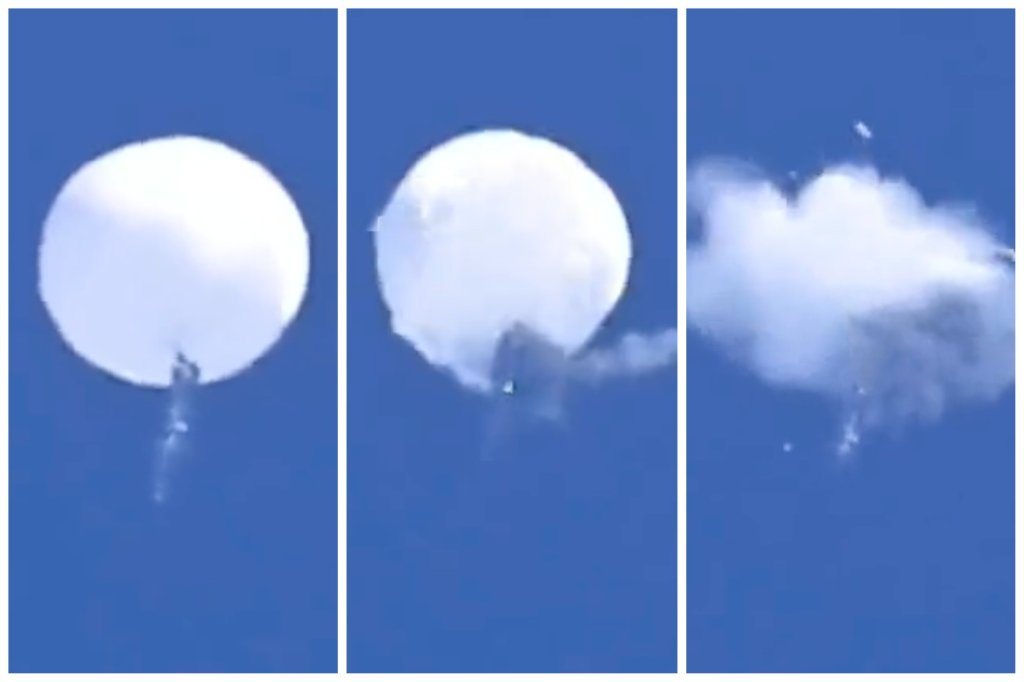
In the last few days, U.S. jet fighters have intercepted four balloons and popped them. Although the military has not officially admitted it, all four appear to be balloons equipped with electronics for spying. It is possible that we will never know, as what they manage to find is probably a military secret.
President Biden’s decision to bring these devices down is in sharp contrast to Trump, who let three or four such devices float over the U.S. during his régime without bringing it to anyone’s attention. Typically, he was full of anti-Chinese bluster—bluster, that did not translate into action.
We know that the Chinese have launched a number of spy satellites. Why, I wonder, did they feel it was necessary to supplement their findings with such a low-tech device as a balloon? Is it possible that their spy satellites did not produce satisfactory information? Were the Chinese balloons self-propelled? Or did they just drift any which where at the mercy of the winds? I doubt we’ll ever know.
Soldiers of People’s Liberation Army (PLA) march in formation during the military parade marking the 70th founding anniversary of People’s Republic of China, on its National Day in Beijing, China October 1, 2019. REUTERS/Thomas Peter
It is fashionable in the United States to overestimate the Chinese as an international aggressor. Since its involvement in Korea some seventy years ago, China’s Peoples’ Liberation Army (PLA) has not acquitted itself particularly well:
In 1962, there was a border dispute with India which did not involve air or naval forces, in which the three PLA regiments occupied an area in the Himalayas known as Aksai Chin.
In 1967, China attempted to invade Sikkim, just east of Nepal, but were driven back by Indian troops.
In 1979, China invaded North Viet Nam (which was allied with Russia) and lost heavily to battle-hardened Viet troops under Võ Nguyên Giáp.
Recently, China has occupied various uninhabited rocks in the South China Sea, which are in danger of being inundated by tsunamis common in the area due to volcanic activity.
It has been much more common for the PLA to be involved in the suppression of minority populations in south and western China.
So although the PLA on paper is powerful, it has no real history of success in battle. Although I am not in favor of pooh-poohing them as a threat, I think we tend to go too far in the opposite direction.
I must admit, however, that the PLA wins hands down on the parade ground.
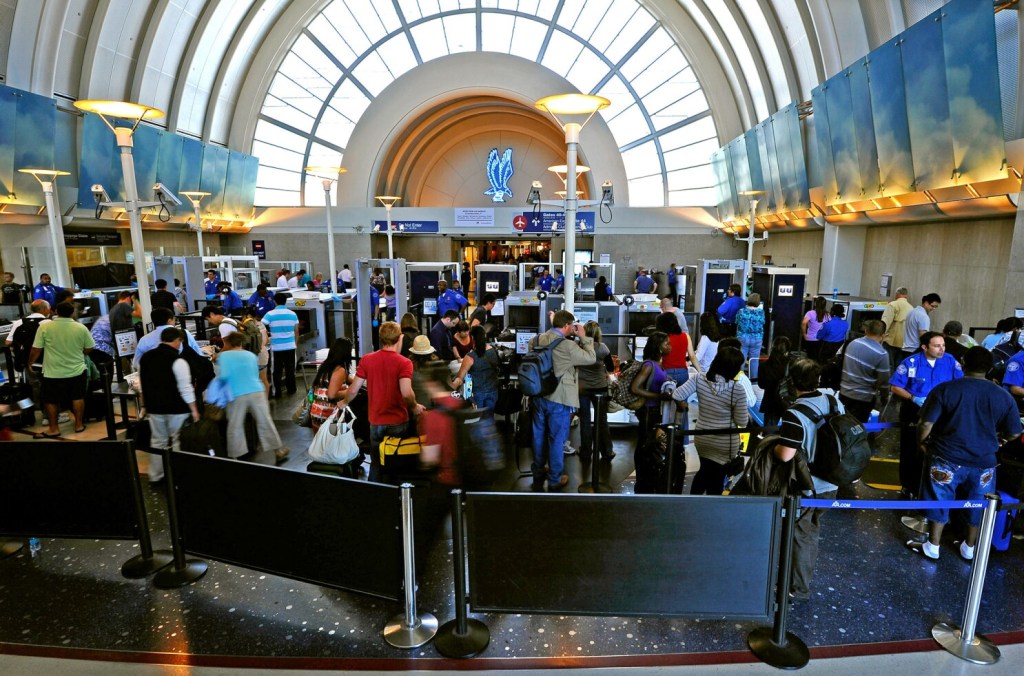
It was the night of January 14, 2020. I was scheduled to take a flight on Volaris to Guadalajara, Mexico, and then on to Mérida in Yucatán. The Tom Bradley International Terminal at LAX was crowded with Chinese returning to their country. Most of the flights were to Beijing, Shanghai, Wuhan, and other major cities on the Chinese mainland. My Mexico flight was one of the few in the wee hours of the morning that was to a Western Hemisphere destination.
A month earlier, on December 1, 2019, a patient was admitted to a hospital in Wuhan in Hubei Province, China, with a strange case of pneumonia. I didn’t know anything about the official Chinese coverup of the disease until around January 24, when I was staying at the Hotel Lopez in Campeche, where I had access to the Al Jazeera news channel in English on my TV. The whole time I stayed there, the news was filled with pictures of Chinese healthcare personnel in hazmat suits. There were just then beginning to be cases of the unknown disease in the United States, Japan, Thailand, South Korea, Viet Nam, Taiwan, and Nepal.
By the time I returned to the United States on February 7, mass quarantines were in effect in various countries around the globe. A month later, in the middle of March, Martine and I attended a Hungarian folk dance performance of Kárpátok before submitting ourselves to the lockdown the next day.
There is an interesting chronology of the first days of the Covid-19 outbreak available by clicking here. Fortunately, we managed to avoid getting the disease; and my fingers are crossed that we never will.
If you read Martha Gellhorn’s Travels with Myself and Another: A Memoir, you should probably start with the penultimate chapter entitled “What Bores Whom?” In it, she muses about a large group of hippies staying at her hotel in Eilath, Israel’s port on the Gulf of Aqaba. The gilded youth were mostly strung out on hash, and their conversation was mostly about how so-and-so was squashed out of his or her gourd. And then, quite suddenly, we get Martha’s thoughts about travel:
Thinking of those kids at Eilath has given me a new slant on horror journeys. They are entirely subjective. Well of course. If I had spent any time analyzing travel, instead of just moving about the world with the vigour of a Mexican jumping bean, I’d have seen that long ago. You define your own horror journey, according to your taste. My definition of what makes a journey wholly or partially horrible is boredom. Add discomfort, fatigue, strain in large amounts to get the purest-quality horror, but the kernel is boredom. I offer that as a universal test of travel, boredom, called by any other name, is why you yearn for the first available transport out.
Travels with Myself and Another gives us four journeys, all of which are quite horrorshow. But they are by no means boring, though I would have given money to have stayed at home. First there was her trip with then-husband Ernest Hemingway to China in the middle of her war with Japan. That was followed up by a boat trip in the Caribbean in 1942, at a time when Nazi U-Boats were sinking hundreds of ships there. The longest chapter is about a solo trip to Africa, starting in Cameroon, stopping in Chad and the Sudan, and finally a jaunt through East Africa in a Land Rover which she drove herself. Finally, there is a short chapter about a visit to Moscow around 1972 to visit Nadezhda Mandelstam, the widow of poet Osip Mandelstam—during which she could not get a single decent meal.
Although all four of her journeys are truly horrible, the author seems to revel in her difficulties. In a way, they make her observe more clearly. And her book is a travel classic despite all the “discomfort, fatigue, strain.”
I think I will read some of her war correspondence next to see how she regards travel when she is being fired upon.






 Tarnmoor
You must be logged in to post a comment.