Mindalae – A Museum of Ecuadorian Handicrafts

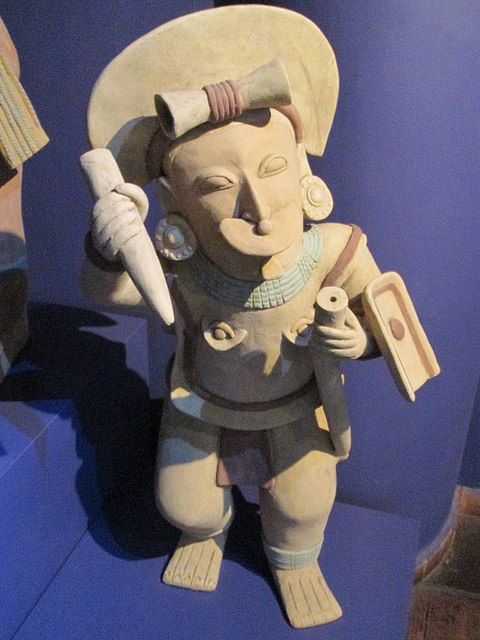
Ceramic Snake

My brother and I were staying on La Niña in the tourist suburb of Mariscal at the Viejo Cuba. On our first day in Ecuador, we were tired out by the 9,000 foot (3,000 meter) altitude, but we had a few hours before vegging out for the night. Right down the street, at the intersection with Reina Victoria, was a fantastic folk museum called the Mindalae. Both of us were interested in purchasing some folk art: The Mindalae provided a guide to the best of what was produced around the country.

We took the elevator to the top floor and proceeded to walk down looking at the exhibits, many of them based on pre-Columbian originals. Included were ceramics, textiles, ceremonial objects, basketry, and other crafts. Adjoining the museum is a craft store with an excellent selection of items paralleling the exhibits, and offered at a fair price.
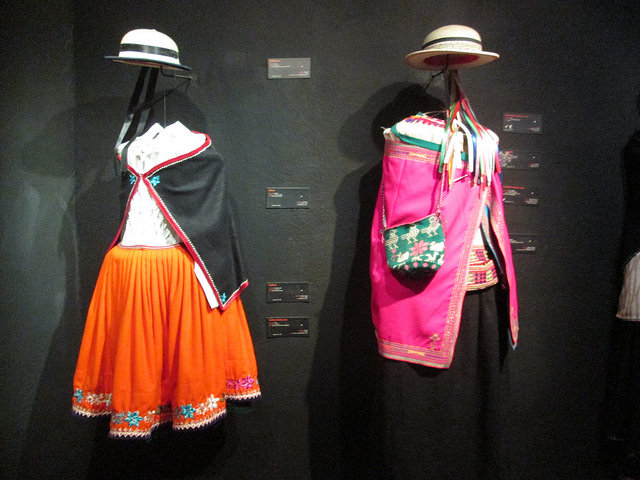
Costumes

The displays at the museum were in both Spanish and English. If you are interested in Andean handicrafts, it is a good idea to visit a museum like the Mindalae before visiting the various local markets. You will have a better idea of what is available in every region of the country.

Dan and I enjoyed the Mindalae so much that, after Dan left to return to the U.S., I visited it a second time.

A Look Back at Ecuador

Native Otavaleños Entering Church

There are few places I have visited to which I would not like to return. I am speaking particularly of my travels in Europe, Canada, Mexico, and South America. There are a fairly large number of cities in the United States that, I hope, will never see my shadow again. On the other hand, there are parts of the U.S., particularly in the Southwest, that I love. New Mexico, for instance. My mouth is watering for those red and green chile peppers, the best in the world.

Last year at this time, I was planning for the trip that my brother and I took to Ecuador. I loved the places that we chose to visit, particularly Quito, Otavalo, Mindo, and Cuenca. The only problem was that traveling by automobile through the larger Ecuadoran cities required the tracking skills of a scout: Street signs around the periphery of every city were practically nonexistent. We finally got into the habit of following what looked to us like intercity buses, which were pretty easy to distinguish from the local rat-traps.

Otavalo was perhaps my favorite place. That was mostly because the inhabitants were mostly Otavaleños. Gringos stood out like sore thumbs. That’s okay, because sometimes it’s fun to be lost in a crowd of indigenous people, even if they didn’t speak a word of Spanish. (Their language was mostly Quechua.) Just taking a walk through their marketplace was like being in another world.

My problem is a simple one. If I were to go back to all the places I loved, I would be alive for several more decades—and no man knows how much time is left to him.

The Fashion Police

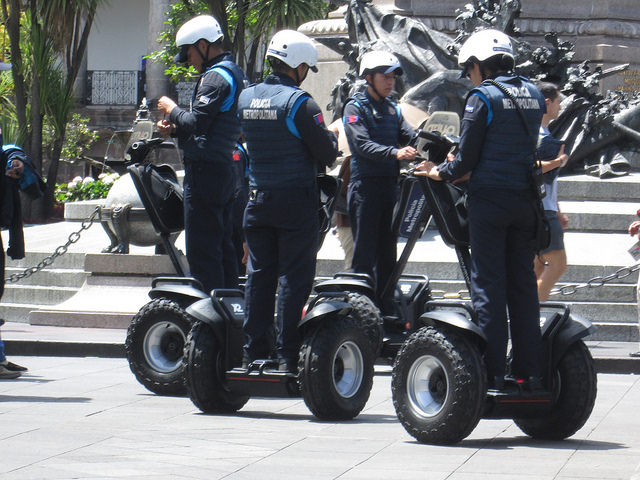
In Quito, There Are Many Types of Police

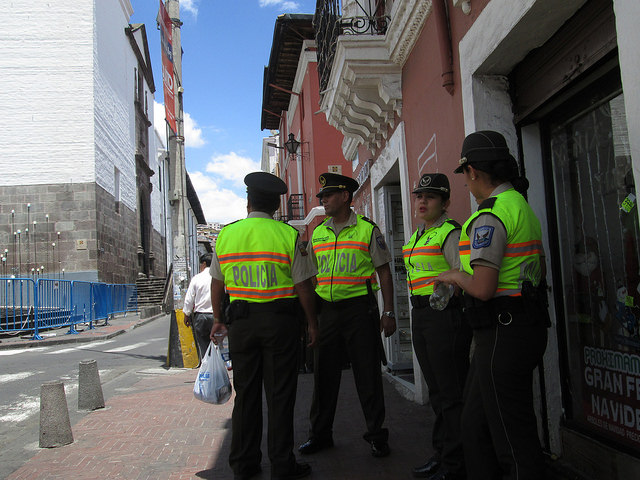
One thing that my brother and I noticed when we were in Quito, Ecuador, last October was that there are many different types of police. We sat in the central Plaza de Independencia for upwards of two hours, watching the different types of police congregate and go their separate ways, only to be replaced by policia with different uniforms and different means of locomotion. We were particular amused by the Segway patrol that mostly wheeled around chatting with one another.

At one point, as we were going by in a taxi, we noticed a number of heavily armed military escorting several male and female officers into the Municipal Palace. They seem to have arrived there without any major mishaps, like having a Segway run over their feet.

Just a few blocks away, there were four cops with bright yellow vests.

These Police Seemed to Be Guarding a Church (Rear Left)

All I could guess is that the creation of different government security forces was a form of mitigating the unemployment problem that seems to be endemic throughout South America.

Several times, we asked the police for directions. They were always very polite, even if they didn’t understand us. Fortunately, we didn’t look like bad guys; else, we would have been mobbed by policia wearing a variety of different uniforms. (It would have given them something to do for a change.)

Unfinished Business

Accordion Player in Downtown Buenos Aires

Accordion Player in Downtown Buenos Aires

I always say I have unfinished business with the people, places, and things that I love. Take Argentina, for instance. I have been there in 2006, 2011, and 2015. The first time, I broke my shoulder by slipping on the ice in Tierra Del Fuego; the second time (the best), I went with Martine and saw a good chunk of the Patagonia; the third time was mostly just fill-in, with visits to Iguazu Falls and Sar Carlos Bariloche. But I am by no means finished with Argentina, nor Argentina with me.

There is a broad stretch of the South Atlantic I’d love to see between Rio Gallegos and Carmen de Patagones. I would not mind taking long bus rides to God-forsaken ports like Puerto San Julian, Puerto Deseado, Caleta Olivia, Comodoro Rivadavia, and Bahia Blanca. I don’t even care if there aren’t that many notable tourist sights. I could easily put up with some slow time, especially as I would have two Kindle readers with me, and some 3,000 different titles to read. At my side will be my pocket digital rangefinder camera to catch people and places in the process of being something special.

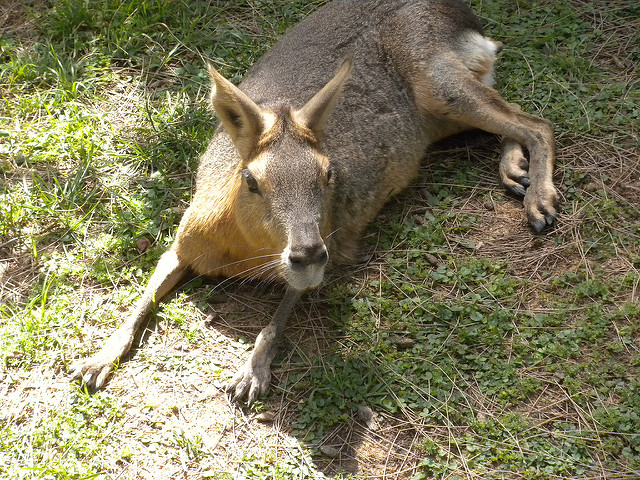
Guanaco in the Buenos Aires Zoo

Guanaco in the Buenos Aires Zoo

Argentina isn’t the only place I’d like to see again. I wouldn’t mind spending more time at the English Bookshop in Quito, Ecuador. And Iceland will continue to be a lifelong love of mine. I only wish I could get Martine to come with me. She has some idea that she would have to dress like an Eskimo amid huge snowdrifts. Far from it! Iceland will be one of the few countries to benefit from global warming. My favorite destinations in Europe are on hold for now, because I suspect that mass immigration will change that continent forever. I also want to see more of the American Southwest, and Martine and I are planning one such trip right now that will take up large swaths of New Mexico, Colorado, and possibly Utah.

As Lao Tzu wrote, “From wonder, into wonder, existence opens.”


Standing on the Equator

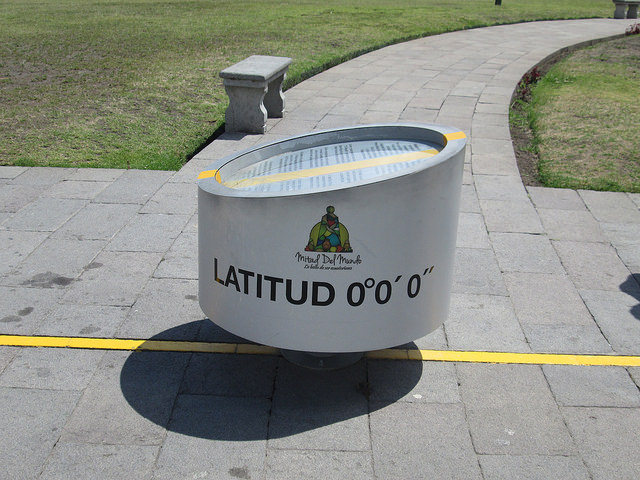
At the Mitad del Mundo

At the Mitad del Mundo

That yellow painted line is supposed to be the Equator. But actually, according to computer measurements, the actual Equator is about 240 meters north of the line. Not that it matters: That woman in the lower half of the picture who is straddling the yellow line thinks she is getting some of the Middle of the Earth mojo—but she probably isn’t. Dan and I didn’t bother pacing out the 240 meters to the real Equator, because we would have fallen into a volcanic crater to our deaths. And some things just are not worth sacrificing oneself for!

Ecuador created a nice museum and restaurant complex at what it calls the Mitad del Mundo, which takes the sting out of the slightly misplaced line. The only problem we had was getting there in our rental car. Fortunately, there is a Mitad del Mundo bus line. We just followed the buses until we actually met up with a helpful road sign, of which there are probably not more than a dozen in the whole country.

Close Enough for Government Work

Close Enough for Government Work

There is nothing in Ecuador to compare with the tourist éclat of Machu Picchu in Peru. So the Mitad del Mundo will have to do. Fortunately, it’s not half bad.

Going Whole Hog

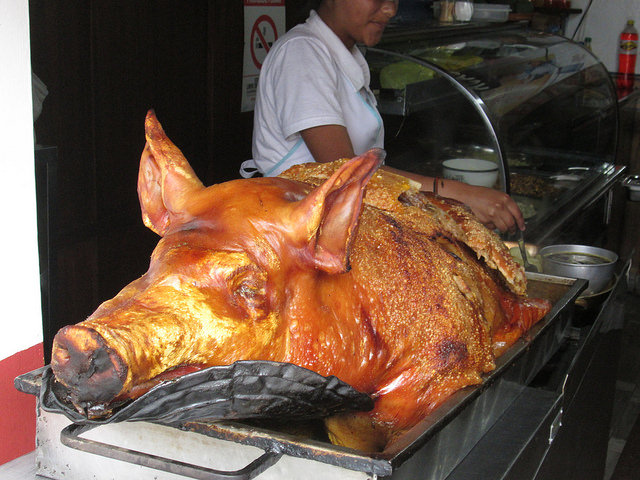
Go Ahead, Pig Out!

Go Ahead, Pig Out!

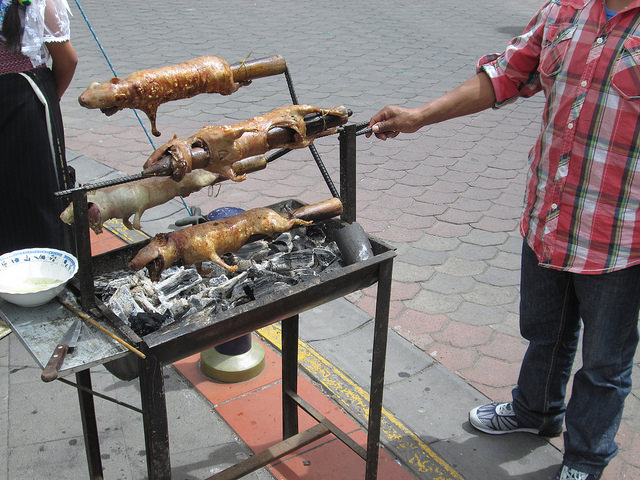
Dan and I were in Otavalo, two hours north of Quito. Famous for its textile and other handicrafts, the town of some 90,000 inhabitants is also famous for fiestas. In addition to the Ecuadoran equivalent of carnitas (shown above), there are other local meat specialties, such as cuy, or guinea pigs (shown below). In both Peru and Ecuador, I have seen paintings in cathedrals of the Last Supper in which Christ and his apostles were dining on cuy. (I’ll try to post one of them at some point in the future.)

Cooking Cuy, or Guinea Pigs

Cooking Cuy, or Guinea Pigs

Dan resolved to try some cuy, but I guess he didn’t have the heart for it. I guess it reminded him too much of the hamster named Mutzi that we had as a pet when we were kids. Also, they are famous for their paucity of meat combined with a plethora of tiny bones.

Latin American Churches

Altar of Quito’s La Compañía de Jesús Church

Altar of Quito’s La Compañía de Jesús Church

In my posting the other day on Why Did I Go to Ecuador?, I seem to have left out one of the main reasons. This applies equally to Peru and probably Colombia, but not so much to Argentina, Chile, and Uruguay.

I am referring to the Catholic cathedrals, basilicas, and other old churches of the Andes. Until age 17, I received a Catholic education at St. Henry School in Cleveland and Chanel High School in Bedford, Ohio. Then, while I was at Dartmouth, although a nominally Congregationalist school, I was very active with the Catholic Students’ Newman Club.

Coming to California has been disastrous to my faith—but yet something remains. It comes out when I visit the Andean churches, the most beautiful of which is La Compañía de Jesús church (shown above) near Quito’s Plaza de la Independencia.

In both Peru and Ecuador, I frequently stopped in at the local churches; and, not infrequently, I stayed for the services. In the Andes, I felt like a Catholic again. Even the smaller churches in places like Otávalo, Alausi, and Mindo drew me in.

The Small Church in the Village of Mindo

The Small Church in the Village of Mindo

In my life’s journey, I can see my returning to the Catholic Church. I continue to take exceptions to many points of dogma, such as the prohibitions on married priests, women in the priesthood, abortion, and divorce and some doctrines such as the relatively recent ones of the Immaculate Conception and what I call Papal Inflammability. On he other hand, there is much to admire. At this point, I am not sure which route I will take.

It’s OK To Be a Fool!

When in Doubt, Use All Means To Communicate—Even If It Makes You Look Like a Fool

When in Doubt, Use All Means To Communicate—Even If It Makes You Look Like a Fool

I never took Spanish in school, so most of my knowledge of the language comes from an old Berlits Latin American Spanish phrase book. I’m pretty good at getting a place to stay, and even better at ordering a meal. What I cannot do is engage in a conversation. I will try gamely, but my Rule #1 is never ever get flustered.

Once you get flustered, the person who is talking to you will think that you are being a rude dickhead for no earthly reason. It is far better to look stupid and try patiently with your limited repertoire, including hand gestures and even written notes.

At the bus station in Cuenca, I tried hard to buy a ticket for a ride to Alausi. Although the signs on the booth indicated that Patria buses stopped there, the lady refused to sell me a ticket there. Instead she went into a long explanation which I didn’t understand. Finally, I bought a ticket instead to Riobamba, which was a major stop on the line, albeit past Alausi. I figured I could get off the bus near enough to Alausi to get there by other means—at worst walking a kilometer or two down the hill. (I knew that the buses would not stop in Alausi itself, as it was in a valley below the Pan-American Highway.)

In the end, not only did I have no trouble getting off at the Alausi bus station on the Pan-American Highway (a place called La Estación), but the conductor called a cab for me.

I think what the woman’s long explanation at the Cuenca terminal was all about was that the bus did not go into the town of Cuenca, a fact which I already knew. Although I was out about fifty cents by buying a ticket to Riobamba, everybody was a winner in this transaction.


Why Did I Go to Ecuador?

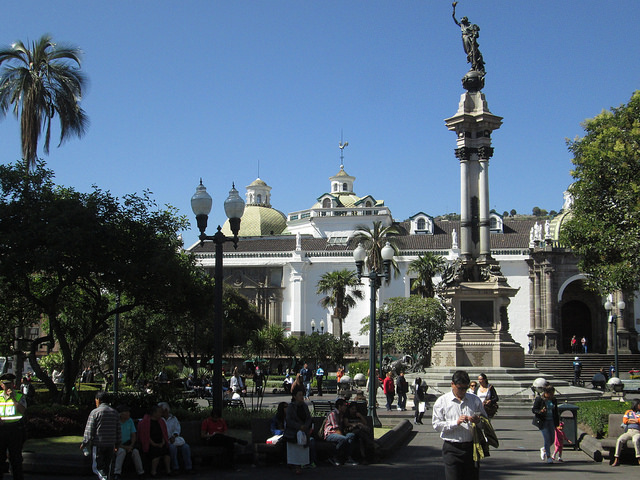
Plaza Independencia in Quito

Plaza de la Independencia in Quito

A reasonable question, one that I have been asked frequently by people who know me. My answers will probably tell you a whole lot more about me than about Ecuador:

  1. I am drawn to South America because it is at one and the same time strangely different, yet not to the extent that I would feel totally at sea. And it has been so neglected by North Americans.
  2. The Andes are incredible. When my brother and I were lost on a road that was not on our map, we suddenly came upon the volcano Chimborazo, which was not only striking in its own right, but surrounded by herds of wild vicuñas. It was a magical moment of the type I keep having in Latin America.
  3. You can always find a bench at a beautiful tree-shaded plaza, get a shoe-shine, and do some world class people watching.
  4. It’s so nice to leave Los Angeles during a heat wave and find oneself in the mountains.
  5. South Americans feel so out of the way of “mainstream civilization” that they tend to be friendly and curious. I keep having interesting conversations with locals who know a little English; when they don’t speak English, I just try to carry on with my poor Spanish.
  6. I have a positive loathing of mosquitoes, so I tend to avoid jungles.
  7. It’s fun to spend the months before vacation time reading up on a culture with which one isn’t familiar.
  8. After standing on the zero meridian at Greenwich Observatory in London, I always wanted to stand on the Equator.
  9. Nobody I know knows anything about Ecuador.
  10. Ever since my visits to Mexico in the 1970s and 1980s, I fell in love with Pre-Columbian art in all its variety.

There’s probably half a dozen more reasons I could come up with, but this’ll do for starters.

Pre-Columbian, Then and Now

A Unique Museum Linking Pre-Columbian Art to the Present Day

A Unique Museum Linking Pre-Columbian Art to the Present Day

There it was, a museum just one block from our hotel in the Mariscal district of Quito. I knew that Dan was interested in seeing and buying Ecuadorian handicrafts, so we decided to pay a visit to the Museo Mindalae, which calls itself an ethno-historical museum of Ecuadorian handicrafts.

It turned out to be a good call. Although we are more than half a millennium away from Christopher Columbus, the peoples of the Andes are still very much in touch in touch with their ancestors. Of course, not only the Spanish, but subsequent rulers encouraged them in this. Today, the Fundación Sinchi Sacha, which runs the museum, not only encourages them, but runs a three-story handicraft store featuring the best of their work at fair prices.

Pre-Columbian or Current?

Pre-Columbian or Current?

I wound up liking the Museum so much that I returned to it the day before leaving Ecuador for the U.S. Both Dan and I bought several pieces of art from the store.

When, subsequently, we saw the crafts markets at Otavalo and Cuenca, we had a good idea what we would find and how much it might cost.