A One-Man Renaissance

Francisco Toledo (1940-2019)

In his book On the Plain of Snakes: A Mexican Journey, Paul Theroux met with Francisco Toledo in Oaxaca shortly before the artist died. I was curious to see images of some of his works because his meeting with Theroux raised my interest.

A Zapotec Indian from Juchitán in the southeast corner of the State of Oaxaca (near the Isthmus of Tehuantepec), Francisco Benjamin López Toledo was a noted painter, sculptor, illustrator, and protestor. When McDonald’s wanted to plant the Golden Arches in the zócalo of Oaxaca, Toledo set up a table offering free tamalitos to passers-by explaining to them the damage that would be done to their culture.

Animal-Headed Woman

When Theroux asked him what he thought of Frida Kahlo, Toledo replied:

I started out hating her. Then later I began to see that she represented something. And outsiders were interested in her. Her life was so complex and painful. So she is something. But there are so many others.

Kahlo is well known to art critics outside of Mexico, along with a handful of other artists such as Orozco, Rivera, Tamayo, and Siqueiro; but Toledo is right that Mexico is fairly crawling with great art. This was brought home to me during my recent trip to Yucatán, when I made a point of visiting art and folk museums.

Illustration: Mythical Creature

To another American visitor, Toledo describes his work:

What I do is a mixture of things, but the pre-Hispanic world has been a source of inspiration. There are certain solutions that are decorative that come from pre-Hispanic art and at the same time there is much primitive art that is refined or simple but also very modern.

They described his work as employing innovative materials, such as sand and amate paper, which was used by pre-Columbian Indians, made with the crushed bark of the amate tree (Ficus insipida, a species of fig).
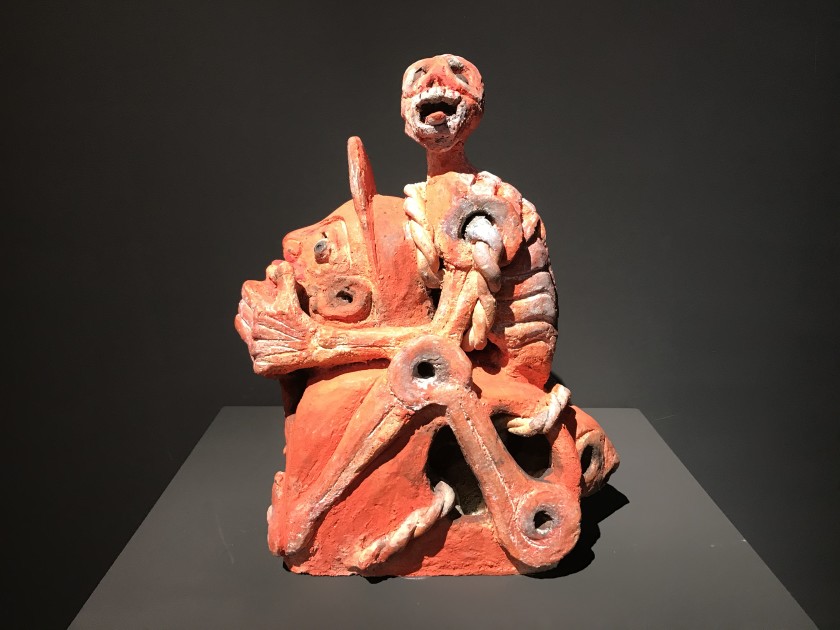
A Ceramic Sculpture Honoring the Disappeared of Mexico

I hope to present the work of other Mexican artists in posts to come.

Todos Somos Calaveras

Statue of Skeletal Woman at Mérida’s Hotel La Piazzetta

At some time in the 1980s—I disremember the year—I was on a long bus ride between Mazatlán and Durango over the mountains. It was November 2, the Day of the Dead, and the bus was crowded with men, women, and children headed toward distant cemeteries with baskets of food. A young mother with a baby and numerous packages sat down next to me taking the aisle seat. I helped her by holding the child or various packages for a while, until she disappeared at some small town to hold a picnic by the grave of one of her loved ones. Was it her husband? her mother? I never knew.

The following quote is from Elizabeth Sayers and Chloe Sayer’s book The Skeleton at the Feast. It throws some light on the feast day:

In Mexico—to quote Ms Sayer—the first and second of November belong to the dead. According to popular belief, the deceased have divine permission to visit friends and relatives on earth and to share the pleasures of the living. To an outsider the celebrations might seem macabre, but in Mexico death is considered a part of life. A familiar presence, it is portrayed with affection and humor by artists and crafts workers. For the Aztec, as for other ancient peoples, death signified not an end but a stage in a constant cycle. Worship of death involved worship of life, while the skull—the symbol of death—was a promise of resurrection…. The death of the individual was seen as a journey, for which numerous offerings were needed. Life is a fleeting moment—a dream—from which death awakens us.

It is all summarized in the Mexican saying “Todos somos calaveras”—“We are all skeletons.” The candy stores are full of confections shaped like skulls and skeletons. All the energy that we Gringos put into Halloween is directed toward La Dia de los Muertos. I suspect that, perhaps, the Mexican holiday is, all told, more healthy than our Halloween.

Ceviche

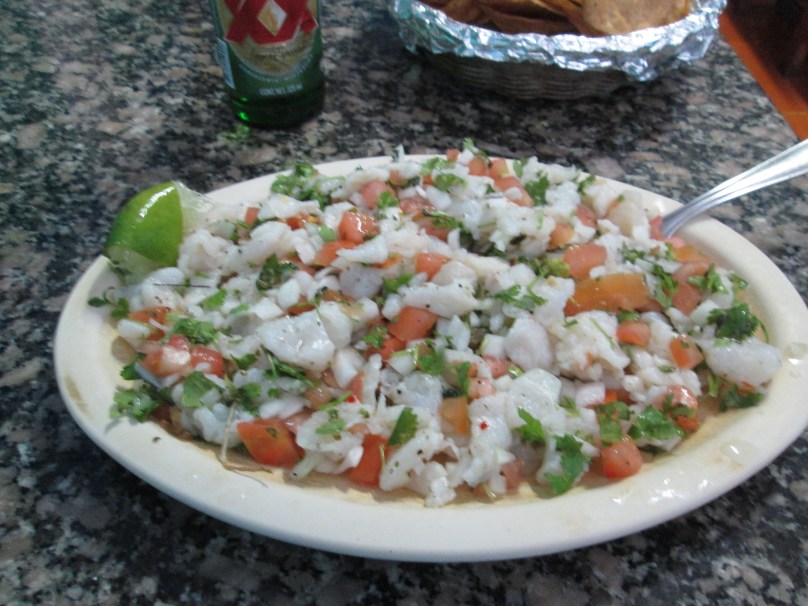
Ceviche de Pescado con Limon

My last meal in Mérida before returning to the U.S. was at a grungy little seafood dive on Calle 62 called the Blue Marlin (Marlin Azul). It was a raw fish dish called ceviche de pescado that is “cooked” with the addition of fresh lime juice. Also it contains cut-up tomatoes, chiles, and cilantro. It is served cold and is an ideal lunch dish.

In Progreso, a few days earlier, I had a ceviche de pulpo made with the same ingredients, except that octopus replaces the fish. I was in hog heaven.

Actually the seafood dish I ate the most in Yucatán this last trip was filete de pescado veracruzana. It was a grilled filet of fish in a tomato sauce with onions, olives, and capers. I never got tired of it, especially when I was near the sea and knew that the fish was super fresh.

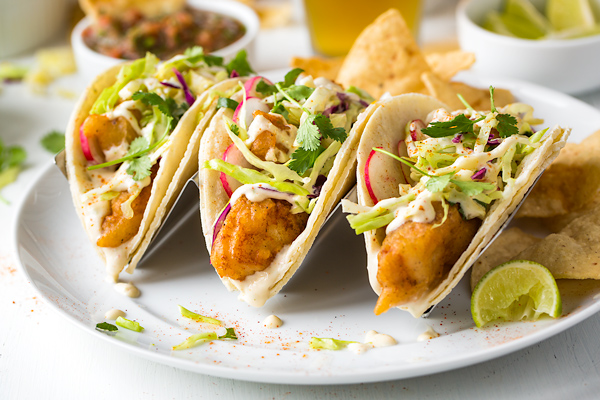
During this awful coronavirus outbreak, I dream of traveling by bus between various seaport cities in Baja California and living on fish tacos and other local specialties.

Baja Style Fish Tacos

When I was growing up in Cleveland, I didn’t think much of fish. Lake Erie, the shallowest of the Great Lakes, was for all intents and purposes a body of water noted for dead fish floating on its surface. I have had some good seafood in Los Angeles, but avoid shrimp and lobster, as I seem to be allergic to them—possibly because of the pollution of the Pacific Ocean around the coast of Southern California.

Traveling to places like Iceland or Mexico where the seafood is so fresh and interesting makes me dream of travel again. Sigh.

House of Horrors

Mummified Corpses in Guanajuato’s Museo de las Momias

In this month of Halloween, I thought I would make mention of the most horrific museum I have ever visited, the Museo de las Momias (that is, Mummies) de Guanajuato.

Imagine to yourself a museum consisting of corpses dug up in a Mexican mining town that have been naturally mummified because of the mineral content of the soil. Many were interred during a cholera epidemic which filled the local cemetery to such an extent that the town had to charge a fee for the right to remain buried. According to Wikipedia:

The human bodies appear to have been disinterred between 1870 and 1958. During that time, a local tax was in place requiring a fee to be paid for “perpetual” burial. Some bodies for which the tax was not paid were disinterred, and some—apparently those in the best condition—were stored in a nearby building. The climate of Guanajuato provides an environment which can lead to a type of natural mummification, although scientific studies later revealed that some bodies had been at least partially embalmed. By the 1900s the mummies began attracting tourists. Cemetery workers began charging people a few pesos to enter the building where bones and mummies were stored.

When I visited Guanajuato in the late 1980s, my introduction to the museum was itself grim: A young father was carrying a child’s coffin on his shoulders to be buried, with no one else in the family following him.

Shades of Edgar Allan Poe: The Wikipedia entry continues with this grim fact:

One of the mummies who was buried alive was Ignacia Aguilar. She suffered from a strange sickness that made her heart appear to stop on several occasions. During one of these incidents, her heart appeared to stop for more than a day. Thinking she had died, her relatives decided to bury her. When her body was disinterred, it was noticed that she was facing down, biting her arm, and that there was a lot of blood in her mouth.

The only way I kept the contents of my stomach under control while I was in the museum was the extent to which I busied myself taking pictures. None of these are in this post, as they have yet to be converted to JPEG files from the Kodachrome slides I was then shooting.

Even a writer like Ray Bradbury had trouble seeing the displays of mummies in the museum:

The experience so wounded and terrified me, I could hardly wait to flee Mexico. I had nightmares about dying and having to remain in the halls of the dead with those propped and wired bodies. In order to purge my terror, instantly, I wrote ‘The Next in Line.’ One of the few times that an experience yielded results almost on the spot.

América Tropical

The Reconstruction of América Tropical in Downtown LA

In the 20th century, Mexico produced three great muralists: José Clemente Orozco, Diego Rivera, and David Alfaro Siqueiros. On other occasions, I have written about the influence on me of the Orozco frescoes at Dartmouth College. Sometimes, I think that my interest in Latin America began in the Reserve Room of Baker Library, where the frescoes were located.

Los Angeles has only a reconstruction of David Alfaro Siqueiros’s América Tropical, which was created in 1932 at its present location on Olvera Street. Unfortunately, Siqueiros’s revolutionary message angered LA business leaders, who had the mural painted over.

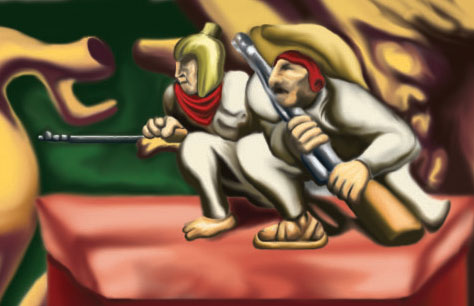
Reconstruction of Detail

Today, the fresco is restored—but, alas, only in black and white. Below is what the original looked like:

The Fresco As It Originally Appeared

It took a quarter century for the Getty Conservation Institute to restore the image which was obliterated by layers of white paint. You can read about it here. When the Covid-19 outbreak comes to an end, you can view the restoration in person.

Returning to Yucatán—After 28 Years

The Plaza Grande in Mérida

The Year 2020 for me began with relief and some elation. The relief because, on the day before I left for Mexico, I had turned 75 and outlived my father, who died at age 74. The elation was because, after 28 years, I was returning to one of my favorite places on Earth. I started coming in 1975, when I was 30, annoying my parents who wanted me to spend all my vacations in Cleveland with them. Then I returned several more times, once during such a fierce heat wave that I had to fly to the mountains of Chiapas for relief. The last time was in 1992, when I came with Martine and three of my co-workers from Urban Decision Systems.

On January 14, I emplaned from LAX to Guadalajara, and after several hours from there to Mérida. No sooner did I step off the plane than I went through a kind of manic shock of recognition. I took a taxi to the Hotel La Piazzetta at Parque de la Mejorada, where I had a simple, clean, and comfortable room. (As with most of my accommodations, particularly at the beginning of a trip, I had reserved in advance.)

My Table and Chairs at the Hotel La Piazzetta

Although I arrived at the airport in Mérida around noon, I didn’t do anything special except walk around the city endlessly (developing a nasty blister) and having a spectacular lunch at the Chaya Restaurant on Calle 59 (whose dining room is shown below). I ordered a meal of Panuchos, fruit juice with chaya (also known as tree spinach), and flan, which is called queso napoletano in Yucatán.

The Dining Room at the Chaya Restaurant in Mérida

My vacation was to last three and a half weeks and take me all around the States of Yucatán and Campeche. I visited many of the great Maya ruins I had seen on previous trips, plus Edzna and Ek Balam. Would I go back? Yes, in a heartbeat.

However miserable this whole coronavirus quarantine is, my year started with a spectacular vacation that lifted my spirits so high that, more than six months later, I am still not back to ground level. That’s only one of the things travel can do for one.

Deatinations: Baja

Suddenly, in My Quarantined Stupor, Baja California Looked Better and Better

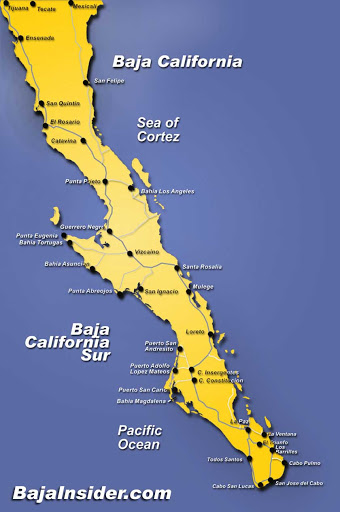
Next to my seat at the kitchen table sits a stack of Lonely Planet and Moon travel guides. Of late, the top volume in the stack has been the Moon Baja guide. I have nibbled at the edges of the 775-mile (1,274 km) peninsula several times: once to Cabo San Lucas for several days, once to Ensenada for three days, once to Tijuana on a day trip, and once to Mexicali.

What begins to interest me of late is a drive on Mexica Route 1 from Tijuana all the way to Cabo San Lucas. If I went by bus, it would be a 24-hour ride. If I went by car, it would be much longer, because there are a number of towns along the way at which I’d like to stop for several days, and a number of side trips to the old Jesuit missions which are the Mexican equivalent of the Serra’s missions in my State of (Alta) California.

Mapa of the Baja California Peninsula

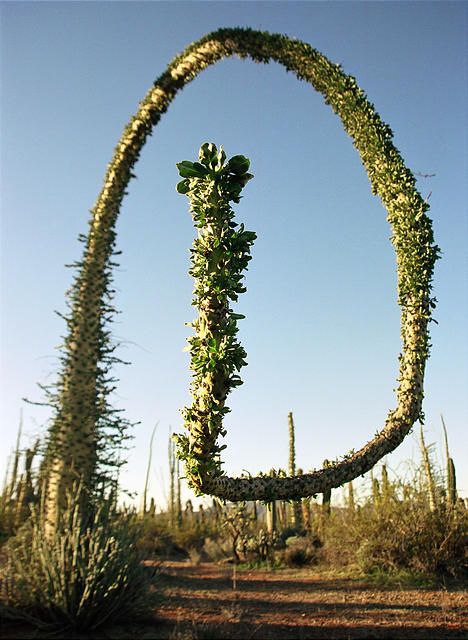
I am not much of a beach person, but I do love the desert—but never during the heat of summer. I see myself visiting missions, Indian cave paintings, taking pangas to se the Grey Whales, eating fish tacos and drinking good Mexican beer. I want to see the desert full of strange Boojum Trees (Fouquieria columnaris), which look as if they could have been invented by Dr. Seuss.

Paging Dr. Seuss

The damnable thing is that Baja is so close to Los Angeles. It would take me maybe three hours to drive to the border. I would prefer to rent a car, but I don’t like the idea of driving from TJ to Los Cabos and back again. I’ll have to see if some special arrangement could be made for me to fly back after dropping the car off.

Well, it’s maybe just a pipe dream; but it could happen.


Pining for the Pyramids

Maya King at Mérida Anthropology and History Museum

With the continuing bad news of the continuing ravages of the coronavirus, I begin to wonder whether I will ever again be able to travel. Of the countries that have encountered the virus, the United States has perhaps been the one nation whose people have been most incompetent at surviving. It doesn’t help that our national leadership seems to be intent on running up the totals of people infected and killed by the virus. I become increasingly furious at people who act as if Covid-19 didn’t exist.

My friend Peter tells me of seeing a wedding rehearsal at a park in San Pedro consisting of some two hundred people, none of whom were wearing face masks. Using the plague’s mortality statistics, it is likely that two of the people present will lose their lives, and possibly more will come down with the virus who are friends and family of the attendees.

There appears to be a large population that couldn’t be bothered with protecting themselves from the coronavirus. Either they see themselves as invincible, or they are resentful of politicians who are trying to enforce the quarantine, or they are f—ing stupid.

Admittedly, I don’t like wearing a face mask. When I am driving or walking outside in such a way that I could swing around people I encounter, I don’t wear a mask. Indoors, however, there is a danger that someone could cough or sneeze or even talk in my direction; so I don my mask and grit my teeth.

On my kitchen table is an old Lonely Planet guide to Mexico that I page through every day. I have found dozens of places that look interesting to me, from Baja California to Sonora to the Chihuahua al Pacifico Railroad … and the list goes on and on. My fingers are crossed that the stupidity of my fellow Americans does not turn me into an involuntary shut-in.


Plague Diary 26: The Latin American Hot Spot

Covid-19 Still Rages in Latin America

I was disappointed to hear that Latin America is still considered a global hot spot for the Coronavirus, particularly Brazil, Peru, and Mexico. According to a bulletin issued yesterday by the U.S. Embassy in Mexico City:

The number of confirmed and suspected cases is still increasing daily in several regions of Mexico. Mexico City, Tabasco, Sinaloa, Aguascalientes, and Yucatan currently report the highest incidence rates of active cases (incidence rate is the number of cases per 100,000 inhabitants in the last 14 days). Hospital occupancy rates are also increasing, with the highest levels in Mexico City, Mexico State, Guerrero, Morelos, and Chiapas. Mexican health authorities have reiterated calls for people to stay home during this time.

Since I would love to re-visit Yucatán and Chiapas, this comes as bad news if i wanted to leave the country for my vacation. More and more, I think I will have several short vacations this year in the Southwestern U.S.


Plague Diary #22: The Shrunken Universe

In My Life, the Maya Stand for the Universe at Large

The first time I traveled outside the United States, it was to Yucatán in 1975, when I was thirty years old. The last time I traveled outside the United States, it was the same—just as I reached the age of seventy-five. Almost immediately after my return to California, the Universe shrank suddenly. There was my apartment with its books and DVDs (and, yes, VHS tapes); there were the grocery stores and pharmacies and doctors’ offices. and precious little else.

Now, as the coronavirus is pulling out with the tide, the Universe is slowly growing larger. There are changes: people are wearing face masks (or not), and the rate of growth is incremental, with promise of sudden expansion after Independence Day. I have this sudden urge to travel, even if it is to the nearby desert, which is starting to heat up as summer nears. I would be content to travel somewhere in the United States with Martine. Currently, she is uninterested in visiting any foreign country except perhaps Canada.

On my kitchen table is a small pile of Lonely Planet guidebooks which I look into from time to time to remind myself that my present reality is just a small subset of what exists. I would not mind returning to Yucatán to visit the Maya sites that have so far eluded me: Cobá, Chacchoben, Dzibanche, Kinichna, Oxtankah, Calakmul and the Rio Bec sites, Yaxchilan, and Bonampak. Then, too, there are the Maya ruins in adjacent Belize—a new border to cross.

In fact, every time I look, there are more Maya sites to see. Most of them are in jungle terrain, which would mean protecting myself from mosquitoes, garrapatas, and other baddies referred to in Mexico as bichos. I rather like the fact that there is always more to see, to know, to absorb. To quote the Tao Teh Ching, “From wonder into wonder existence opens.”