Puno Gets No Respect

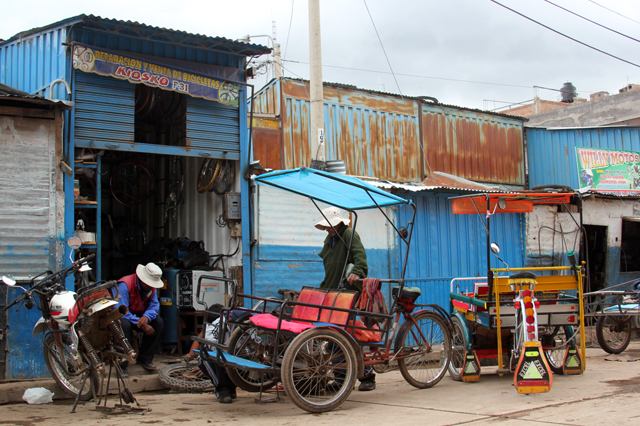
Bicycle Repair Shop in Puno

Bicycle Repair Shop in Puno

As one who lived the first seventeen years of his life in Cleveland, Ohio, I am well aware that some places come as a major disappointment to travelers. Cleveland was usually referred to as “The Mistake on the Lake” and, parodying the Chamber of Commerce motto of “The Best Location in the Nation,” “The Worst Location in the Nation.” And on the old Dobie Gillis TV show, wasn’t that hippie Maynard G. Krebs always going to see a movie called The Monster That Devoured Cleveland.

Well, Puno is one of those cities that gets no respect. A major entrepot for goods being trucked from Peru to Bolivia and vice versa. It is also one of Peru’s major centers of indigenous population, including both Quechuas and Aymaras.

If you take a look at the books written by travelers, you get a pretty dim view of the place. Paul Theroux (The Old Patagonian Express) and Christopher Isherwood (The Condor and the Cows) didn’t even give the place a chance: They arrived at night and left that same night on a boat bound across lake Titicaca for Copacabana, Bolivia. Since there are now no boat crossings to Bolivia—unless one is on an expensive catamaran tour—that option no longer exists.

When Patrick Leigh Fermor visited in the early 1970s (Three Letters from the Andes), he didn’t have much good to say about the place:

There was little for the eye to feast on outside. Puno is an assembly of corrugated iron roofs, sidings and goods yards sprawling round a church like a Gothic mud pie. We picked our way through the debris and squatting Aymara Indians—treading softly lest we tread on their dreams—to a ramshackle lacustrine port where an old steamer lay at anchor, brought piecemeal overland long before the railway, so that each plate was cut down to the weight a mule can carry, and sometimes a llama, then welded and riveted together again on the lake shore.

Fermor describes being met at the train station by a gaggle of unruly Aymara porters “seizing our luggage and bickering and punching each other all the way across the tracks to the repellent Ferrocarril hotel,” which had mislaid all the partys reservations.

Some years later, Michael Jacobs (The Andes), had this to say about Puno: “Neither of us was keen to stay any longer than necessary in Puno, which looked, under bright sunlight, even uglier than I had remembered it. The sun accentuated its resemblance to a waste tip of dirty brown boxes washed up by the lake.”

In Cut Stones and Crossroads, Ronald Wright damns the city with faint praise: “Puno has improved: I’ve found a hotel with hot water and a restaurant with hot food.” In The White Rock, Hugh Thomson considers Puno a “‘one-nighter,’ if that.”

Given all that bad publicity, I am sure that I will enjoy Puno. There isn’t much to see in the city proper (or should I say improper?), but there are the burial towers at Sillustani and the Islands of Taquile and Amantani in the middle of the lake. Plus, I will be trying to outlast the soroche I am sure will overtake me there at the elevation of 12,500 feet. Hey, nothing can surprise me: I’m from Cleveland.


Inti Raymi

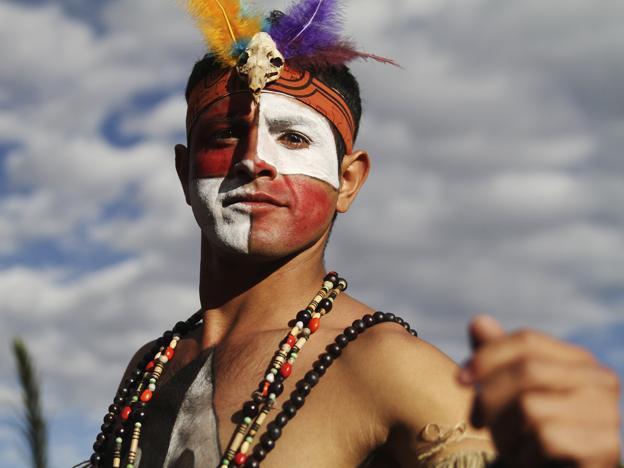
Inca Warrior

Inca Warrior

Before Francisco Pizarro upset the whole apple cart, Inti Raymi was one of four major Inca festivals celebrated in Cusco. It is still celebrated annually, except the venue has moved to the nearby ruins of Sacsayhuamán—usually pronounced by American tourists as “Sexy Woman.” The following description of the festival’s origin is from Wikipedia:

According to chronicler Garcilaso de la Vega, Sapa Inca Pachacuti created the Inti Raymi to celebrate the new year in the Andes of the Southern Hemisphere. The ceremony was also said to indicate the mythical origin of the Incas. It lasted for nine days and was filled with colorful dances and processions, as well as animal sacrifices to thank Pachamama and to ensure a good cropping season. The last Inti Raymi with the Inca Emperor’s presence was carried out in 1535, after which the Spanish and the Catholic priests banned it.

Since 1944, there has been a re-enactment of the Inti Raymi ceremonies on June 24 of each year. Although this re-enactment is mostly for the benefit of tourists, there are still real Inti Raymi ceremonies held by Quechuan peoples throughout the Andes.

The Gringo Trail

The Volcano El Misti Rises Above the Cathedral of Arequipa

The Volcano El Misti Rises Above the Cathedral of Arequipa

Most tourists visiting South America tend to follow a well-beaten path to such destinations as Iguazu Falls and Machu Picchu. This is so pronounced in Peru that there is a roughly U-Shaped itinerary known as the Gringo Trail. It stretches from Lima south to Arequipa, occasionally taking in such stopovers as Paracas, Nazca, and the Oasis of Huacachina. Then, around Arequipa, there is Colca Canyon (twice as deep as our Grand Canyon), and the even more remote and even deeper canyon at Cotahuasi. From there, the tourist usually heads of Cusco, Machu Picchu, and Lake Titicaca. Backpackers frequently continue on to Copacabana and La Paz in Bolivia and on south.

In September, I myself will be hitting the Gringo Trail. The difference is that I will be avoiding two groups of people that constitute most of the tourists: backpackers and charter bus tour groups. I will probably encounter some of the same people several times, but I will likely not be traveling with them; and I won’t be staying in neither youth hostels nor five star hotels. I don’t mind the backpackers that much, but I dislike getting stuck in a party hostel in which the drinking and loud talk continue far into the wee hours of the morning. It will actually b quite a challenge to be taking the Gringo Trail while avoiding other travelers.

There are other sights in Peru beyond the Gringo Trail, but first I have to see to what extent I am affected by soroche, acut mountain sickness. It would be nice some day to visit Ancash, Huancayo, and Huancavelica. As for the Amazon areas, no thanks: I loathe mosquitoes.

The High Point of My Trip


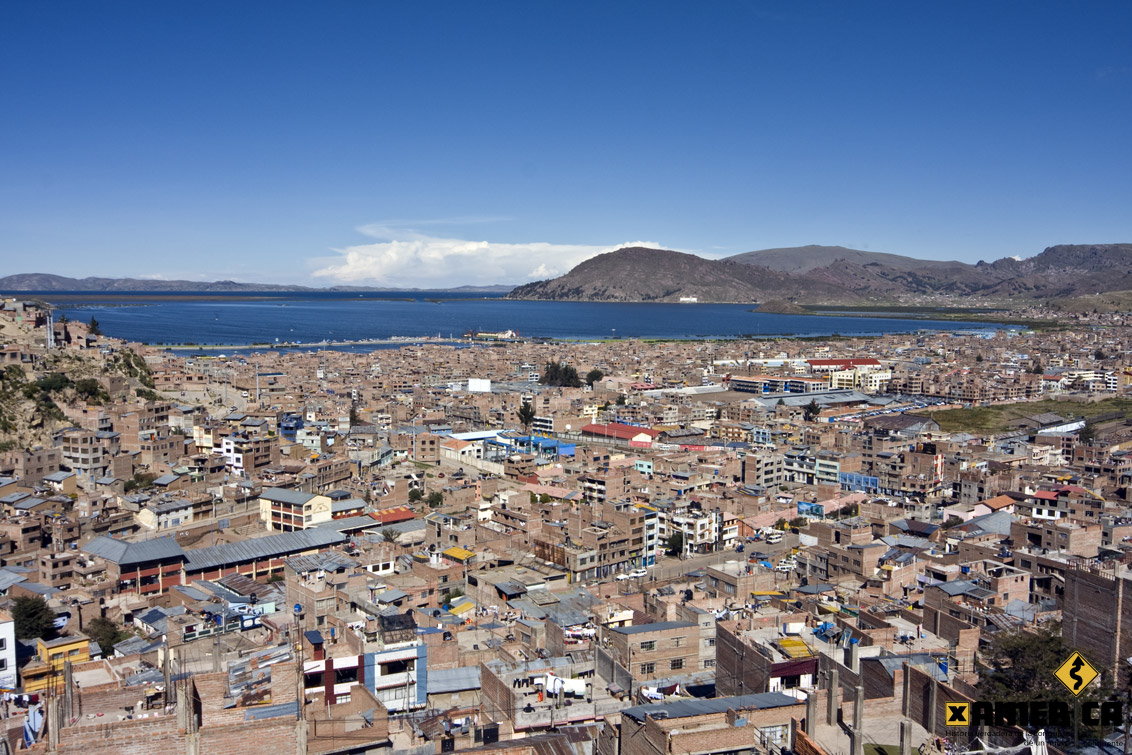
Puno on the Shore of Lake Titicaca

Puno on the Shores of Lake Titicaca

If my upcoming Peru vacation is a success, it will be because I was able to withstand life at 12,000 feet (3,650 meters) altitude. The high point (both literally and figuratively) of my trip will be at Puno, a somewhat ungainly city on the shores of Lake Titicaca. There will be short times during which I will be at 15,000 feet (4,570 meters) or more as I go over mountain passes between Arequipa and Chivay, between Arequipa and Puno, and between Puno and Cusco.

The hotel at which I will be staying—the Casa Andina Classic Tikarani on Jirón Independencia—provides oxygen for its guests as well as mate de coca if I am beginning to feel the onset of acute mountain sickness, or soroche, as the natives call it.

In the end, it is possible I am making too much of all this, but I will be traveling by myself. I have to be prepared to take immediate action in case I am one of the 1-2% of travelers in danger of High Altitude Cerebral Edema (HACE) or High Altitude Pulmonary Edema (HAPE). If that happens, I will immediately return to Arequipa and figure out a Plan B that involves visits to Tacna, Peru and Arica, Chile, cities that figured in the War of the Pacific (1879-1883), in which Bolivia lost its seacoast. (Even so, they still have admirals.)

If I find I can take the altitude, I’ll spend a night on Isla Taquile, which involves a 400 foot climb up a trail to reach the center of town. There, I will spend a night with one of the local families before returning to Puno by launch the next day.

After Puno, I head downhill to Cusco, and later still further downhill to Ollantaytambo and Machu Picchu.


Serendipity: The Singing Letter

Mural of Inca Indians

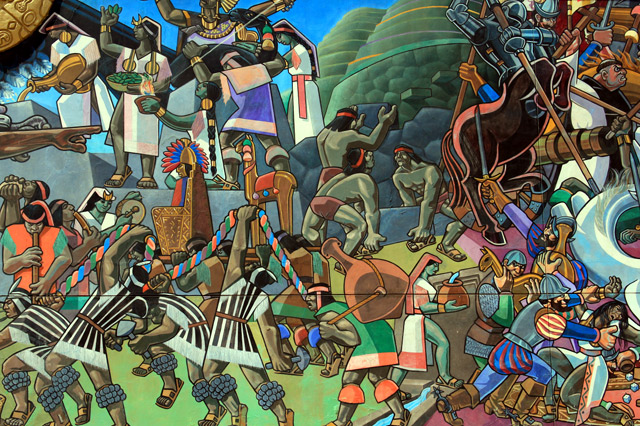
Mural of Incas and Spanish

I have read some experts that say that the Incas had possessed a form of phonetic writing with knotted cords called quipus, whereas others say that these cords were used only for inventories and such—much as the Minoan Linear A and B was used in Ancient Crete. Last night, I ran into a tale from around 1541 quoted by Peruvian writer and antiquarian Ricardo Palma, which sheds some light on the whole issue:

The time came when the first harvest of melons was taking place in the Barranca melon fields and that marks the beginning of our story.

The overseer selected ten of the best melons, packed them in two boxes and put them on the shoulders of two of the Indians serving there and gave them a letter for the master.

The two Indians had carried the melons a few leagues when they sat down to rest near a wall. As one would expect, the aroma of the fruit awakened the curiosity of the Indians and a battle began between fear and their appetite.

“Do you know something, brother?” said one of them to the other in his Indian dialect. “I have discovered a way to eat some melons without anyone finding out. All we have to do is hide the letter behind the wall. It won’t be able to see us eat so it won’t be able to accuse us of anything.”

The naiveté of the Indians attributed to writing a diabolical and marvelous prestige. They didn’t believe that the letters were only symbols but that they were spirits, which functioned not only as messengers but also as watchmen or spies. [Italics Mine]

The second Indian thought that his companion’s idea was a very good one, so without saying a word, he placed the letter behind the wall, put a rock on top of it and then the two proceeded to devour, not eat, the inviting and delicious fruit.

As they were nearing Lima the second Indian gave himself a blow to the head and said, “Brother, we are making a big mistake. We need to make our burdens equal, because if you carry four and I carry five our master will suspect something.”

“Well said,” replied the other Indian.

And so once again they hid the letter and then they ate a second melon, that delicious fruit that according to the saying is gold before breakfast, silver at noon and death in the evening, for it is true that there is nothing more indigestible and causes more upset stomachs after a full meal.

After the Indians arrived at Don Antonio’s home they delivered to him the letter that announced the fact that the overseer was sending ten melons.

Don Antonio, who had promised to give some of the first melons of the harvest to the archbishop and several other individuals, began to examine what the Indians had brought.

“What do you think you are trying to do, you good-for-nothing thieves?” bellowed the irate landowner. “The overseer sent ten melons and two are missing.” Whereupon Don Antonio read the letter once more.

“There were only eight, master,” protested the two Indians.

“The letter says ten and you have eaten two of them on the road. You over there! Give these scoundrels a good beating—a dozen blows for each one.”

And the poor Indians, after receiving a thorough thrashing, sat in the corner of the patio gloomily considering what had happened to them.

Then one of them said, “You see, brother? The letter sings.”

Don Antonio happened to hear what the Indian had said, whereupon he shouted, “Yes, you rascals. And you better watch your step and not try any more funny business because now you know the letter sings.”

And Don Antonio related the incident to his friends at the next tertulia. The saying became popular and eventually made its way to the Mother Country.

The quote is from Palma’s Peruvian Traditions (1872-1910).

Ugly But Magnificent

Andean Condor

Andean Condor

Andean Condors, like all members of the vulture family, are not exactly cute; but with their 10-foot wingspans, they are awe-inspiring. The only time I ever saw Vultur gryphus was on in Argentinian Patagonia, on my way to the dock to take a cruise to see the glaciers that feed into Lago Argentino. There were two of them a few miles out of El Calafate visible from the left side of the bus. Of course, by the time I got my camera out, they had swooped around the hill and out of sight.

In Peru, I hope to photograph them at Colca Canyon, about a hundred miles northwest of Arequipa. The Canyon has a depth of 13,650 feet (4,160 meters), making it twice as deep as the Grand Canyon in Arizona. I will try to take a tour that stops at Cruz del Condor, where they tend to glide in large numbers past a viewing point looking for their favorite carrion. I hope I can get a few pictures to bring back and post on this blog site.

Colca Canyon is probably the third most popular tourist destination in Peru, after Machu Picchu and Lake Titicaca.


Beats Greyhound Hands Down

Cruz Del Sur (Southern Cross) Is One of Peru’s Premier Bus Lines

Cruz Del Sur (Southern Cross) Is One of Peru’s Premier Bus Lines

For some reason I cannot quite fathom, Martine likes to go to Sacramento via Greyhound. (Perhaps it’s because the airport is many miles north of the city.) Today I was doing some research on returning to Lima from Cusco. Originally, I planned to fly; but then I realized that I would not only have to pony up for the flight, but also I’d have to book a hotel for the night. Then I looked at Cruz Del Sur’s website, and my eyes popped out.

I had some good feelings about South American buses from my experiences in Argentina, but some of the the long-distance Peruvian lines look really good. Probably the best of the bunch are Cruz Del Sur, Ormeño (which has a 6,002 mile route—the longest in the world—between Caracas, Venezuela and Buenos Aires, Argentina), and Oltursa. Many have what are called Executivo or Cama services, which include seats that recline from 160-180º, plus a lot of other extras. The Crucero Suite service includes these, plus meals (included in the price), stewards/stewardesses, entertainment with personal headphones and screens, two restrooms per bus, air conditioning and heating, reading lamps, a kit including blanket and pillow, and bingo. Check out this Cruz Del Sur website in English and compare it to the increasingly trashy public transportation services on offer in the United States.

Of course, nothing is perfect in this world. In the summer of 2013, a Cruz Del Sur bus full of American, European, and Asian tourists was held up outside of Ayacucho by eight armed bandits in the middle of the night. They pulled the bus off the road and proceeded to rob the passengers of over $50,000 in cash and personal goods. You can read the story in Peru This Week. Ayacucho is a dangerous place that served as the center of the Sendero Luminoso (“Shining Path”) guerrilla insurgency in the 1980s and early 1990s.

Peru is a deceptively large country: From Cusco to Lima is a 21-22 hour bus ride with a single stop on the way. I kind of hope it isn’t Ayacucho.


Peru, Here I Come …

I Am Flying LAN Down to Lima

I Am Flying LAN Down to Lima

… but not just yet.

Yesterday evening I book my flight to Peru via Kayak. I got a nice nonstop from LAX to Lima (LIM) on LAN Airlines. Formerly LAN Chile, it is now part of the Latam Group, after having merged with TAM of Brazil—a South American aviation giant. And yet, while airlines in the United States are cutting back on service, LAN provides meals on real plates with real cutlery and free wine. Would I fly a U.S. airline out of the country? Uh, no.

When Martine and I took LAN to Buenos Aires in 2011, we enjoyed our flight as much as possible considering how long we were in the air. The LAX to Buenos Aires run is just about one of the farthest trips one can take in the Western Hemisphere. We both felt that the airline was well managed, especially as compared to Argentina’s own national airlines, Aerolineas Argentinas, which once landed us at the wrong airport—not bothering to tell us until we were in the air. That cost us a $60 cab ride from Ezeiza, as opposed to nearby Aeroparque.

How do I feel about my upcoming trip three months from now? Let’s ask Herbie the Magical llama:

Cool

Cool


Sillustani

Ancient Aymara Burial Towers

Ancient Aymara Burial Towers

This fall, when I travel to Peru, one of the places I hope to visit is Sillustani, near the shores of Lake Titicaca roughly between Juliaca and Puno. When I arrive in Puno by bus from Arequipa, I will have a couple of days to adjust to the 12,500-foot (3,810 meters) altitude around the lake. On one of those days, I hope to take a half day tour to visit the chullpas at Sillustani. These are Aymara burial towers, presumably for noble families, of the pre-Inca Aymara people who lived here.

One of the things I am beginning to learn is that Peru consists of many more pre-Columbian peoples than just the Incas. Before 1400, the Incas were a relatively small tribe who created a large empire, largely due to Pachacuti, a.k.a. Yupanqui, whose reign rapidly spread north to Ecuador and south to Chile.

Below are two local indigenous women photographed at Sillustani:

Two Aymara or Quechua Women

Two Aymara or Quechua Women Working on Their Handicrafts

Notice the spindles in their hands. From what I understand, both men and women spend much of their spare time creating the textiles for which the area is famous.

Indiana Jones in the Flesh

Hiram Bingham III and Indiana Jones

Hiram Bingham III and Indiana Jones

Yes, Virginia, there was a real Indiana Jones. He was the son of a Protestant missionary in Hawaii, who was in turn the son of a Protestant missionary in Hawaii. In fact, if you’ve read James Michener’s Hawaii, his grandpappy was Abner Hale. Hiram Bingham III (1875-1956) had too much of the spirit of wanderlust to be tied down to a clerical life. He was an explorer, aviator, and eventually Governor of Connecticut and U.S. Senator from Connecticut during his long and active life.

He came to my attention as the self-proclaimed discoverer of the ruins of Machu Picchu in Peru, which I hope to visit later this year. He came upon the ruins in 1911, thinking he was the first—even though they appeared on an 1874 map. No matter. Even if he was wrong, Bingham did a great job publicizing the ruins using his association with Yale University and the National Geographic Society. Among other things, he wrote an excellent book entitled Lost City of the Incas: The Story of Machu Picchu and Its Builders in 1948. (He also wrote several other books, including Inca Land: Explorations in the Highlands of Peru and The Ruins of Choqquequirau, among others.)

If he weren’t such a good writer, I might not have forgiven Bingham for being so wrong. Not only was he the first white man at Machu Picchu: He thought he had discovered Old Vilcabamba, the last hideout of the Incas as they fled the Conquistadores. In reality, the last four Inca rulers were based in the jungle at a place called Espiritu Pampa. Curiously, Bingham had been there (see photo below), but thought the place was far too tropical for his beloved Incas.

Bingham (Upper Right) and Peruvian Assistant at Espiritu Pampa (1911)

Bingham (Upper Right) and Peruvian Assistant at Espiritu Pampa (1911)

It is almost pathetic to read Bingham’s forcing the issue regarding his misidentification. He practically ordered furnishings for the rooms from Macy’s to prove his point:

One day we located the burial place of the High Priestess or Mama-cuna, the Lady Superior of the convent, the person chiefly responsible for the training of the Chosen Women. It was a very sightly location on a rock-sheltered terrace on the slopes of Machu Picchu Mountain, about a thousand feet above the highest part of the ruins. The terrace was about forty feet long above some agricultural terraces and connected with the highest by two flights of stairs. It was almost completely overhung by an immense bowlder which looked like a peaked crag of the grey granite mountain. The flat-faced projecting portion of the bowlder was at least fifty feet high. The terrace was constructed largely of rock and gravel. Sheltered from the fierce noonday heat of the sun, it offered an ideal resting place for the Mother Superior.

Yes, but what kind of tea did she drink?

I might be a little hard on the guy, with all his palaver about Chosen Women and Virgins of the Sun. Remember, the Incas had no writing, so Bingham filled his discovery from his own imagination. Mother Superior my Aunt Fanny!