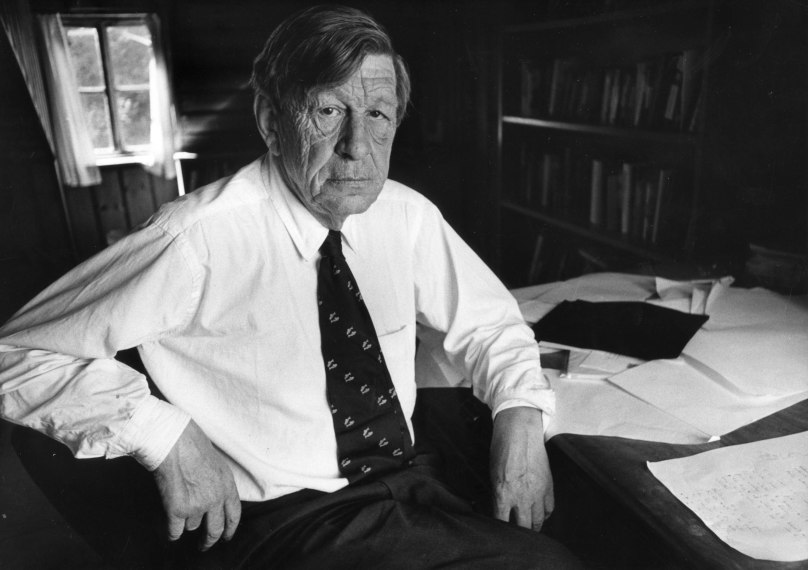
I would like to carefully read several poems a week. And then re-read them until I can wring every particle of sense out of them. A good one to start with is W. H. Auden’s “At Last the Secret Is Out.”
At Last the Secret Is Out
At last the secret is out, as it always must come in the end, the delicious story is ripe to tell to tell to the intimate friend; over the tea-cups and into the square the tongues has its desire; still waters run deep, my dear, there’s never smoke without fire.
Behind the corpse in the reservoir, behind the ghost on the links, behind the lady who dances and the man who madly drinks, under the look of fatigue the attack of migraine and the sigh there is always another story, there is more than meets the eye.
For the clear voice suddenly singing, high up in the convent wall, the scent of the elder bushes, the sporting prints in the hall, the croquet matches in summer, the handshake, the cough, the kiss, there is always a wicked secret, a private reason for this.
One of my favorite poets at last weekend’s Los Angeles Times Festival of Books was Katie Farris, who read from her works on Saturday, April 20, at the Poetry Stage. Her recently published collection—Standing in the Forest of Being Alive—brought together her experiences with third-stage breast cancer, the global Covid pandemic, and an America at the point of heading for a messy divorce. Here is her explanation of how it all came together:
What drew me to her poems was her debt to Emily Dickinson and William Blake, two of my all-time favorite poets. In fact, there is definitely something of Emily in her work—without the sometimes obscure wording that sends the reader back to the beginning to make sense of the poet “telling it slant.” Below is the first poem from her collection:
Why Write Love Poetry in a Burning World
To train myself to find in the midst of hell what isn’t hell.
The body bald cancerous but still beautiful enough to imagine living the body washing the body replacing a loose front porch step the body chewing what it takes to keep a body going—
This scene has a tune a language I can read a door I cannot close I stand within its wedge a shield.
Why write love poetry in a burning world? o train myself in the midst of a burning world to offer poems of love to a burning world.
It is no surprise that the three poets whose readings I most liked at the Los Angeles Times Book Festival Poetry Stage were all women. They represented three different life paths which, while typically feminine, were universal in their humanity.
The first is Maggie Millner, born in upstate New York, an instructor in writing at Yale University. The poem is from her poetry collection entitled Couplets.
1.12
There are many ways, of course, of telling it. But each account obscures
some other version equally true. One is that I lied to everyone I knew.
Another—this one I really do believe— is that for years I loved him more than me.
I can conjure even now our first apartment’s tile: white diamonds in their blue argyle
frieze around the sink, the dirty grout I’d scour with a toothbrush while he was out
at work. I can count four bathmats over eight years, hear the record player catch
every time we stood up from the table. And I can still feel the invisible
moat we both lived in, on the other side of which we knew lay torment, exile, wreckage,
the anarchy of singledom. Loss upon loss. I remember testing it, the moat: throwing across
a rope to check its breadth, twice to the waist wading in before retreating, shamefaced,
reining myself back. To him it was a sea I think entirely impassable. To me
it was a dizzying ravine that circled us for years, then cut between.
What with bookstores becoming rarer than hen’s teeth and the average American seemingly unable to read anything more daunting than the label of a beer can, I am becoming ever more determined to support books and reading. Therefore, I shall be spending the weekend looking at books, buying books, and attending talks by authors as well as poetry readings, My next post will be on Monday, April 22.
The Los Angeles TimesFestival of Books has become a huge event that brings together readers of all stripes. I even forego my usual sneering at readers of bodice-ripper romances: They, too, are readers—like me in one way, unlike in all others.
When I am not scanning book titles, I go for rest to the Poetry Pavilion, where there is a new poet every twenty minutes during the day. The pavilion never fills up like some of the other stages with big name celebrities, but it is (1) more comfortable and (2) more rewarding. Although I don’t read as much poetry as I should, it is always interesting to hear poets reading their own work.
Next week, I will write posts about those poets that interested me the most.
No, the lower-case “t“ in the above title is not an error. It is explained by Polish/Ukrainian philosopher and author Sigizmund Krzhizhanovsky (1887-1950) in a 1918 essay entitled “Argo and Ergo.”
All the things in my world I divide into these and Those.
These have worn out my eyes; they have rubbed my hands sore; they are covered with layers of my touches; they surround me, chafing my very eyes, my skin, they are all right here and here. I know them to the finest flexure—point—mark; they have all been counted and recounted.
Whereas Those things: are not within my grasp, my eye cannot reach, but I believe: they are the essence: beyond all distances, outside all tangencies, where lines of sight have come to an end and colors faded away.
To think is to transpose things: from these into Those, from Those into these.
Some people rejoice if, having taken this thing right here at hand, they can remove it to That: we shall call them this-into-Thaters. This sort of person is usually drawn to poetry, music, and so on. People who would rather, on reaching for Those distant things, bring them as close as possible to eye and brain, we shall call That-into-thisers: their minds, attracted by science, by the exactitude of definitions, like to “reveal”mysteries and “discover” secrets,
This short tale by Jorge Luis Borges (1899-1986) is, to my mind, the most incredible tale ever told about the power of poetry. It is told here in its entirety. It and many equally wonderful poems and stories can be found in Dreamtigers (in Spanish, El Hacedor).
That day, the Yellow Emperor showed the poet his palace. They left behind, in long succession, the first terraces on the west which descend, like the steps of an almost measureless amphitheater, to a paradise or garden whose metal mirrors and intricate juniper hedges already prefigured the labyrinth. They lost themselves in it, gaily at first, as if condescending to play a game, but afterwards not without misgiving, for its straight avenues were subject to a curvature, ever so slight, but continuous (and secretly those avenues were circles). Toward midnight observation of the planets and the opportune sacrifice of a turtle permitted them to extricate themselves from that seemingly bewitched region, but not from the sense of being lost, for this accompanied them to the end. Foyers and patios and libraries they traversed then, and a hexagonal room with a clepsydra, and one morning from a tower they descried a stone man, whom they then lost sight of forever. Many shining rivers did they cross in sandalwood canoes, or a single river many times. The imperial retinue would pass and people would prostrate themselves. But one day they put in on an island where someone did not do it, because he had never seen the Son of Heaven, and the executioner had to decapitate him. Black heads of hair and black dances and complicated golden masks did their eyes indifferently behold; the real and the dreamed became one, or rather reality was one of dream’s configurations. It seemed impossible that earth were anything but gardens, pools, architectures, and splendrous forms. Every hundred paces a tower cleft the air; to the eye their color was identical, yet the first of all was yellow, and the last, scarlet, so delicate were the gradations and so long the series.
It was at the foot of the next-to-last tower that the poet—who was as if untouched by the wonders that amazed the rest—recited the brief composition we find today indissolubly linked to his name and which, as the more elegant historians have it, gave him immortality and death. The text has been lost. There are some who contend it consisted of a single line; others say it was a single word. The truth, the incredible truth, is that in the poem stood the enormous palace, entire and minutely detailed, with each illustrious porcelain and every sketch on every porcelain and the shadows and the light of the twilights and each unhappy or joyous moment of the glorious dynasties of mortals, gods, and dragons who had dwelled in it from the interminable past. All fell silent, but the Emperor exclaimed, “You have robbed me of my palace!” And the executioner’s iron sword cut the poet down.
Others tell the story differently. There cannot be any two things alike in the world; the poet, they say, had only to utter the poem to make the palace disappear, as if abolished and blown to bits by the final syllable. Such legends, of course, amount to no more than literary fiction. The poet was a slave of the Emperor and as such he died. His composition sank into oblivion and his descendants still seek, nor will they find, the one word that contains the universe.
It’s not easy to read The Nature of Things by Lucretius. Not only does he attempt to summarize the philosophy of Epicurus and the science knowledge of his day (40-55 BC), but he did in in rhymed couplets, which in this edition are translated as heptameter (“fourteeners”).
Not to worry: If you press on, you will get the gist of what Lucretius writes, and you will encounter some great passages such as this one on the role of the gods in life:
If you possess a firm grasp of these tenets, you will see
That Nature, rid of harsh taskmasters, all at once is free,
And everything she does, does on her own, so that gods play
No part. For by the holy hearts of gods, who while away
Their tranquil immortality in peace!—who can hold sway
Over the measureless universe? Who is there who can keep
Hold of the reins that curb the power of the fathomless deep?
Who can juggle all the heavens? And with celestial flame
Warm worlds to fruitfulness? And be all places at the same
Time for all eternity, to cast a shadow under
Dark banks of clouds, or quake a clear sky with the clap of thunder?
What god would send down lightning to rend his own shrines asunder?
Or withdraw to rage in desert wastes, and there let those bolts fly
That often slay the innocent and pass the guilty by?
It is a far different world than hours. Instead of the Periodical Table of the Elements, Lucretius had earth, wind, air, and fire. You can see him bending in obscure directions to explain such phenomena as magnetism, thunder, earthquakes, and plagues. Yet one could not help but admire the ingenuity of an astute observer who had no notion of Newtonian Physics, let alone Quantum Physics, yet tried his hardest to explain what he saw.
I get a real feeling of inadequacy every time I read Russian poetry in translation. How can one really appreciate a country’s poetry unless one speaks the language? What Russian I know relates only to, of all things, chess. I used to play international correspondence chess in competition, so I had to understand certain terms such as “position drawn” or “resigns” or the names of the pieces in several languages. That doesn’t help me understand what Marina Tsvetaeva meant in the above illustration. I’ve read Tsvetaeva and several of her countrymen in translation. Most recently, I read Arseny Tarkovsky’s collection I Burned at the Feast.
Again and again, I would run into stanzas that seemed to open vistas for me—only to wonder how the poem read in the original language. Here are a few examples:
A word is only a skin,
a thin film of human lots,
and any line in your poem
can sharpen the knife of your fate.
Or this:
Something was leading us.
Built by miracle, whole cities split—
like mirages before our eyes.
And mint bowed beneath our feet,
and birds hovered above our heads,
and fish nosed against the river’s flow,
and the sky unscrolled above the land…
while behind us, fate followed
like a madman with a razor in his hand.
Russians love the poetry of Pushkin, but I have no idea of what he sounds like in the original Russian. Sometime in the next year, I will read Babette Deutsch’s translation of Eugene Onegin. But is it really any good? Some people say it is, but I am at the mercy of whatever translation I select.
Cottle, in his life of Coleridge, relates the following amusing incident:–’I led my horse to the stable, where a sad perplexity arose. I removed the harness without difficulty; but, after many strenuous attempts, I could not remove the collar. In despair, I called for assistance, when Mr. Wordsworth brought his ingenuity into exercise; but, after several unsuccessful efforts, he relinquished the achievement as a thing altogether impracticable. Mr. Coleridge now tried his hand, but showed no more skill than his predecessor; for, after twisting the poor horse’s neck almost to strangulation, and the great danger of his eyes, he gave up the useless task, pronouncing that the horse’s head must have grown since the collar was put on; for he said,“it was a downright impossibility for such a huge os frontis to pass through so narrow an aperture.” Just at this instant, a servant-girl came near, and understanding the cause of our consternation, “Ha! master,” said she, “you don’t go about the work in the right way: you should do like this,” when, turning the collar upside down, she slipped it off in a moment, to our great humiliation and wonderment, each satisfied afresh that there were heights of knowledge in the world to which we had not yet attained.—William Evans Burton, The Cyclopædia of Wit and Humor, 1898
As I … meditated the direction of modern poetry, my discouragement blackened. It seemed to me that Mallarmé and his followers, renouncing intelligibility in order to concentrate on the music of poetry, had turned off the road into a narrowing lane…. Idea had gone, now meter had gone, imagery would have to go; perhaps at last words might have to go or give up their meaning, nothing be left but musical syllables…. I was standing there like a God-forsaken man-of-letters, making my final decision not to become a “modern.” I did not want to become slight and fantastic, abstract and unintelligible.—Robinson Jeffers, Preface to Roan Stallion






 Tarnmoor
You must be logged in to post a comment.