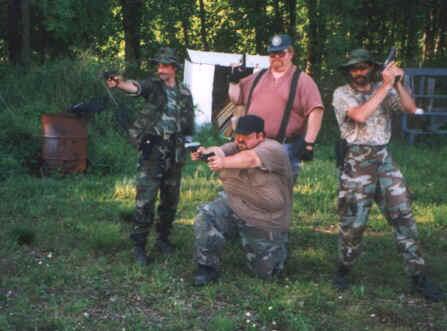
“Stupidity of the Vilest Kind”

Dick Cheney

Dick Cheney

You are wedded to stupidity, my fine friend, of the vilest kind; you are impeached of this by your own words, out of your own mouth; and this, it seems, is why you dash into politics before you have been educated. And you are not alone in this plight, but you share it with most of those who manage our city’s affairs… Plato: Alcibiades

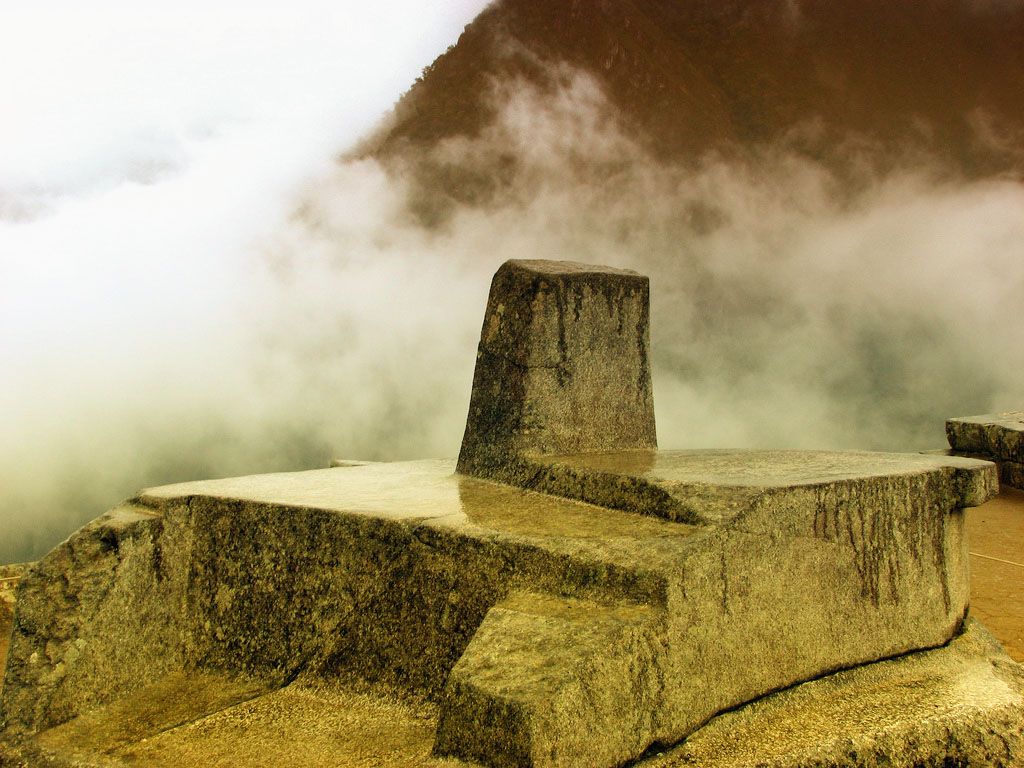
Intihuatana

The Inca Had No Writing, Just Knots, Called Quipu

The Inca Had No Writing, Just Knots, Called Quipus

I spent many vacations between 1975 and 1992 visiting archaeological sites in Mexico. These included not only Mayan and Aztec, but also Totonac, Toltec, Zapotec, Mixtec, Olmec, and whatever peoples built the ruins at Teotihuacán. As a result, I developed a feeling for the strengths and weaknesses of these Meso-American peoples. This year I plan to visit Peru and acquaint myself with the Incas and the various peoples who preceded them in the Andes.

So far my researches have turned up some interesting results. First of all, the Incas had no writing—as such. Instead, they used colored threads of llama, alpaca, or cotton with knots tied into the various strands called quipus. We know which knots stood for the various digits in their base-10 numbering system, but have no idea how they managed to convey any kind of qualitative content, such as “Look out for that Lord Manco: He’s trying to pull a fast one on you.”

In contrast, the Mayans had a hieroglyphic language which is just now being understood, as well as a vigesimal (base-20) numbering system which is relatively easy to understand.

Whereas the peoples of Mexico had no animals they could use to either ride or carry or pull weights—remember: they did not have the wheel!—the Incas developed their own draft animals by breeding guanacos into llamas, alpacas, and vicuñas. Llamas could not bear human riders, but they could bear up to one hundred pounds of weight on their backs; and, unlike horses, they were comfortable about climbing stairs at high altitude. When fighting the conquistadores, the Inca learned to set up ambushes at places where one of their mountain roads turned into stairs. As the horses bunched up afraid to take the stairs, the Incas atop the ridge line would tumble huge rocks down upon their enemy.

An Intihuatana, or “Hitching Post of the Sun” at Machu Picchu

An Intihuatana, or “Hitching Post of the Sun” at Machu Picchu

Who were more advanced, the Incas or the Pre-Columbian peoples of Mexico? My feeling is that they were both remarkable. Where the Mayans excelled in writing, the Incas were great architects and built thousands of miles of roads—many of which exist to this day despite all the earthquakes that have occurred since they were built.

A good example of Inca ingenuity are the Intihuatanas, or “Hitching Posts of the Sun,” that are found at various sites, such as at Pisac and Machu Picchu. An Intihuatana was a stone that was carefully cut so that the Inca savants could note when the sun was approaching a solstice. An excellent discussion of the stone at Machu Picchu, together with angles and measurements, appears in a scholarly article by Dieter B. Hermann, which was translated into English and appears on the net as an Acrobat PDF file. The stone at Pisac was heavily damaged when a camera crane fell on it during the filming of a beer commercial in 2000. The Inca ruins can survive earthquakes, frosts, and thaws for whole centuries … but apparently not wayward humans.


A Forgotten War

Chinese Troops in the Sino-Vietnamese War of 1979

Chinese Troops in the Sino-Vietnamese War of 1979

Once the U.S. abandoned Saigon to the Viet Cong in 1975, we seem to have lost all interest in Southeast Asia. There was, however, a lot happening. The Pol Pot regime in Cambodia, which was supported by the Chinese, was engaged in genocide on a massive scale. Also, we must not forget at that time that the Sino-Soviet conflict was at its height: The Russian-Chinese border fairly bristled with guns and military units. At the time, the Hanoi government had a military alliance with the Soviet Union. When Vietnam invaded Cambodia and deposed the Khmer Rouge, China decided to punish its neighbor to the south.

On February 17, 1979, somewhere between 200,000 and 600,000 troops of the Peoples’ Liberation Army (PLA) invaded North Vietnam and occupied the all territory for approximately twenty miles south of the border. It appears that China either wanted to test the alliance with Russia or divert the crack Viet military units engaged in Cambodia—or both, or neither. A number of reasons have been adduced for this incursion, and China wasn’t owning up to its motivation for so doing. Vietnam met the attack by the 1st and 2nd military regions—essentially militia—under the command of Dam Quang Trung and Vu Lap. The number engaged of the Vietnamese forces was a fraction of the Chinese force, but it inflicted heavy casualties on the PLA, and suffered heavy casualties in return. (The numbers vary depending on whether one is following Chinese or Vietnamese statistics.)

Newsweek Cover in Feb 1979

Newsweek Cover on March 5, 1979

When I heard that, after thirty-five years of relative peace, the Chinese are once again testing the resolve of the Vietnamese by drilling an oil well off the Paracel Islands in the South China Sea, which are claimed by both nations, my antennae started to tingle. Tiny uninhabited islands are big news these days, mainly because they extend the territories claimed by adjoining land powers. Claiming a tiny rock can extend one’s territorial waters by literally thousands of square miles. And both China and Vietnam need all the oil they can get.

The Vietnamese responded by rioting and attacking Chinese within their borders, along with the businesses they ran. China has been chartering flights to evacuate its nationals from Vietnam.

Although the PLA is huge, it is largely untested in battle. The Sino-Vietnamese War of 1979 was probably the largest military conflict it faced in the last half century—and it did not fare too well faced with a smaller number of Vietnamese militia. At that time, one must remember that the Vietnamese had been at war ever since the end of World War Two and, as a people, were probably as battle-hardened as one could be.

It would be interesting to see whether China is willing, once again, to test Vietnam’s resolve.


It Wasn’t Us, Was It?

The Red Spot on Jupiter Is Beginning to Disappear

The Great Red Spot on Jupiter Is Beginning to Disappear

What with the glaciers shrinking and the ozone hole growing ever larger, we are dismayed to learn that the Great Red Spot on Jupiter is likewise beginning to shrink. In the late 19th Century, it was estimated to be 25,500 miles wide. Beginning in 2012, it’s less than half that size, now only 10,250 miles across. According to CBS News:

Michael Wong, a scientist at the University of California, Berkeley, told The Associated Press that the spot is a mystery. Astronomers don’t know why it’s red or shrinking, or what will happen next. If this pace continues, in 17 years the spot could be gone. Or it could stop at a smaller size.

The Great Red Spot is actually a giant storm, perhaps the planetary equivalent of a Polar Vortex. If the storm vanishes, will we be up to our ears in displaced Jupiterians? Will the giant planet wobble out of orbit and come crashing down into our part of the Solar System? Or is it an environmental phenomenon that has nothing to do with us and wouldn’t affect us for the next several million years? No one knows.

Perhaps our space program can enlist some volunteers to land on the harsh ammoniac surface of the planet and suss things out. I know several hundred people in Washington, DC who would be perfect for the job.


“I’ve Seen a Dying Eye”

Emily Dickinson

Emily Dickinson

The above illustration is from TeenReads.Com, which has an interesting take on the New England poetess. Whenever I have been away from her for a while, I love to read a few scattered poems by the poetess from Amherst, Massachusetts. Most recently, I have admired the following short poem:

I ’ve seen a dying eye
Run round and round a room
In search of something, as it seemed,
Then cloudier become;
And then, obscure with fog,
And then be soldered down,
Without disclosing what it be,
’T were blessed to have seen.

The images of the eye of the dying person running round and round, becoming obscured with fog, and finally being “soldered down” are a sobering, almost too intimate view of death. At the very end, Dickinson at last calls the dying person’s sight “blessed” without divulging the mystery of what was seen during those last few moments. A sense of mystery pervades the room, and our consciousness as readers.


The Indigenous Eye

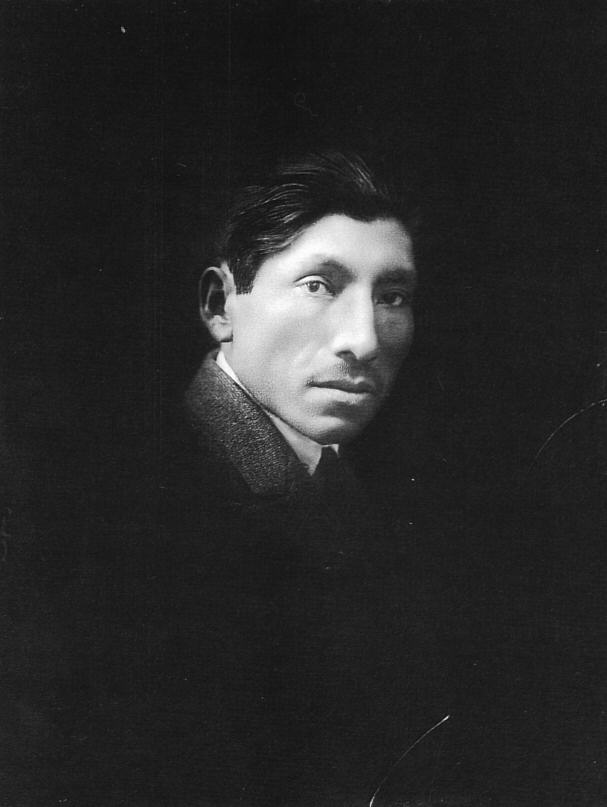
Inca Photographer Martín Chambi Jiménez

Inca Photographer Martín Chambi Jiménez

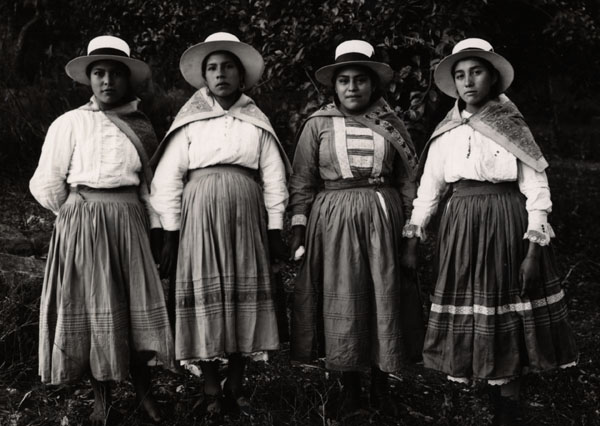
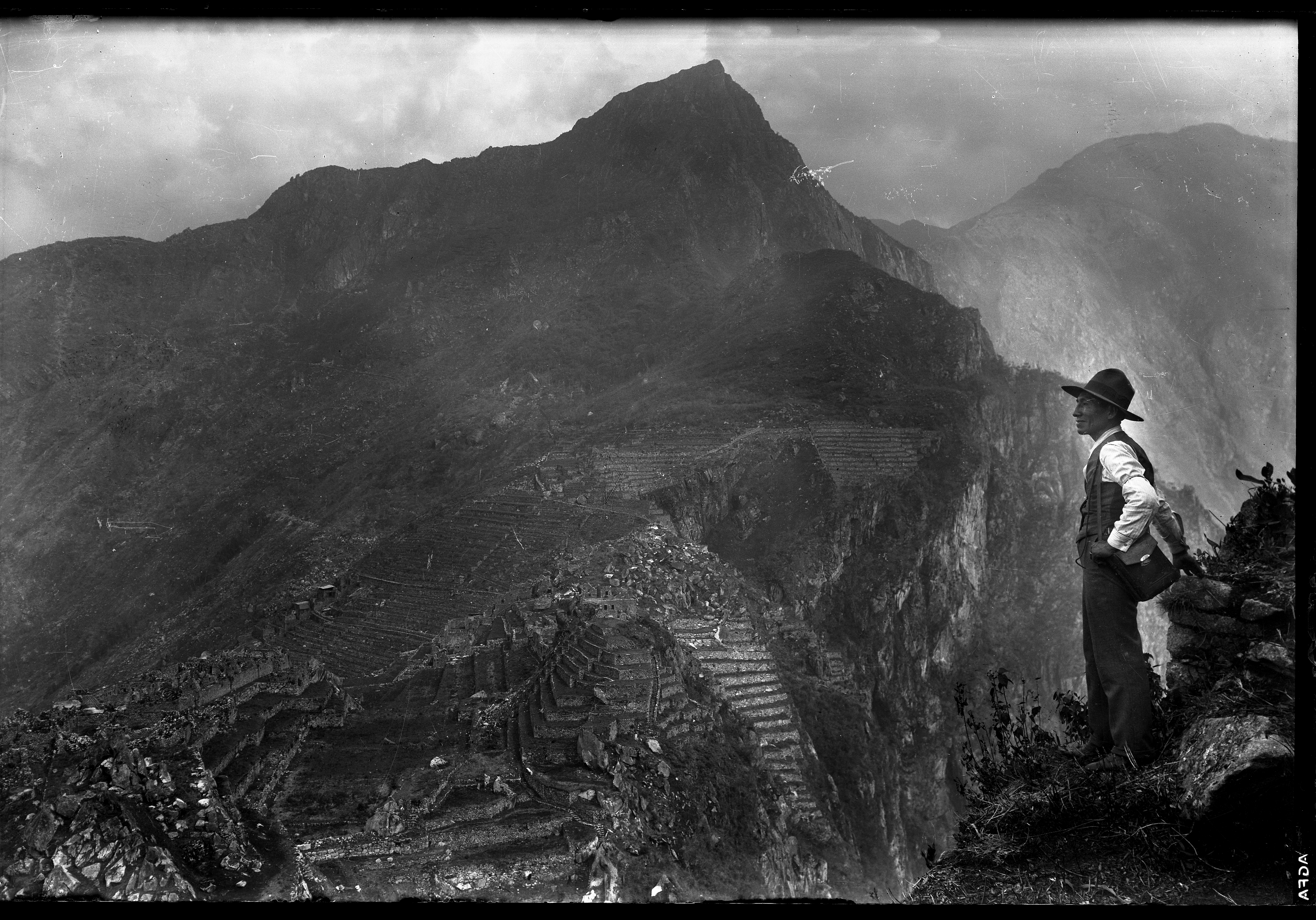
One of the problems with photography as an art form is that the viewpoint is usually that of a European or North American. It would have been wonderful to have photographs taken by native Navaho or Tibetan or Zulu photographers so that we could see the world from their unique perspective. One rare exception is the work of a native of Cusco, Peru, the indigenous Inca Martín Chambi Jiménez (1891-1973). Through his eyes, we see the locals of Cusco, the ruins of Machu Picchu, the back country natives, and whatever caught his eye. Below, for instance, is portrait of four young Quechuan campesinas:

Peruvian Campesinas

Peruvian Campesinas

And here is an eagle’s eye view of the ruins at Machu Picchu:

Overlooking the Ruins

Overlooking the Ruins

If you would like to see a collection of his photographs, you can find some interesting examples on Google Image.


American Spring No Show

I Guess the Weather Was Inclement

I Guess the Weather Was Inclement

Today was supposed to be the day. Millions of irate patriotic Americans would descend on Washington to get rid of Barack Obama and his libtard legions. I looked at their Facebook page for clues as to what happened to this massive convergence of right-thinking Americans, and where they could have gone instead. Maybe they’re all seeing the new Godzilla instead, which opens today in Los Angeles. Or else there’s a sale somewhere on military-style assault rifles. In any case, it appears unlikely that the Obama Administration and its Kenyan Communist stooges will be supplanted by something more in line with the thinking of the psychotic masses.

In what news commentator Rachel Maddow calls “a big nutball day in Washington and Bunkerville,” confused hordes will gather to enforce American Spring’s aims, which include “Restoration of Constitutional government, rule of law, freedom, liberty ‘of the people, by the people, for the people’ from despotic and tyrannical federal leadership.”  I guess Bunkerville, Nevada is where Cliven Bundy is holed up with his militia followers waiting to pounce on anyone who shows up to collect grazing fees on land his family has worked since the 7th century A.D.

The self-proclaimed official website of American Spring laid out their plans in full:

Phase 1 – Field millions, as many as ten million, patriots who will assemble in a peaceful, non-violent, physically unarmed (Spiritually/Constitutionally armed), display of unswerving loyalty to the US Constitution and against the incumbent government leadership in Washington D.C., with the mission to replace with law abiding leadership. Go full-bore, no looking back, steadfast in the mission.

Phase 2 – One million or more of the assembled 10 million must be prepared to stay in D.C. as long as it takes to see Obama, Biden, Reid, McConnell, Boehner, Pelosi, and Attorney General Holder removed from office.
Consistent with the US Constitution, as required, the U.S. Congress will take appropriate action, execute appropriate legislation, deal with vacancies, or U.S. States will appoint replacements for positions vacated consistent with established constitutional requirements.

Phase 3 – Those with the principles of a West, Cruz, Dr. Ben Carson, Lee, DeMint, Paul, Gov Walker, Sessions, Gowdy, Jordan, should comprise a tribunal and assume positions of authority to convene investigations, recommend appropriate charges against politicians and government employees to the new U.S. Attorney General appointed by the new President.

At the end, there is this reassuring footnote: “*All actions in Phase 2 & 3 will be consistent with the U.S. Constitution.” Boy, that’s good to know. I was worried there for a while.

Click here to see what the Twitterati are saying about the big event.


Solar Maximum?

An Unusual View of Our Sun Three Weeks Ago

An Unusual View of Our Sun Three Weeks Ago

As we in Southern California suffer through wildfires, desert winds, and hundred-degree temperatures, I was impressed by this view of the sun from Astronomy Picture of the Day on May 6 of this year. According to the description:

Our Sun has become quite a busy place. Taken only two weeks ago, the Sun was captured sporting numerous tumultuous regions including active sunspot regions AR 2036 near the image top and AR 2038 near the center. Only four years ago the Sun was emerging from an unusually quiet Solar Minimum that had lasted for years. The above image was recorded in a single color of light called Hydrogen Alpha, inverted, and false colored. Spicules cover much of the Sun’s face like a carpet. The gradual brightening towards the Sun’s edges is caused by increased absorption of relatively cool solar gas and called limb darkening. Just over the Sun’s edges, several filamentary prominences protrude, while prominences on the Sun’s face are seen as light streaks. Possibly the most visually interesting of all are the magnetically tangled active regions containing relatively cool sunspots, seen as white dots. Currently at Solar Maximum—the most active phase in its 11-year magnetic cycle, the Sun’s twisted magnetic field is creating numerous solar “sparks” which include eruptive solar prominences, coronal mass ejections, and flares which emit clouds of particles that may impact the Earth and cause auroras. One flare two years ago released such a torrent of charged particles into the Solar System that it might have disrupted satellites and compromised power grids had it struck planet Earth.

Kind of looks like a shaggy old tennis ball, doesn’t it?


The Man in the High Castle

Prague Castle, Seat of the Czech Government

Prague Castle, Seat of the Czech Government

No, this isn’t about the Philip K. Dick novel of that name, but about a nation’s president who came to the world’s notice after many years as a jailed dissident and as a playwright of international renown. I am referring to Václav Havel, the last president of Czechoslovakia and (after Slovakia decided to go its own way) the first president of the Czech Republic.

I have just finished reading his informal memoir, To the Castle and Back: Reflections on My Strange Life as a Fairy Tale Hero. Written after he left office in 2003, this book consists of three interleaved sequences:

  1. Reflections written mostly in 2005 during a protracted visit to the United States
  2. A series of memos to his staff dating from 1993-2003 that he found on his computer
  3. An ongoing interview with Czech writer Karel Hvizd’ala about his experiences running a country that had suddenly cast off the yoke of Communism

It also shows some of the small issues that endlessly plagued him, such as the following:

In the closet where the vacuum cleaner is kept, there also lives a bat. How to get rid of it? The lightbulb has been unscrewed so as not to wake it up and upset it.

At other times, Havel had to complain to his staff about the ugliest old telephones being in the most prominent places, about the length of the watering hose used in the gardens, and why the good silverware was not being used for state dinners.

I was curious to discover that Havel, despite being a well-known writer, was petrified whenever he had to begin writing anything. And he appears to have written all his own speeches! (And well, too.)

Czech President Václav Havel

Czech President Václav Havel

Particularly impressive was Havel’s answer as to Hvizd’ala as to what his credo was as the President of the Republic:

I think that the moral order stands above the legal, political, and economic orders, and that these latter orders should derive from the former, and not be techniques for getting around its imperatives. And I believe this moral order has a metaphysical anchoring in the infinite and the eternal.

Can you imagine any of our own leaders being so candid, to the point, and right at the same time?

Despite the book’s informality, I find it that To the Castle and Back gives probably the best picture of what the transition from Communism to Capitalism was like in one country, and the perils of what Havel calls “postcommunism,” in which the former Communist leaders, being still in a position of power and with all the right connections, loot the country.


Ilya Repin, Painter

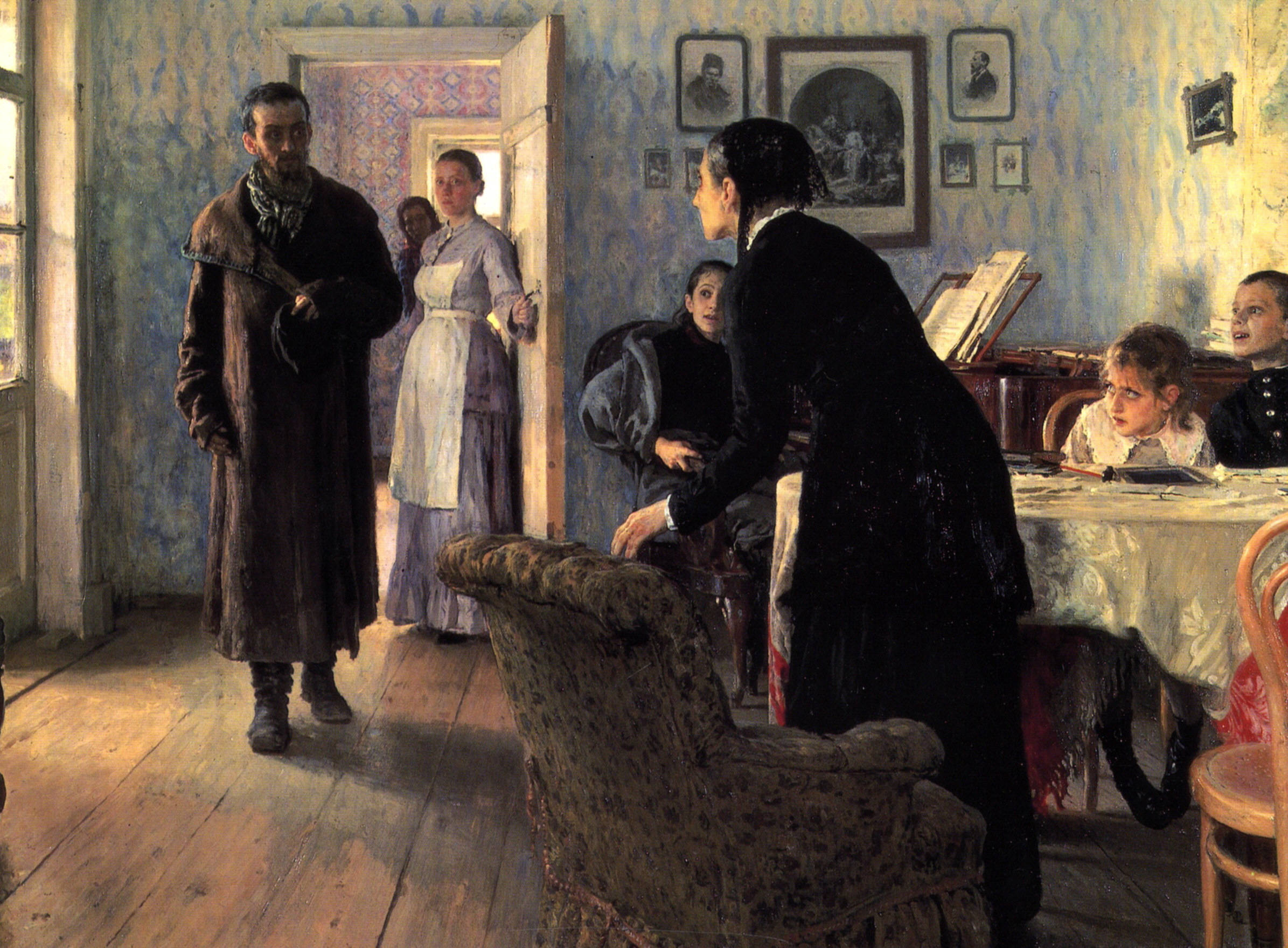
“Unexpected Visitors”—The Protypical View of 19th Century Russian Family Life

“Unexpected Visitors” (1883)—The Protypical View of 19th Century Russian Family Life

The only Russian painters that most of us in the Western World are able to name were likely expatriates, men such as Marc Chagall and Wassily Kandinsky. As for myself, I have a particular liking for the works of Ilya Yefimovich Repin (1844-1930), a Russian realist whose work was exhibited worldwide, but who lived and died in Russia. He was a supporter of the Russian Revolution of 1917 and was, in turn, honored by the Communist leadership.

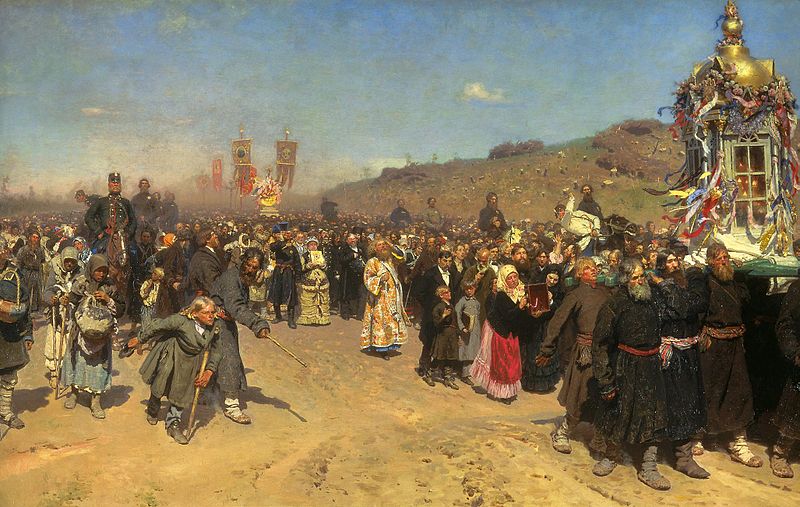
Among his most famous paintings are “Barge Haulers on the Volga” (1873);  “Unexpected Visitors,” shown above; “Religious Procession in Kursk Province” (1883), shown below; and “Reply of the Zaporozhian Cossacks” (1880-91).

“Religious Procession in Kursk Province”

“Religious Procession in Kursk Province”

The above painting strongly reminds me of the fiction of Nikolai Leskov, one of my favorite (and least well-known) Russian writers.