
The Six Lost Tribes of the Confederacy

Robert Reich, Dartmouth Class of 1966

Robert Reich, Dartmouth Class of 1966

I knew Robert Reich when we were in the same graduating class at Dartmouth College. I was the film critic for the school newspaper, and Robert was a cheerleader for the football team. He probably doesn’t remember me (there were 800 of us in that class), but I remember him. The important thing is that he has become a powerful voice for the direction that American politics should take.

What, exactly, does that mean as far as the GOP is concerned? According to Robert’s website, the Republican party has splintered into six not altogether compatible factions:

  1. “Evangelicals opposed to abortion, gay marriage, and science.” That would include Ted Cruz, Mike Huckabee, and Rick Santorum.
  2. “Libertarians opposed to any government constraint on private behavior.” That would be Rand Paul.
  3. “Market fundamentalists convinced the ‘free market’ can do no wrong.” Most of them pay lip service to this statement, though if Mike Bloomberg decided to run, this would be his mantra.
  4. “Corporate and Wall Street titans seeking bailouts, subsidies, special tax loopholes, and other forms of crony capitalism.” Enter Donald Trump.
  5. “Billionaires craving even more of the nation’s wealth than they already own.” Trump again, plus other candidates feeding from the billionaire-funded PACs.
  6. “And white working-class Trumpoids who love Donald. and are becoming convinced the greatest threats to their wellbeing are Muslims, blacks, and Mexicans.” Well, now, this one is pretty obvious.
This is Just One of the Faces of Today’s GOP

This is Just One of the Faces of Today’s GOP

You could take all the remaining candidates and map them by their emphasis on one of these six strains. What makes their races so difficult is that many of the candidates tend to lose their focus when they are split so many different ways.



Rat Number 42


Sometimes, You Just Can’t Win

Sometimes, You Just Can’t Win

The following comes from AboveAverage.Com. I thought you might find it amusing:

Researchers at Harvard are incredibly annoyed with a lab rat they describe as “a real asshole.”

“We’re trying to research how obesity impacts brain function,” explained Dr. Stu Macho. “To do that, we got all these normal rats and started observing them. Then this little fucker, we call him #42, starts eating a ton. He got super fat and starts walking into his cage walls like a moron when we try to observe him. But then, at night, he’s completely normal. It’s totally throwing off our data. He’s being a real shithead.”

shutterstock_365565182

I mean, look at this little shithead.

This isn’t the first time #42 has ruined an experiment. Dr. Macho explains, “I once ran an experiment to test whether the scent of cats was frightening to rats. We gave them a treat every time they pushed a big red button. Then we sprayed it with cat scent. Literally every single rat was too scared to push the red button, except #42. He pushed it, winked, and then held his little paws out for his treat. He’s such an asshole, his data screwed my entire thesis.”

Dr. Macho believes #42’s behavior is intentional and aimed specifically at him. “I caught him laughing at me once while I was trying to sort data he’d fucked up. I know what you’re thinking, ‘Can rats even laugh? And what would it look like?’ Trust me, when a rat laughs at you, you’ll know.”

When asked why he doesn’t simply exchange #42 for a less malicious rat, Dr. Macho explained, “You can’t just use an infinite number of lab rats. They start to think you’re a psycho if you keep asking for more.” Dr. Macho sighed. “I feel like I’m living in an annoying Pixar movie where I’m the bad guy – oh, wait….I’m the bad guy. I’m the evil scientist performing experiments on a sassy, smart rat. And my name is Dr. Stu Macho? Oof, yeah, I’m the wrong one here.”

Just behind Dr. Macho, #42 winked and walked directly into his food bowl.

What Have Billionaires Done for Us Lately?

Trump with His Plane

Trump with His Plane

There is a certain category of voter who thinks we need a businessman at the helm of this country. Do we? What have businessmen done for us lately?

Perhaps their biggest contribution has been to send American jobs overseas. My father used to be a machine tool builder in Cleveland. Now there is an ever-dwindling number of machine tool builders in the United States. Plenty of them in Southeast Asia, however!

If a hypothetical President Trump were in charge, what might he do? For starters, he could send less desirable (i.e. Democrat) voters to Syria, Libya, and Somalia—countries which are in the process of being rapidly depopulated.

He can raise his salary and create new perks for his office. (Isn’t that what billionaire businessmen do best?)

He could find sneaky ways of making his investments worth more (and those of his competitors worth less).

Really, in the end, all American CEOs care about is me, Me, ME, ME! After all, they didn’t get rich by helping losers. And we are all losers, aren’t we?


Hijacking The Presidential Race

Antonin Scalia (1936-2016)

Antonin Scalia (1936-2016)

The 2016 election has quite suddenly morphed into a struggle for control of the U.S. Supreme Court. If the Republicans refuse to fill Scalia’s seat with a new Obama nominee until the inauguration of a new president next January, then they will be openly guilty of sabotaging the Constitution so that their minority party can control the country. As you may recall, that has been tried before in 2013 when John Boehner and Mitch McConnell staged a shutdown of Congress.

Republicans like to think that most Americans are conservatives. That is true to some extent, especially where fiscal issues are concerned, but untrue when it comes to cultural issues. And that divergence can only be expected to grow as the aging angry white population of the U.S. dies off.

The Dragon and the Monkey

Dragon

Dragon

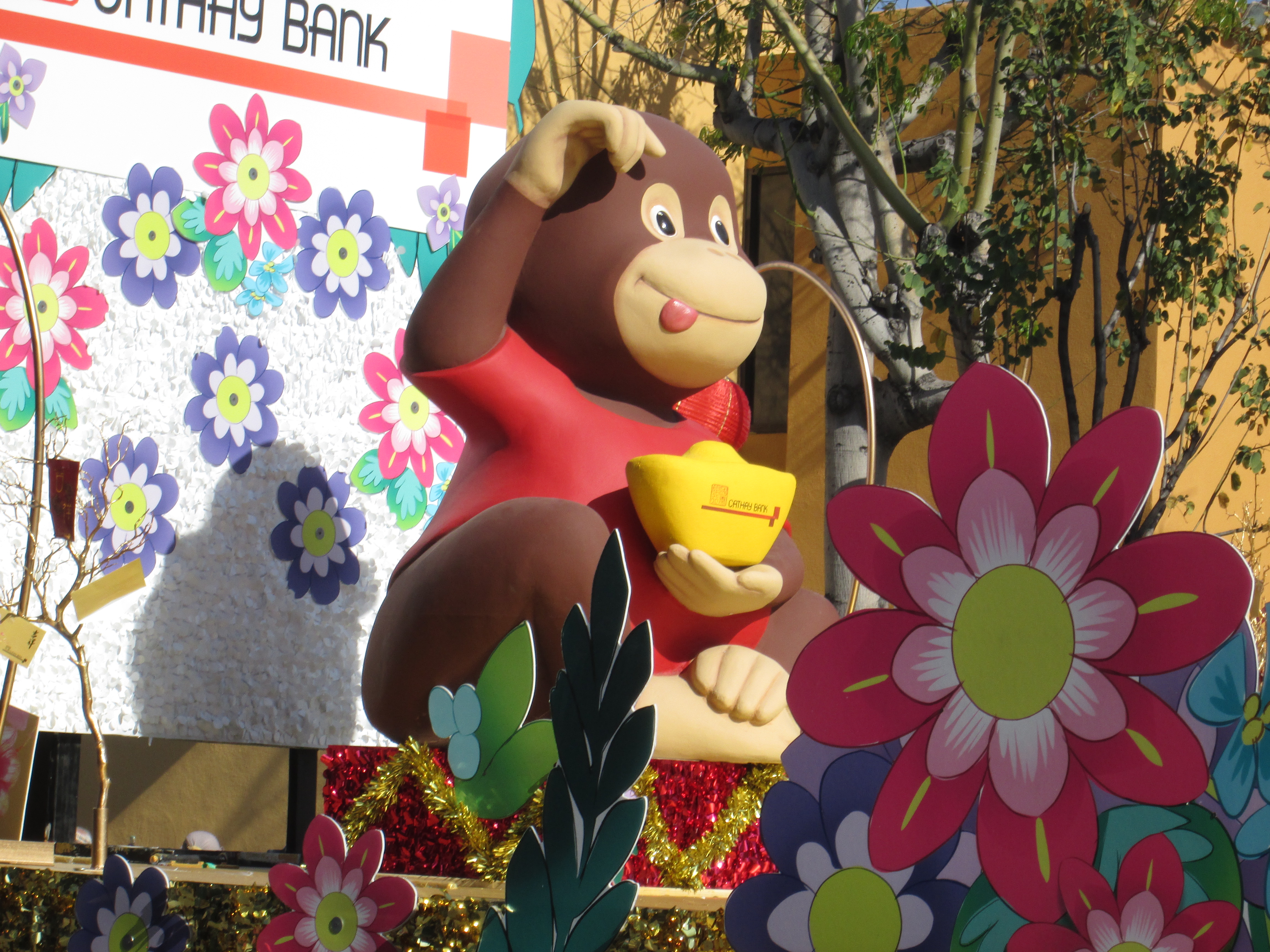
Today, for the first time in two or three years, Martine and I attended the Golden Dragon Parade in Chinatown to celebrate the new Year of the Monkey. It turns out that I was born in the Year of the Monkey, but according to Chinese astrology, this may not be a lucky year for me. Fortunately, I do not believe in any kind of astrology.

Martine, on the other hand, was born in the Year of the Dragon, which means that we are complementary. But I am convinced that we are complementary for other reasons than those picked by astrologers.

Monkey

Monkey on Cathay Bank Float

To avoid various construction and marathon race snarls, we took the bus downtown and went to our usual Chinatown restaurant, the Sala Thai on Alpine Street. I had a spicy fish filet with basil and peppers, and Martine had her usual pad see ew with chicken and broccoli.

Even though the parade was fraught with symbolism which we didn’t altogether understand, we had a great time.


Flea-Bitten Empire

With the Legions Came Another Invader ....

With the Legions Came Other Invaders ….

According to an article in The Guardian, we tend to give a lot of credit to the Romans for cleanliness and hygiene. What is not commonly associated with them are “lice, fleas, bed bugs, bacterial infections from contamination with human feces, and 25ft-long tapeworms, a misery spread across the empire by the Roman passion for fermented fish sauce.”

But what about all those Roman baths? Well, how often was the water changed? Or did the bathers regale themselves in a bacteriological soup until the bucket brigade of slaves renewed the water? Unchanged water “left the bathers swimming in a warm soup of bacteria and the eggs of parasites such as roundworm and whipworm.” Then, too, many simply bathed themselves in olive oil, which was cleaned off with a strigil, an kind of scraper with a curved blade used to scrape sweat and dirt from the skin in a hot-air bath or after exercise.

Roman Baths

Roman Baths

And what about those tapeworms? Here the culprit was the Romans’ use of a fermented raw fish sauce called garum. According to Piers Mitchell, from whose article in The Journal of Parasitology this information is derived: “Wrapped around the Romans’ intestines …, the parasites could remove nutrients from food before it could be digested, which could cause severe or even fatal anaemia. Evidence from some Roman sites in Italy revealed that up to 80% of the child skeletons had evidence of severe anaemia.”

Another common source of ill health was the use of human feces to fertilize vegetable gardens. If the human wastes were allowed to compost for a year or more, there would be no danger from bacteriological infections; but there is no proof that the Romans knew of this.

Archaeologists found that the Romans with their baths were no freer from infection and worms and such like than the supposedly more primitive Vikings.

Sic transit gloria Imperii!

Tannu Tuva or Bust!

Very Nice, But There Were No Railroads in Tuva

Very Nice, But There Were No Railroads in Tuva

One of the things I remember most vividly from my stamp collecting days was the availability of postage stamps for non-countries. These were for real places on the map, but not for entities that had their own postal services. The one I remember most vividly is Tannu Tuva (formerly in the Soviet Union).

According to Wikipedia:

Tuva was a region in central Asia between Russia and Mongolia, which in 1921, under Russian instigation, became the Tuvan People’s Republic. A treaty between the Soviet Union and the Mongolian People’s Republic in 1926 affirmed the country’s independence, although no other countries formally recognized it. In 1944, it was annexed to the Soviet Union as part of the Tuvan Autonomous Oblast and in 1961 became the Tuva Autonomous Soviet Socialist Republic. Its successor since 1992, the Tuvan Republic, is a member of the Russian Federation.

I remember reading a book in the 1990s about American physicist Richard Feynman’s failed attempts to visit Tuva, which were detailed in a book by Ralph Leighton entitled Tuva or Bust!: Richard Feynman’s Last Journey. Apparently he never got a visa approval before his final illness.

Some early Tuvan stamps may actually have been used postally, at least in the early days. Most, however, were issued in Moscow with picturesque settings to hard currency from capitalist collectors for Mother Russia. The stamp pictured above of a camel racing a railroad train was a bit fanciful, as there are no railroads in Tuva. Also, why wasn’t the text on the stamp in Cyrillic or even Mongolian letters?

I remember confronting an old family friend about his extensive collection of Tuvan postage stamps. A former postal employee, he became red in the face when told by a little boy that his Tuvan stamps were merely pretty paper.


Ocean Park

In His Case, I’ll Make an Exception

In His Case, I’ll Make an Exception

It was my friend Lynette who opened my eyes to the “Ocean Park” series of abstract paintings by Richard Diebenkorn (1922-1993). Ordinarily, I dislike nonrepresentational art; but in Diebenkorn’s case, I’ll make an exception. He moved in Los Angeles around the same time I did, and I found his choice of colors reminded me of the Santa Monica neighborhood after which this series is named.

Usually, colors alone do not mean much to me. In the case of Mark Rothko, for example, they mean less than nothing. In “Ocean Park #40” above, I could probably find something like that particular pattern somewhere along Ocean Park Boulevard.


Ocean Park #105

Ocean Park #105

The same goes for “Ocean Park #105” above.

I wonder, if the color scheme of an abstract painting suggests something to me, can it really be said to be abstract at all?

Adventures in Stamp Collecting

20 Fillér Stamp Honoring Hungarian Radio Manufacturing

20 Fillér CTO Stamp Honoring Hungarian Radio Manufacturing

One would think that nothing can be so staid and stolid a pastime as stamp collecting. Mind you, it’s getting increasingly difficult since most stamps—in the U.S. anyway—are of the peel and stick variety. As a child, I remember soaking stamps still attached to pieces of envelope and postcard in lukewarm water to remove the gum. Then I carefully dried the stamps under a blotter weighted down with a book so the stamps wouldn’t curl. The end result was pretty presentable.

But then the Soviet block discovered CTO—short for canceled to order—with perfect cancellations that were printed right on the stamp which came without gum. In effect they were mint ungummed stamps.

Of course, mint never used stamps were more expensive. Putting them in albums caused a certain amount of existential angst. One could use a stamp hinge, but (horrors!) it left a mark on the gum. The option was to buy expensive mounts in which the mint stamps were wholly encased.

My guess is that there are relatively few stamp collectors left, and that they are mostly aging rapidly. What with smart phones and their ilk, kids are not interested in anything that requires patience, knowledge, and care. Too bad! I learned a lot from my old hobby and had lots of fun.

This is the first of several posts under the general heading of “Adventures in Stamp Collecting,” consisting of stories I remember from my collecting days.

Some of these stories are more interesting than they seem at first glance.

Serendipity: A Snark-y Response

The Snark at the Dock

The Snark at the Dock

The following comes from the Foreword of Jack London’s The Cruise of the Snark:

Our friends cannot understand why we make this voyage.  They shudder, and moan, and raise their hands.  No amount of explanation can make them comprehend that we are moving along the line of least resistance; that it is easier for us to go down to the sea in a small ship than to remain on dry land, just as it is easier for them to remain on dry land than to go down to the sea in the small ship.  This state of mind comes of an undue prominence of the ego.  They cannot get away from themselves.  They cannot come out of themselves long enough to see that their line of least resistance is not necessarily everybody else’s line of least resistance.  They make of their own bundle of desires, likes, and dislikes a yardstick wherewith to measure the desires, likes, and dislikes of all creatures.  This is unfair.  I tell them so.  But they cannot get away from their own miserable egos long enough to hear me.  They think I am crazy.  In return, I am sympathetic.  It is a state of mind familiar to me.  We are all prone to think there is something wrong with the mental processes of the man who disagrees with us.

The ultimate word is I LIKE.  It lies beneath philosophy, and is twined about the heart of life.  When philosophy has maundered ponderously for a month, telling the individual what he must do, the individual says, in an instant, “I LIKE,” and does something else, and philosophy goes glimmering.  It is I LIKE that makes the drunkard drink and the martyr wear a hair shirt; that makes one man a reveller and another man an anchorite; that makes one man pursue fame, another gold, another love, and another God.  Philosophy is very often a man’s way of explaining his own I LIKE.