The Sturgeon Moon

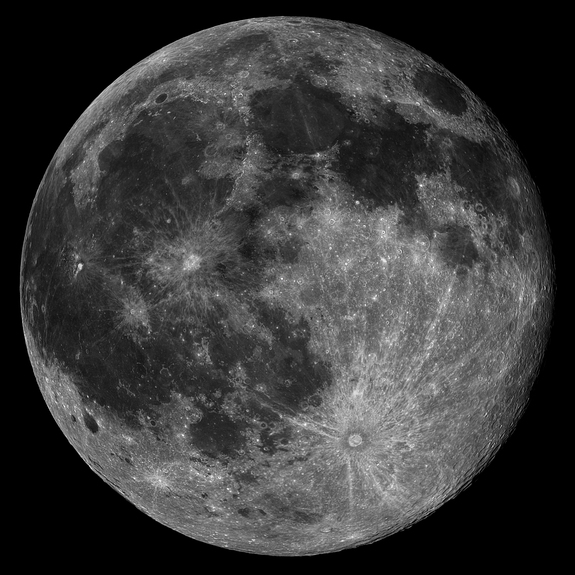
Today Marks the Sturgeon Moon

Today—August 18—Marks the Sturgeon Moon

There is a separate name for every full moon of the year. No doubt you’ve heard of the blue moon, when there are two full moons in a single month. That, however, is more a trick of the calendar than of anything else.

The sturgeon moon of August 18 is also called the red moon. the grain moon, the green corn moon, and the blueberry moon.

According to the Farmer’s Almanac, here are some other full moon nicknames:

  • January: The Wolf Moon
  • February: The Snow Moon
  • March: The Worm Moon
  • April: The Pink Moon
  • May: The Flower Moon
  • June: The Buck Moon
  • August: The Sturgeon Moon
  • September: The Corn Moon or the Harvest Moon
  • October: The Hunter’s Moon or the Harvest Moon
  • November: The Beaver Moon
  • December: The Cold Moon or the Long Nights Moon

Since the Indians did not use the Gregorian Calendar, they would not be troubled by the Blue Moon. After all, it only happens once in a Blue Moon.

Wheels

Hoverboard

Hoverboard

I have seen it coming over the years, the burgeoning diversification of wheeled transport for young people. When I first came to L.A. late in 1966, there was a concert film (which included the Rolling Stones) called The T.A.M.I. Show, which was filmed in 1964. It began with a prologue of a couple of young skateboarders rolling down a steep street in what looked like Pacific Palisades. I have even seen a few motorized skateboards recently that look clearly illegal, but their owners must think they are powerful chick magnets.

Of course, bicycles have been around since the 1800s, but now they are getting ever more popular, with occasional street closures called CicLAvia. (I remember getting stuck on Venice Boulevard in Mar Vista for over half hour during one of those.)

Next were inline skates, which infuriated bikers because skaters wound up taking too much of the lateral space in bicycle lanes as they moved from side to side.

Although scooters have been around since my childhood, the Razor scooter came in around 1999. (BTW, I’ve seen a few motorized versions of this as well.) Around the same time, the first Segways started coming out. And we mustn’t forget the infamous hoverboard, which is under fire for safety reasons.

I hesitate to think of what’s next. Unfortunately, the devotees of all these modes of transportation act as if they were the only game in town. Their devotees like to get into “the zone” as they speed up past all obstacles, such as stop signs, traffic signals, and unwary pedestrians.

Perhaps it’s like the United States as a whole, which is rapidly fragmenting into ever smaller subsets of wheeled transportation. In future, will there be separate lanes for pogo sticks? Will toddlers’ strollers be motorized and driven by their occupants? Will little red wagons ever come back?


Looking Back at Art Deco

Imaginative Reconstruction of an Art Deco Apartment

Imaginative Reconstruction of an Art Deco Apartment

Art Deco was born in France in the period immediately after the First World War and lasted roughly up to the start of the Second World War. According to British art historian Bevis Hiller, it was “an assertively modern style [that] ran to symmetry rather than asymmetry, and to the rectilinear rather than the curvilinear; it responded to the demands of the machine and of new material [and] the requirements of mass production.” Its name comes from the French Arts Décoratifs, from the 1925 Exposition Internationale des Arts Décoratifs et Industriels Modernes held in Paris.

It was not an art of the people. Rather it was associated with the wealthy, for whom optimism is a kind of religion. According to Wikipedia, it “represented luxury, glamour, exuberance and faith in social and technological progress.”

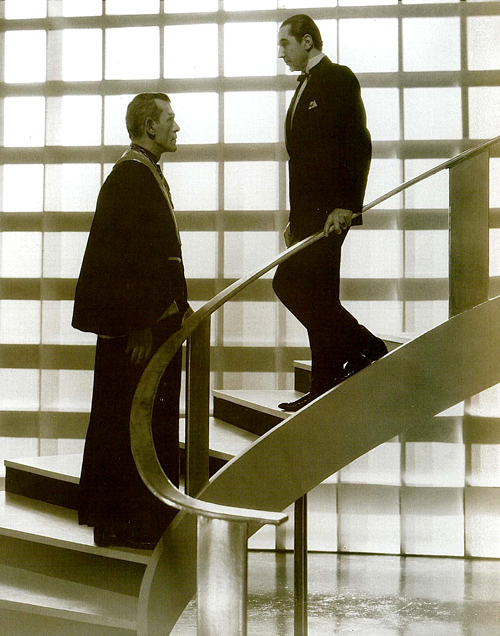
Our visit to the Mullin Automotive Museum in Oxnard last Saturday set me to thinking: To whom did Art Deco really belong? I am reminded of the strange mansion set of Edgar G. Ulmer’s The Black Cat (1934) starring Béla Lugosi and Boris Karloff as Hjalmar Poelzig, the archetypal Art Deco man.

Art Deco Domestic Architecture in The Black Cat (1934)

Art Deco Domestic Architecture in The Black Cat (1934)

There were even Art Deco print fonts, such as the following:

Art Deco Type Font

Art Deco Type Font

Think about the lavish movie sets of the Fred Astaire and Ginger Rogers movies, set in lavish Art Deco hotels in Europe and elsewhere. These were not places where people such as myself would feel highly uncomfortable. It was a world of tuxedos, butlers, fantastic dance floors, and a spic-and-span shine that almost glistened. It was “high tech” for the technology that was then extant, which manifested itself in the luxury French automobiles on display at the Mullin Museum.

Some of it filtered down to the middle class, but for the most part it represented an aspiration to empyrean social realms beyond the reach of most people.

Still, it could be incredibly beautiful, as in the paintings of Tamara de Lempicka, architecture such as the Chrysler Building in New York, industrial design, textiles, jewelry, and—of course—the cinema. I believe that we are just beginning to understand this movement.

Tamara in a Green Bugatti

Self Portrait in a Green Bugatti

Self Portrait of the Artist in a Green Bugatti (1929)

One of the discoveries I made at the Mullin Automotive Museum in Oxnard yesterday was an Art Deco painter by the name of Tamara de Lempicka. There it was, next to all those beautiful Bugatti automobiles of the 1920s and 1930s: A self portrait of the artist in a green Bugatti. (Although Wikipedia states that the painting is in a Swiss private collection, it seems that Peter W. Mullin brought it, or a passable copy of it, for his museum.

There is something about the smug look on the subject’s face behind the wheel of a luxury automobile that struck me as the epitome of Art Deco. According to the Wikipedia article on her:

Lempicka became the leading representative of the Art Deco style across two continents, a favorite artist of many Hollywood stars, referred to as ‘the baroness with a brush’. She was the most fashionable portrait painter of her generation among the haute bourgeoisie and aristocracy, painting duchesses and grand dukes and socialites. Through her network of friends, she was also able to display her paintings in the most elite salons of the era.

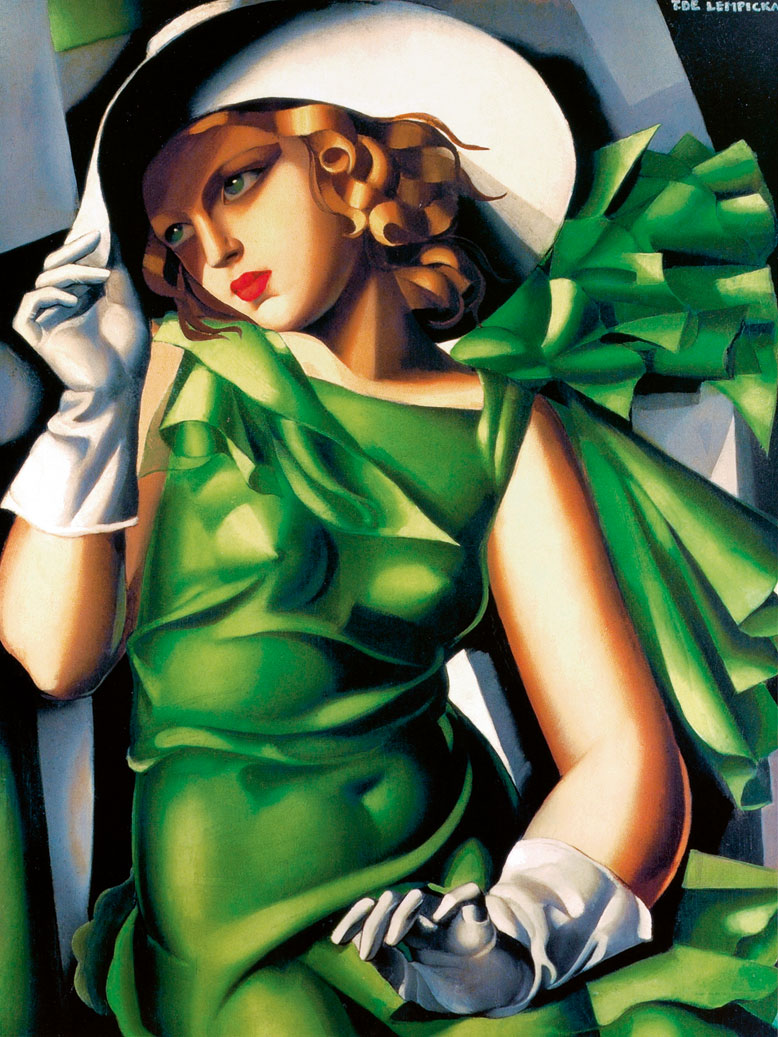
Below are two of her other paintings to give you some idea of her work:

Woman in Green

Woman in Green

There is usually a strong facial resemblance in many of her female subjects. All three of these paintings could be described as self-portraits.

Portrait of Mme Allan Bott at Saint-Moritz

Portrait of Mme Allan Bott at Saint-Moritz

“The Pinnacle of 20th Century Art and Design”

A Museum Dedicated to the Art of the French Automobile 1900-1940

A Museum Dedicated to the Art of the French Automobile 1900-1939

Oxnard, California, is blessed with two world-class automobile museums less than a mile from each other. Martine and I had visited the Murphy Auto Museum twice so far this year. It was a little more difficult to visit the Mullin Automotive Museum, mainly because it is open for tours only twice a month by reservation only.

The Mullin Automotive Museum was founded by Peter W. Mullin, an American businessman and philanthropist, who, early on, fell in love with French autos, particularly the Bugatti (which was 100% French despite the Bugatti family’s Italian origins).

Bugatti Hood Ornament

Bugatti Hood Ornament and Grill

The cars at the museum were a revelation. According to the museum’s founder:

For me the French automobiles of the 1920s and 1930s represent the pinnacle of 20th century art and design—the artistic realization in steel, leather, and glass of a modern idea created at a moment when hand craftsmanship embraced the machine, and a spirit of optimism fueled an explosion in artistic and technical development. As an avid collector, the preservation of these rolling sculptures for the enjoyment of future generations is both a responsibility and a pleasure. I relish the stewardship and preservation of their exciting histories.

Surrounding the automobiles along the outer walls is a world class exhibit of art nouveau and art deco works, including paintings, sculptures, and furniture—to to mention some of the neatest hood ornaments I’ve ever seen.
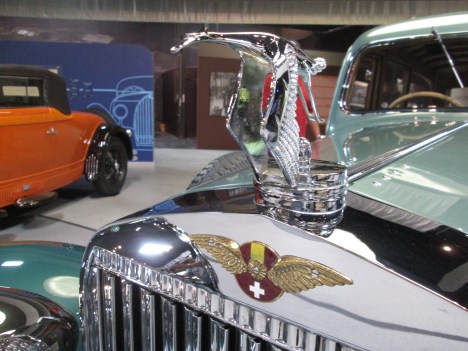
Flying Hood Ornament

Flying Hood Ornament

I was so impressed not only with the cars and the artwork that I plan on doing one or more follow-up blogs. Martine and I showed up at opening time (10 AM) and had to be ushered out at closing time (3 PM). We plan on returning in a number of months, when they have changed their exhibits.

Below is view of the exhibit floor, which is designed to resemble the original Paris automobile salons of the early 20th century, complete with signs indicating the major “exhibitors.”
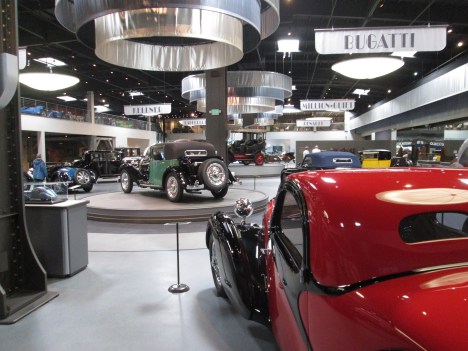
The Exhibit Floor

The Exhibit Floor


To avoid getting stuck in beach traffic, we returned home via California 126, stopping at Cornejo Produce in Fillmore for some fresh locally-gown produce.


The Avila Adobe

In the Middle of Olvera Street, L.A.’s Oldest Still-Existing House

In the Middle of Olvera Street, L.A.’s Oldest Still-Existing House

In my semi-retirement, I’ve taken to going downtown at least once a week and doing some exploring. Today, I started out at the Central Library reading Claude Izner’s In the Shadows of Paris, set in the City of Lights back in the 1890s.

I picked out a volume of Charles Bukowski’s letters in the literature section and checked it out, making my way to Meeting Room A at 12:30 for something completely different: A guided session on meditation by Giselle Jones. It was super-relaxing. I will look out for other meditation events at the Library.

Then it was on to Dash Bus B to Olvera Street. I had a hankering for some more of Cielito Lindo’s taquitos and chile rellenos. Yum! They were even better than last time.

Finally, I paid a visit to the oldest surviving house in Los Angeles: The Avila Adobe. Although L.A. was first settled in 1781, all the houses were destroyed by the ravages of time, except for the Avila Adobe, which was built in 1818 by Francisco Avila, one of the city’s earliest alcaldes (mayors). The house was an oasis of calm amid the frantic crowds looking to buy souvenirs.

From there, it was a short walk to the bus stop for the Santa Monica Big Blue Bus #R10 to return home.

The Black Finger Cult

Indulging in Past Favorites

Indulging in Past Favorites

Not two weeks ago, I wrote a post about one of my favorite Japanese actors, Raizo Ichikawa, particularly as he appeared in a 1960s series called variouslythe Kyoshiro Nemuri films and “The Sleepy Eyes of Death.” Since then, I checked out eBay and found that the whole series of twelve films was available for just over a hundred dollars in Zone 1 DVD format. Naturally, I wasted little time in buying the set.

Tonight, I watched my favorite title, Trail of Traps (1967) directed by the underrated Kazuo Ikehiro. I sat entranced as Kyoshiro walked his way between Tokyo (called Edo in those days) and Kyoto, carrying a statue of the Virgin Mary for safekeeping. Along the way, he is seduced several times—Kyoshiro is, after all, an anti-hero—and attacked by a group of devil worshiping baddies who call themselves the Black Finger Cult.

It’s nice to feel the same way after almost half a century about a film one loved to distraction back in the day. Raizo Ichikawa was indeed an excellent actor, and the Daiei Studio people did a great job putting the series together.

Too bad Raizo had to die so young. I think he was even more promising than James Dean.


The Game Face of Death

Michael Phelps Introduces a New Rio Meme

Michael Phelps Introduces a New Rio Meme

While waiting for his next event, U.S. swimmer Michael Phelps assumed the Great Stone face of Death, concentrating hard on his next medal(s). You may recall the 2012 London Olympics, when the award for best Oly-Meme went to gymnast McKayla Maroney, though hers was the “Not Impressed” face while the Phelpser went all-round death glare.

McKayla maroney Is Not Impressed

McKayla Maroney Is Not Impressed

Eve Babitz and the Taquitos

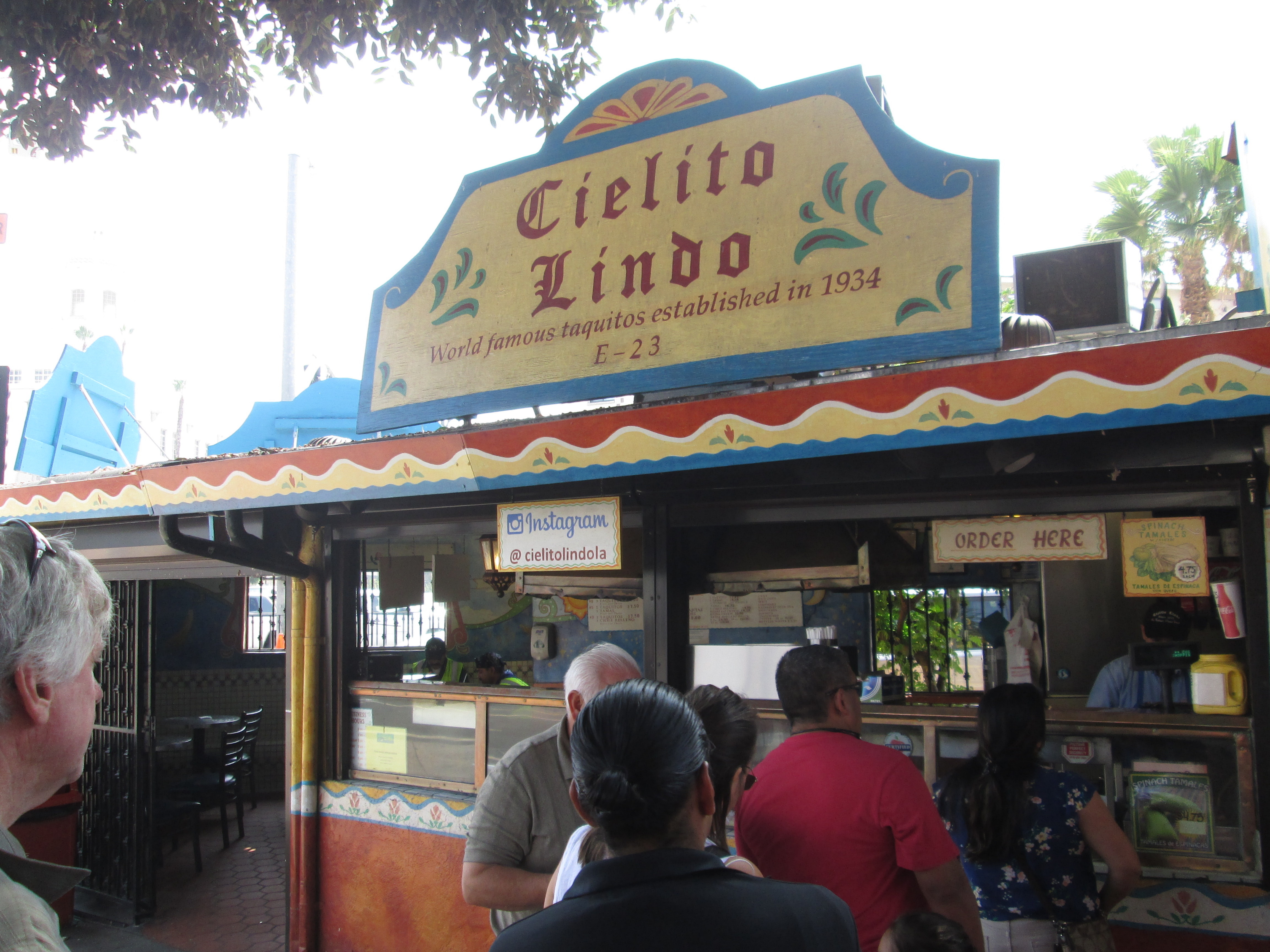
Cielito Lindo, Specializing in Beef Taquitos on Olvera Street

Cielito Lindo, Specializing in Beef Taquitos on Olvera Street

As I was visiting the Taste of Ecuador Festival by Olvera Street yesterday, I decided to find the place that Eve Babitz writes about in her book Eve’s Hollywood about what could have kept rock star Janis Joplin from OD’ing. Toward the end of the book is an essay entitled “The Landmark,” which she dedicated to food writer M. F. K. Fisher. She starts at the very beginning of Los Angeles:

In 1781 a Franciscan with 24 ex-cons and runaway slaves decided to name something that didn’t exist La Ciudad de Nuestra Signora [SIC] La Reina de Los Angeles and proceeded to build a church and a street called Olvera Street. The church and the street are still there, preserved by this huge city called L.A. as a landmark from when one street was named the City of Our Lady, Queen of the Angels. The street is uneven and bricky and lined with terrific shops where you can get things you think you want, cheap. And taquito stands for in case you get hungry. Taquitos are much better than heroin, it’s just that no one knows about them and heroin’s so celebrated.

Now Eve’s book was written over forty years ago. I decided to see if I could find her favorite taquito stand, which she describes as follows: “The best place to get them [taquitos], though they are also sold in other places throughout the mall, is the place on the Northeast part of Olvera Street.”

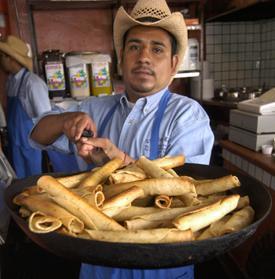
Making Taquitos at Cielito Lindo

Making Taquitos at Cielito Lindo

It just so happens that the Northeasternmost restaurant on Olvera Street is Cielito Lindo (“My Little Beautiful Heaven”), which has been around since 1934 and specializes in taquitos in a way that none of the other restaurants on the Street do. Once again, Eve continues:

They have black frying pans with long handles that are about a foot and a half in diameter and have sides that flare out about 3 inches high so that oil won’t hit the cook. With metal prongs, the guy lays the raw taquitos neatly in the oil over a fire of coal that produces a heat of such intensity that blast-furnace clouds encompass the buyer as he watches the taquitos cook and the guy turns them over when they are done on one side.

Except for the coal fire, which is now probably against some city health or safety regulation, that’s pretty much what I saw at Cielito Lindo, such that I am 100% sure that this is the place to which Eve would have directed Janis Joplin to keep her from that nasty heroin.

By the way, the taquitos were delicious. I will return there for more. Their chile rellenos are pretty good, too.


Ecuador in Los Angeles

Flag at 18th Annual Taste of Ecuador Food festival

Flag at 18th Annual Taste of Ecuador Food Festival

I noticed that there was going to be an 18th Annual Taste of Ecuador Food Festival downtown today, so after I walked uphill on the treadmill for an hour at the gym, I grabbed the Santa Monica #10 Freeway Flyer Bus to Union Station. I had attended one of these events two or three years ago, so I knew pretty much what was going to be there.

According to the organizers, there are some 5,000 Ecuadorians in Los Angeles.

I ate a sanguche de chango (pork sandwich on a bolillo roll) that tasted pretty good, and washed it down with a licuada de sandía (watermelon drink).

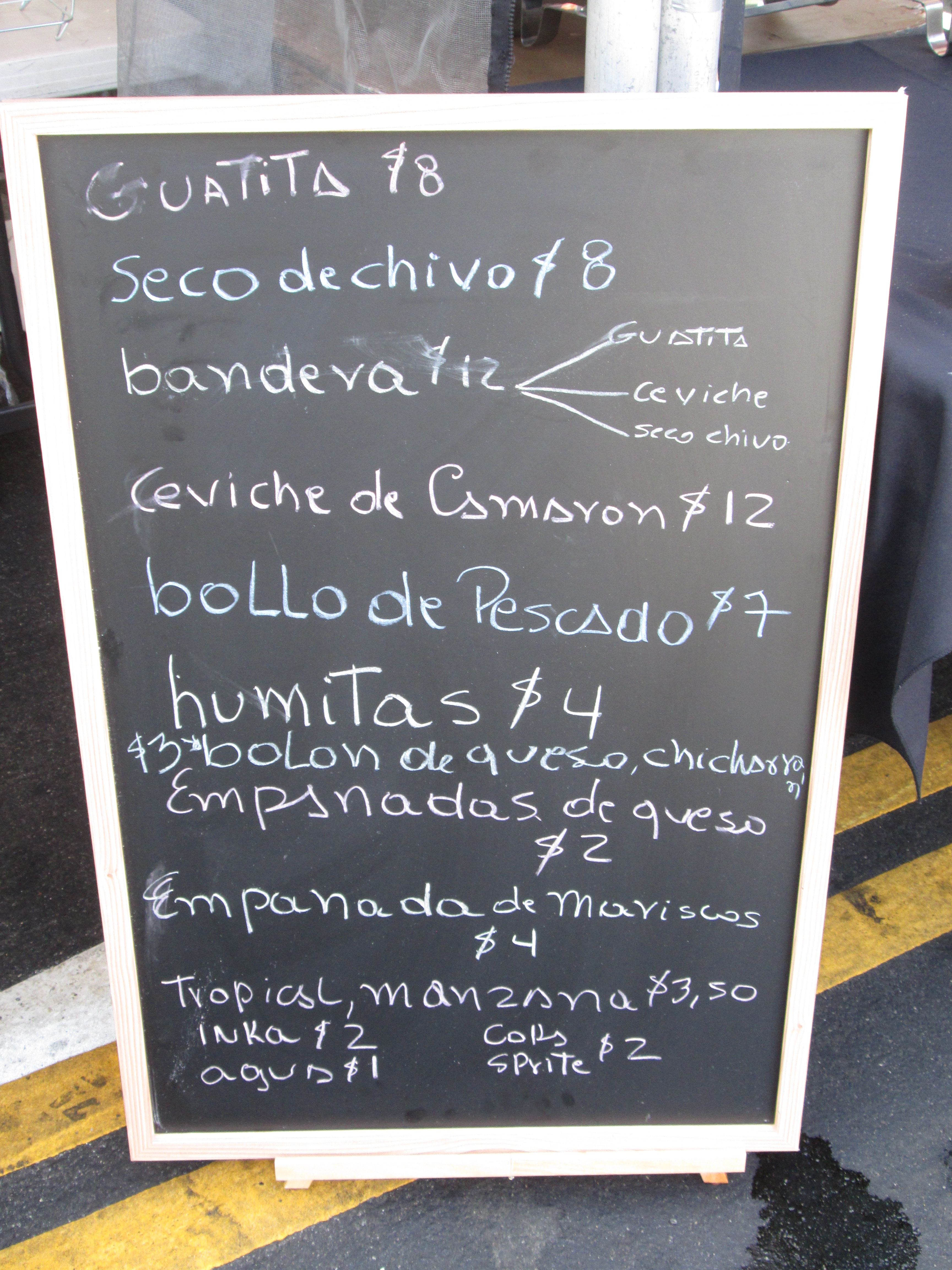
Below is a typical menu from one of the stands:


Ecuadorian Menu at Food Stall

Ecuadorian Menu at Food Stall

Notice the reference to Inka Cola at the bottom of the menu. It is the most popular soda pop of Peru and Ecuador, though it tastes sort of like Mountain Dew on steroids.

On sale at a couple stands were Ecuadorian soccer football jerseys with the national colors.

It wasn’t much, but it’s a reminder that Dan and I are heading down to El Mitad del Mundo in a couple of months.