Would You Spend Your Afterlife With This Guy?

Marshall Applewhite, Alias “Do”

We are coming up on one of those sad anniversaries with which our history as a nation is crowded. Twenty years ago, the Heaven’s Gate cult committed mass suicide in a Rancho Santa Fe, California mansion. The members of the cult believed that, in the wake of the comet Hale-Bopp was a spaceship that was going to taken them to heaven. They dressed in black track suits with patches that said “Heaven’s Gate Away Team.” They also wore identical Nike Decade sneakers and took enough amphetamines with vodka to send them into another world, though probably not heaven.

Their leader was one Marshall Applewhite, who went by the name “Do”—and, yes, he did himself in as well. Looking at his picture (above), would you give your life for this obvious flake? Apparently thirty-nine people did, most of them in their forties, at an age when presumably they should have known better.

Logo From the Heaven’s Gate Website

The website of the group is still in existence, maintained by a couple who used to be members, but transgressed by getting married. It has a very 90s look to it, but then the group didn’t survive the decade. According to an article in today’s Los Angeles Times:

Several hundred people joined the group over the years, although the vast majority left for a variety of reasons. Some who left came back. Those who remained to the end were largely longtime devotees. Twenty-one were women, 18 men. They ranged in age from 26 to 72, with more than half in their 40s.

Almost all of them were veteran seekers of spiritual truths, people who had tried other religions, tried tarot cards, tried hallucinogenic drugs.

So when comet Hale-Bopp began to arrive, it was time to check out.


Originalism

It’s Not Like They Were Gods

One thing I do not understand is the judicial principle of originalism, according to which we have to somehow divine the intent of our Founding Fathers. That strikes me as rather silly. Take Thomas Jefferson and John Adams, for example. While Jefferson was Adams’s Vice President, he did everything possible to subvert him, including hiring a yellow journalist named James Callender to attack Federalist positions. This was at a time when the winner for President was forced to take the loser as his Vice President. And that was written in the Constitution! (It was not until later in life that Adams and Jefferson were reconciled, and they both wound up dying on July 4, 1826, fifty years to the day after the Declaration of Independence.)

If two of our Founding Fathers were such enemies, how is it possible to arrive at any consensus by reading their long-dead minds regarding the problems of the 21st Century. Remember, these same Founding Fathers were forced to accept slavery. Perhaps Trumpf’s nominee to replace the late Antonin Scalia, Neil M. Gorsuch,  would be more comfortable if slavery were reinstated.

Will we all have to wear powdered wigs and take snuff? Do we have to give up the automobile in favor of the horse and buggy? Would we have to give up the Internet and our whole telecommunications network just because some judge has this jones about some long dead politicians, as great as they were in the context of their own times.

From Point A to Point B

UPS Freight Jets

There is a growing branch of literature which consists of nonfiction. How is that possible? The Nobel Prize for Literature in 1996 was awarded to Svetlana Alexievich of Belarus for her work, which consists primarily of interviews of people affected by the nuclear accident at Chernobyl or the Soviet War in Afghanistan. As for Americans, we have John McPhee, who has written a series of nonfiction works of high literary quality.

I have just finished reading his Uncommon Carriers, which deals, in turn, with long-haul truckers; a place in France where ships’ pilots are trained; boats that tow barges on American rivers; the parcel sorting services of UPS; and mile-and-a-half-long coal trains. In between, there is a delightful essay by the author about retracing the route of Henry David Thoreau and his brother John described in A Week on the Concord and Merrimac Rivers—which I had read when it was first published in the New Yorker.

McPhee likes to take what looks like a boring subject that nobody would write about and turn it into a gem. For instance, there is that tetralogy he wrote about American geology beginning with Basin and Range and ending with Assembling California. One would think that McPhee’s books might be a tad boring, but they never are.

To date, I have read—in the order of publication—the following ten McPhee titles:

  • The Crofter and the Laird
  • Pieces of the Frame
  • Giving Good Weight
  • Basin and Range
  • In Suspect Terrain
  • La Place de la Concorde Suisse
  • Rising from the Plains
  • The Control of Nature
  • Looking for a Ship
  • Uncommon Carriers

There’s not a single boring read in the bunch. Each McPhee I read whets my appetite for more.

Computer Security Gone Wild

That Is 4 Sure!

As an IT specialist, I am surrounded by hundreds of passwords for our computer network and its users. Every system seems to have its own requirements, with financial institutions being the most demanding:

  • One or more capital letters
  • Several lower case letters
  • One or more numbers
  • One or more special characters (!@#$%^&* etc.)

As if that weren’t bad enough, some systems require you to change passwords every 90 days or so. Now the IRS has gotten involved: Users of accounting systems that store Social Security Numbers and Federal Tax IDs are required to create passwords that comply with the standards enumerated above, and moreover change them at 90 day intervals.

What is a good password? As the illustration above indicates, length is probably the best attribute. There is a fun website called How Secure Is My Password? that is fun to use. Given any password you type in, it tells you approximately how long a computer can crack it. Let’s enter a password called, simply enough, “password.” Your password would be cracked instantly. Let’s say your password is “Longer Passwords Make Stronger Passwords.” That would take a computer 89 septendecillion years to crack. You get the general idea. (I think it would actually be cracked sooner, because computers are always getting faster.)

Some people think that using letter/number substitutions such as “4“ for “for” or “B100dy Pa55w0rd5!” for “Bloody Passwords!” would do the trick. Not really. Not when a hacker uses brute computing force to check all possible letter/number/special character permutations. And these artificial passwords are always harder to remember. And you know what happens when you lose a vital password? You’re up Excrement Creek without a paddle.

What I do is keep all my passwords up to date in a Microsoft Excel file that is itself passworded. You can even create sequences of passwords, such as:

  • 1-2-Buckle-My-Shoe
  • 3-4-Shut-The-Door
  • 5-6-Pick-Up-Sticks
  • 7-8-Lay-Them-Straight
  • 9-10-A-Big-Fat-Hen

I’ve actually used that sequence for one bank (but no longer).

There are even computer programs that save your passwords for you—even Internet browsers. But if it’s a separate system, how do you know it wasn’t designed by computer hackers? It’s like all those unsolicited anti-virus systems whose sole purpose is to load viruses onto your system. It pays to be a bit suspicious.


“Nothing Gold Can Stay”

Fall Colors in Wisconsin

Here’s a short poem by Robert Frost about the brilliant gold leaves of a New England autumn. I miss them greatly: I went to college in New Hampshire, and in California there isn’t much brilliant foliage in the fall. The poem is entitled “Nothing Gold Can Stay.”

Nature’s first green is gold,
Her hardest hue to hold.
Her early leaf’s a flower;
But only so an hour.
Then leaf subsides to leaf.
So Eden sank to grief,
So dawn goes down to day.
Nothing gold can stay.

More Than You Ever Wanted to Know

But Don’t Let That Lull You into Passivity!

That little photo inset in the above picture are of Kevin McCarthy and Dana Wynter from Invasion of the Body Snatchers (1956). You remember that picture: It’s where pods from Outer Space are replacing the citizens of a sleepy Northern California town. How appropriate! It seems that the invasion is coming from the Evil Forces of Trumpfism and his Alt-Right followers.

The news cycle has become overcrowded with Tweets, Executive Orders, and the usual run of Republican Follies (such as the new unlamented American Health Care Act (AHCA). Where the presidency used to generate only two or three news stories each day, now we are confronted with a whole slew of attempts to deprive the citizens of this country of what they want and what they need. Our formerly good government is being replaced by an invasion of Right Wing Pod People with their alternative facts (lies), economic nationalism (isolationism), enemy of the people (friend of the people), fake news (truth), and America first (corporations and billionaires first).

There’s Always Plenty to Go Around!

There is an old Chinese curse: “May you live in interesting times!” It’s so easy to become dispirited and just give up. Even if you feel as if you’re being attacked by a hydra, I suggest you stay awake and defend your liberties. Get used to letting your two state senators and your congressman know what you want. Call or e-mail them on a regular basis. Let them know they can be replaced in 2018—and you know that’s just around the corner.

Why I’m REALLY Going to New Mexico

Hatch Chiles Roasting

After what I posted yesterday, I thought I’d say why I’m really going to New Mexico this summer. When you live in a particular climate zone for most of your life, you yearn for the foods of the region. As a not quite but almost native Californian, that means corn and chiles. And the best chiles in the world come from New Mexico. The joke is that there is a state question: “Red or green?” If you can’t make up your mind, there’s another answer: “Christmas” means a mixture of red and green. I will probably switch between red and green from meal to meal.

There is a nifty local restaurant site called Roadfood.Com. Take a look at the restaurants and dishes they recommend for New Mexico by clicking here. (Compare with what’s available in your state.)

Now poor Martine isn’t going to be able to eat any chiles, but she likes hamburgers and chicken and beans; so there’ll be plenty of generic American food to keep her happy.

The Frontier Restaurant Near the UNM Campus

Fortunately, there are some parts of the United States which have their own cuisine. Of particular interest to me are the shellfish of New England, the anything from Louisiana, the fried catfish and BBQ of the Southeast, and the chiles of New Mexico. All are American food at its best. Originally, I hailed from Ohio. Other than great home-cooked Hungarian food, I can’t say much good about the whole state.

What’s Happening to American Food?

Yeah, Well, I Mean Other Than That ….

In the big cities on the Right and Left Coasts, what we know of as American food is—I think, anyhow—starting to disappear. Not that American cuisine is necessarily the best in the world. Being Hungarian, I know it couldn’t hold a candle to a home-cooked Magyar meal. But there are some good American dishes of which I am quite fond. For someone who truly hates the Confederacy, I like Southern food: fried catfish, grits, collard greens, black-eyed peas—though I stop short at chicken. (Martine, on the other hand, is a big time poultry devotee.)

I think the problem is those guys with toques who like to think of themselves, standing in their kitchens, as masters of all they survey. The Food Channel has introduced us to a whole generation of soi-disant chefs who basically like to screw around with food, mix flavors like crazy, and build photogenic little towers on the plate. I think of these toque-n chefs the same way I think of those little kids who like to mix Coke with Mountain Dew with Root Beer at one of those automatic soda dispensers, thinking they’ll come up with something new and interesting. Of course, they never do.

Martine is unable to eat the range of food that I can. I would be perfectly content eating nothing but Asian food all my life, or Mexican, or Argentinean. She has irritable bowel syndrome and needs good plain food. We usually compromise when we go out: one meal to make me feel good, and maybe the next to make her feel good.

Today, for instance, we found that a restaurant chain we loved that had been out of business for over 10 years still had one branch in Sherman Oaks, near the intersection of Moorpark and Van Nuys Boulevard: It was Hamburger Hamlet. The food was not great—not like pigging out in New Orleans on a po’ boy or in Boston on scrod—but it is good; and the menu is large enough and interesting enough to make me feel better than dining at Denny’s or Norm’s.

In our lifetimes, I think the American coffee shops will disappear, at least in the big cities. I hate to think what the chefs of tomorrow will do to our stomachs.

L.A. Writers: Raymond Chandler

The Creator of Philip Marlowe

When I started writing this series of posts, I should have started it off with Raymond Chandler. He is, in so many ways, the quintessential L.A. writer. I did not because I mistakenly thought he was British. Look at that picture: Those eyeglasses, that pose—they partake of this prototypical English gentleman. In fact, Chandler was born in Chicago of an American father and an Irish mother. Although he spent many years in Britain, and even at one point became a naturalized British citizen, his writing career was pure Los Angeles.

I have just finished re-reading his fifth novel, The Little Sister (1949), and kept running into passages that screamed L.A. to me. When told he was in love with the beautiful actress Mavis Weld, Chandler replies:

That would be kind of silly. I could sit in the dark with her and hold hands, but for how long? In a little while she will drift off into a haze of glamour and expensive clothes and froth and unreality and muted sex. She won’t be a real person any more. Just a voice from a sound track, a face on a screen. I’d want more than that.

One of Chandler’s LAPD homicide detectives delivers this thoughtful description of the life of a cop in the city:

It’s like this with us, baby. We’re coppers and everybody hates our guts. And as if we didn’t have enough trouble, we have to have you. As if we didn’t get pushed around enough by the guys in the corner offices, the City Hall gang, the day chief, the night chief, the Chamber of Commerce, His Honor the Mayor in his paneled office four times as big as the three lousy rooms the whole homicide staff has to work out of. As if we didn’t have to handle one hundred and fourteen homicides last year out of three rooms that don’t have enough chairs for the whole duty squad to sit down in at once. We spend our lives turning over dirty underwear and sniffing rotten teeth. We go up dark stairways to get a gun punk with a skinful of hop and sometimes we don’t get all the way up, and our wives wait dinner that night and all the other nights. We don’t come home any more. And nights we do come home, we come home so goddam tired we can’t eat or sleep or even read the lies the papers print about us. So we lie awake in the dark in a cheap house on a cheap street and listen to the drunks down the block having fun. And just about the time we drop off the phone rings and we get up and start all over again. Nothing we do is right, not ever. Not once. If we get a confession, we beat it out of the guy, they say, and some shyster calls us Gestapo in court and sneers at us when we muddle our grammar. If we make a mistake they put us back in uniform on Skid Row and we spend the nice cool summer evenings picking drunks out of the gutter and being yelled at by whores and taking knives away from greaseballs in zoot suits. But all that ain’t enough to make us entirely happy. We got to have you.

The “you” of the quote is Philip Marlowe, whom the police accuse of withholding evidence on two icepick murders and waltzing scot-free because of his private investigator’s license.

Chandler’s descriptions of night in L.A. rise almost to the verge of poetry:

I drove east on Sunset but I didn’t go home. At La Brea I turned north and swung over to Highland, out over Cahuenga Pass and down on to Ventura Boulevard, past Studio City and Sherman Oaks and Encino. There was nothing lonely about the trip. There never is on that road. Fast boys in stripped-down Fords shot in and out of the traffic streams, missing fenders by a sixteenth of an inch, but somehow always missing them. Tired men in dusty coupés and sedans winced and tightened their grip on the wheel and ploughed on north and west towards home and dinner, an evening with the sports page, the blatting of the radio, the whining of their spoiled children and the gabble of their silly wives. I drove on past the gaudy neons and the false fronts behind them, the sleazy hamburger joints that look like palaces under the colors, the circular drive-ins as gay as circuses with the chipper hard-eyed carhops, the brilliant counters, and the sweaty greasy kitchens that would have poisoned a toad. Great double trucks rumbled down over Sepulveda from Wilmington and San Pedro and crossed towards the Ridge Route, starting up in low-low from the traffic lights with a growl of lions in the zoo.

Behind Encino an occasional light winked from the hills through thick trees. The homes of screen stars. Screen stars, phooey. The veterans of a thousand beds. Hold it, Marlowe, you’re not human tonight.

Not human? Hardly: No one is more human than Marlowe. He is like the knight in Albrecht Dürer’s “Knight, Death, and Devil,” as shown below:

Knight, Death, and the Devil

Poor Marlowe, he doesn’t even have the friendship of a dog as shown in the engraving above.

Devil’s Highway

They Were Bound to Change the Name

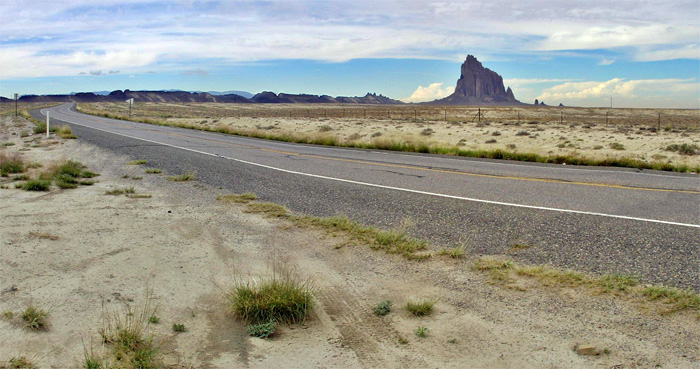
When Martine and I have finished taking the Durango & Silverton Narrow Gauge Railroad connecting Durango with Silverton, we will head down to Gallup, NM, perhaps stopping for a few hours at Window Rock, AZ, the capital of the Navajo Nation.The road connecting Farmington, NM with Gallup used to be called U.S. 666, aka “The Devil’s Highway.” A few years back, the highway changed its number to the less apocalyptic U.S. 491.

Even 491 has a curious Biblical resonance. When Peter asked Jesus how many times shall he forgive his brother who sins against him. According to Matthew 18:22, Jesus answered him, “ I say not unto thee, Until seven times: but, Until seventy times seven.” Let’s see, that multiplies out to 490. In the 1960s, Vilgot Sjoman came out with a Swedish film entitled 491, presumably referring to the end of someone’s patience at being excessively sinned against.

Highway 491 with Ship Rock in the Distance

When we take Highway 491 née 666, we will pass Ship Rock, sacred to the Navajos (see above photo). I’ve always wanted to take this route from Farmington to Gallup, but I usually traveled in the past via the Chaco Culture National Historical Park, which is my favorite destination in New Mexico. However, like many of the best places in New Mexico, I would not venture to take a rental car down the washboarded access road. That also goes for the Bisti Badlands and the De-Na-Zin Wilderness, all in the same general area.

Had I but world enough and time, however, ….