Killing Batteries

Leif Pettersen, Travel Writer Extraordinaire

Travel writers tend to be a bloodless crew these days, which is why I find Lonely Planet writer Leif Pettersen such a delight. He is a specialist in travel to Romania and Moldova (you’ve always wanted to go there, haven’t you?). He is the author of a blog called Killing Batteries, which sends you to some of the more interesting pieces he’s written. My favorite posting is entitled “The 10 Best Lonely Planet Articles of All Time (That I Wrote),” which is a good place to start. It will tell you why Florence is not always the best place to go in Italy, delicious local foods that look ugly, rain and other travel buzz-kills, how to travel with friends (and not want to kill them), stuff you should never take on a trip (includes: children and pets), and best places to stage a cathartic breakdown.

One could read travel articles for information, but if Leif is the author, you will also enjoy them, because the man has a great sense of humor.

Pettersen has recently come out with a book entitled Backpacking with Dracula. Remember, he is an expert on travel in Romania. And he thinks one of the safest places in the world to have a cathartic breakdown is Bulgaria. So you can feel comfortable with Pettersen behind the Slivovitz Curtain.


That Stupid Wall

Will There Be Any Guard Towers Manned by Machine-Gunners?

Last night I was reading author Ursula LeGuin’s blog, and I came upon this poem about Trumpf’s infamous wall written by a poet who is part Mexican Yaqui Indian and part European ancestry.  I am referring to Anita Endrezze. Her poem is called, appropriately, “The Wall.”

The Wall

Build a wall of saguaros,
Butterflies, and bones
of those who perished
in the desert. A wall of worn shoes,
dry water bottles, poinsettias.
Construct it of gilded or crazy house
mirrors so some could see their true faces.
Build a wall of revolving doors
or revolutionary abuelas.
Make it high as the sun, strong as tequila.
Builders of sugar skulls. Adobe or ghosts.
A Lego wall or bubble wrap. A wall of hands
holding hands, hair braided from one woman
to another, one country to another.
A wall made of Berlin. A wall made for tunneling.
A beautiful wall of taco trucks.
A wall of silent stars and migratory songs.
This wall of solar panels and holy light,
panels of compressed Cheetos,
topped not by barbed wire but sprouting
avocado seeds, those Aztec testicles.
A wall to keep Us in and Them out.
It will have faces and heartbeats.
Dreams will be terrorists. The Wall will divide
towns, homes, mountains,
the sky that airplanes fly through,
with their potential illegals.
Our wallets will be on life support
to pay for it. Let it be built
of guacamole so we can have a bigly block party.
Mortar it with xocoatl, chocolate. Build it with coyote howls
and wild horses drumming across the plains of Texas,
from the memories
of hummingbird warriors and healers.
Stack it thick as blood, which has mingled
for centuries, la vida. Dig the foundation deep.
Create a 2,000 mile altar, lit with votive candles
for those who have crossed over
defending freedom under spangled stars
and drape it with rebozos,
and sweet grass.
Make it from two-way windows:
the wind will interrogate us,
the rivers will judge us, for they know how to separate
and divide to become whole.
Pink Floyd will inaugurate it.
Ex-Presidente Fox will give it the middle finger salute.
Wiley Coyote will run headlong into it,
and survive long after history forgets us.
Bees will find sand-scoured holes and fill it
with honey. Heroin will cover it in blood.
But it will be a beautiful wall. A huge wall.
Remember to put a rose-strewn doorway in Nogales
where my grandmother crossed over.
pistols on her hips. Make it a gallery of graffiti art,
a refuge for tumbleweeds,
a border of stories we already know by heart.

Anita Endrezze

I love the heart behind this poem. Maybe it’s not perfect, but it adequately chides the Cheeto-headed mofo for his stupid ideas, none of which he is capable of putting into action as yet. And never, I hope.


Samurai Swords

Toshiro Mifune as Musashi Miyamoto

The above scene is an evocative moment in Musashi Miyamoto (1954), the first film in Hiroshi Inagaki’s Samurai trilogy. Musashi, heretofore called Takezo, has been imprisoned in Himeji Castle by the wily (and wise) Buddhist priest Takuan for three years. He has just stepped out of the castle for the first time and takes a look back at the walls that held him while he learned to tame his wild impulses.

I first saw Inagaki’s trilogy at a seminal point in my life. I had just moved to Los Angeles to start studying film history and criticism at UCLA. Before my classes  began in January 1967, the Toho La Brea theater began screening Musashi Miyamoto. In the following months, Duel at Ichijoji Temple (1955) and Duel on Ganryu Island (1956)—the remaining films of the trilogy—were to be shown. Although I had seen many films at Dartmouth College, I was just starting to get into the whole jidai-geki genre.

Also, I fell in love with Kaoru Yachigusa, the perennially frustrated love interest in the trilogy.

In fact, I got so much into it that, in June, I moved to an apartment on Mississippi Avenue, right in the heart of the Sawtelle Japanese-American neighborhood. At that time, there were two Japanese restaurants around the corner, the O-Sho and the Futaba Grill, where I frequently dined, learning how to tame those unruly chopsticks. My ignorance was still pretty much in evidence: I took the squares of tofu in my miso shiru soup to be shark’s fin.

Kaoru Yachigusa as Otsu, the Love Interest in the Trilogy

Before long, I was going with my film friends to all five Japanese movie theaters in Los Angeles: Not only he Toho LaBrea, but the Kabuki (Shochiku Studio) and Kokusai (Daiei Studio) near Adams and Crenshaw, and the Sho Tokyo (Daiei Studio) and Linda Lea (Tohei Studio). Now all five theaters are gone, but back then, I collaborated with two of my friends (Alain Silver and Jim Ursini) in a column for The UCLA Daily Bruin entitled “The Exotic Filmgoer,” which commemorated not only the Japanese theaters, but some of he others. We wrote under the collective pseudonym of Tarnmoor.

The Criterion Collection has released DVD and Blue-Ray editions of the Samurai trilogy, which are well worth your while.

Serendipity: My Hovercraft Is Full of Eells

The Eells in Question Was the Reverend Myron Eells

In preparation for a projected trip along the Inside Passage to Alaska, I am reading Jonathan Raban’s Passage to Juneau: A Sea and Its Meanings (New York: Pantheon Books, 1999). The book is full of delightful historical anecdotes about Captain Vancouver and other early explorers and settlers. Some got along well with the Indians: Others didn’t. One in the latter category was the Reverend Myron Eells, known for his “garrulous moralism.” More than fifty years after he passed on, he was still remembered by old people who, as children, been on canoes with him. In 1934, William M. Elmendorf interviewed a Skokomish elder who spoke of Eells as “that awful man.” The elder went on to say:

People didn’t like him very well. He was collecting Klallam words from some Klallam Indians who were visiting here one time. I had to translate for him. So he would ask them for words like father, mother, house, dog, and so on. And those people didn’t think much of Eells, so they would give him all sorts of dirty, nasty words, and he would write them down in a book. Then he would try to use some of these words. thinking he was talking Indian, and people would just about bust trying to keep from laughing.

If you have any interest in primitive languages, it would help first to see whether one is on the same wavelength as one’s interviewees. (Oh, and my apologies to Monty Python’s Flying Circus!)

Reckless Driving—With Impunity—At Least, So Far!

A Crazy Man Is Behind the Wheel. When Will We Apprehend Him?

After some six months in office, President Trumpf is turning out to be the cray man I thought he would be. I still remember the worst night of my life, watching the election returns coming in while I was twisting and turning in a hotel in Quito, Ecuador. (Note: Although I was not in the U.S. at that time, I had voted before I left on my vacation.)

It is time to bring the Trumpf to account for his many crimes—and his “you can’t catch me” attitude. What are we waiting for? Child pornography on his computer? Goosing Brigitte Macron in front of her French President husband? An executive order to have Liberals castrated?  Sodomizing Hillary and Chelsea Clinton in front of Congress? Banishing Barack Obama to Kenya? Regardless what he does, he can continue to rely on his core supporters, consisting of the 40% of eligible voters who don’t give a sh*t what happens to our country, especially to the city slickers on the East and West Coasts.

I think we have to be created. Perhaps we should pass out free Oxycontin and other opioids in those states that voted most heavily for him. Those voters should not be immune from sharing in their President’s horrible fate, whatever it might be. Since Trumpf hates Iran so much, perhaps the ancient Persian form of execution known as “The Boat,” or Scaphism, would be appropriate:

The intended victim was stripped naked and then firmly fastened within the interior space of two narrow rowing boats (or hollowed-out tree trunks) joined together one on top of the other with the head, hands and feet protruding. The condemned was forced to ingest milk and honey, and more honey would be poured on the victim to attract insects, with special attention devoted to the eyes, ears, mouth, face, genitals, and anus. In some cases, the executioner would mix milk and honey and pour that mixture all over the victim. The victim would then be left to float on a stagnant pond or be exposed to the sun. The defenseless individual’s feces accumulated within the container, attracting more insects which would eat and breed within the victim’s exposed flesh, which—pursuant to interruption of the blood supply by burrowing insects—became increasingly gangrenous. The individual would lie naked, covered from head to toe in milk, honey, and his own feces. The feeding would be repeated each day in some cases to prolong the torture, so that fatal dehydration or starvation did not occur. Death, when it eventually occurred, was probably due to a combination of dehydration, starvation, and septic shock. Delirium would typically set in after a few days.

In case you didn’t know, I really don’t like the man.


“This Must Be Thursday”

The Richard Riordan Central Library in Downtown Los Angeles

The entire quote is from Douglas Adams, author of The Hitchhiker’s Guide to the Galaxy: “This must be Thursday. I never could get the hang of Thursdays.” And that’s the way I felt when I was working full time in an accounting office. I never did get along very well with my boss (nobody could), so when he cut me back to two days a week, I saw that as an opportunity. I said, “Okay, I’ll work on Tuesdays and Fridays.” Those were days when our late tax manager worked, so my boss couldn’t use me as a highly unqualified tax manager, which he was not above doing.

One Thursday in June 2016, I took the Expo Line downtown and hung out at the Central Library on Fifth Street. Just by chance, I noticed that there was a regular Mindful Meditation session conducted by the UCLA Mindful Awareness Research Center (MARC), and I attended.  And I’ve been attending ever since. I read for a couple of hours in the Literature and Fiction Department on the top floor, and usually check out a couple of books. Then I go to Meeting Room A on the ground floor where the sessions are held.

In more ways than one, the Central Library has become a part of my life. I feel energized by these meditation sessions. Afterwards, I go for lunch either to the Grand Central Market on Hill Street, Little Tokyo, Chinatown, or Olvera Street. Then I take the Big Blue Bus R10 freeway flier back home.

So now I can say I get the hang of Thursdays. It’s one of my favorite days of the week. That leaves Mondays and Wednesdays for doctors’ appointments and miscellaneous explorations of this gigantic city of which I am becoming more of a part as time passes.


A Fort from the Apache Wars

Porch at Fort Stanton, New Mexico

Not far from Lincoln, New Mexico, which saw the Lincoln County War in which Billy the Kid was involved, lies a U.S. Cavalry fort from the days of the Apache Wars. In fact, it also played a role in the Lincoln County War—on the side of the Dolan/Murphy cabal. Most U.S. Cavalry forts in the Old West were constructed of adobe and so were eroded to nothingness by the rains. Fort Stanton, on the other hand, was built of stone and faced with whitewashed stucco, and so has come down to us more or less intact.

In fact, after the Indian Wars, the fort was used for various other purposes, such as a tuberculosis hospital and a prison camp for Nazi POWs. It is now in the New Mexico State Park system and has a museum and a number of outbuildings which are open to visitors.

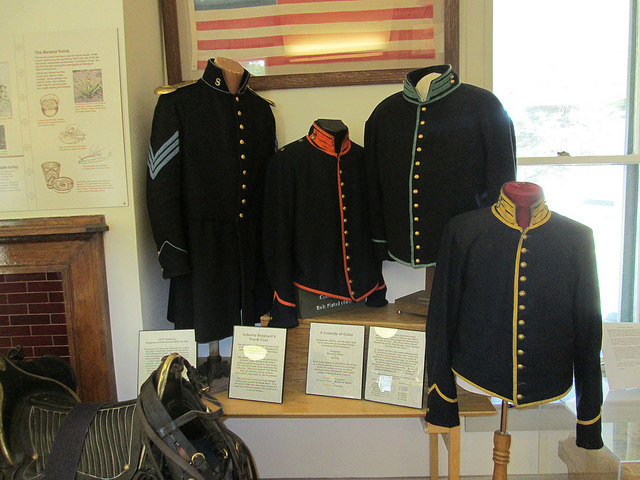
Cavalry Tunics in the Fort Stanton Museum

Martine and I saw Fort Stanton the same day we visited the town of Lincoln, which is only about a quarter of an hour away. The museum and outbuildings can be visited in about two hours is one is thorough, and an hour if one just wants a quick look at the museum. It’s an unusually pleasant place, with the Rio Bonito running through the grounds, and a helpful docent managing the welcome desk.

“A Pile of Dead Leaves”

Raymond Queneau (1903-1976)

Raymond Queneau has been known to me for some time: I read We Always Treat Women Too Well (1947) twice. But now that I have finished The Last Days: A Novel (1936), I think I have discovered a major talent.

The Last Days is the story of what one might call a social cohort, a group of people of varying ages who know each other to varying degrees. Interestingly, there are only two women in the cohort, Suze and Fabie, and they enter in only insofar as they have relationships with the males. Some of the males are students who are trying to study for a diploma in philosophy from the École Normale Supérieure; one is an aging teacher of history; another is a con man; and there are other various hangers-on. The one truly superior figure is the waiter Albert, who has everything all figured out, as described by his co-worker, Louis:

He didn’t only know how to see the future. He was also a philosopher. A real one. He used to say to me: “You see, the customers, they’re like a pile of dead leaves.”

I asked him why. He answered. “Leaves, when they’re on the tree, if you didn’t know that autumn existed you might think they’d stay there forever. That’s like our customers. They come back every day as regular as clockwork: you think they’ll go on doing so forever. But then one day the wind blows as carries the leaves off to the gutters and the street sweepers make little piles of them on the edge of the pavements to await the dust-cart. Me too, every year I make my little pile when the autumn arrives, my little pile of dead souls.”

Albert’s one goal in life is to win back the money that his father lost at the races: No more, just enough to live a comfortable life in retirement, and not a sou more. And he actually manages to do this, returning to work at the café the next day.

The others, such as the student from Le Havre, Vincent Turquedenne, manage to lose their virginity, hang out with their friends, and even get their diploma. The history teacher—feeling he spent his whole life teaching geography while he himself never traveled—dies and has a magnificent funeral. The con man figures he would be immortal if he never laid down, because that’s what kills one, but then gets sick and is put to death and, of course, dies.

There is a simple beauty to this story that makes me want to read more of Queneau’s work. Fortunately, a lot of it is available.


Leaving the Heat Far Behind

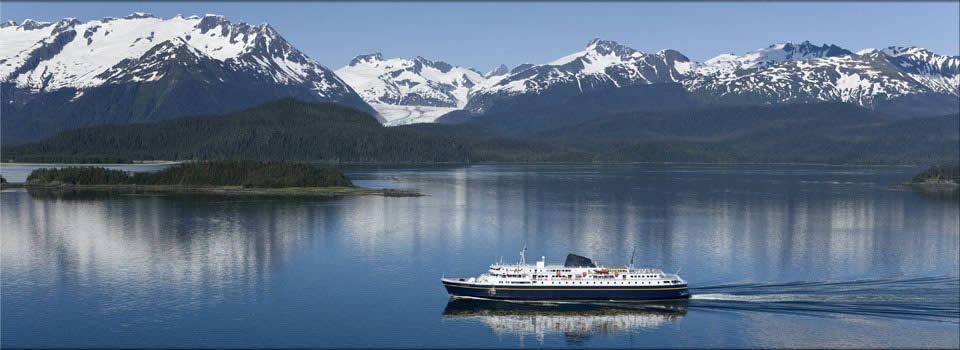
One of the Seagoing Ferries of the Alaska Marine Highway

We’re barely into July, and I’ve already had it with this summer! It started with triple-digit daily temperatures in New Mexico and continued with a Mexican Monsoon heat wave in Southern California. I am looking to take a vacation along Alaska’s Inside Passage using a combination of a flight and a series of short trips on the Alaska Marine Highway. I would not consider taking a regular cruise line for the following reasons:

  • I don’t want to eat myself into an early grave.
  • I don’t want to be sociable with other passengers: I would rather grimace at them than play in their reindeer games.
  • I don’t want to pay a ridiculous single-traveler penalty—because I would be going alone, me and my Kindle loaded with 1,500 books.

The places I would like to visit include Ketchikan, Sitka, Juneau, the Mendenhall Glacier, Skagway, and nearby parts of the Yukon. Ideally, I would go after the first frost has killed off most of the mosquito population. I understand there is a narrow gauge railroad that connects Skagway with Carcross in the Yukon, and I would not be averse to visiting Whitehorse.

My question is: Can I manage to afford two vacations in one year? Perhaps, if I’m lucky. But I have a strong desire to leave summer far, far behind me.


Alienation Effect

Rod Serling with Playhouse 90 Logo

Today was a strange day. It was beastly hot and humid, with a Mexican Monsoon effect. Having no air conditioning in our apartment—and living in an area that regularly gets hit by power blackouts—Martine and I decided to go to the Paley Center for Media in Beverly Hills.  The lobby was crowded with young tourist couples seeing the displays about American Horror Story, a series on FX with which I was previously unacquainted. These guys (and their women) were heavily tattooed, wore their baseball hats backwards, did not know to flush toilets, and led with their smart phones taking pictures of everything in sight.

I suddenly felt old. Here I was with a large group of young people that made me feel alienated. And here I was going to see a couple of Playhouse 90 episodes from 1959. I might has well have been talking in Armenian to a group of prairie dogs. Did I feel bad about that? In a way I did, though I would not have considered going far to seek common ground with them: The gulf between me and them yawned as big as the Grand Canyon.

But I felt delighted with the Playhouse 90 episodes I saw, shot in consecutive weeks. The first was “The Town That Turned to Dust,” written and introduced by Rod Serling and directed by John Frankenheimer. The story was about a lynching in a small Texas border town called Dempseyville of a Mexican youth who was accused by William Shatner, as the local dry goods merchant, of beating up his wife Fay Spain and robbing the store. The sheriff who is powerless to prevent the lynching is Rod Steiger, in a powerful role, with James Gregory as a visiting newspaperman.

The other was a dramatization of “The Great Gatsby” starring Robert Ryan as Gatsby and Jeanne Crain as Daisy May Buchanan. Rod Taylor was excellent as Nick Carraway. Rod Serling introduced the episode, which was directed by Franklin Schaffner.

Although I do not watch much (if any) current television, I have a great deal of love and respect for the early days of the medium. Back at the beginning, they not only knew how to produce superlative entertainment, but used people who knew how to act, not just nod their heads meaningfully.