Mar-a-Lardo in 2024?

The Neverending Election: So Boring Your Ears Will Bleed!

It is now official. Donald J. Trump will run for president in 2024. He plans to bore us into submission with his endless rambling disconnected speeches, complete with antediluvian dance moves and fist pumps. When his announcement to run was made at Mar-a-Lago on Tuesday, his mostly sympathetic audience was so fatigued that they tried to leave the room—but Trump had ordered the doors to be locked to prevent that from happening.

Isn’t that against the law? What if there were a fire? I would have called the local fire department from the floor of the auditorium. But then I am no friend of the Trumpster Dumpster.

Missing from the audience were Don Junior, who “missed his flight” and Ivanka, who has decided to remove herself from politics and Papa’s bedroom eyes

Compared to his announcement in 2015, when he came down the escalator like a god descending from Heaven, this was a low-energy event. The 2022 midterm elections have hurt the Trump brand, but he refuses to give it credence. Is he going to claim the 2024 election was stolen if he gets only a tiny percent of the vote?

You know, Americans are mighty fickle, and could it be that all the stuff Trump stands for is fast becoming passé? Maybe democracy will ultimately be saved because the 45th President is yesterday’s news.

North to Alaska

Misty Fjords National Monument in Southeast Alaska

On my kitchen table, there is a pile of Lonely Planet guidebooks to various places. Many times, I will page through the books carefully reading about the places to visit, the best places to sleep, and even the best restaurants.

Lately, I have been spending a lot of time daydreaming about Alaska. I have planned several possible itineraries:

  • Southeast Alaska: Ketchikan, Prince of Wales Island, Wrangell, Sitka, Juneau, Haines, and Skagway.
  • Central Alaska: Anchorage, Mount McKinley (Denali), Fairbanks.
  • Southwest Alaska: Anchorage, Seward, Homer, Kodiak, Katmai National Park and possibly Unalaska/Dutch Harbor.
  • “Bush” Alaska:Nome, Fairbanks, Deadhorse, and Barrow.

All four itineraries would cost much more than my usual vacations, especially as many involve charter flights on float planes, rental cars, and trips using the Alaska Marine Highway ferry system. I can probably fly the 6,100 miles (9,900 km) to Argentina for half of what any of the above would cost me.

Why don’t I take a cruise? The thought of being with the same group of strangers for a week or more, leaving the ship only to take “baby steps” trips ashore would drive me off my rocker. I have always entertained some contempt for cruise passengers, referring to them as “boat people” and insisting on communicating with them only in Hungarian. (I have a thing about strangers: I can put up with them on a day trip, but only in small doses.)

If I had the money, I would start by going to the Alaska panhandle first. There would be a lot of rain, but it would be beautiful—and there is all that great fish to eat!

Marlowe Times Three

Raymond Chandler had the good fortune to have three excellent movies adapted from his books. There have been others, too, but they are either rarely seen or not quite up to snuff.

  • The Big Sleep (Warner Brothers 1946), directed by Howard Hawks with Humphrey Bogart as Marlowe
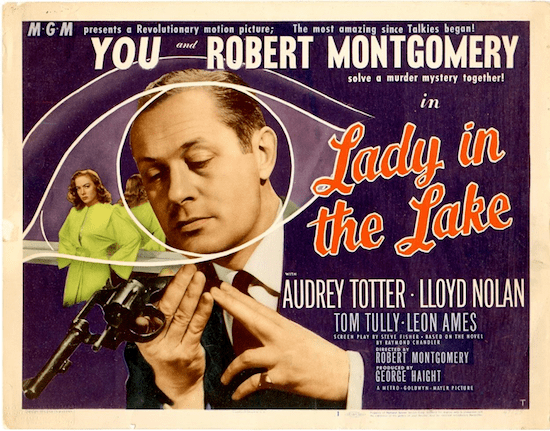
  • Lady in the Lake (MGM 1947), directed by Robert Montgomery and starring the director as Marlowe
  • Murder, My Sweet (RKO 1944), directed by Edward Dmytryk with Dick Powell as Marlowe

The films are listed in order from my most favorite to my least favorite—though I like all three very much and have seen all of them multiple times.I consider The Big Sleep as one of the 10 best American films ever made.

Lady in the Lake was a tour de force all filmed by Robert Montgomery from the point of view of Philip Marlowe. The only times we see Marlowe are at the beginning and end of the film and when Marlowe looks in the mirror. It was a chancy experiment, but it succeeded largely because of the great acting job put in by Audrey Totter.

I just saw Murder, My Sweet again for the nth time this afternoon on Turner Classic Movies (TCM). The film was based on Chandler’s Farewell, My Lovely. It came at a key point in Dick Powell’s acting career: Hitherto, he had been a singer and dancer. With this film, he showed he could be as hard-boiled as anyone in Hollywood.

Raymond Chandler’s novels and stories are among my favorite works of mystery fiction. I have read them all, several of them multiple times. And I will continue to re-view these three films again and again.

The Medicine of Bow-Returning

An Excerpt from a Short Story by Mary Austin

Some of the best books about the American West were written by Mary Hunter Austin (1868-1934). In the last year of her life, she published a collection of short stories entitled One-Smoke Stories, in which the following appears:

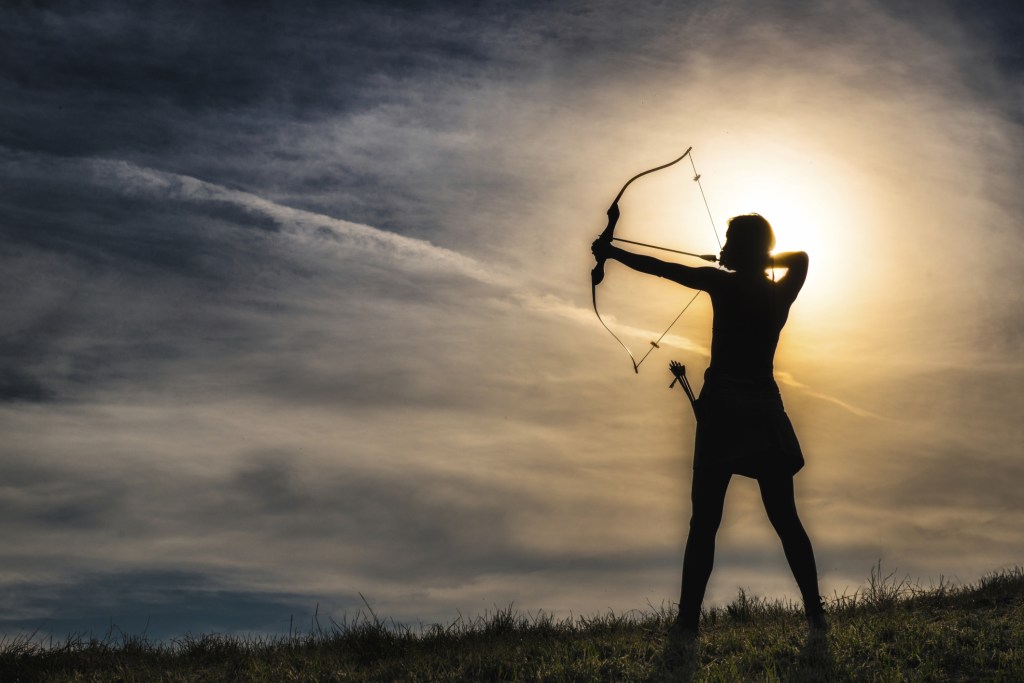
So Taku-Wakin, who was afterward called Bow-Returning, went toward the mountain called Going-to-the-Sun for his fast, and as he went he felt the thoughts of his mother push him. He went far, climbed the high mountains and bathed in the sacred lakes, keeping holy science. On the mountain, when by fasting he was removed from himself, his eyes were opened. He saw all the earth and the sky as One Thing, even as the bow is one thing and the cord of the bow which draws it. Even so he saw the thoughts of men pulling at the corners of the world as the cord pulls at the bow, and the bow bending and returning. In the silence he heard in his heart the One-Who-Walks-in-the-Sky talking.

‘This is true medicine, Taku-Wakin. All things are one, man and the mire, the small grass and the mountain, the deer and the hunter pursuing, the thing that is made and the maker, even as the bow and the cord are one thing. As the bow bends to the cord, so all things bend and return, and are opposed and together. The meaning of the medicine is that man can hurt nothing without also hurting himself.’ Thus said the One-Who-Walks-in-the-Sky to Taku-Wakin….

After long seeking he heard the voice of the Sky-Walker. Then said Bow-Returning: ‘This is my medicine, that everything is One Thing, and in this fashion I have kept it. Meat I have taken for my needs according to the law of food-taking, but I have hurt no man. Neither the flower in the field have I crushed, nor trodden on the ant in my pathway. How is it, then, that my wife is dead, my son given to another, and my medicine is gone from me?’

Then said the One-Who-Walks-in-the-Sky to Bow-Returning, ‘Did I not also make woman?’

Journey to the East

Indian Holy Man

In many ways, most of my life has been a “Journey to the East.” I was raised as a Roman Catholic, going to Catholic schools from the 2nd through the 12th grades. Even at Dartmouth College, I was a worshiper at the Newman Club. In fact, when I fell into a coma in September 1966, it was Father William Nolan, the Catholic chaplain at Dartmouth, who urged the school’s medical insurance program to keep covering me, even though my coverage had officially lapsed at the beginning of the month. So my family and I owe a debt of gratitude to the Catholic Church.

One does not undergo a massive physical trauma without affecting the way one thinks and believes. That September, I was getting ready to take the train to Los Angeles to start graduate school in film history and criticism at UCLA. I had to delay my film classes until the winter quarter to allow me to recuperate.

What was the first book I read when I arrived in Los Angeles? It was Hermann Hesse’s Siddhartha, closely followed by Paul Reps’s Zen Flesh Zen Bones. I had begun my own Journey to the East, mostly in my reading.

Why did I never fly to Asia to experience Hinduism, Taoism, and Buddhism directly? Strangely—especially for someone who was visited so much of Latin America—I was afraid that I wouldn’t survive the experience. Among my fellow Clevelanders who attended Dartmouth College was a student by the name of Noel Yurch. I was shocked to find out from the alumni magazine after I had graduated from college that he had gone to India and died of some gastrointestinal disease.

Curiously, my niece Hilary went to India and studied Yoga at an ashram without suffering any major adverse effects. Today, she is a yoga instructor in the Seattle area. But I was convinced it would be fatal for me. Was it nothing but funk? Perhaps.

Today, I still read many books about the Eastern religions. I consider myself to be a strange combination of Catholic, Hindu, Taoist, and Buddhist. Although I do not go to church on Sundays, I do not consider myself to be an Atheist or even an Agnostic. And when I visit Mexico or South America, I spend hours visiting Catholic churches and even attending Mass. But I no longer buy the whole package.

So in my so-called Journey to the East, I still have one foot in the Catholic Church, or at least one or two toes.

“Wind, Water, Stone”

Mexican Poet Octavio Paz (1914-1998)

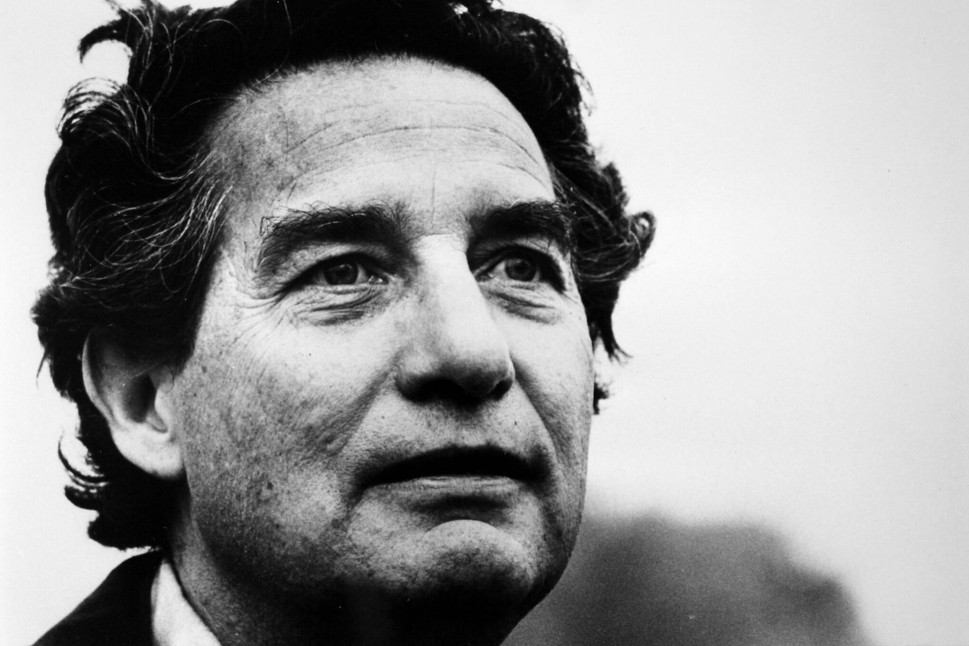
As I grow older, I am drawn more and more toward poetry as the most profound literary medium. There is something utterly simple about “Wind, Water, Stone” by Mexican Nobel-Prize winning poet Octavio Paz, yet that simplicity is merely a pathway to wide vistas that keep drawing one in.

Wind, Water, Stone

For Roger Caillois

Water hollows stone,
wind scatters water,
stone stops the wind.
Water, wind, stone.

Wind carves stone,
stone's a cup of water,
water escapes and is wind.
Stone, wind, water.

Wind sings in its whirling,
water murmurs going by,
unmoving stone keeps still.
Wind, water, stone.

Each is another and no other:
crossing and vanishing
through their empty names:
water, stone, wind.

Palmyra

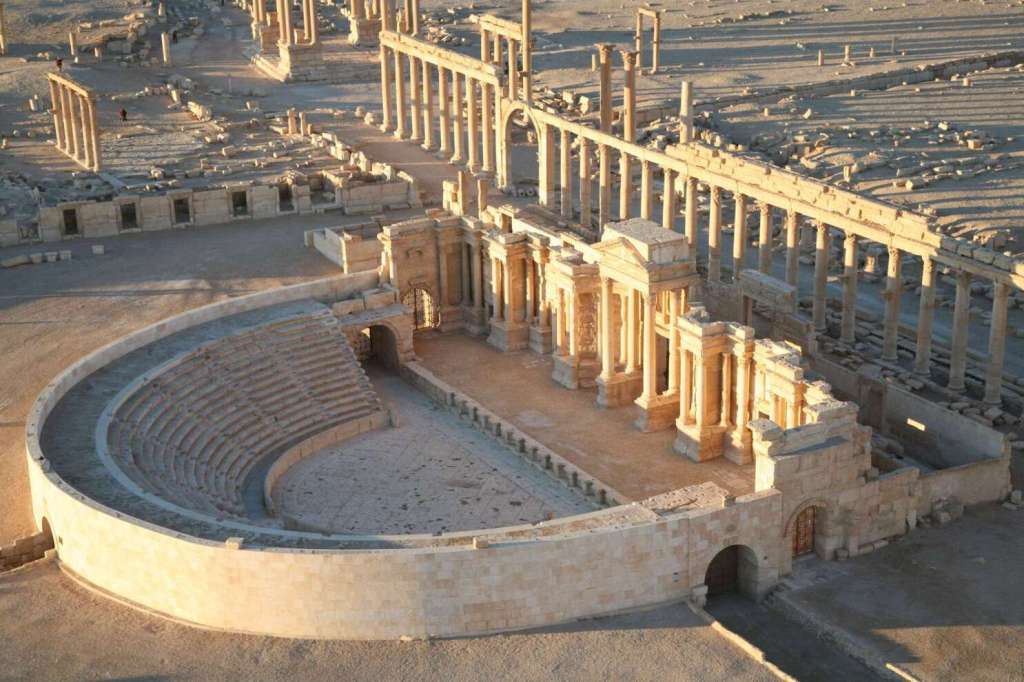
Ruins of Roman Theatre in Palmyra

It’s all in ruin now, more so since the Islamic State (ISIS) decided to extend the ruination in 2015. There was a brief time in the third century A.D. when Palmyra was independent and prosperous. It stood midway between Rome and Persia and was coveted by both. It was ruled by such enlightened leaders as Septimius Odaenathus and, after his death, his widow Septimia Zenobia. Under Zenobia, Palmyra controlled lands from central Anatolia to Southern Egypt.

That was too much for Rome. In 273, the Roman Emperor Aurelian destroyed Palmyra and exiled Zenobia to Rome. At that time, the city had some 200,000 inhabitants. Somewhat later, Diocletian re-established the city, but it never again grew to the size and power it had under Odaenathus and Zenobia.

It is a wonderment to me that throughout history there existed little “golden ages” of relative happiness and prosperity. At Palmyra’s height, its people were considerably wealthier than the citizens of Rome itself. By the third century, the Roman Empire itself was powerful, though its original inhabitants had passed their zenith as all the resources were spent building up the massive army presence along the northern and eastern borders.

I sincerely hope the same thing will not happen to the United States. With this election, I breathed a little more easily and had a few glimmerings of hope.

Urban vs Rural

Do You Want Rural America to Set Your Priorities?

Looking at the coverage for the 2022 Midterm Elections, I find myself appalled by the decisions made by voters in Rural America. Although I am pleasantly surprised by the many failures of Republican candidates (as opposed to what pundits had predicted), I wonder by rural voters vote the way they do.

When the Founding Fathers decided on what sort of government the former British colonies would have, they saw the new nation as a union of states. That led, among other things, to the infamous Electoral College which gave the edge in Presidential elections to rural states. The very fact that all states, irrespective of population, have two senators meant that the least populous state, Wyoming, with 580,000 residents, had as much clout in the senate as California, with 39.24 million residents.

The way the Electoral College works is that, for each state, one adds the number of U.S. senators (two per state0 to the number of members of the House of Representatives. That means that Wyoming has 3 electoral votes, whereas California has 53. That doesn’t look so bad at first, until you realize that California has roughly 78 times as many people as Wyoming, not 19 times as many. That distortion is caused by the addition of Wyoming’s two senators.

I don’t get a good feeling about the voters who live in rural America. They’re not all sturdy independent farmers: More likely, they’re living from hand to mouth and are bitterly opposed to us city folks. I also get the feeling that theirs is primarily an “F—k You“ vote.

We have to be aware of the fact that rural voters can get into an awful snit and sink the Ship of State for no good reason.

Among the Dead

Day of the Dead Participants

This is kind of a coda to yesterday’s post entitled “Dia de los Muertos.” Many of the attendees at the Day of the Dead Festival in Canoga park wore nifty costumes and frequently had very professional face painting jobs. There was a booth at the festival where most of the work was probably done.

As much as Martine felt intimidated by the size of the crowd, I wound up enjoying the artistry of the costumes and makeup, and the obvious sincerity of the ofrendas (the little altars to a family’s dead).

A Gathering of Skeletons

I will probably have to go by myself, but I wouldn’t mind traveling to other Day of the Dead observances next year. As much as I like Halloween, I also admire the Mexicans’ celebratory confrontation of their own future demise.

Dia de los Muertos

Although the Mexican Day of the Dead actually occurred on November 2, All Souls Day in the Catholic liturgy, the neighborhood of Canoga Park decided to hold their festival today. Martine and I were to meet a friend at the festival, but there was the usual problem with cell phones: It was too loud to here the telephone ring.

That was the first thing that set Martine off. Second was the size of the crowd. Neither of us positively like crowds, but her dislike of them approaches the realm of phobia. Thirdly, she abhors skeletons and costumes that suggest death. Finally, there were a lot of classical cars on display; but they were all tricked out as Mexican low-riders.

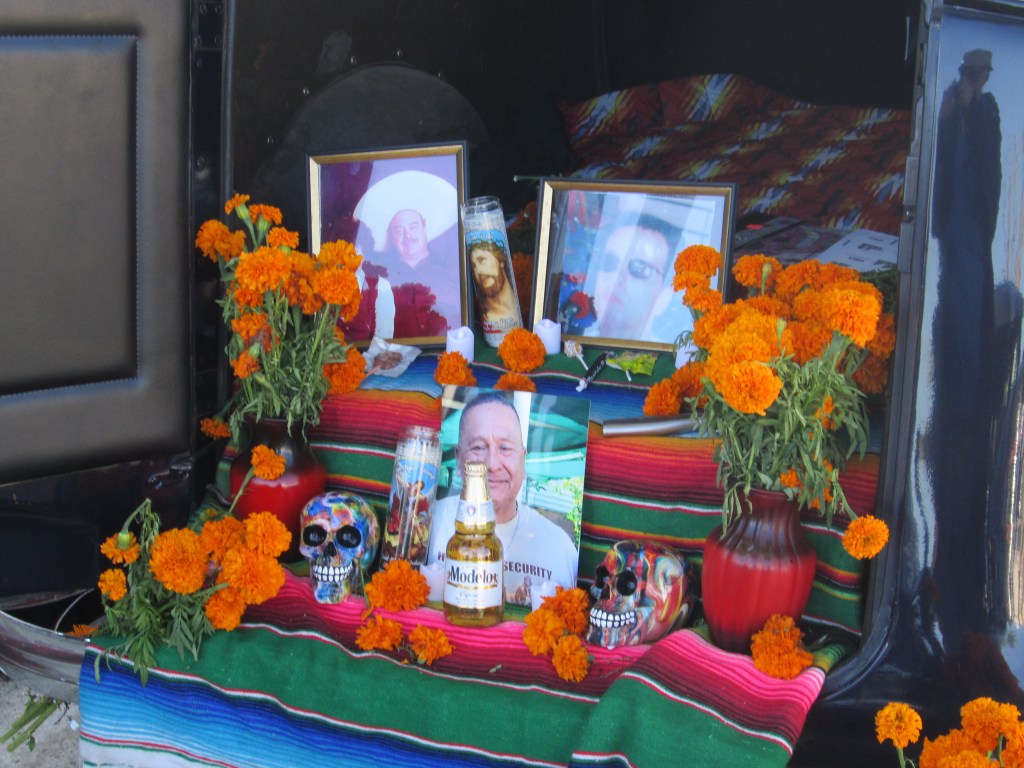
Only the first two things set me off, but I was interested in the costumes people wore and the cars. Many of the cars had ofrendas, little memorials to loved ones who have passed on.

An Ofrenda Occupying the Trunk of a Low-Rider

Where Martine did not particularly like Mexican customs, I, on the other hand, have many years of traveling in the Republic and admiring from afar these same customs. I remember one bus ride I had back in the 1980s on the Dia de los Muertos between Mazatlán and Durango. The bus was filled with Mexican families on their way to have a picnic at the cemetery by the grave of their loved ones. I thought it was a splendid custom, and I helped out by holding a baby for a few miles while the young mother who sat next to me was otherwise occupied.

In the end, I knew I had to make it up to Martine. I could have made a scene and called her too thin-skinned, but instead I bought her her first cotton candy in sixty years. Then, on the way home, we stopped at Bea’s Bakery in Reseda for some of their first class pastries.So, in the end, she had some good things to remember.