A Haibun is a uniquely Japanese medium in which prose and haiku poetry are interspersed. I will attempt to memorialize some of my travel experiences using the Haibun genre from time to time. My intent is to follow the style of Matsuo Bashō:
First look at the ruins
My eyes glued to the chess board
Losing to my guide.
On my first trip to Yucatán in November 1975, I ordered guide services from a company called Turistica Yucateca. The lady who ran the company couldn’t speak a word of English, but we managed to communicate by nouns more or less common to English and Spanish. As my first destination, I chose Dzibilchaltún, about 20 miles north of Mérida. My guide, who had his own vehicle, was Manuel Quiñones Moreno who spoke good English and was well educated. I spent a few minutes looking at the ruins, which were mostly fairly ramshackle; but then he brought out a chess set, and we played several games. I lost all of them.
I have always loved chess, but not with any degree of proficiency.
In any case, I didn’t hold it against Manuel. I hired him the next day to show me the ruins of Acanceh and Mayapán. I kind of wish that Turistica Yucateca were still around, but that was almost half a century ago.
A Haibun is a uniquely Japanese medium in which prose and haiku poetry are interspersed. I will attempt to memorialize some of my travel experiences using the Haibun genre from time to time. My intent is to follow the style of Matsuo Bashō:
November norte
White-clad Maya point and laugh
Paper boats bobbing in the street.
It was November 1992. I was in Yucatán with Martine and three friends from work: George Hoole and Jin and Christine Han. On the last day but one of our trip, the peninsula suffered a storm called a norte, because it originated in the United States and gathered strength as it crossed the Gulf of Mexico. The streets of Mérida were flooded: There was no walking without wet stains halfway up the leg. We were staying at the Posada Toledo, an old mansion turned hotel, near the center, worried whether our return flight the next day would be able to take off. Jin Han lightened the mood by carefully folding paper boats and setting them adrift in the street. They aroused considerable hilarity among the passersby.
I cannot help but see myself in this haiku by the great Japanese poet Matsuo Bashō:
Another year is gone—
A travel hat on my head,
Straw sandals on my feet.
Two weeks from today, I will be in Mérida, Yucatán, reacquainting myself with the world of the Maya. In many ways, Matsuo Bashō is the poet of travel. His book, The Narrow Road to the Deep North, is the ultimate vade mecum for a traveler. The record of a 1,500-mile journey through the main Japanese island of Honshu, it captures with great beauty and subtlety the joys and sorrows of a life on the road.
The sound of a water jar
Cracking on this icy night
As I lie awake.
The extreme conciseness of the haiku form can lead to poetry that is brilliant—or banal. One has to somehow put two ideas together (as the ice and the sleepless traveler) with an absolute minimum of embellishment. Ah, but when it succeeds!
On the withered grass
Shimmering heat waves rise
One or two inches high.
I will, as usual, travel with a blank notebook. I would love to compose haiku relating to my upcoming journey to Mexico. It’s possible, but, alas, not likely. Even though I don’t usually go out evenings (except in Mérida), I will probably find myself too busy reading from my Amazon Kindle, which is fully loaded with hundreds of works of literature and history.
Before visiting any foreign country, I always like to get a supply of banknotes in that country’s currency for the first few days of my trip. So today I headed to Bretton Woods Currency in Brentwood to pick up a couple hundred dollars worth of pesos. The act of handling another country’s currency is always a magical moment for me: I suddenly feel the reality of my impending vacation—in this case, exactly two weeks from today. I got three denominations: 500 Pesos, 200 Pesos, and 100 Pesos.
My favorite is the 500 Peso note, which shows painter Diego Rivera on the front and his wife, the painter Frida Kahlo, on the reverse.
Mexican Patriots Miguel Hidalgo and José Maria Morelos on the 200 Peso Note
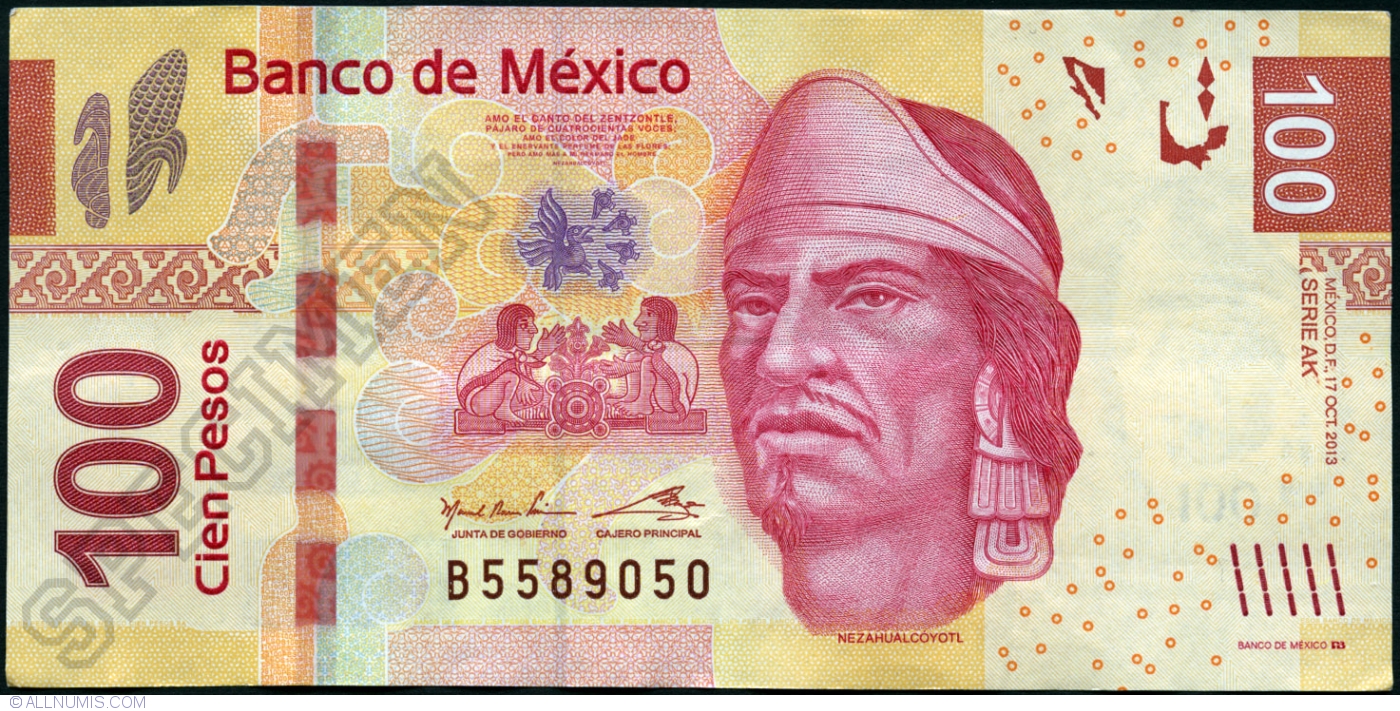
Nezahualcoyotl, Pre-Columbian Poety and Ruler of Texcoco
Above are the 200 and 100 Peso bank notes. I was intrigued by the figure shown on the 100 Peso note of Nezahualcoyotl, “Coyote Who Fasts,” who died some fifty years before Hernan Cortés landed at Vera Cruz with a party of conquistadores.
In the article on him in Wikipedia, I read the following interesting description:
Unlike other high-profile Mexican figures from the century preceding Spanish conquest of the Aztec Empire, Nezahualcoyotl was not Mexica; his people were the Acolhua, another Nahuan people settled in the eastern part of the Valley of Mexico, settling on the eastern side of Lake Texcoco.
He is best remembered for his poetry, but according to accounts by his descendants and biographers, Fernando de Alva Cortés Ixtlilxóchitl and Juan Bautita Pomar, he had an experience of an “Unknown, Unknowable Lord of Everywhere” to whom he built an entirely empty temple in which no blood sacrifices of any kind were allowed — not even those of animals. However, he allowed human sacrifices to continue in his other temples.
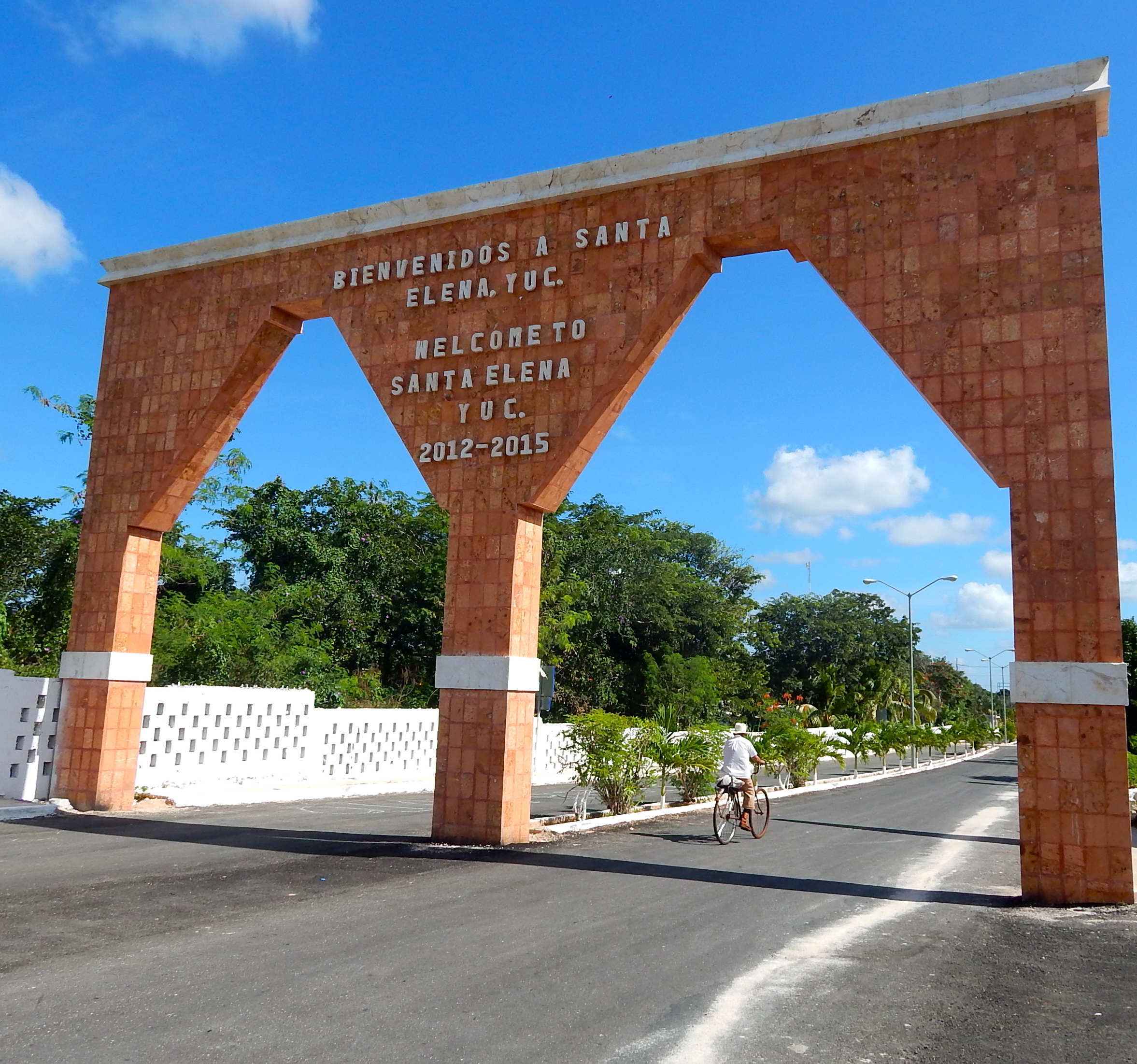
I am frantically trying to get reservations to hotels in Yucatán—much later than I usually would. It is all due to the problem with my left knee. I wanted some assurance that it was not the beginning of a condition that might rapidly get worse. As a result, I am making reservations a month or so later than I usually would. Unfortunately, a lot of the places I wanted to stay have already been booked, even for such a small town as Santa Elena, which is midway between the ruins of Uxmal and Kabah. I may have to spend big money to stay at the Hacienda Uxmal at the ruins, where I stayed twice before in 1975 and 1992—that is, if I can.
No doubt I will find something. It’s just a little more work than usual.
The Luxurious Hacienda Uxmal Across the Street from the Ruins
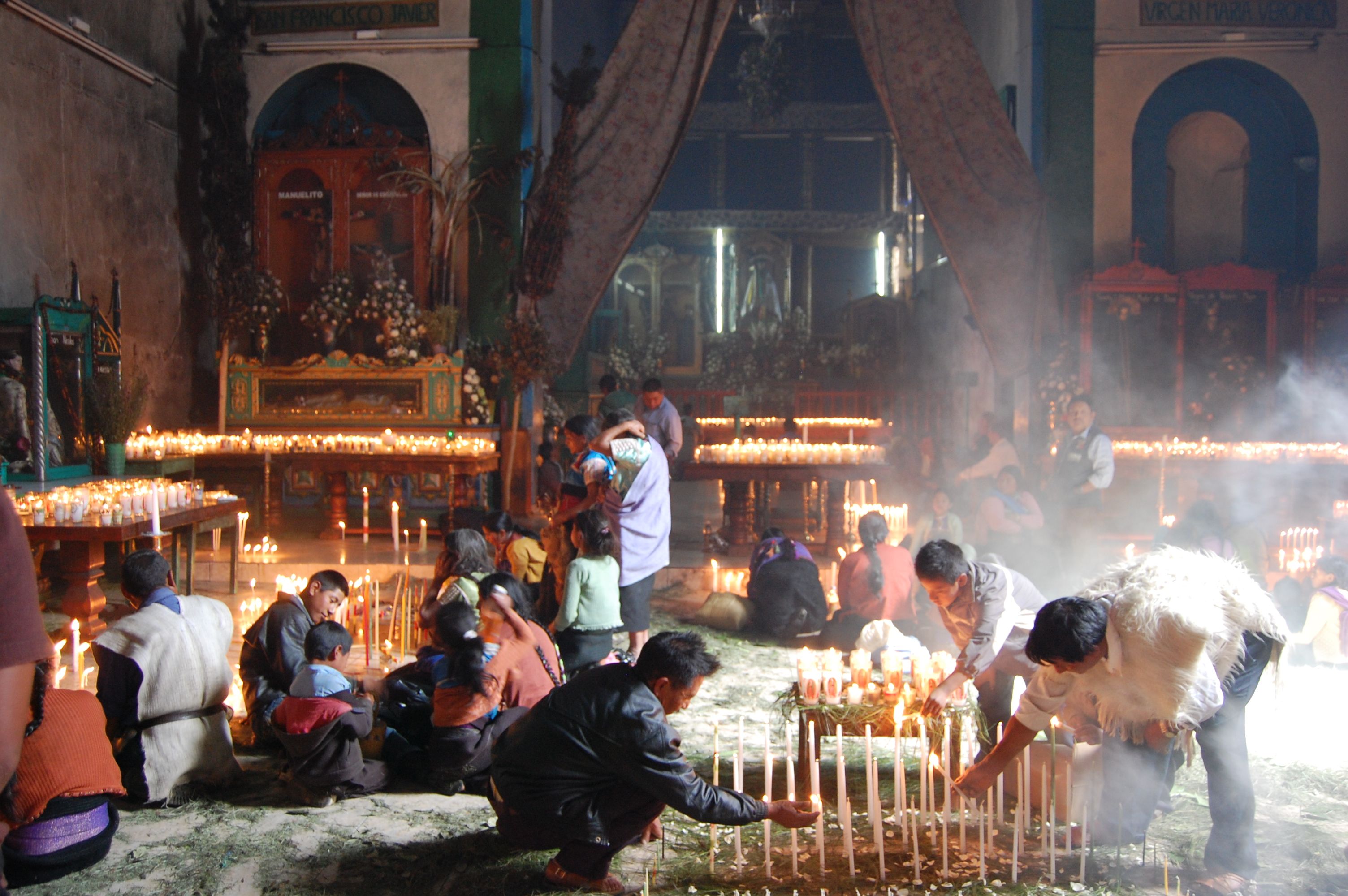
A Rare (and Forbidden) Interior Shot of the Chamula Religious Observances
My brother and I visited the Tzotzil village of San Juan Chamula in 1979. We stood in the back of a stake truck from San Cristóbal de las Casas along with dozens of Chamulas. In the village, we requested permission to visit the church, which was at one time Catholic until the Tzotzil threw the priests out and took over the churches for their own syncretic observances. In the alcalde’s office, we had to sign a promise that we would not take any photographs inside under pain of the severest punishment. (During the 1980s, at least European tourist was killed by an angry mob for just such a transgression).
I found the following description in Paul Theroux’s On the Plain of Snakes: A Mexican Journey, which I have just finished reading:
On the way to Oventic I stopped at the town of Chamula, famous for its weird church observances, where the interior of the basilica of San Juan Bautista was ablaze with flames. Worshipers crouched on the floor arranging candles, fifty or a hundred in symmetrical patterns, then lighting them and, in the candlelight, drinking Coca-Cola and ritually burping—eructation believed to be salutary—and splashing libations of Coke on the church floor, which was covered with sand.
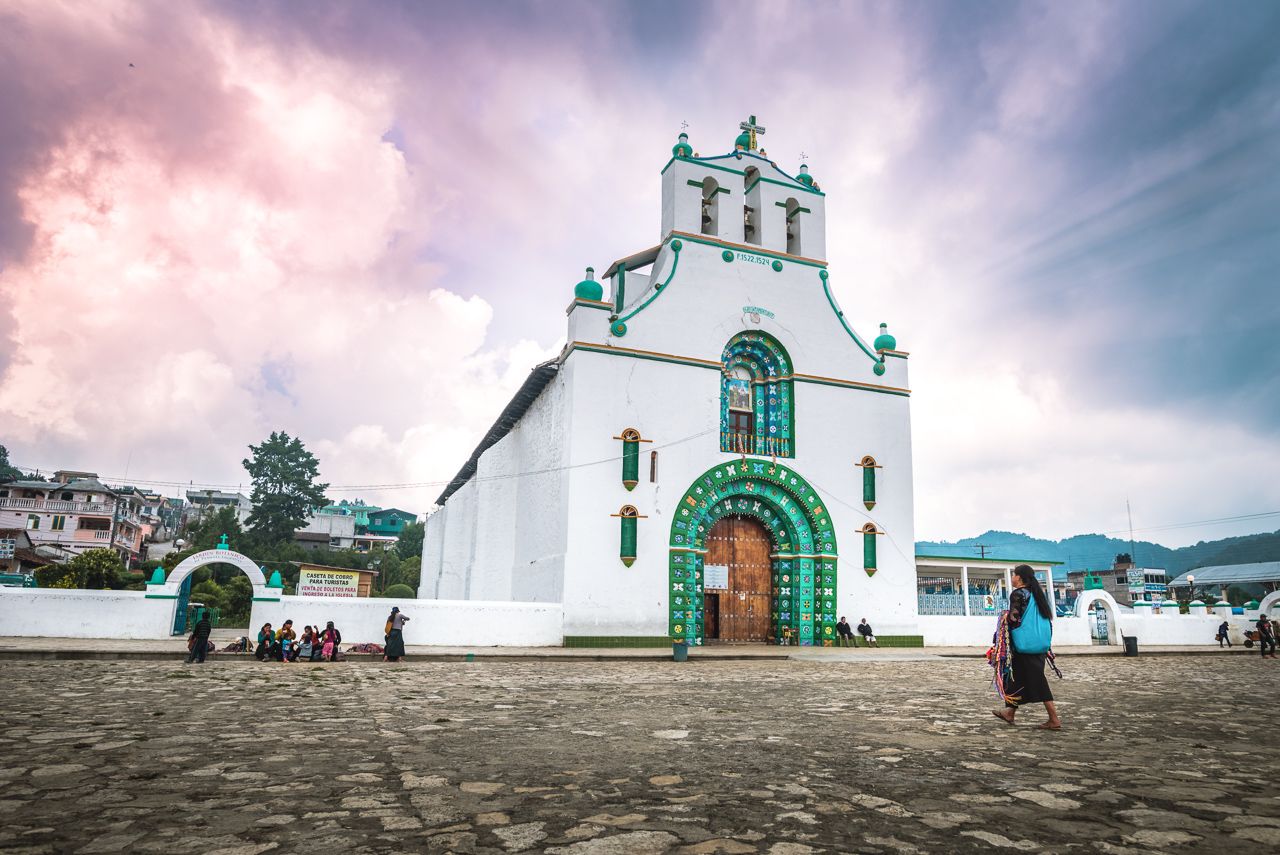
The Church at San Juan Chamula
There were no pews, there were no priests, there was no Mass or formal service. It was a gathering of curanderos—medicine men—and those wishing to be cured. Other solemn groups were chanting, passing hens’ eggs around the the faces and bodies of prayerful pilgrims in a limpia—a purification—or holding a squawking chicken near a kneeling devotee, and a moment later the chicken’s neck was wrung, and the softened, drooping carcase placed near the candles.
As I watched, a man approached me holding a bottle and a glass. He said, “Mezcal,” and poured me a slug and offered it. I drank it, blinked away the dazzle in my eyes, thanked him, and kept looking.
It was a fusion of pre-Hispanic traditions and Christian dogma, the result an observance involving a mass of candles, throttled chickens, and soda pop. (But sheep are sacred, never harmed or eaten: the town of Chamula is full of grazing sheep.) Added to these rituals was a chance for retribution, because if the chosen saint did not grant the supplicant’s wish, the deity could be punished, just as the Zapotecs and mayans punished their gods and saints, lashing their images with whips. In this church, the statues of saints, which had been ceremonially draped, with an uttered prayer, could be stripped of their robe if the prayer was not answered.
Check out the above YouTube video, which gives a you a feeling of life in this Tzotzil village.
I finally settled on my date of departure for Mexico to take place around the middle of next month, though Volaris still has not confirmed my reservation. I will be flying to Mérida via Guadalajara both ways. I could have elected to transfer in Mexico City, but I have memories of a flight some thirty years ago while the passengers waited for hours for a well-connected wife of a politician to be boarded ever so fashionably late.
But then, when one travels in Mexico, one travels by Mexican rules. This involves an expectation of the unexpected, and a sharp attention paid to current circumstances, despite conflicting information from supposedly authoritative sources.
In preparation, I have been reading Paul Theroux’s On the Plain of Snakes: A Mexican Journey (Boston: Houghton Mifflin Harcourt, 2019). Ever since running into his book of a series of railroad journeys from Boston to Argentina entitled The Old Patagonian Express, I have been deeply influenced by his writings on travel. Theroux is profoundly cynical, though perhaps not so much as Tobias Smollett, whose journey of a trip to France and Italy earned him the nickname of Smelfungus by no less than Laurence Sterne.
Theroux provides a nice summary in his book about the land I am about to visit:
I have not found a traveler or commentator, foreign or Mexican, who has been able to sum up Mexico, and maybe such an ambition is a futile and dated enterprise. The country eludes the generalizer and summarizer; it is too big, too complex, too diverse in its geography and culture, too messy and multilingual—the Mexican government recognizes 68 different languages and 350 dialects.
When my best and oldest friend talks about Mexico—usually disparagingly—he really means the border regions, where the drug cartels, police, and army are the major players. I myself have visited several Mexicos:
Border Mexico (Tijuana, Ensenada, Mexicali, and Cabo San Lucas)
Pacific Beach Resort Mexico (Mazatlán, Puerto Vallarta)
Colonial Mexico (Zacatecas, Guanajuato, San Miguel Allende, Querétaro)
My favorite is the last category, which can be further subdivided into Highland Maya (San Cristóbal de las Casas), Jungle Maya (Palenque), and Yucatec Maya (Mérida, Uxmal, Chichén Itzá, Uxmal, Campeche).
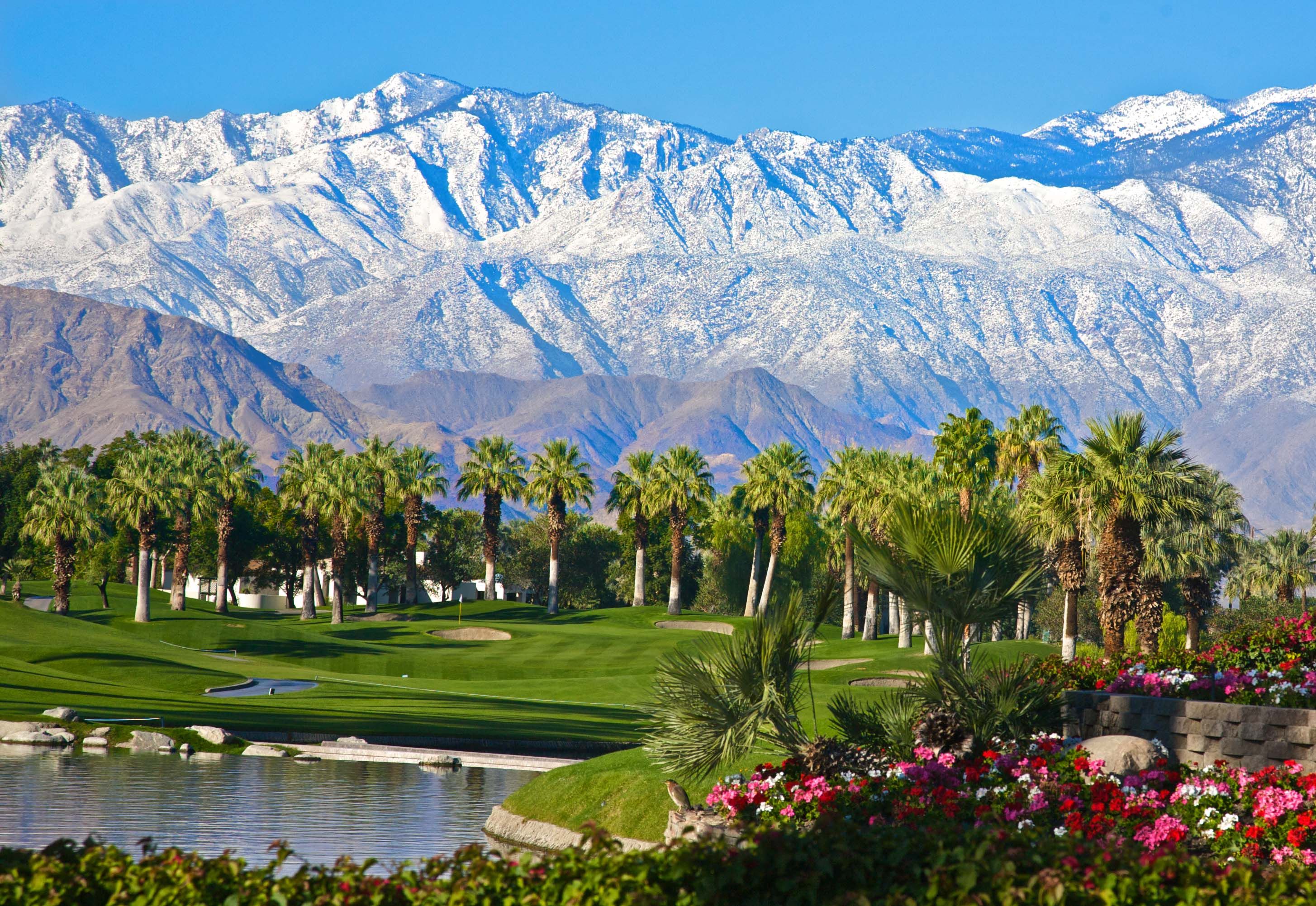
I will be taking a few days off to go to Palm Desert in the Coachella Valley for a family get-together. In addition to my brother Dan and sister-in-law Lori, my niece Hilary with husband and sons; step-niece Jennifer; and step-nephew Danny will be present. Martine won’t be coming with me because she hates the Coachella Valley, having lived and worked in nearby Twentynine Palms back in the 1990s.
As I am quite sterile and prefer not to adopt, my brother’s side of the family has become increasingly important to me. In the same way, I have always maintained close relations with the children of my best friends. It’s either that or spend my declining years shouting at kids to get off my lawn.
When I get back to Los Angeles on Monday, I hope to have some good stories to tell you and pictures of my family to show you.
The Area Covered by the Auto Club Indian Country Map (in Orange)
This posting is about a map that I love. Ever since 1985 when I drove with my friends Peter and Gayle to the area around Flagstaff, Arizona, I have fallen in love with the Southern California Auto Club map that covers the main tourist areas of the American Southwest. It is called, simply, the Indian Country map. It covers southern Utah, Northern Arizona, southwest Colorado, and northwest New Mexico. Within its coverage area lie Acoma Sky City, Arches, Bryce Canyon, Canyon de Chelly, Chaco Canyon, Durango, Grand Canyon, the Hopi and Navajo Indian reservations, Lake Powell, Mesa Verde, the Petrified Forest, most of the Pueblo Indian reservations, Sandia Peak, Santa Fe, and Zion—all of which I have visited on various trips.
It is probably the most useful tourist map produced in the United States. Especially for someone like myself, who loves this part of the country above all others.
The AAA Indian Country Map
There are times when I wish I had a camper van that I could use to visit the many hundreds of tourist sights covered by this map. What with my age, I can no longer kneel on the ground to put up a tent, but I could sleep—most comfortably—in a good camper van.
If you are interested, there is an interesting article about the cartographer who produced and updates this map. You can find it by clicking here.
A Welsh Tea House in the State of Chubut, Argentina
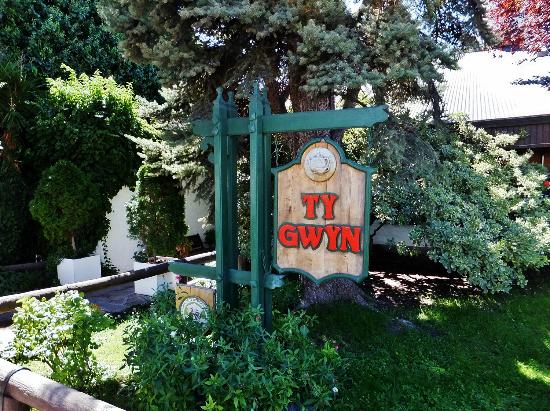
Today’s post is the result of finding a business card in Spanish for one of our 2011 Argentina destinations. It was part of the best day on that particular trip. In the morning, Martine and I went to the giant Magellanic penguin rookery at Punta Tombo where we saw baby penguin eggs hatching under the watchful eyes of hungry shore birds. Then we drove to the Welsh settlement at Gaiman where we had high tea at the Ty Gwyn.
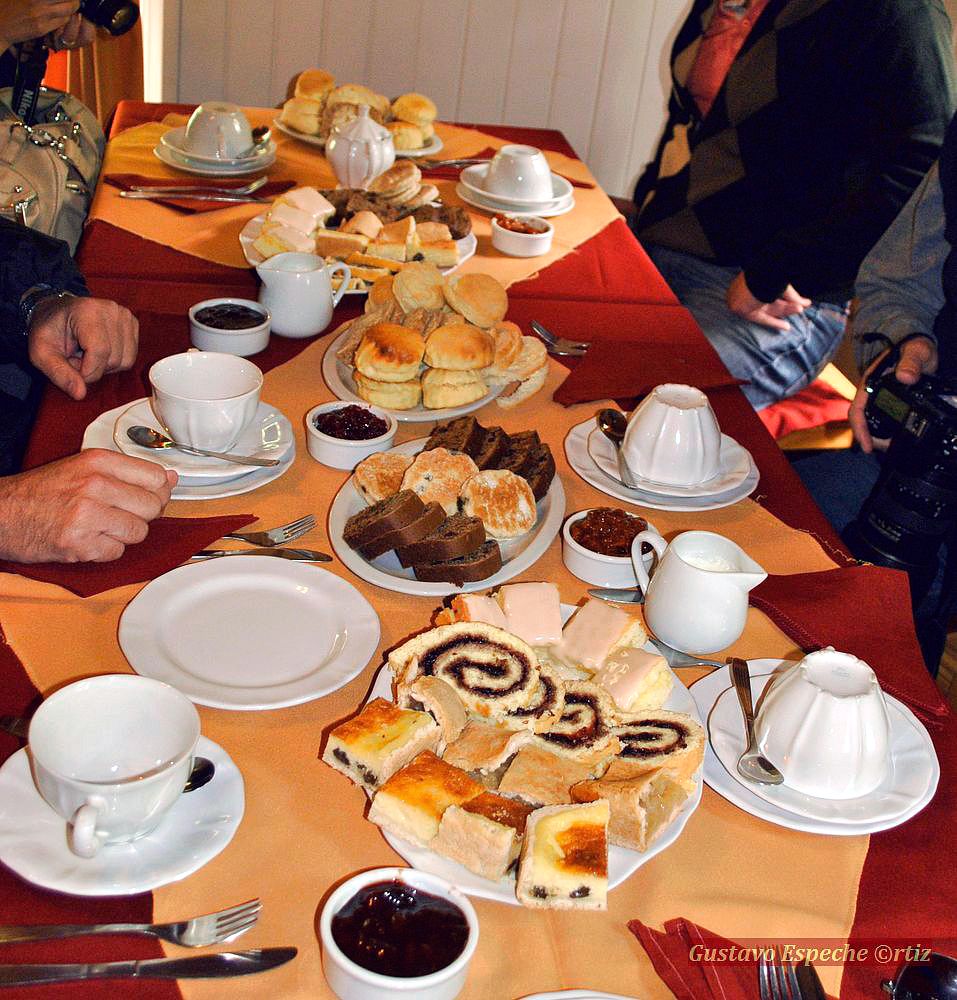
Although we were many thousands of miles from Wales, it was as if we were in the Old Country. The tea, sandwiches, and cakes were absolutely delicious. In fact, we had such a good time that we took a bus from Puerto Madryn back to Gaiman and had another high tea.
High Tea at Ty Gwyn
The State of Chubut was originally settled by the Welsh who settled in a number of communities, including Gaiman, Puerto Madryn, Trelew, and Dolavon. At the souvenir shops at the Trelew airport, a conspicuous presence were the packages of Torta Negra Galesa, the dark Welsh Cake that is the highlight of a Welsh tea.
The only other places where Martine and I had high tea were at Blenheim Palace in England—the birthplace of Winston Churchill—and Butchart Gardens near Victoria, British Columbia, Canada. It is interesting that the Welsh in Argentina were easily on a par with the other two.








You must be logged in to post a comment.