The Land of Mordor, Minus the Shadows

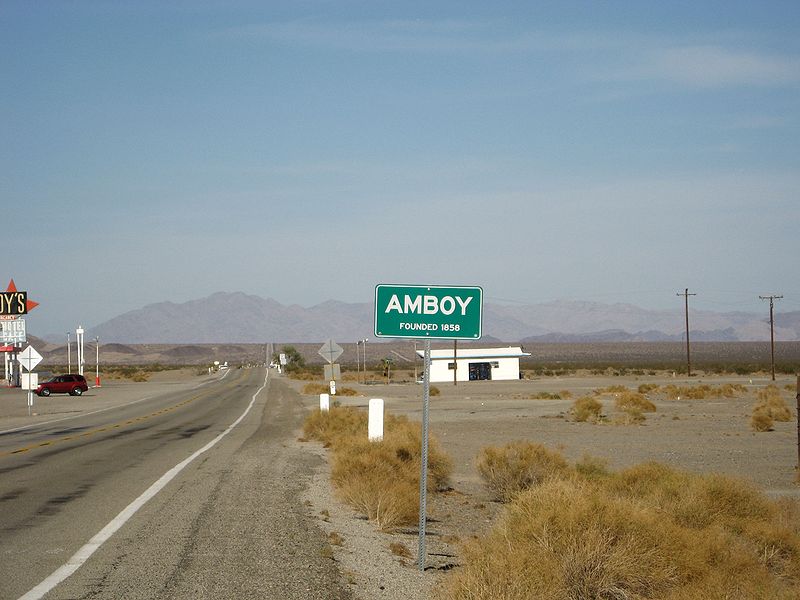
Beautiful Downtown Amboy

Beautiful Downtown Amboy

There are several places in Sunny California which I would compare to J.R.R. Tolkien’s Mordor. You know he place I mean:

Three Rings for the Elven-kings under the sky,
Seven for the Dwarf-lords in their halls of stone,
Nine for Mortal Men doomed to die,
One for the Dark Lord on his dark throne
In the Land of Mordor where the Shadows lie.
One Ring to rule them all, One Ring to find them,
One Ring to bring them all and in the darkness bind them
In the Land of Mordor where the Shadows lie.

Except the places I would liken to Mordor are singularly without shadows. Curiously, they are all connected to dry lake mining operations. The grimmest of all is Amboy, on the original Highway U.S. 66. It lies a few miles east of Barstow, a hellhole in its own right, which is a rail junction and the gateway to Fort Irwin.

Today the population of Mordor—I mean Amboy—is perhaps four. Roy’s Coffee Shop and Cabins is no longer a going concern, unless someone is filming in the neighborhood. (Bagdad Cafe was filmed in Bagdad, a few miles west on 66.)

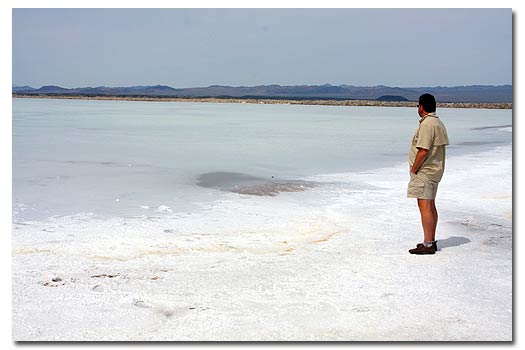
Amboy owes its existence to Route 66, but also to Bristol Dry Lake, which contains some 60 million tons of salt for your French fries.

Bristol Dry Lake

Bristol Dry Lake

Also in the area are mines containing Boltwoodite, a relatively rare form of uranium, along with gypsum, calcite, and fluorite.

I got to know Amboy when Martine used to work at Twentynine Palms at the U.S. Marine Base there (she was a clerical worker at the Naval Hospital there). A couple of times, I would pick her up, drive through the ghastly “community” known as Wonder Valley settled by veterans of gas attacks in World War I along a road which terminated at Highway 66 in Amboy. From there we headed to Las Vegas using the Kelbaker Road and the Morningside Mine Road. It’s a desolate area with sand dunes (near Essex) and some spectacular stands of Joshua Trees.

What are the other places in California I liken to Mordor? They’re right next to each other on the road from Ridgecrest and China Lake to Death Valley: namely, Trona and Borosolvay. Both are desolate but more habitable than Amboy. Yes, hell can be sunny sometimes.

“Are You Comfortable in Bed?”

I’m More Comfortable Than HE Is, As I Don’t Sleep on Rocks

I’m More Comfortable Than HE Is, As I Don’t Sleep on Rocks

In my last batch of spam e-mail, I got one entitled “Are You Comfortable in Bed?” As my answer is yes, I did not see fit to open the e-mail, which probably sold vigara [sic] or cialas [sic] or something like that. Thankfully, I am not suffering from electoral dysfunction. Which is to say, I usually vote Democratic.

Getting eight hours of sleep a night is important to me. That is challenged by my massive intake of iced Baruti Assam tea this time of year, but I usually manage to sink back into sleep quickly after draining my lizard. Occasionally Martine and I make like buzz saws, but curiously it doesn’t bother us much. I actually feel reassured that Martine is asleep next to me; and she graciously refrains from kicking me when I start sawing wood.

Every once in a while, I have a difficult time dropping off to sleep because my mind is racing in an infinite loop. I find that the only way to deal with that is to get up and either a bit of a TV movie (the only time I watch TV) or read a book. That somehow closes the infinite loop and allows me to doze. The one thing that does not work in that case is to twist and turn for hours. Better not to even try!

I am appalled when I hear of people getting by on five or fewer hours a night. Sometimes Martine can’t sleep because of her back pain. Frequently she wakes at five in the morning and twists and turns until morning light (or later).

We have an extra firm mattress which helps Martine somewhat. And our living room sofa is similarly firm. These things help (and they don’t bother me at all), but I would be happier if Martine’s back pain abated to the point that she could accompany me on my travels. It’s a lot more fun having her with me.

The Cloud-Covered City of the Kings

The Garúa Investing the Coastline of Lima

The Garúa Investing the Coastline of Lima

Just because Peru is a few degrees south of the Equator doesn’t mean the sun is always shining. In fact, from June through November, a warm wind interacting with the cold Humboldt current results in a condition around Lima locally referred to as la garúa. As one American expat describes it:

It is more than a fog, less than a rain. It is the heavy mist that sometimes appears in the winter in Lima. The locals call it la garúa, a sea mist caused by warm winds interacting with the cool water of the ocean. It is a condition found usually from June through November along the Peruvian Coast.

Arriving in Lima as I am in September, I will be in the Peruvian equivalent of March (subtract six from the ninth month of the year), which means it will still be winter. That will be fine with me, because I abhor hot weather. I expect Lima will be similar to our spring marine layers in Los Angeles that we usually refer to as “June Gloom.”

Here is another view, taken from the historic center of the City of Kings:

Foothills of the Andes from Central Lima

Foothills of the Andes from Central Lima

It will be a challenge to me as a photographer to make my scenic views interesting, but it will be fun. Once I leave Lima, I will be in the bright sunny mountains with their spectacular clouds.

Ring of Fire

The Volcano Sabancay: Erupting Again

The Volcano Sabancaya: Erupting Again

The Pacific Ring of Fire stretches from Indonesia and the Southwest Pacific in a massive arc around Asia, North America, down to the West Coast of South America. According to Peru This Week, this zone “is the site of 85% of global seismic activity caused by friction between shifting tectonic plates.”

In South America, the culprit is the Nazca Plate, which borders the Pacific side of the continent, and which features a convergent boundary subduction zone and the South American Plate, which action has formed the Andes. Hardly a day passes by when I don’t hear of another earthquake in Peru (usually in the Richter 4.0-5.5 range); and hardly a month passes by without a new volcanic eruption. Today, it is reported that Sabancaya (see above) in the State of Arequipa has begun to spew ash. If it continues, I will probably be there to see it in person next month at this time.

Below is an illustration of how the Nazca Plate (in light brown) subducts the South America Plate (in green), thereby causing all these dire events (and, by the way, over the millennia, causing much of the beauty of the Andes as well):

The Nazca Plate Takes a Dive, Wrinkling the Face of the Earth

The Nazca Plate Takes a Dive, Wrinkling the Face of the Earth

Last year, I visited Iceland, through which runs the boundary between the Eurasian Plate and the North American Plate, resulting in several dozen active volcanoes and frequent earthquakes. In fact, the boundary runs right through the middle of Thingvellir National Park, where it is expanding the size of Iceland (and the park) year by year.

What is it with me and volcanoes? Is it because I live in multiply cross-faulted Southern California with its own history of earthquakes? Maybe in future I should visit Krakatoa and Mount Vesuvius?


Imagining Argentina

Tango Dancers in La Boca

Tango Dancers in La Boca

Even though I’ll be in Arequipa, Peru, a month from today, I still look back fondly to Argentina, which I visited in 2006 and 2011. In fact, today Martine and I ate dinner at Empanadas Place at Sawtelle and Venice Boulevards in Mar Vista. I had an entraña (skirt steak) sandwich and iced mate cocido, while Martine had two empanadas, one stuffed with spinach and the other chopped beef. It is probably one of our favorite places to eat on L.A.’s West Side; and, according to Martine, the empanadas there were better than what we were served in Argentina. (Of course, the place for empanadas is in Northwest Argentina around Salta and Tucumán.)

In addition to Empanadas Place, there is a very good Argentinean restaurant on Main Street in Culver City: the Grand Casino Bakery & Café. We go there several times a year.

I have come to love drinking yerba mate tea and—very occasionally—sneaking some alfajores cookies filled with dulce de leche. My two visits to the Southern Cone of South America have resulted in a series of cravings I have yet to fill. Although we saw a good part of Patagonia, I have yet to go to Carmen de Patagones, Viedma, San Carlos de Bariloche, and Esquel. (In 2011, there was a major volcanic eruption at Puyehue and Cordon Caulle in the Chilean Andes which covered several whole states of Patagonia with ash—so we went to El Calafate instead to see the glaciers.)

To be sure, when I return from Peru, I will be haunted by my desire for Peruvian food. Fortunately, there are also Peruvian restaurants in L.A.; but I am sure it is but a pale shadow of what I will be eating next month. Plus, I will no doubt miss interacting with the Quechua and Aymara peoples of the Peruvian altiplano.

Independence Day 1821

Declaring Independence Was One Thing, But Winning It Another

Declaring Independence Was One Thing, But Winning It Another

Peru is now celebrating the 193rd anniversary of its own Declaration of Independence by José de San Martin in Lima, as shown in the famous painting above by Juan Lepiani. As with our own Declaration of Independence, there was still a lot of fighting to come. Worse still, disunity was rampant. So much so that San Martin left for Europe in disgust and remained there until his death in 1850. Compared to what happened in South America, our own struggle for independence was a cakewalk, thanks largely to Admiral de Grasse and the French navy.

Let me give you a brief timeline. First there were the native peoples of what is now Peru, who were mostly gobbled up by the Inca empire. Then the Spanish came in under Francisco Pizarro, defeated the Incas, and set up a European-based government. All went somewhat smoothly under the Peninsular War of the early 19th century, in which the English, abetted by Spanish guerrillas, drove Napoleon’s French out of the Iberian Peninsula—at the cost of messing up their colonies in the New World. All criollo (native-born white) officials were replaced by new administrators from Spain. So, feeling disenfranchised, the criollos rebelled under Bolivar, San Martin, Sucré, O’Higgins and others. They won, effectively driving the Spanish from South America.

Even to this day, Peru is largely a criollo-run country, even though whites constitute only 15% of the population. Naturally, the 45% who are Amerindians and the 37% who are Mestizo (mixed races) currently feel disenfranchised. Is Peru due for another revolution? In a way, it had one in the 1980s and 1990s under the Shining Path and the MRTA guerrillas, who were defeated in a series of bloody confrontations in which thousands of innocent people were killed.

It is inevitable that the non-whites in power will be replaced by more of the people from the Altiplano and jungle regions as time goes on. There may be other Independence Days to come. Who knows?

After all, there are people who feel the same way in the United States, people who dress in 18th century costumes with tea bags dangling from their hats.

Before the Incas

Yes, There Were Great Civilizations Before the Incas

Yes, There Were Great Civilizations Before the Incas—Witness This Moche Pot

We tend to think that the only advanced Pre-Columbian Civilizations were the latest. For Mexico and Central America, that would mean the Aztecs and Mayas; for Peru, the Incas.

As one who has traveled to Mexico many times to see archaeological sites, I can vouch for the fact that, long before the Aztecs left their mythical homeland of Aztlán, there were other civilizations in Mexico that they replaced, but which they did not necessarily improve upon. The peoples who built Teotihuacan north of Mexico City did it around a hundred years before the Christian era. Then there were the Toltecs, the Totonacs, the Olmecs, and the Huastecs. I have seen remains from these and other Meso-American civilizations over a thirty-year period.

The Mayans are slightly different: They were less a centralized political entity than a people who have been around for thousands of years and lived through both empires and more localized city states and leagues of city states. The last Mayans were conquered by the Spanish at Tayasal in 1697, representing a much thornier military target for the conquistadores than the Aztecs.

The Moche Civilization of Peru

The Moche Civilization of Peru (100-800 AD)

Like the Aztecs, the Incas were fairly late on the scene, first coming to notice around 1438 and being conquered (but not decisively) by Francisco Pizarro a hundred years later. In many ways they were not as advanced as the Aztecs and Mayans inasmuch as they did not have writing—though they appear to have been able to use a writing system of colored knotted cords called quipus for inventories and other business purposes. (In this regard, they were like the ancient Greeks who used Linear A in a similiar way.)

What the Incas had going for them were primarily two things:

  1. They built a great paved road system covering some 25,000 miles. (But since these roads included steps at times, they could be navigated by sure-footed llamas, but not by the Spaniards’ horses).
  2. They were great builders who, in a major earthquake zone, erected structures that are still standing.

Prior to the Incas, there were numerous Peruvian civilizations who bettered the Incas in many respects. The Moches or Mochica of the north were just one example: Their pottery is far more artistic (see above photo) than anything the Inca were able to create. Then, there were the Wari, the Nazca, the Chavin, Tiwanaku, Chincha, Chanka, and Chimu.

My upcoming trip to Peru will include some visits to non-Inca ruins, such as Huaca Pucllana of the indigenous Lima culture and Pachacamac of the Ichma people. If it weren’t for the fact that I’ve never been to Peru before—and I don’t know whether I can go again—I will concentrate mostly on the Inca sites of the Sacred Valley between Cusco and Machu Picchu.


Bad Taxi!

Beware of Unregulated Taxis

Beware of Unregulated Taxis

In many countries, taxicabs are unregulated. There are no meters. What is worse, many of them are looking for victims to rob, rape, or kidnap. According to the PeruNews website:

In the taxi robbery, a driver takes you to where his accomplices are waiting and then stops, sometimes pretending to stall the engine or run out of fuel. Then, you get mugged or kidnapped. Nice.

Many of the cabs used in these crimes have just been stolen, so don’t get into a vehicle with e.g. a broken window. You can reduce the chances by taking a cab from a company that you call up.

On the street, one cab is as good as another. The fact that it’s yellow, has a phone number written on it, is parked by the cinema rather than being driving past when you flag it down, a driver with official-looking ID; none of these means a safe taxi.

Many of the worst instances take place from Lima’s Jorge Chavez International Airport. Of course you can get a better deal if you walk past the legitimate (and more costly) taxi stands in the airport’s international arrivals area, but you can also get driven to ATMs and requested under duress to drain your bank account with the maximum permissible withdrawals.

That’s one of the reasons it’s a good idea to have a cellphone in Peru. This way, you can get a list of legitimate taxi companies from your guidebook and call for pickup. So what if it costs a few soles more! Your security is worth something, no?

Another problem, even with legitimate taxis, are thieves that break windows and grab the passengers’ bags. Make sure your luggage is securely locked in the trunk, and keep any bags with you on the floor and between your legs. You might even want to get a strap that attaches them to your legs. I plan to do that, even though I am taking a Taxi Verde or a Mitsui Remisse from the airport.

In one sense, Peru is a dangerous place. In another—wherever you are in the world—you have to keep your eyes open and be ready.

Puno Gets No Respect

Bicycle Repair Shop in Puno

Bicycle Repair Shop in Puno

As one who lived the first seventeen years of his life in Cleveland, Ohio, I am well aware that some places come as a major disappointment to travelers. Cleveland was usually referred to as “The Mistake on the Lake” and, parodying the Chamber of Commerce motto of “The Best Location in the Nation,” “The Worst Location in the Nation.” And on the old Dobie Gillis TV show, wasn’t that hippie Maynard G. Krebs always going to see a movie called The Monster That Devoured Cleveland.

Well, Puno is one of those cities that gets no respect. A major entrepot for goods being trucked from Peru to Bolivia and vice versa. It is also one of Peru’s major centers of indigenous population, including both Quechuas and Aymaras.

If you take a look at the books written by travelers, you get a pretty dim view of the place. Paul Theroux (The Old Patagonian Express) and Christopher Isherwood (The Condor and the Cows) didn’t even give the place a chance: They arrived at night and left that same night on a boat bound across lake Titicaca for Copacabana, Bolivia. Since there are now no boat crossings to Bolivia—unless one is on an expensive catamaran tour—that option no longer exists.

When Patrick Leigh Fermor visited in the early 1970s (Three Letters from the Andes), he didn’t have much good to say about the place:

There was little for the eye to feast on outside. Puno is an assembly of corrugated iron roofs, sidings and goods yards sprawling round a church like a Gothic mud pie. We picked our way through the debris and squatting Aymara Indians—treading softly lest we tread on their dreams—to a ramshackle lacustrine port where an old steamer lay at anchor, brought piecemeal overland long before the railway, so that each plate was cut down to the weight a mule can carry, and sometimes a llama, then welded and riveted together again on the lake shore.

Fermor describes being met at the train station by a gaggle of unruly Aymara porters “seizing our luggage and bickering and punching each other all the way across the tracks to the repellent Ferrocarril hotel,” which had mislaid all the partys reservations.

Some years later, Michael Jacobs (The Andes), had this to say about Puno: “Neither of us was keen to stay any longer than necessary in Puno, which looked, under bright sunlight, even uglier than I had remembered it. The sun accentuated its resemblance to a waste tip of dirty brown boxes washed up by the lake.”

In Cut Stones and Crossroads, Ronald Wright damns the city with faint praise: “Puno has improved: I’ve found a hotel with hot water and a restaurant with hot food.” In The White Rock, Hugh Thomson considers Puno a “‘one-nighter,’ if that.”

Given all that bad publicity, I am sure that I will enjoy Puno. There isn’t much to see in the city proper (or should I say improper?), but there are the burial towers at Sillustani and the Islands of Taquile and Amantani in the middle of the lake. Plus, I will be trying to outlast the soroche I am sure will overtake me there at the elevation of 12,500 feet. Hey, nothing can surprise me: I’m from Cleveland.


Inti Raymi

Inca Warrior

Inca Warrior

Before Francisco Pizarro upset the whole apple cart, Inti Raymi was one of four major Inca festivals celebrated in Cusco. It is still celebrated annually, except the venue has moved to the nearby ruins of Sacsayhuamán—usually pronounced by American tourists as “Sexy Woman.” The following description of the festival’s origin is from Wikipedia:

According to chronicler Garcilaso de la Vega, Sapa Inca Pachacuti created the Inti Raymi to celebrate the new year in the Andes of the Southern Hemisphere. The ceremony was also said to indicate the mythical origin of the Incas. It lasted for nine days and was filled with colorful dances and processions, as well as animal sacrifices to thank Pachamama and to ensure a good cropping season. The last Inti Raymi with the Inca Emperor’s presence was carried out in 1535, after which the Spanish and the Catholic priests banned it.

Since 1944, there has been a re-enactment of the Inti Raymi ceremonies on June 24 of each year. Although this re-enactment is mostly for the benefit of tourists, there are still real Inti Raymi ceremonies held by Quechuan peoples throughout the Andes.