Demoted!

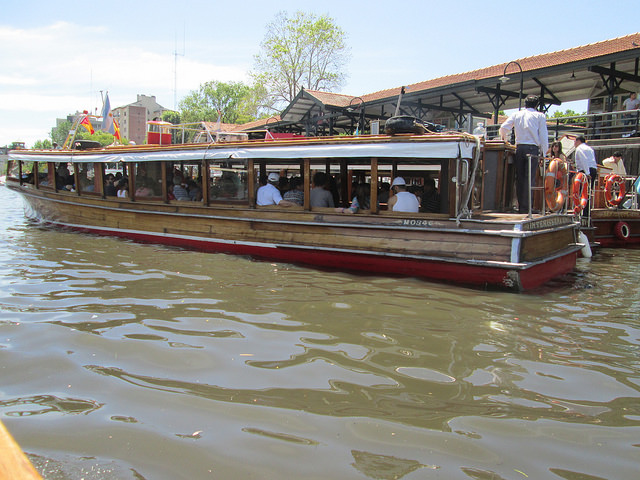
Carmen de Patagones Seen from Viedma

Carmen de Patagones Seen from Viedma

The two cities sit on opposite banks of the Rio Negro. Carmen de Patagones, on the north bank, is the southernmost city of the State of Buenos Aires; Viedma, occupying he south bank, is the capital of the State of Rio Negro, which extends west as far as the Andes and the Chilean border.

It seems that the current edition of the Lonely Planet Guide to Argentina no longer has chapters for the twin cities on the Rio Negro. I guess they’re not Disneyfied enough to draw all the tour groups. For travelers driving from Buenos Aires to Patagonia, it is at best a stopping place for the night before big chunk of attractions around Puerto Madryn and Trelew.

Viedma also happens to be the terminus of the Tren Patagonico, about which I wrote yesterday. From there, it goes clear across the State of Rio Negro to the Patagonian Lake District around San Carlos de Bariloche. Today, I finally got an e-mail response from the Tren Patagonico people telling me they’ll be ready to take my reservation for November in a week or so.

If my reservation is confirmed, I’ll spend a couple of nights in either Viedma or Carmen de Patagones and wander around both towns seeing the local museums.

In 2001, I remember being the only visitor in a two-hour period to the old fish canning museum in Heimaey in Iceland’s Vestmanneyjar Islands. I loved every minute. The curator gave me a personal tour and explained how Heimaey was the main fishing port in Iceland, a country whose GDP is based on their fish catch. Even though the museum is no more (I looked for it in 2013 but couldn’t find it), I have special memories of my visit. And that is much better than being jostled by huge crowds of tourists who distractedly push their way past all the exhibits on their way to the next destination.

So Viedma and Carmen de Patagones have been demoted! So much more for me to see!

Argentina: One Remaining Question

An Overnight Train Trip Clear Across Patagonia

An Overnight Train Trip Clear Across Patagonia

Right smack in the middle of my trip, there is a question of how I’m going to get from Buenos Aires to San Carlos de Bariloche. Most people would probably elect to fly, but I want to minimize my exposure to Aerolineas Argentinas, a state-run airline with a laughably intricate labor union structure. There are a dozen or more unions, any of which can decide to call a strike any time. In 2011, they decided to fly us to Ezeiza’s Ministro Pistarini Airport rather than Aeroparque Jorge Newberry, necessitating a fifty dollar cab ride in the middle of the night to our hotel in the Congreso district.

(As currently planned, I will use Aerolineas to fly from Puerto Iguazu to Aeroparque, and Santiago, Chile, to Aeroparque. Let’s see how badly they screw me up this time.)

What I would like to do is to take an overnight bus to Viedma on the coast, and the Tren Patagonico from Viedma to Bariloche. Below is a map of the route:

Cutting Across the State of Rio Negro

Cutting Across the State of Rio Negro

Part of this was traveled by Paul Theroux on the trip covered by his book The Old Patagonian Express—except he got off at Ingeniero Jacobacci and transferred to a southbound narrow-gauge train from Jacobacci to Esquel.

The only problem is that I have not so far succeeded in making a reservation for the November 13 train. If they do not respond to my reservation request by October 15, I will take a bus from Buenos Aires to San Martín de los Andes. From there, I will take the scenic Ruta de Siete Lagos (Route of the Seven Lakes) to Bariloche. In either case, I have a reservation for Bariloche beginning November 14.

Either way, I’ll probably have a good time.


Dreaming of Proust

Alfred George Stevens’s “Portrait of Sarah Bernhardt” (1885)

Alfred George Stevens’s “Portrait of Sarah Bernhardt” (1885)

When you’re a hopeless intellectual like me, you, too, will have dreams that smack of literary criticism. This one is from last Saturday night. Despite the hot, humid weather we’re having in Los Angeles, I had just begun re-reading the second volume of Proust’s In Search of Lost Time, in the David Grieve translation called In the Shadow of Young Girls in Flower. (That title alone gives rise to dreams of a sort.)

Marcel has finally won the right to go to the theater to see the great actress La Berma (thought to be Sarah Bernhardt) as Racine’s Phèdre, albeit chaperoned by his grandmother. Feeling he is about to be exposed at long last to the holy grail, Marcel awaits the magical moment. It comes, but, alas, the lad is disappointed. Although he claps and cheers madly with the audience, Marcel feels that the actress did not live up to her hype.

That’s where my dream begins. I am thinking: Well, now, the entire heptology is full of disappointments: In the first volume Swann is cruelly deceived by his love, Odette de Crécy … but marries her anyhow. Marcel idealizes the ancient nobility of the Oriane, Duchesse de Guermantes, but gives us ample opportunities throughout the series to see how trivial her decorous life has become. As for Palamède, Baron de Charlus, he is given to affairs with lower class young men and, in the final volume, ends up being flagellated by one of them in a male bawdy house. Albertine does wind up in a relationship with Marcel, but he agonizes constantly that she is bi-sexual. Besides, she dies young.

Again and again, it almost seems as if Proust’s grand theme is either “You can’t always get what you want” or “Nothing is as good as it seems at first.”

And that’s where my dream left off. In the end, though, I rejected my dream interpretation. Marcel’s inner life is so vivid and intense that all the disappointments still make it all worthwhile. If that negativity were the only thing I got from reading Proust, why would I be reading the seven volumes for a third time? (Er, aside from THAT, I mean).

Incidentally, the original Stevens portrait of Sarah Bernhardt (above) is at the Hammer Museum in Westwood, near my place of work.


Under the Bridges

James Doolin’s Painting “Bridges”

James Doolin’s Painting “Bridges”

On past visits to the Autry National Center’s exhibit of paintings of the West, I had always admired James Doolin’s “Bridges” (illustrated above). By  now, I have begun to believe that it is one of the most representative landscapes of Los Angeles, simultaneously showing the present web of freeways and, underneath all the concrete, the desert.

I could almost swear the scenes are of the Pasadena Freeway (I-110), which I drove today on the way back from visiting Bill and Kathy Korn in Altadena. It looks like the stretch as you approach downtown L.A. from the north. You can see the 1930s concrete work (in fact the year 1937 appears on the lower left abutment).


On the Road to Mordor

Deserted “Jackrabbit Homestead” in Wonder Valley

Deserted “Jackrabbit Homestead” in Wonder Valley

Today, Martine and I visited the Autry Center, the L.A. museum dedicated to the American West. In addition to an excellent exhibit on the American West in the Civil War, there was an intriguing show featuring the “jackrabbit homesteads” of Wonder Valley.

Martine used to live in this area when she worked at the Twentynine Palms Marine Corps Air Ground Combat Center in the hospital. It was not a happy time for her, and she has retained zero interest in living in the heat of the desert, even at a couple thousand feet altitude.

I remember one time after tax season in 1995, just after the Oklahoma City terrorist bombing, I picked Martine up in Twentynine Palms and took the road through Wonder Valley, Amboy, Essex, and various other obscure desert towns on the back roads to Las Vegas.

Deserted Homestead Cabin

Deserted Homestead Cabin

Kim Stringfellow, a resident of the area, has done a brief documentary for KCET-TV about the “jackrabbit homesteads” of wonder valley which can be accessed by clicking here. Originally, the area was settled by First World War veterans whose lungs had been damaged by poison gas. It was thought the desert air would help them. It didn’t.

The next population bump came around the 1940s and 1950s after the Small Tract Act of 1938 was passed. Settlers could lay claim to five acres of high desert for as little as $20 an acre if they put up a shack on the property and lived there. These homesteads are now mostly deserted. What could a settler do with five acres of desert and, for all intents and purposes, no water? There was, however, no shortage of hot and cold weather, scorpions, rattlesnakes, coyotes, and—oh, yes—jackrabbits.

The Most Influential Books in My Life

I Read All These Books Multiple Times, Starting at Least Thirty Years Ago

I Read All These Books Multiple Times, Starting at Least Thirty Years Ago

These are not necessarily the greatest books I have ever read. They are, however, the ones that have most influenced me. Each of them, I have read multiple times, and I first read them all before 1985. I have presented them here in alphabetical order by author:

  1. Anonymous. Njals Saga. Why haven’t more Americans read this book? It tells of a time when Iceland was governed by clans, and justice was crude but effective. It’s one of two Icelandic sagas that have a museum dedicated to them. The Njals Saga museum is in Hvöllsvollur, and I have visited it twice. The other honors Egils Saga and is located in Borgarnes.
  2. Balzac, Honoré de. Old Goriot. How does a young man make his way through life? Balzac’s hero, Eugène de Rastignac, is one of the great heroes in fiction.
  3. Borges, Jorge Luis. Labyrinths. Borges has been one of my teachers, having turned me on to so many of the books, people, and places that have mattered in my life. I am re-reading it now for the fifth time.
  4. Chatwin, Bruce. In Patagonia. Maybe not every word that Chatwin writes is true, but even his fictions have lured me to the southern tip of Argentina twice, and soon, for the third time.
  5. Chesterton, G. K. The Man Who Was Thursday. Learn with Gabriel Syme how to see the lamppost from the light of the tree instead of vice versa. Here we are in the world of paradox.
  6. García Marquez, Gabriel. One Hundred Years of Solitude. This is a book I bought at a souvenir stand at the ruins of Chichén Itzá in Yucatán. It showed me that life was magical.
  7. Highet, Gilbert. The Art of Teaching. Originally, I wanted to become a college professor. I never quite made it, but Highet made me wish I had. I first read this book while I was in high school.
  8. Orwell, George. Keep the Aspidistra Flying. Another high school read: How does one tread the fine line between genteel poverty and selling out?
  9. Proust, Marcel. In Search of Lost Time. I am reading this now for the third time. I hope to live to read it several times more. Generally, it takes me a decade to re-read all seven novels in the series. When reading it, I am totally absorbed in the world of Marcel.
  10. Strunk, William and White, E. B. The Elements of Style. Strunk & White showed me that good writing is essentially simple and direct. Another classic from my teen years.

I could easily add more titles, but these titles keep swirling around in my head and influencing me.


The Cook

I Do All the Cooking at Home

I Do All the Cooking at Home

At some point during the 1960s, I discovered that eating out at restaurants all the time was going to:

  1. Eat into my finances
  2. Deprive me of the fruits and vegetables I needed to survive and
  3. Make me tired of eating out all the time

I knew what good food was because I was raised on my Mom’s Hungarian home cooking, supplemented by my great grandmother Lidia’s special dishes. But I made the mistake of never learning from them, though I did help my Mom from time to time, mostly stirring the pot so the food would not burn.

My first experiments were pretty bad: They usually had too many spices (more or less randomly chosen) and relied excessively on rice and pasta as the carbohydrate base. Also I used way too much ground beef, for which I now substitute lean ground turkey.

When Martine came to live with me in the early 1990s, I also had to learn to cook to please her. This is not easy. Martine cannot eat spicy food, and there are too many ingredients that she flat-out doesn’t like. Also, as she suffers from recurring bouts of irritable bowel syndrome, I have to be able to turn on a dime and cook something especially bland at a moment’s notice. This week, for example, despite the heat and humidity, I made a pot of vegetable soup.

Tonight, I plan to cook Ree Drummond’s spaghetti with artichoke hearts and tomatoes. I like her recipes because they are well conceived, simple, and lavishly illustrated. Her cooking column is called “The Pioneer Woman.” I haven’t found a clinker yet in the lot.

Why do I do all the cooking? Well, for one thing, Martine is notably maladroit at cooking; and her mother prepared the most vile dishes I have ever eaten. (Her vegetables were greasy!) Secondly, I like to cook. It makes me feel good about myself. Every once in a while I experiment with a new recipe that I have to throw out, but essentially I have a fairly decent repertoire of healthy dishes that I can rely on to see us through.

I’ve cooked the spaghetti with artichoke hearts and tomatoes two or three times before with good results. I just have to make sure the tomatoes are chopped up fine because big pieces of tomato are one of Martine’s bête noires.

Felix Culpa

I Profit from My Booking Error

I Profit from My Booking Error

Until a few days ago, I thought my flight to and from South America was going to set me back slightly over $2,200. That’s mostly because flights from Santiago, Chile to Los Angeles are not cheap. Poring over my ticket confirmation, I find that the $900 for my flight to Buenos Aires via São Paolo is actually a round trip flight. Instead of forking over $1,300 for a flight from Santiago, I just need a much cheaper flight (about $300) from Santiago to Buenos Aires—provided I fly back on Thanksgiving Day via TAM Airlines, again via São Paolo.

I’m not sure how this all happened, but I have verified that my TAM ticket is round trip, and that I will have almost one thousand dollars more to spend on my vacation. Of course, I will have to loll around for six hours at São Paolo’s Guarulhos International Airport, but that’s all right with me. I will have my two Kindles fully charged and can sample some tasty Brazilian chow at my leisure.

As far as missing out on some turkey on Thanksgiving, too bad. Don’t like it much anyhow.


“The Fishes of the Dawn”

Pablo Neruda (1904-1973), Chilean Poet

Pablo Neruda (1904-1973), Chilean Poet

For many years, it was thought that Pablo Neruda was poisoned by order of General Augusto Pinochet Ugarte because of his association with Salvador Allende. Inasmuch as he died only twelve days after Allende, foul play was assumed. Until recently that is. when Neruda’s body was exhumed by a team of forensic scientists, who found no evidence of poison.

I thought I would celebrate this finding by giving you Margaret Sayers Peden’s translation of Neruda’s “Ode to Age”:

Ode To Age – Poem by Pablo Neruda

I don’t believe in age.
All old people
carry
in their eyes,
a child,
and children,
at times
observe us with the
eyes of wise ancients.
Shall we measure
life
in meters or kilometers
or months?
How far since you were born?
How long
must you wander
until
like all men
instead of walking on its surface
we rest below the earth?
To the man, to the woman
who utilized their
energies, goodness, strength,
anger, love, tenderness,
to those who truly
alive
flowered,
and in their sensuality matured,
let us not apply
the measure
of a time
that may be
something else, a mineral
mantle, a solar
bird, a flower,
something, maybe,
but not a measure.
Time, metal
or bird, long
petiolate flower,
stretch
through
man’s life,
shower him
with blossoms
and with
bright
water
or with hidden sun.
I proclaim you
road,
not shroud,
a pristine
ladder
with treads
of air,
a suit lovingly
renewed
through springtimes
around the world.
Now,
time, I roll you up,
I deposit you in my
bait box
and I am off to fish
with your long line
the fishes of the dawn!

It is my hope to read more of Neruda’s poetry before I visit his houses near Valparaiso, Chile.

The Man from La Boca

He Was the Painter of the Port of Buenos Aires

He Was the Painter of the Port of Buenos Aires

Benito Quinquela Martín (1890-1977) is a painter not widely known in the art world of New York, London, or Paris. In Argentina, his work is a different story altogether. Martín was known primarily for painting port scenes around La Boca, which, for most of his life, was the port of Buenos Aires. Today, La Boca is primarily known for cheap souvenir shops and dancers who assume tango positions for pesos for the tourists. Near the tour buses at Caminito, however, sits the Escuela Pedro de Mendoza, which happens to contain the Museo de Bellas Artes Benito Quinquela Martín dedicated to his work.

Boca is not the nicest part of the port city, and it is no longer the port, which has been moved east. The polluted Riachuelo, also known as the Matanza, flows past the museum and the brightly colored buildings decorated with leftover marine paints and inspired by Quinquela Martín’s port views.

Unloading Cargo at La Boca

Unloading Cargo at La Boca

Aside from the tourist ghetto around Caminito and the nearby Boca Juniors football stadium known as the Bombonera, or candy box, Boca is a rough neighborhood from which tourists do not stray far. A century ago, however, it was the port of entry for thousands of Italian, Spanish, and other European immigrants who came to South America looking for a better life. And many of them found it. During the First World War, most soldiers on both sides were fed with canned beef from Argentina and Uruguay; and silent movies like The Four Horsemen of the Apocalypse (1921) starring Rudolph Valentino showed the lives of Argentinian millionaires.

Another Port Scene from Martín

Another Port Scene from Martín

Today, Benito Quinquela Martín is considered to be one of the greatest Argentinian painters of the Twentieth Century; and his work in found in museums throughout Buenos Aires.