
By the Skin of Our Teeth

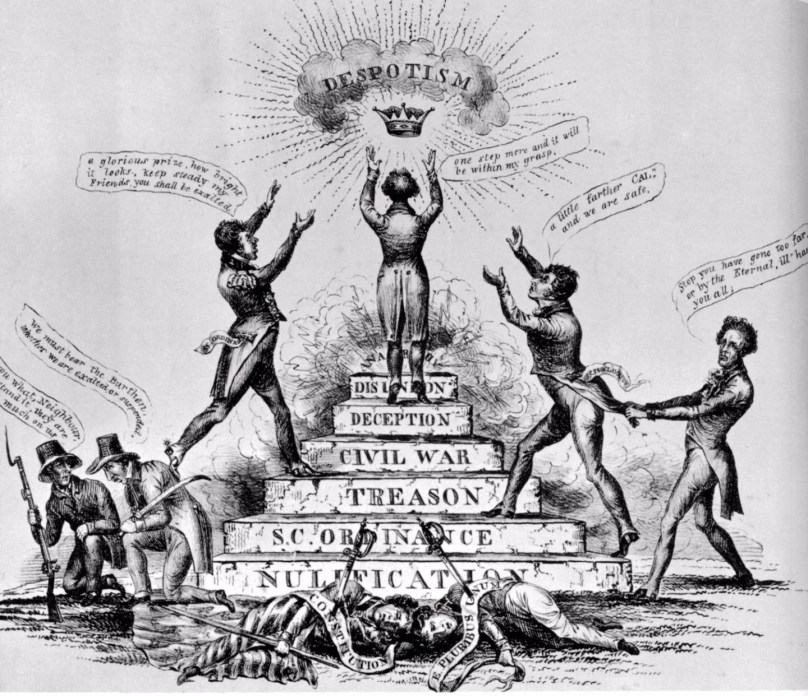
Political Cartoon about the South Carolina Nullification Crisis

As I read more about Andrew Jackson’s presidency, I begin to realize that what the United States is experiencing now with Donald Trump is not atypical in a democracy. Although the Southern states remain restive over a hundred fifty years after their defeat in the Civil War, and there is talk by a few morons about a new Civil War, it does not seem as threatening as what Jackson faced with the threat of South Carolina to secede in 1832.

At that time, muskets were being collected in South Carolina under instructions from the secession-oriented governor of the state. Fortunately, Jackson, himself a Southerner, was ready to counter the secessionists by appointing a Unionist Southerner to command the U.S. armed forces in the state.

I tended to think of American history (at least up to the firing on Fort Sumter in 1861—in South Carolina, no less) as a well-ordered pageant. It wasn’t. Powdered wigs and all, the early days of my country were pretty ragged. And, of course, they still are.

Although I avoid discussions about politics, I firmly believe in exercising my right to vote. It’s just that in politics, as with religion, everyone has his own views. Although I am fairly liberal in my views, I have friends on the Democratic side who are within an ace of believing that our next president should be a black transsexual.

Jackson

1903 U.S. Stamp Honoring Andrew Jackson

On the 250th anniversary of the signing of the Declaration of Independence, I decided to return to reading books on American history. The fact that I refrained for so long was due to my contempt for Donald Trump and the voters who elected him to office in 2024.

Consequently I am halfway through a biography of Andrew Jackson (Jon Meacham’s American Lion: Andrew Jackson in the White House). Recently, I thought of “Old Hickory” as a precursor of the Trump madness. Now I begin to think that, although Jackson was highly conflicted, a slaveholder, and responsible for gross injustices toward the American Indian population of the Southern states, he was by and large an honorable man of his time and place.

For one thing, he was an excellent general, responsible for inflicting a humiliating defeat on the English during the Battle of New Orleans. He served two terms as President of the United States, and did not attempt to loot the country for his personal benefit.

He was probably one of the unhappiest of our nation’s leaders. His beloved wife Rachel died before he was sworn in as president. He had a close relationship with his Andrew and Emily Donelson, who served as his personal assistants. But then a vicious petticoat war between the Donelsons and the wife of his Secretary of War, who was a personal friend, poisoned much of his first term.

Somehow he maintained his popularity among the voters. That was because he firmly believed in following the will of the majority, even if meant stepping on the toes of men like John C. Calhoun, his vice president, or Henry Clay—both of whom craved the presidency for themselves.

I am only halfway through the biography, but have decided to continue reading one or two American histories or biographies a month for the foreseeable future. Since I am rapidly on the road to recovery after my broken shoulder, I shall look for a copy of Bernard DeVoto’s 1846: The Year of Decision for my next read in this series.