Haibun: The Norte

A Norte Storm Lashes the Gulf Coast of Yucatán

A Haibun is a uniquely Japanese medium in which prose and haiku poetry are interspersed. I will attempt to memorialize some of my travel experiences using the Haibun genre from time to time. My intent is to follow the style of Matsuo Bashō:

November norte
White-clad Maya point and laugh
Paper boats bobbing in the street.

It was November 1992. I was in Yucatán with Martine and three friends from work: George Hoole and Jin and Christine Han. On the last day but one of our trip, the peninsula suffered a storm called a norte, because it originated in the United States and gathered strength as it crossed the Gulf of Mexico. The streets of Mérida were flooded: There was no walking without wet stains halfway up the leg. We were staying at the Posada Toledo, an old mansion turned hotel, near the center, worried whether our return flight the next day would be able to take off. Jin Han lightened the mood by carefully folding paper boats and setting them adrift in the street. They aroused considerable hilarity among the passersby.


Traveling with Bashō

Matsuo Bashō (1644-1694) in a Print by Hokusai

I cannot help but see myself in this haiku by the great Japanese poet Matsuo Bashō:

Another year is gone—
A travel hat on my head,
Straw sandals on my feet.

Two weeks from today, I will be in Mérida, Yucatán, reacquainting myself with the world of the Maya. In many ways, Matsuo Bashō is the poet of travel. His book, The Narrow Road to the Deep North, is the ultimate vade mecum for a traveler. The record of a 1,500-mile journey through the main Japanese island of Honshu, it captures with great beauty and subtlety the joys and sorrows of a life on the road.

The sound of a water jar
Cracking on this icy night
As I lie awake.

The extreme conciseness of the haiku form can lead to poetry that is brilliant—or banal. One has to somehow put two ideas together (as the ice and the sleepless traveler) with an absolute minimum of embellishment. Ah, but when it succeeds!

On the withered grass
Shimmering heat waves rise
One or two inches high.

I will, as usual, travel with a blank notebook. I would love to compose haiku relating to my upcoming journey to Mexico. It’s possible, but, alas, not likely. Even though I don’t usually go out evenings (except in Mérida), I will probably find myself too busy reading from my Amazon Kindle, which is fully loaded with hundreds of works of literature and history.


Foreign Lucre

Painter Diego Rivera on Mexico 500 Peso Bank Note

Before visiting any foreign country, I always like to get a supply of banknotes in that country’s currency for the first few days of my trip. So today I headed to Bretton Woods Currency in Brentwood to pick up a couple hundred dollars worth of pesos. The act of handling another country’s currency is always a magical moment for me: I suddenly feel the reality of my impending vacation—in this case, exactly two weeks from today. I got three denominations: 500 Pesos, 200 Pesos, and 100 Pesos.

My favorite is the 500 Peso note, which shows painter Diego Rivera on the front and his wife, the painter Frida Kahlo, on the reverse.


Mexican Patriots Miguel Hidalgo and José Maria Morelos on the 200 Peso Note


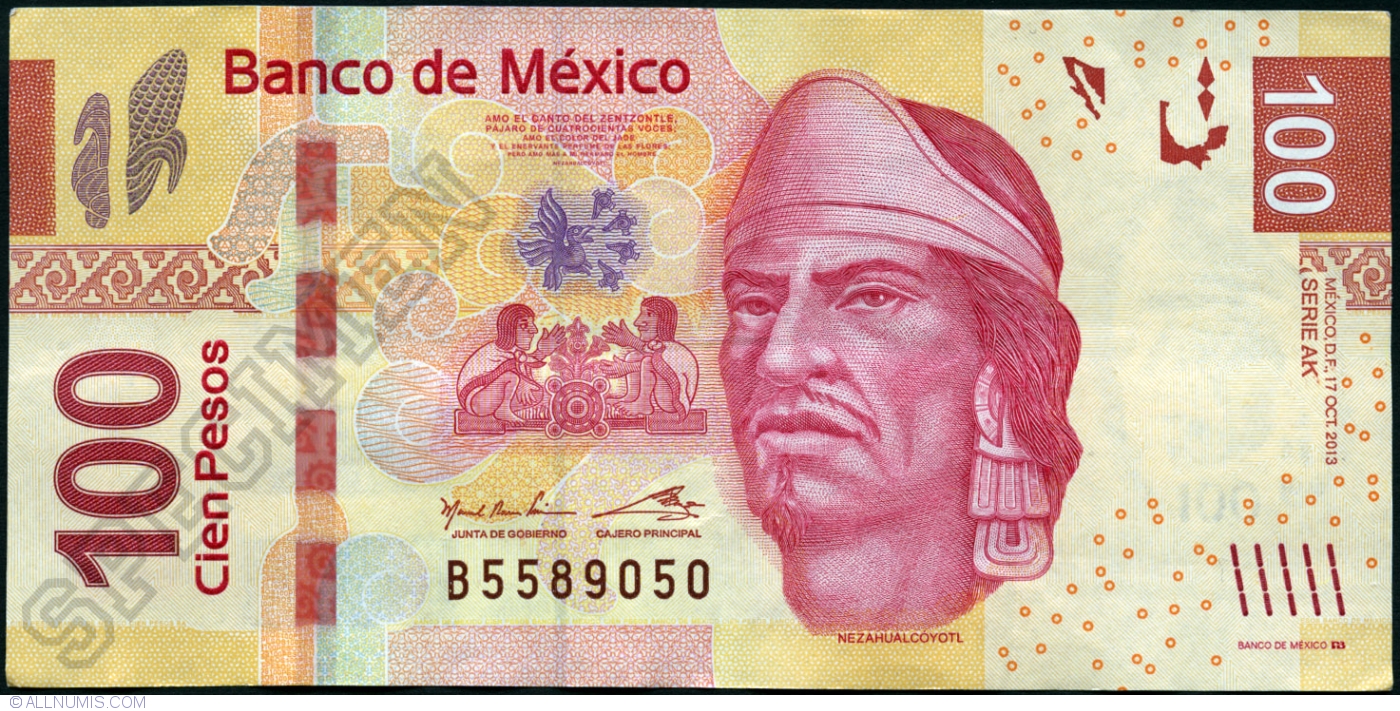
Nezahualcoyotl, Pre-Columbian Poety and Ruler of Texcoco

Above are the 200 and 100 Peso bank notes. I was intrigued by the figure shown on the 100 Peso note of Nezahualcoyotl, “Coyote Who Fasts,” who died some fifty years before Hernan Cortés landed at Vera Cruz with a party of conquistadores.

In the article on him in Wikipedia, I read the following interesting description:

Unlike other high-profile Mexican figures from the century preceding Spanish conquest of the Aztec Empire,  Nezahualcoyotl was not Mexica;  his people were the Acolhua, another Nahuan people settled in the eastern part of the Valley of Mexico, settling on the eastern side of Lake Texcoco.

He is best remembered for his poetry, but according to accounts by his descendants and biographers,  Fernando de Alva Cortés Ixtlilxóchitl and Juan Bautita Pomar,  he had an experience of an “Unknown, Unknowable Lord of Everywhere” to whom he built an entirely empty temple in which no blood sacrifices of any kind were allowed — not even those of animals. However, he allowed human sacrifices to continue in his other temples.

Reservations

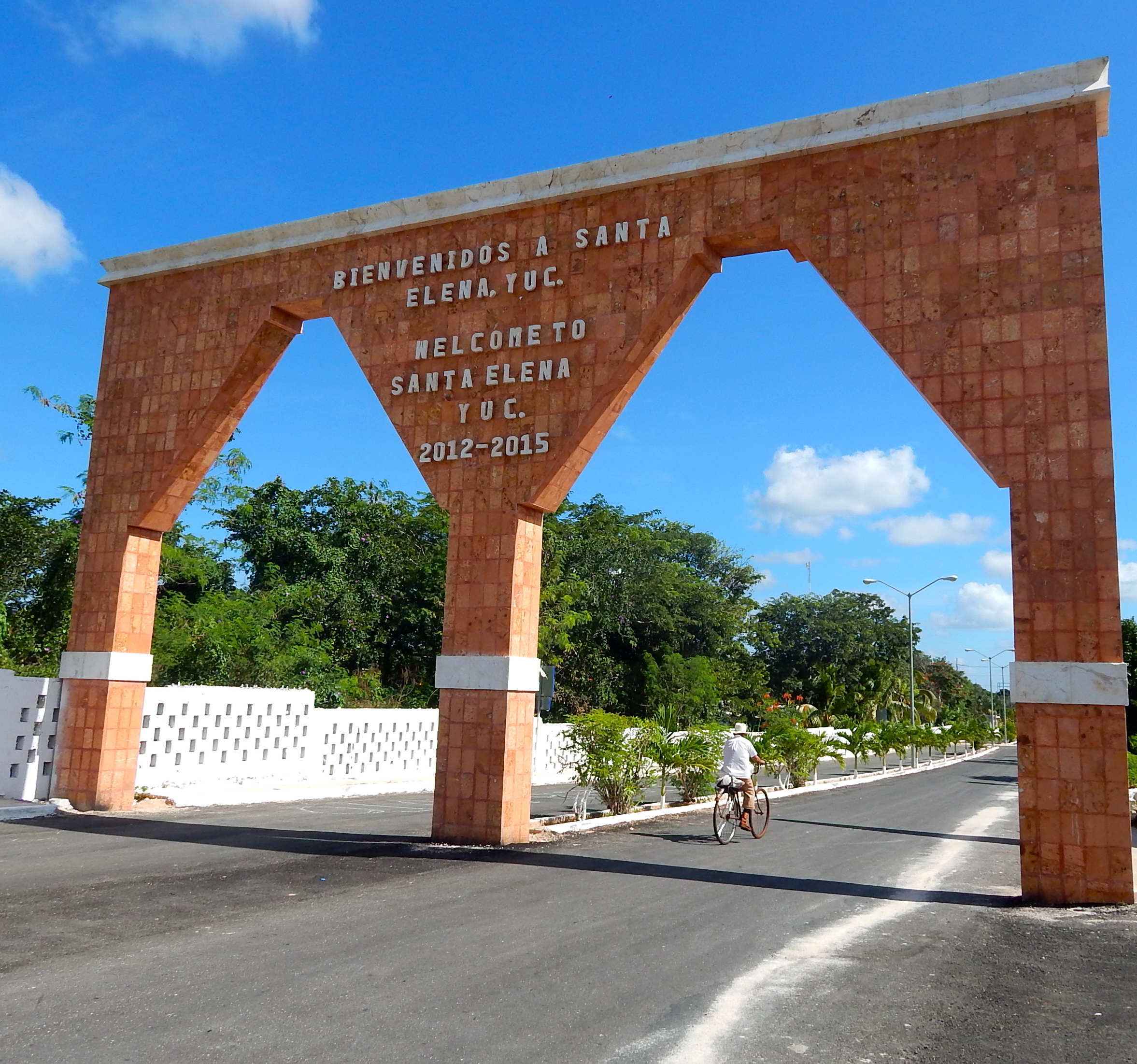
Archway at Entrance to Santa Elena, Yucatán

I am frantically trying to get reservations to hotels in Yucatán—much later than I usually would. It is all due to the problem with my left knee. I wanted some assurance that it was not the beginning of a condition that might rapidly get worse. As a result, I am making reservations a month or so later than I usually would. Unfortunately, a lot of the places I wanted to stay have already been booked, even for such a small town as Santa Elena, which is midway between the ruins of Uxmal and Kabah. I may have to spend big money to stay at the Hacienda Uxmal at the ruins, where I stayed twice before in 1975 and 1992—that is, if I can.

No doubt I will find something. It’s just a little more work than usual.

The Luxurious Hacienda Uxmal Across the Street from the Ruins


The Art of Francisco Toledo

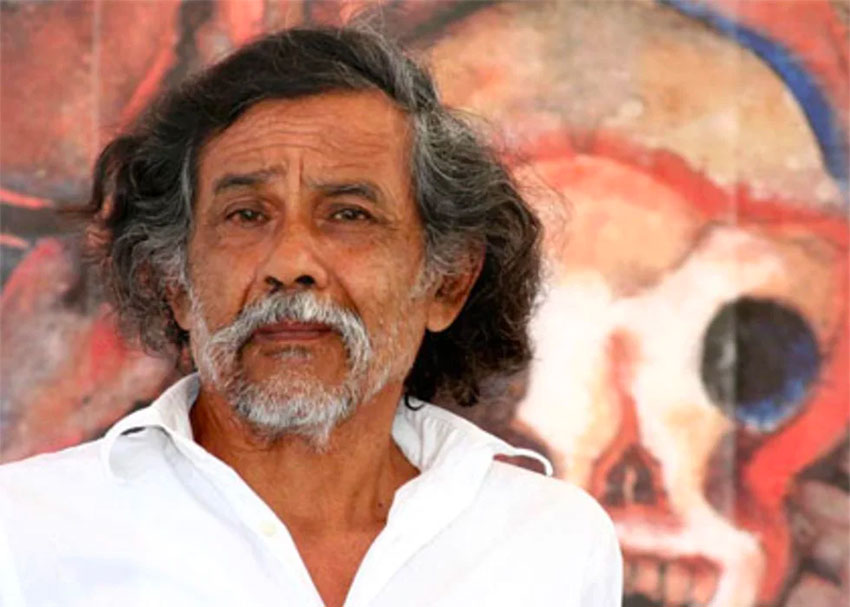
Mexican Painter Francisco Toledo (1940-2019)

Reading Paul Theroux’s On the Plain of Snakes: A Mexican Journey, I was intrigued by the writer’s interview in Oaxaca with artist Francisco Benjamín López Toledo. Looking up his work, I was chagrined to see that he had died just three months ago. It is a pity, because I have not followed Mexican art and artists since the classical trio of Diego Rivera, José Clemente Orozco, and David Siqueiros.

Toledo paintings have a uniquely Mexican feel to them, as if they sprang up from the soil like the prickly agave from which tequila and mezcal are distilled.

Self-Portrait of the Artist

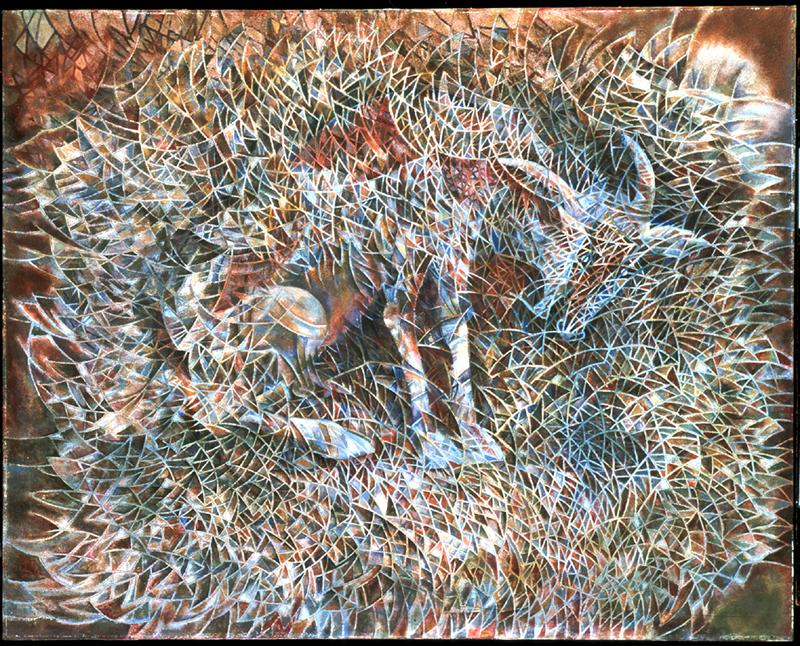
Toledo’s textures are nothing short of amazing. Yet he remains faithful to the forms his work represents. There is no escape in the unadorned, unrepresenting abstract.

Goat (Chivo)

Born in Juchitán, which was recently leveled by several major earthquakes, Toledo was a social activist who threatened to protest naked against the construction of a McDonald’s at the zócalo in Oaxaca. Apparently, the hamburger chain wanted no part of that.


Getting Ready for Yucatán

A Mérida Taxi Receipt from a November 1982 Trip

I finally settled on my date of departure for Mexico to take place around the middle of next month, though Volaris still has not confirmed my reservation. I will be flying to Mérida via Guadalajara both ways. I could have elected to transfer in Mexico City, but I have memories of a flight some thirty years ago while the passengers waited for hours for a well-connected wife of a politician to be boarded ever so fashionably late.

But then, when one travels in Mexico, one travels by Mexican rules. This involves an expectation of the unexpected, and a sharp attention paid to current circumstances, despite conflicting information from supposedly authoritative sources.

In preparation, I have been reading Paul Theroux’s On the Plain of Snakes: A Mexican Journey (Boston: Houghton Mifflin Harcourt, 2019). Ever since running into his book of a series of railroad journeys from Boston to Argentina entitled The Old Patagonian Express, I have been deeply influenced by his writings on travel. Theroux is profoundly cynical, though perhaps not so much as Tobias Smollett, whose journey of a trip to France and Italy earned him the nickname of Smelfungus by no less than Laurence Sterne.

Theroux provides a nice summary in his book about the land I am about to visit:

I have not found a traveler or commentator, foreign or Mexican, who has been able to sum up Mexico, and maybe such an ambition is a futile and dated enterprise. The country eludes the generalizer and summarizer; it is too big, too complex, too diverse in its geography and culture, too messy and multilingual—the Mexican government recognizes 68 different languages and 350 dialects.

When my best and oldest friend talks about Mexico—usually disparagingly—he really means the border regions, where the drug cartels, police, and army are the major players.  I myself have visited several Mexicos:

  • Border Mexico (Tijuana, Ensenada, Mexicali, and Cabo San Lucas)
  • Pacific Beach Resort Mexico (Mazatlán, Puerto Vallarta)
  • Colonial Mexico (Zacatecas, Guanajuato, San Miguel Allende, Querétaro)
  • Canyon Mexico (Copper Canyon)
  • Capital Mexico (Mexico City—a world in itself)
  • Gulf Mexico (Puebla, Papantla, Veracruz, Jalápa, Villahermosa)
  • Zapotec and Mixtec Mexico (Oaxaca)
  • Caribbean Mexico (Cozumel)
  • Mayan Mexico

My favorite is the last category, which can be further subdivided into Highland Maya (San Cristóbal de las Casas), Jungle Maya (Palenque), and Yucatec Maya (Mérida, Uxmal, Chichén Itzá, Uxmal, Campeche).

Uxmal

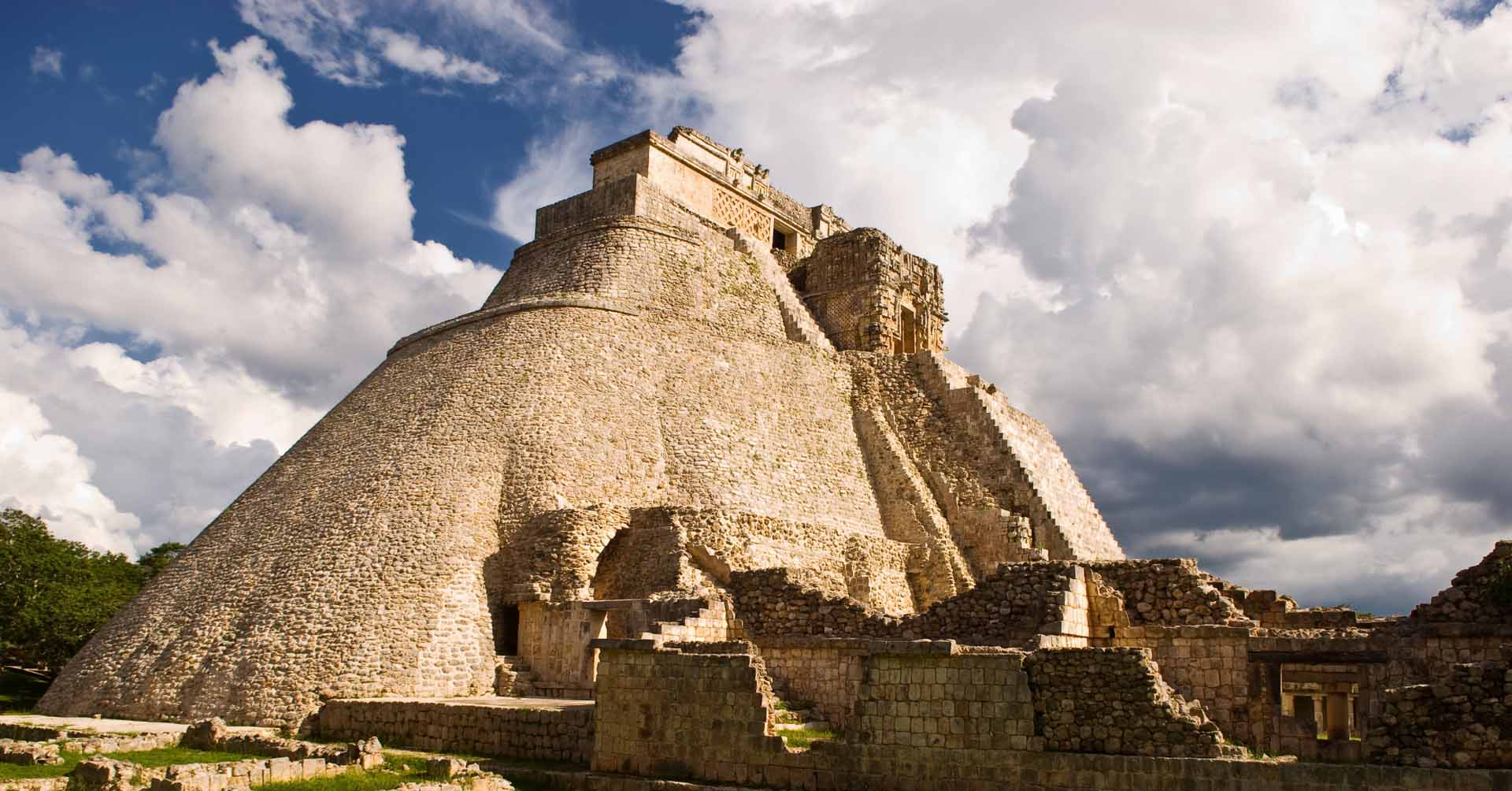
The Pyramid of the Magician at Uxmal in Yucatán

I may have to delay my trip to Mexico until I know what’s happening with the pain in my knee. To refresh your memory, there is some sort of muscular pain in the crook of my left knee, initially diagnosed to be a Baker’s Cyst or some sort of tendonitis. With luck, I will be able to go at some point in January, unless the condition requires surgery.

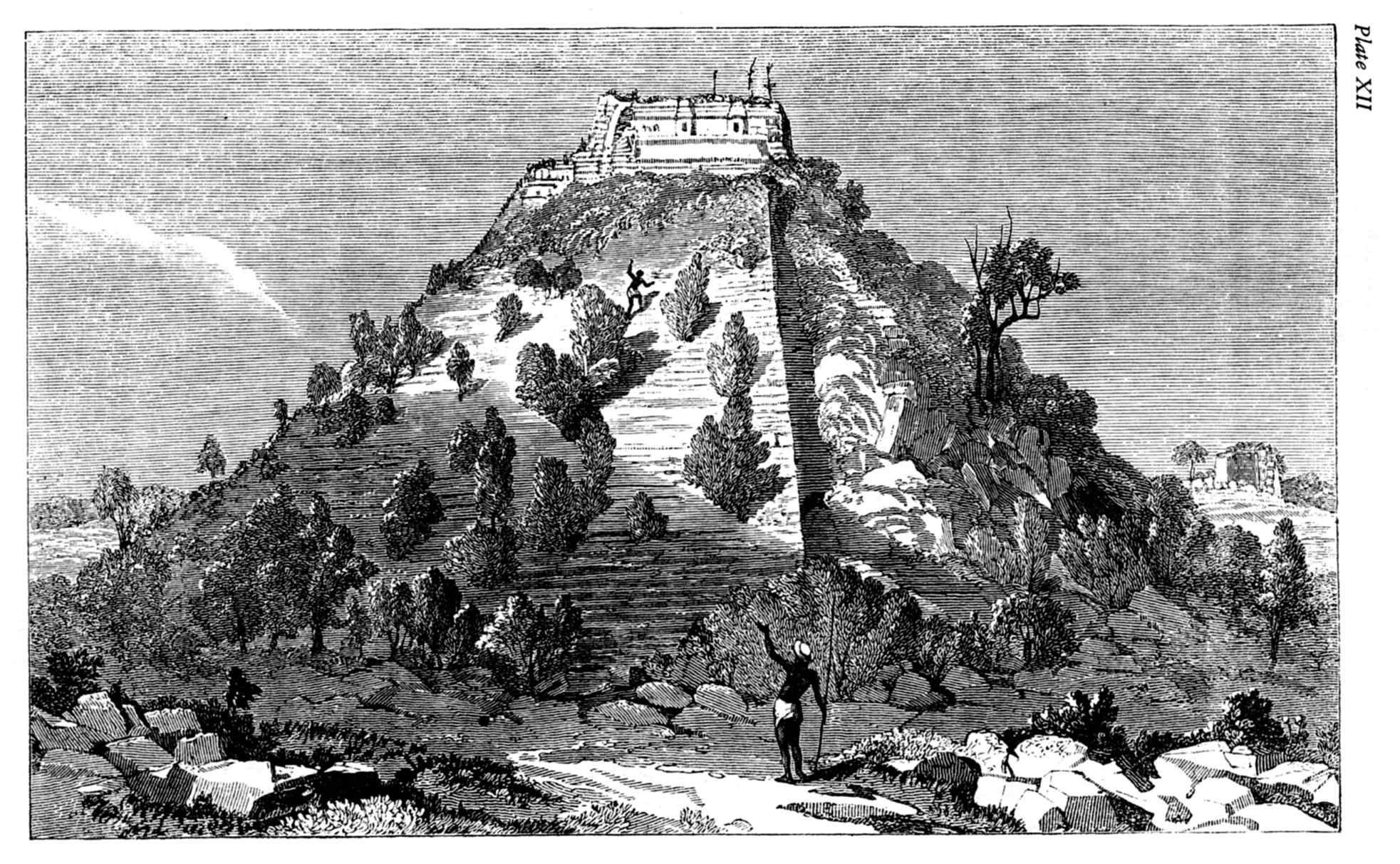
In all, I have been to Uxmal twice, in 1975 and 1992. Both times, I have been impressed that it is the most beautiful of Maya ruins. It is built in the classical Puuc (named after the range of hills where it is located), with smooth rectangular limestone blocks interspersed with images of various Maya deities. It looks even better today, after archeologists have cleared away much of the foliage. Below is an image of the same structure around 1840 when Frederick Catherwood drew it:

Frederick Catherwood’s Illustration of the Pyramid

The city of Uxmal was occupied only up to some point in the 9th century AD, when it is speculated that drought made the ruins in the Puuc Hills uninhabitable. There are no above ground rivers in the limestone peninsula that is Yucatán, and the underground rivers would have required digging through hundreds of feet of rock. Instead, rain water was collected in chultunes, underground storage chambers that circled the ruins.

I was sold on Uxmal from the very start. The van that took me there stopped close by the Pyramid of the Magician. The driver bowed his head and did the sign of the cross upon setting eyes on the pyramid. It is still considered a sacred site by the Maya, even though they have not inhabited it for over a thousand years.


The White City

Mérida at Night

There are a handful of cities with which I have fallen in love over the years. They include Edinburgh, Scotland; Paris, France; Budapest, Hungary; Lima, Peru; and Mérida, Yucatán in Mexico. Mérida is widely known as the White City for the whitewashed look of its buildings. I don’t know if they have any “glass box” high-rises that have been built since 1992 (when I was there last), but I am willing to bet there are none.

I vividly remember arriving there for the first time in November 1975. The taxi ride from Manuel Crescencio Rejón Airport to the Hotel Mérida on Calle 60 was an entirely new experience for me. We passed a huge Coca Cola bottling plant on the road to the airport and a large number of single-story homes that seemed to be open to the street. I saw families sitting at their dinner table as if there were no fourth wall.

It was warm and humid: We were in the tropics. Everything looked so different. Then as we passed the Zócalo, I saw the scruffy looking old cathedral of San Ildefonso, and the large central square with its confidenciales (S-shaped love seat benches).

Confidenciales: Love Seat Benches in Mérida’s Parks

The next few days were an education for me. I decided to take a few tours, but I was up to the challenge of trying my Spanish. I went through a Spanish-only travel agency called Turistica Yucateca and spent two days traveling to such obscure Maya sites as Acanceh, Dzibilchaltún, and Mayapan with an English speaking guide named Manuel Quinones Moreno, who had his own automobile. I played chess with him at the ruins of Dzibilchaltún, losing all my games. We even visited an old henequén hacienda where rope was manufactured. You may recall that there used to be a kind of rope called sisal, named after the Port of Sisal in Yucatán from where the rope was shipped across the world.

I have nothing but happy memories of Mérida, and I look forward to renewing my acquaintance with the White City.

Repeat Performances

I Frequently Re-Read Books That Have Impressed Me

This year I have re-read ten books since the start of 2019, such as Joseph Conrad’s Lord Jim. It has been eleven years since I have read any Conrad, back when I had finally finished Under Western Eyes, which I had started back in college. The main reason I ever re-read a book is to see whether I have somehow changed in the intervening years. Very occasionally, I forget that I have read a particular work in the past and go through it a second time, not realizing my mistake until I check my reading log. Below is a list of 2019 re-reads:

  • Joseph Conrad: Lord Jim
  • Laurence Sterne: The Life and Opinions of Tristram Shandy, Gentleman
  • Sean O’Casey: Juno and the Paycock
  • Virginia Woolf: Monday or Tuesday, Eight Stories. I re-read this one by accident.
  • John Lloyd Stephens: Incidents of Travel in Central America, Chiapas and Yucatán and Incidents of Travel in Yucatán. I will probably re-read a number of other books about Mexico in the next few months, most of which I have not touched for over 30 years.
  • William Shakespeare: Hamlet. Multiple re-reads.
  • G. K. Chesterton: Robert Louis Stevenson and The Poet and the Lunatics. I frequently re-read Chesterton for sheer enjoyment.
  • J. E. Neale: Queen Elizabeth I

A Joy to Read Any Number of Times

As my Yucatán vacation draws close, I will probably re-read Fanny Calderón de la Barca’s Life in Mexico; Charles Macomb Flandrau’s Viva Mexico!; and Malcolm Lowry’s Under the Volcano and a few other books.


Mexican Bus Travel Anecdotes

Toltec Ruins at Tula

After yesterday’s post on intercity buses in Mexico, I thought I’d present a few anecdotes about my experience riding the roads of la Republica over the years. For the most part, my experiences were good—though not all. But they were always interesting.

The worst was in the 1980s when I decided to take a bus trip to Tula to view the Toltec ruins there. I had no trouble getting there, but the return trip started on a bad note. While still on the streets of Tula, the Second Class Autotransportes Valle de Mezquital bus I was taking rear-ended a truck. Fortunately, no one was injured, and eventually the driver, ayudante, and passengers were all able to exit onto the roadway. The company was informed and sent another bus to complete the journey to the giant North Bus Terminal in Mexico City.

In 1979, my brother and I took a Transportes Lacandonia bus from Palenque, where we were visiting the Mayan ruins, to San Cristóbal de las Casas. Again, it was a Second Class bus, and the road was nowhere as nice as it is now. On the way, we saw another bus from the same company coming from the other direction off the road ensconced in a ditch. The driver and passengers were standing around waiting to be picked up and complete their journey. We stopped for a few minutes while the drivers compared notes.

On the same trip, near Ocosingo, our bus was stopped by a Mexican army checkpoint. We were near the Guatemalan border, and the army were checking for arms smuggling connected with the insurgency across the border, which was to go on until a truce was signed almost twenty years later.

That same trip, Dan and I took an all-night bus from San Cristóbal to Oaxaca on a first class bus. (I think it was the Cristóbal Colon line.) As we tried to drop off to sleep, we noticed a parade of cockroaches traveling along the base of the sliding windows. We shrugged and nodded off.