Life on the Rancho

Los Encinos State Historical Park Today

People think of Southern California as being bran new. In actuality, the history goes far back—even earlier than the days when the land was occupied by the Gabrielino and Chumash Indians. I was born in Cleveland, which was founded in 1796 by Moses Cleaveland of Connecticut. Los Angeles is a full fifteen years older, having been founded in 1781 as a Spanish pueblo. So many of our place names come from the Spanish and Mexican land grants. One such community is Encino (“Oak” in Spanish), which was part of the 4,251 acre Rancho El Encino.

On Sunday, Martine and I drove to the Los Encinos State Historical Park in (where else?) Encino to visit the reconstructed ranch buildings. I say reconstructed because adobe did not do particularly well in the earthquakes of 1880 and 1994.

We have visited several of these adobe ranch houses from the 19th century and earlier. There was the Centinela Ranch House in Westchester and the Dominguez Rancho in Rancho Dominguez. And there are perhaps as many as a dozen more which I eventually hope to see, just as I would like some day to visit all the California missions built by Father Junipero Serra, recently sanctified by the Vatican.

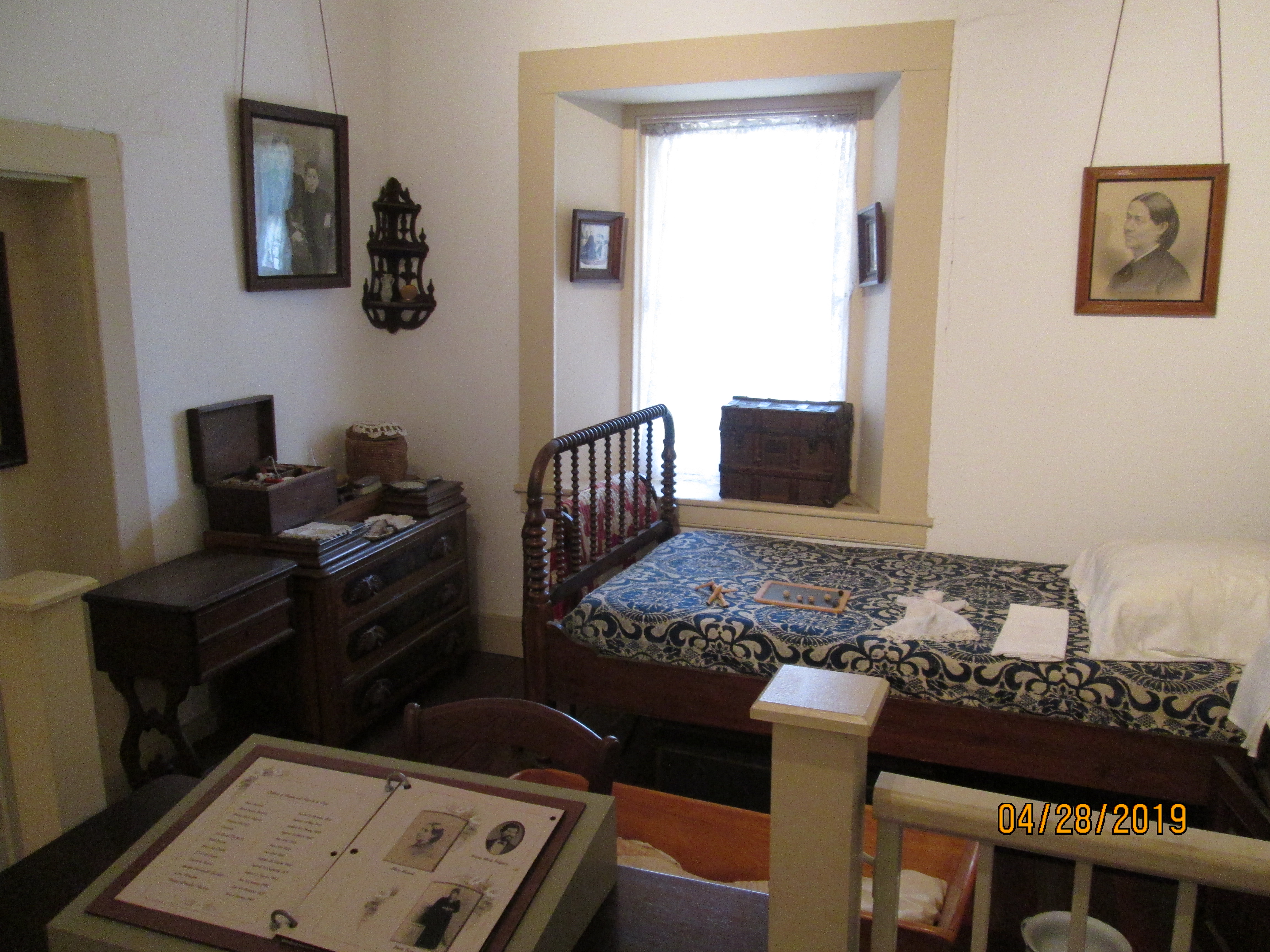
Bedroom in the Ranch House

The Los Encinos State Historical Park does a nice job of bringing together furniture of the period as well as informative displays explaining what life was like on the rancho 150 years ago and more. They even have several stone outbuildings dedicated to food storage and blacksmithing.

Los Angeles has not always been careful of preserving its historical sites. There used to be an old abandoned adobe at the corner of Colorado and 26th Street in Santa Monica, near where I had first real job at System Development Corporation. It was a kind of spooky place, but it is no far. Now it’s a high-rise office building dedicated to entertainment media. No effort was made to move the adobe where it could be restored.


This Is Indeed Poway

Why the Synagogue Shooting Happened There

The mayor of Poway, California, Steve Vaus by name, went on the air to say that the synagogue shooting on the last day of Passover was not representative of Poway. “This is not Poway,” he said. I beg to differ from him.

My own personal experience of Poway was a negative one. When I worked for Urban Decision Systems in the 1990s, we had to let our secretary go: She was getting too old. Her family had her move to Poway, and I went to visit her there. My impression of the town north of San Diego was that it was a sterile racially homogeneous suburban upper class slum. I hated the place and could hardly wait to leave. And that was over twenty years ago!

Now this type of place is a natural for a racist, bigoted shooter. It is easy to develop a hatred for Jews or Muslims or immigrants or African-Americans—if everyone around you is lily white and drinks the same Kool Aid as you do. They’re all in the same bubble.

I’ve read an interesting article in The New Yorker about what the Chinese are doing to keep dissidents from embarrassing the government at inopportune times:

While Presidemt Xi Jinping played host to African dignitaries in the Great Hall of the People, the police played host to [dissident Zha Jianguo] at various scenic spots in the province of Hubei, about a thousand kilometers away. A number of other Beijing activists and civil-rights lawyers … were treated to similar trips….

This practice is known as bei lüyou, “to be touristed.”

I begin to think the Chinese have the right idea. White racists should “be touristed” for several weeks at a time, perhaps to South Africa or Honduras or Afghanistan or even Israel. The idea is that no white person should be so ensconced in his bubble that he does not understand how people who are different need not be conceived of as being threatening.

On my vacations, I have visited a number of what our Presidente would call “shithole countries.” I have come to admire the Latin-American peoples to the south of us. They have been excellent hosts during my travels and more knowledgeable about us than we typically are of them.


To BZ or Not To BZ

Beach Scene at Caye Caulker, Belize

Normally, I am not really a beach person. As my planned vacation to Yucatán takes place, I am thinking of also including Caye Caulker in Belize as a little side trip, a sort of vacation from my vacation so to speak. Why on earth would I be interested in knocking around on a Caribbean island? Especially when there’s nothing of any archeological import to be found there. I don’t particularly like to swim, snorkel, or dive: Hell, I don’t even like wearing shorts.

The answer goes back to my last trip. Throughout Eastern Guatemala, there was one condiment that was de rigeur on every restaurant table. It was a bottle of Marie Sharp’s Hot Habanero Pepper Sauce. Now I have always been partial to habañero (aka Scotch Bonnet) chiles, ever since my 1975 trip to Yucatán. Until I encountered those Marie Sharp’s sauces, with their motto “Proud Products of Belize,” I was contented with the El Yucateco Salsas de Chile Habañero, which came on hot and fierce, and maybe a little raw. What fascinated me about the Marie Sharp’s product was that it had the heat, but also the sweetness of carrots. How did she do it?

The Product in Question

Mind you, I still like El Yucateco, but Marie has won me over.

Now, how does that translate me wanting to spend a few days on an island off the coast of Belize? When I went to Guatemala, I was intrigued by the cultural mix at the port of Livingston: Maya, Garifuna, etc. I thought it would be fun after tromping through miles of Maya ruins in the jungle to sit under a palapa with a cool drink (perhaps a Belikin beer) and a good book. And available to me would be the best of Maya and Caribbean cooking. That sounds like a culinarily and culturally interesting diversion.

Marie Sharp’s manufacturing complex is actually by Stann’s Creek near Dangriga in Southern Belize, but that’s a tad too jungly for me.

From Chetumal in Mexico, I could take a quick boat ride to Caye (that’s pronounced KEY in Belize) Caulker and pass through customs at Ambergris Caye. So I might very well BZ happy there.


“The Land of Counterpane”

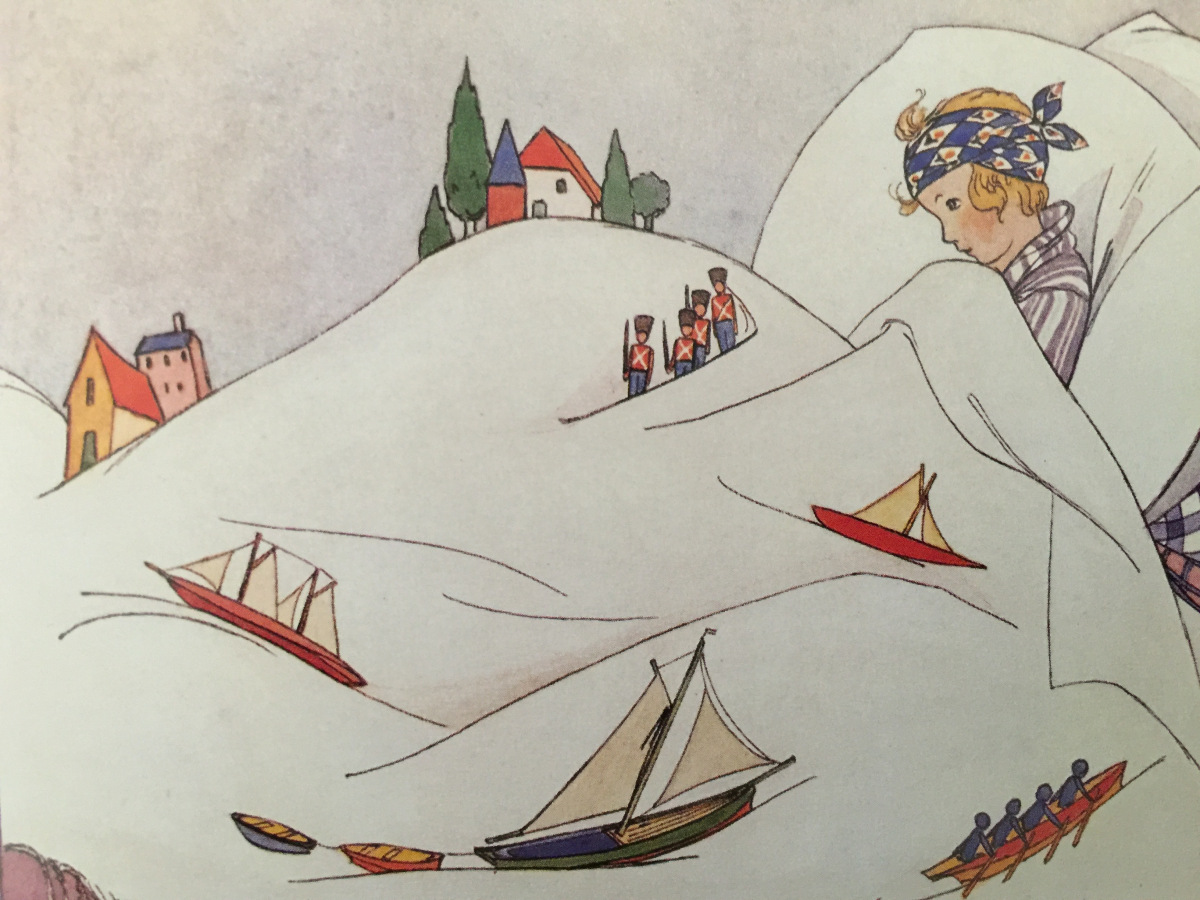
I Remember This Illustration from My Childhood

The first poem I remember was “The Land of Counterpane” from Robert Louis Stevenson’ A Child’s Garden of Verses. I was in grade school and sick with some childhood disease. While Mom and Dad were off at work, and I was being cared for by my great-grandmother Lidia Toth, I was allowed to lie in their bed. Mom had gotten be a library book with this poem in it—and with the above illustration. I don’t know which impressed me more, the words of the poem or the illustration. In any case, the memory has stuck with me through the years. Here’s the words of the poem:

When I was sick and lay a-bed,
I had two pillows at my head,
And all my toys beside me lay,
To keep me happy all the day.

And sometimes for an hour or so
I watched my leaden soldiers go,
With different uniforms and drills,
Among the bed-clothes, through the hills;

And sometimes sent my ships in fleets
All up and down among the sheets;
Or brought my trees and houses out,
And planted cities all about.

I was the giant great and still
That sits upon the pillow-hill,
And sees before him, dale and plain,
The pleasant land of counterpane.

Now, many years later, I am rediscovering RLS, especially his last years in the South Pacific. I wonder if, somehow, my memory over the great gulf of years, has anything to do with my wanting to go back to Stevenson and reacquaint myself with his work. In any case, that’s what I’m doing … and I am enjoying every moment of it.


The Revenger’s Tragedy

Illustration from Thomas Kyd’s Play The Spanish Tragedy (1587)

I have just re-read William Shakespeare’s Hamlet in honor of the Bard’s 455th birthday. Although it has been several decades since my last approach to the play, I was surprised how familiar the language was. Apparently, over the years such expressions as “the dead vast and middle of the night” and “I am but mad north-north-west—when the wind is southerly I know a hawk from a handsaw” have become part of my speech and writing.

This time, however, a new thought struck: The play is not just about Hamlet’s dilatoriness in revenging the death of his father by his uncle (who thereupon married his mother, the queen). It is also about the difficulty of straightforward revenge. And that despite the fact that revenge plays were a popular genre. Even Shakespeare, early in his career, came out with Titus Andronicus (ca 1590), in which there is rape, murder, cannibalism, and oodles of blood. Then, in 1606 came Thomas Middleton’s The Revenger’s Tragedy.

In Hamlet, however, Shakespeare shows that the road to revenge can be rocky. The last scene in Act V begins with the Prince telling his friend Horatio:

Sir, in my heart there was a kind of fighting
That would not let me sleep. Methought I lay
Worse than the mutinies in the bilboes. Rashly,
And prais’d be rashness for it,—let us know,
Our indiscretion sometime serves us well,
When our deep plots do pall; and that should teach us
There’s a divinity that shapes our ends,
Rough-hew them how we will.

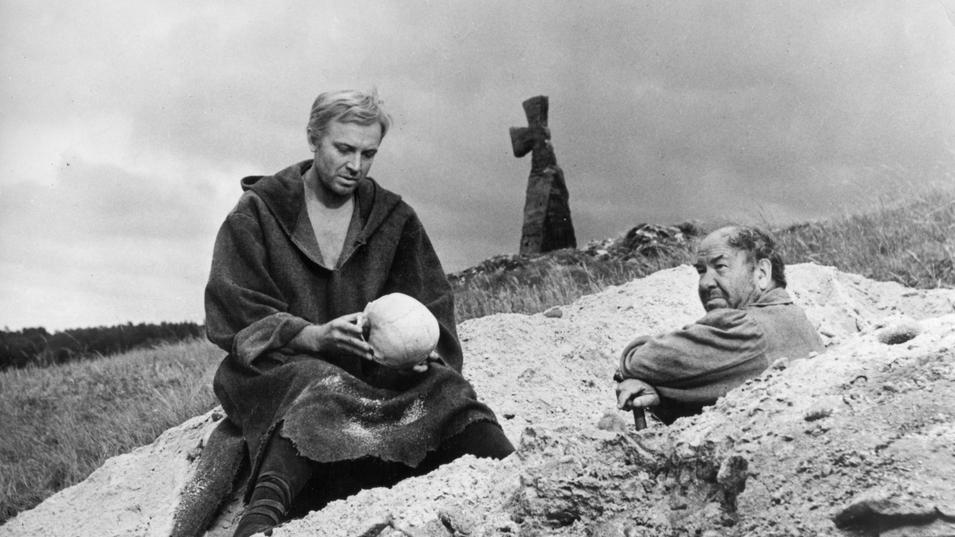
The Graveyard Scene from Grigory Kozintsev’s Russian Film of Hamlet (1964)

This realization on Hamlet’s part after his many hesitations earlier on shows that he has learned a lesson from all his agonizing:

HORATIO.
If your mind dislike anything, obey it. I will forestall their repair hither, and say you are not fit.

HAMLET.
Not a whit, we defy augury. There’s a special providence in the fall of a sparrow. If it be now, ’tis not to come; if it be not to come, it will be now; if it be not now, yet it will come. The readiness is all. Since no man has aught of what he leaves, what is’t to leave betimes?

I wonder how many discoveries await me on re-reading Shakespeare’s plays. I think perhaps it’s worth the effort to make the effort.


His 455th Birthday

Portrait of William Shakespeare (1564-1616)

Today is the 455th anniversary of the birth of dramatist William Shakespeare. To honor his birthday, I picked up my old Penguin edition of Hamlet and started to re-read it for the nth time. It has been a couple of decades since my last reading. I was shocked to the extent that the Bard’s language had become so familiar to me that I almost regarded it as my own. From Act I alone, I had adopted into my own language such expressions as:

Before my God, I might not this believe
Without the sensible and true avouch
Of mine own eyes. (I,i,56-58)

A little more than kin, and less than kind! (I,ii,65)

’A was a ma, take him for all in all,
I shall not look upon his like again. (I,ii,187-188)

In the dead waste and middle of the night. II,ii,198)

I do not set my life at a pin’s fee (I,iv,65)

Something is rotten in the state of Denmark. (I,iv,90)

There are more things in heaven and earth, Horatio,
Than are dreamt of in your philosophy. (I,v,166-167)

The time is out of joint. O cursèd spite
That ever was I born to set it right! (I,v,188-189)

If these short quotes are familiar to you, it is because they have become a part of our language. Shakespeare actually changed the way we think about things. Within the next day or so, I want to write about how Hamlet changed forever the straightforward revenge tragedy that was such a part of Elizabethan and Jacobean dramaturgy.


Flamingo Road

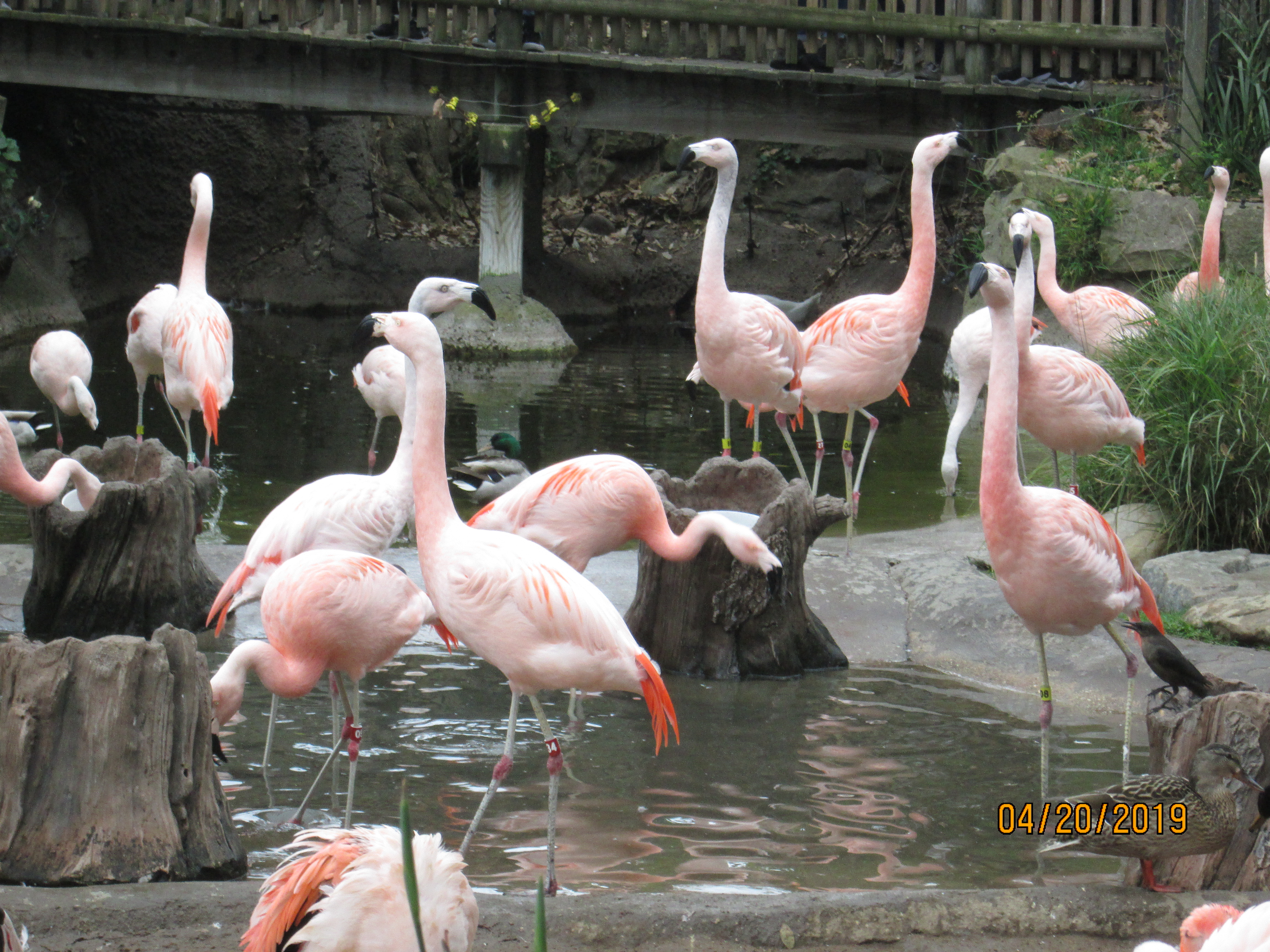
Chilean Flamingos at the Santa Barbara Zoo

On Saturday, Martine and I drove to Santa Barbara for a fish and chips lunch at the Harbor and a visit to the local zoo. Los Angeles has a bigger zoo, but it’s too big, too crowded—and it’s difficult to get buy without multiple stroller collision injuries. They’re always doing construction and forcing large numbers of visitors down narrow pathways, ending up with massive foot traffic jams.

As I mentioned in yesterday’s post, there are two smaller museums that I love: The Living Desert in the Coachella Valley and the Santa Barbara Zoo.

Like all zoos, it is impossible to see all the animals because:

  • Some of them have been withdrawn for various reasons
  • Others prefer to be in hiding, escaping the prying eyes of the gawkers

No matter, I got an eyeful of what I wanted to see, especially Chadwick the African lion, who is usually in the latter category, except that he is visible from the little train ride that circles the 32 acres of the zoo. Plus we saw the elephants, the gibbons, the Humboldt penguins, the giraffes (who have a much harder time of it if they wanted to hide). Oh yes, we also saw (and smelled) the Chilean Flamingos.

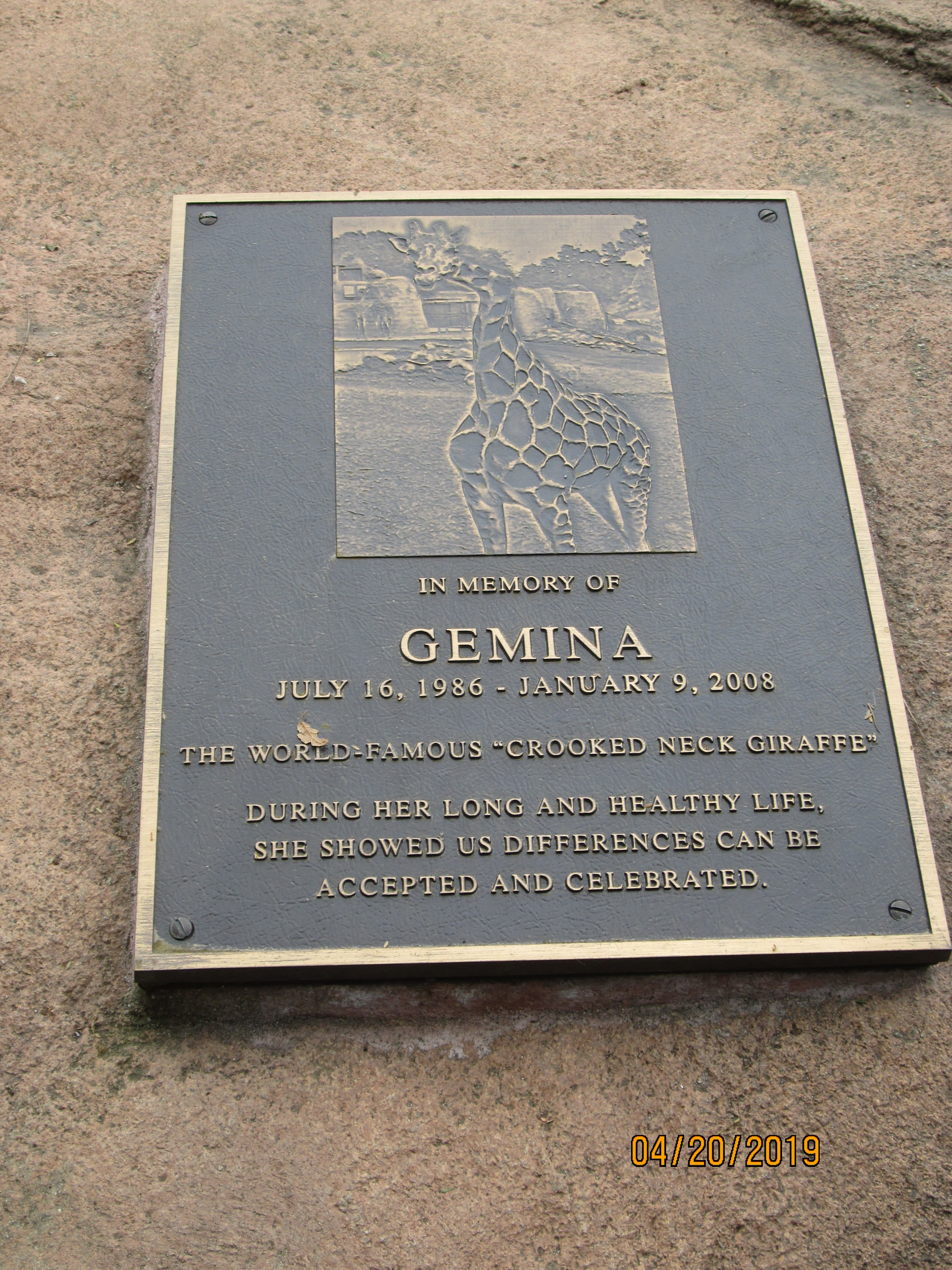
Bronze Plaque Honoring Gemina the Crooked Neck Giraffe

There is even a nice bronze plaque commemorating Gemina, the zoo’s late “crooked neck giraffe,” who died in 2008. I remember seeing her, with her neck that took off at a 90 degree angle midway up. It looked incredibly painful; but Gemina had a longer than normal life and was attractive enough to at least one male giraffe who made her a successful mother with healthy issue. One of these days, I’ll try to find one of my pictures of Gemina. I know I took several on former trips to the zoo.


New Zoo Revue … Coming Right at You!

A Weird Memory from the 1970s

Early in the 1970s, I was working on my master’s thesis for the UCLA Film Department. It was going to be about how animated films echoed our culture’s collective unconscious. This was before DVDs and cheap VHS tapes, so I had to see animated films whenever I could. At that time, there was a Bugs Bunny show every morning at 7:30, which I studiously watched, taking copious notes about Bugs, the Roadrunner, Pepe le Pew, Tweety, Sylvester, and the whole gang. Before Bugs Bunny came on the air, there was a young children’s show called The New Zoo Revue.

I was entranced by what I saw of the show, and I fell in love with Emily Peden (shown on the right above), who played Emmy Jo. Here is a link to a couple minutes from their show:

Why did I suddenly think of this show? Yesterday, Martine and I drove to Santa Barbara and visited the Santa Barbara Zoo, which—along with the Living Desert in Palm Desert—is one of my favorite small zoos. I guess I’ll have to write about it some other time, when I can stop thinking about Emmy Jo’s lovely legs. So strange to have the 1970s sneak up on me that way!

Did Balzac Ever Go to Java?

Cover of a French Edition of the Voyage

Well, not exactly. But he is known to have drunk approximately fifty cups of Java each day. No doubt that helped inspire him to write this hilarious spoof of voyages to exotic locales. It is not until the last couple of pages that Honoré de Balzac writes:

In truth, soon I will be losing no time in taking the stagecoach once again, travelling back to Paris across the fields of Touraine and Poitou that I thought I should never see again. During my first days back in Paris I had a lot of trouble persuading myself that I had not indeed been to Java, so much had that traveller [M. Grand-Besançon] struck my imagination with his tales.

So in the end it is a delightful hoax. Balzac tells a series of tall tales redolent of earlier (unsubstantiatable) journeys full of tall tales about the flora, fauna, and women of the Far East. Not all of it consists of tall tales, such as this realistic warning to travelers to be alert at all times:

Go inside a shop selling precious cloths; bargain, buy some cashmere or a length of tamava … if you turn your back for a moment while the merchant is rolling up your purchase on the counter, wrapping it and tying it with string, the package flies to the back of the shop and is replaced by another containing inferior goods, that an apprentice has been preparing in the corner of the shop to look exactly like the one you were buying. With no explanation for this miraculous metamorphosis, you return to the shop furious at having been duped by the Chinese everybody had warned you about; but his only response is to laugh at you.

I have read virtually all of Balzac as translated into English, but this is by far the funniest of his works. An English edition entitled My Journey from Paris to Java (Singapore: Editions Didier Millet, 2010) is available.


The End of Tusitala

RLS (Seated Center, Rear) and His Household in Samoa

His nickname in Samoa was Tusitala, “The Teller of Tales.” He had gone to Oceania for his health. It is not known what the exact nature of his illness was, but it seemed to be hereditary. His mother died of an apparent stroke at the age of 38. When he died on on December 3, 1894, Robert Louis Stevenson was only 44.

I have just finished reading the letters that RLS wrote to his friend and sometime editor Sidney Colvin between November 1890 and October 1894. They have been published as The Vailima Letters, named after the author’s estate in Samoa. In them, he writes about his frequent illnesses, his involvement in island politics, and his intense efforts to make money by writing novels and stories. In those last four years, he wrote:

  • Catriona (1893), aka David Balfour, a sequel to Kidnapped
  • Island Night’s Entertainments (1893), aka South Sea Tales
  • The Ebb-Tide (1894), co-author Lloyd Osbourne
  • Weir of Hermiston (1896), left unfinished at the author’s death
  • St. Ives: Being the Adventures of a French Prisoner in England (1897)

At times, Stevenson’s letters rise to the level of poetry. In March 1891, he writes:

I said I was tired; it is a mild phrase; my back aches like toothache; when I shut my eyes to sleep, I know I shall see before them—a phenomenon to which both Fanny and I are quite accustomed—endless vivid deeps of grass and weed, each plant particular and distinct, so that I shall lie inert in body, and transact for hours the mental part of my day business, choosing the noxious from the useful. And in my dreams I shall be hauling on recalcitrants, and suffering stings from nettles, stabs from citron thorns, fiery bites from ants, sickening resistances of mud and slime, evasions of slimy roots, dead weight of heat, sudden puffs of air, sudden starts from bird-calls in the contiguous forest—some mimicking my name, some laughter, some the signal of a whistle, and living over again at large the business of my day.

In May1892, this description of clouds appears in the letters:

As I rode down last night about six, I saw a sight I must try to tell you of.  In front of me, right over the top of the forest into which I was descending was a vast cloud.  The front of it accurately represented the somewhat rugged, long-nosed, and beetle-browed profile of a man, crowned by a huge Kalmuck cap; the flesh part was of a heavenly pink, the cap, the moustache, the eyebrows were of a bluish gray; to see this with its childish exactitude of design and colour, and hugeness of scale—it covered at least 25°—held me spellbound.  As I continued to gaze, the expression began to change; he had the exact air of closing one eye, dropping his jaw, and drawing down his nose; had the thing not been so imposing, I could have smiled; and then almost in a moment, a shoulder of leaden-coloured bank drove in front and blotted it.  My attention spread to the rest of the cloud, and it was a thing to worship.  It rose from the horizon, and its top was within thirty degrees of the zenith; the lower parts were like a glacier in shadow, varying from dark indigo to a clouded white in exquisite gradations.  The sky behind, so far as I could see, was all of a blue already enriched and darkened by the night, for the hill had what lingered of the sunset.  But the top of my Titanic cloud flamed in broad sunlight, with the most excellent softness and brightness of fire and jewels, enlightening all the world.  It must have been far higher than Mount Everest, and its glory, as I gazed up at it out of the night, was beyond wonder.  Close by rode the little crescent moon; and right over its western horn, a great planet of about equal lustre with itself.  The dark woods below were shrill with that noisy business of the birds’ evening worship.  When I returned, after eight, the moon was near down; she seemed little brighter than before, but now that the cloud no longer played its part of a nocturnal sun, we could see that sight, so rare with us at home that it was counted a portent, so customary in the tropics, of the dark sphere with its little gilt band upon the belly.  The planet had been setting faster, and was now below the crescent.  They were still of an equal brightness.

I could not resist trying to reproduce this in words, as a specimen of these incredibly beautiful and imposing meteors of the tropic sky that make so much of my pleasure here; though a ship’s deck is the place to enjoy them.  O what awful scenery, from a ship’s deck, in the tropics!  People talk about the Alps, but the clouds of the trade wind are alone for sublimity.

I could easily come up with another half dozen passages that impressed me. And I am all the more impressed becau8se today is my father’s birthday. Were he still alive, he would be 108 years old. But, alas, he died at the age of 74—which, to be precise, is my present age—a fact which makes me ever more conscious of my own mortality.