
Neither Rare Nor Well Done

Perhaps the Most Inventive Funnyman in Television

Perhaps the Most Inventive Funnyman in Television

Because it was a drizzly day (courtesy of El Niño), Martine and I spent the afternoon at the Paley Center for Media in Beverly Hills. While Martine was bringing up episodes of “Superman” with George Reeves, Captain Kangaroo, and “My Little Margie,” I was watching a number of episodes of “The Ernie Kovacs Show.”

What Georges Méliès was to the cinema, Ernie Kovacs was to the medium of television: He was brilliantly inventive and something of a magician. All the other comedians on early TV came up from vaudevillian comedy skits, Kovacs started with the new medium itself. He was not only the starring actor: He was also the director and, if the show had one, the main writer.

Music was a recurring unifying theme to the strange collection of cutaways which might include:

  • A cute young woman taking a bubble bath, with strange things happening in the tub
  • The Nairobi Trio, three apes playing music and annoying one another
  • The furniture in an office acting as instruments, from the filing cabinet to the typewriter to the telephone switchboard to the water cooler
  • Artistic variations on a cowboy gun duel

One recurring piece of music used was “Mack the Knife” sung in German, but he has also used the 1812 Overture (during which we cut to Kovacs breaking a stalk of celery at key junctures), and “The Tennessee Waltz” sung in Polish—or was it Slovenian?—while he unsuccessfully lowers a chained escape artist into the river who never manages to re-emerge.

For the three hours that I watched the shows, I was in seventh heaven. Kovacs is a fellow Hungarian (though he, like me, was born in the U.S.), and he occasionally inserts some phrases in Magyar.

On the way home, I drove by the intersection of Santa Monica Boulevard and Beverly Glen where Kovacs died in an auto accident on my seventeenth birthday in 1962.

The one quote that he is remembered for is typical Ernie: “Television: A medium. So called because it’s neither rare nor well done.” Well, when Ernie Kovacs was on the job, it was well done.

Serendipity: Who’s Afraid Like Virginia Woolf?

British Author Virginia Woolf

British Author Virginia Woolf

The following is the beginning of a book review by Linda Colley of Jenny Uglow’s In These Times: Living in Britain Through Napoleon’s Wars, 1793-1815. The review is entitled “Facing Napoleon’s Own EU” and can be found in the November 5, 2015 issue of The New York Review of Books.

Throughout 1940, Virginia Woolf struggled with the terrors and mysteries of war. Neither of the Woolfs knew that their names were on the “black list” of Britons set to be arrested—and presumably killed—in the event of a successful Nazi invasion, but since [husband] Leonard was Jewish, the couple prepared for the worst. They hoarded gasoline in their garage so as to be able to kill themselves by inhaling carbon monoxide, and took the further precaution of of acquiring a deadly dose of morphine from a friend. But none of this protected them from hearing Hitler’s voice over the radio, or the noise of German bombers flying over their London house at night, rattling its windowpanes.

“Here they are again,” wrote Virginia in a famous essay published five months before her suicide. “It is a queer experience lying in the dark and listening to the zoom of a hornet which may at any moment sting you to death.” Earlier, she had written about how different all this was from British experience of the Napoleonic Wars. Both Jane Austen and Walter Scott lived through these conflicts, she noted, yet neither had mentioned it in their novels. This, she thought, demonstrated “that their model, their vision of human life, was not disturbed or agitated or changed by war. Nor were they themselves…. War were then remote:; wars were carried on by soldiers and sailors, not by private people.”

Unfortunately, Woolf was particularly prey to depression. Her house in London was destroyed by bombing, and her most recent book (a biography of her friend Roger Fry) was not well received. On March 28, 1941, she loaded her pockets with heavy stones and walked into the River Ouse, drowning herself. Her body was not found until weeks later. In her last note to her husband, she wrote:

Dearest, I feel certain that I am going mad again. I feel we can’t go through another of those terrible times. And I shan’t recover this time. I begin to hear voices, and I can’t concentrate. So I am doing what seems the best thing to do. You have given me the greatest possible happiness. You have been in every way all that anyone could be. I don’t think two people could have been happier till this terrible disease came. I can’t fight any longer. I know that I am spoiling your life, that without me you could work. And you will I know. You see I can’t even write this properly. I can’t read. What I want to say is I owe all the happiness of my life to you. You have been entirely patient with me and incredibly good. I want to say that—everybody knows it. If anybody could have saved me it would have been you. Everything has gone from me but the certainty of your goodness. I can’t go on spoiling your life any longer. I don’t think two people could have been happier than we have been.

So when you hear about ISIS and Donald Trump’s latest outrage, remember that it is still possible to survive, and even prevail. I look at Virginia Woolf’s face and cannot help falling in love with it.


What, No Hajj?

Saudi Arabia Has Halted All Flights To/From Iran

Saudi Arabia Has Halted All Flights To/From Iran

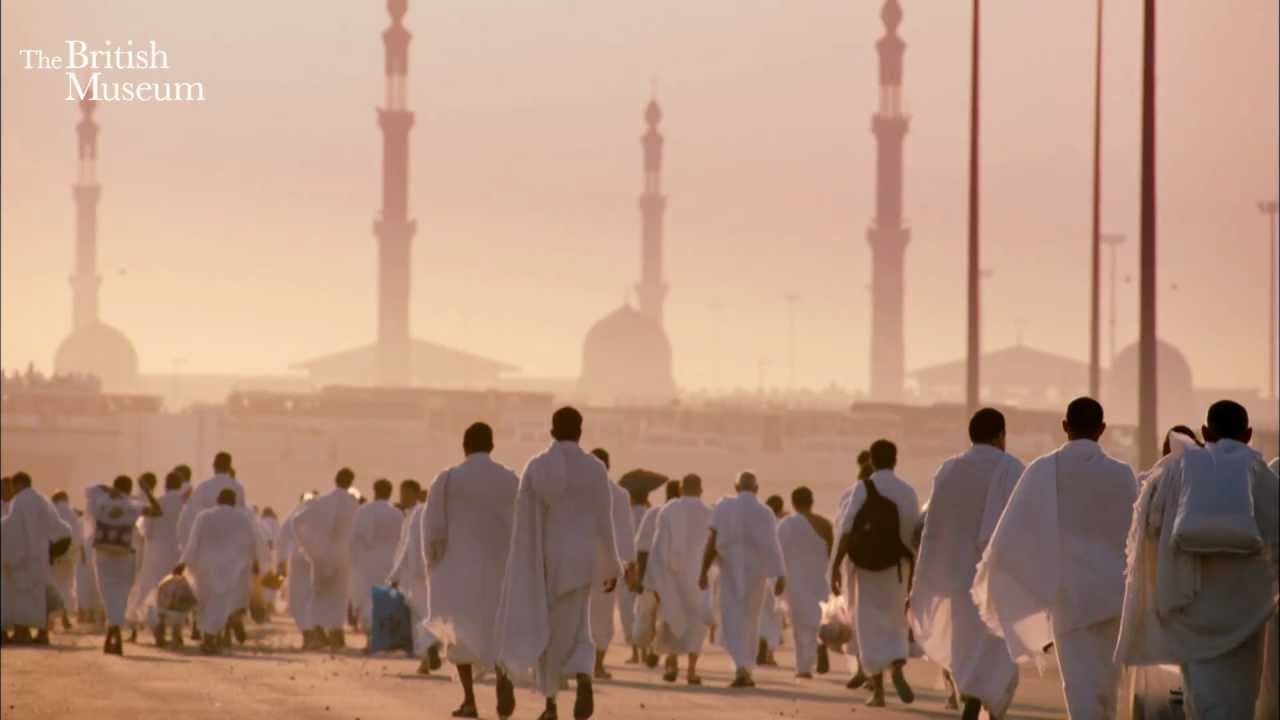
It is a mandatory religious duty for all Muslims, at least once in their life, to make a pilgrimage to Mecca. Now that Saudi Arabia and Iran are on the outs, the Saudis have forbidden all flights linking their two countries. This alone has the potential of leading to further nastiness. Admittedly, Iranian pilgrims can still go by boat (and risk being robbed by Somali pirates) or by land (and risk being robbed by bandits).

I cannot help but think that the real reason for all this nastiness is the conflict in Yemen between Shi’a rebels (called the Houthis) and the Saudis and their allies. In the end, the Saudis may think now is the time to rid themselves of the Shi’a menace once and for all.

Now what is this Sunni/Shi’a split all about? According to the BBC:

In early Islamic history, the Shia were a movement – literally “Shiat Ali” or the “Party of Ali”. They claimed that Ali was the rightful successor to the Prophet Muhammad as leader (imam) of the Muslim community following his death in 632.

Ali was assassinated in 661 after a five-year caliphate that was marred by civil war. His sons, Hassan and Hussein, were denied what they thought was their legitimate right of accession to the caliphate.

Hassan is believed to have been poisoned in 680 by Muawiyah, the first caliph of the Sunni Umayyad dynasty, while Hussein was killed on the battlefield by the Umayyads in 681. These events gave rise to the Shia concept of martyrdom and the rituals of grieving.

There are three main branches of Shia Islam today—the Zaidis, Ismailis and Ithna Asharis (Twelvers or Imamis). The Ithna Asharis are the largest group and believe that Muhammad’s religious leadership, spiritual authority and divine guidance were passed on to 12 of his descendants, beginning with Ali, Hassan and Hussein.

The 12th Imam, Muhammad al-Mahdi, is said to have disappeared from a cave below a mosque in 878. Ithna Asharis believe the so-called “awaited imam” did not die and will return at the end of time to restore justice on earth.

In other words, the roots of the conflict go all the way back 1,400 years and show no signs of slackening.

It’s a sobering thought that we, who cannot even pronounce the name “Muawiyah,” may be affected in some way by this stramash.

The Intimate Enemy

Sunni Anti-Shi’a Propaganda

Sunni Anti-Shi’a Propaganda

In a 1997 lecture entitled “The Origin of Satan in Christian Tradition,” Religious Historian Elaine Pagels writes about how the character of Satan morphed over the centuries from a messenger of God’s to His enemy:

So there are many stories about Satan’s origin; but what struck me about them is this. Diverse as they are, whichever version you choose, they all agree on one thing: that this greatest and most dangerous enemy did not originate (as we might have expected) as an outsider, an alien, or stranger. Satan is no distant enemy: on the contrary, he is an “intimate enemy”—one’s closest relative, older brother, or trusted colleague—the kind of person on whose goodwill and loyalty the well-being of family and society depends, but one who turns unexpectedly hostile, jealous, and dangerous.

So it is not the total outsider whom we hate, but the heretic—one whose belief is close to ours except on some details which to some will seem trivial. Such were the Arians and Nestorians in the early days of the Christian Church. And such are the Sunni and Shi’a over the last 1,400 years.

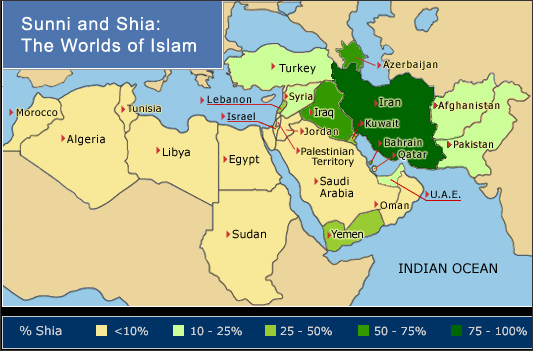
With the execution of a prominent Shi’a cleric (Sheikh Nimr al-Nimr), Saudi Arabia has earned the undying hatred of Iran. For many centuries, there has been a small Shi’a minority in the Eastern portion of the Arabian peninsula, and the executed sheikh was their religious leader. Shown below is a map illustrating the distribution of the two sects in the Middle East:

Percent Shi’a in the Middle East and North Africa

Percent Shi’a in the Middle East and North Africa

This comes at a bad time for Saudi Arabia, as the sharp decline in the price of oil is about to have dire consequences in the ability of the kingdom to provide benefits for its favored citizens. The price of gas has jumped 50%, water and electricity are going up, and the country’s safety net is in danger.

So what should we do? I think this is a good time to put our hands firmly in our pockets and start whistling until we see who wins, King Kong or the Dinosaur.

Living in the Desert

By the Thousand Palms Oasis

By the Thousand Palms Oasis

When my brother first told me he was thinking of moving to he Coachella Valley, Martine and I both thought it wasn’t a good idea. Martine had lived for a couple of years in Twenty Nine Palms, where she worked at the Naval Hospital at the Marine Combat Center there. She hated the desert. As for me, I do not like living in a hot climate.

Of course, if anyone could make it work, it’s Dan. After all, his previous home in Paso Robles was almost as hot as Palm Desert. When he wanted to call down, he and Lori would drive to the beach along the Central Coast, which was frequently 20-30 degrees Fahrenheit cooler. Living in Palm Desert, he is surrounded by mountains. He is already working on a log home at Idyllwild in the foothills, where the elevation of 5,413 feet (1,650 meters) affords some protection from the summer blast on the floor of the Coachella Valley.

I love visiting the desert, especially in the cooler months. Dan is not far from Joshua Tree National Park and Anza-Borrego State Park, which are two favorite destinations of mine.


Thoughts in a Dry Season

Descanso’s Rose Garden on New Years Weekend

Descanso’s Rose Garden on New Years Weekend

Today, Martine and I went to visit Descanso Gardens in La Cañada-Flintridge. Despite the drought, I thought at least the camellias would be in bloom. There were camellias all right—two blossoms looked pretty fair. Most of the camellia bushes had not yielded any flowers. The Rose garden (above) looked as if it were ready for some cactus plantings.

I report with a smirk that rain is predicted for most of this week beginning tomorrow night. I have already gone on record about the unjustifiably high salaries TV weather persons earn for telling whoppers to their broadcast audience. Oh, it will probably rain—a few millimeters in the mountains. But I rather doubt I will be getting wet soon unless I take a shower.

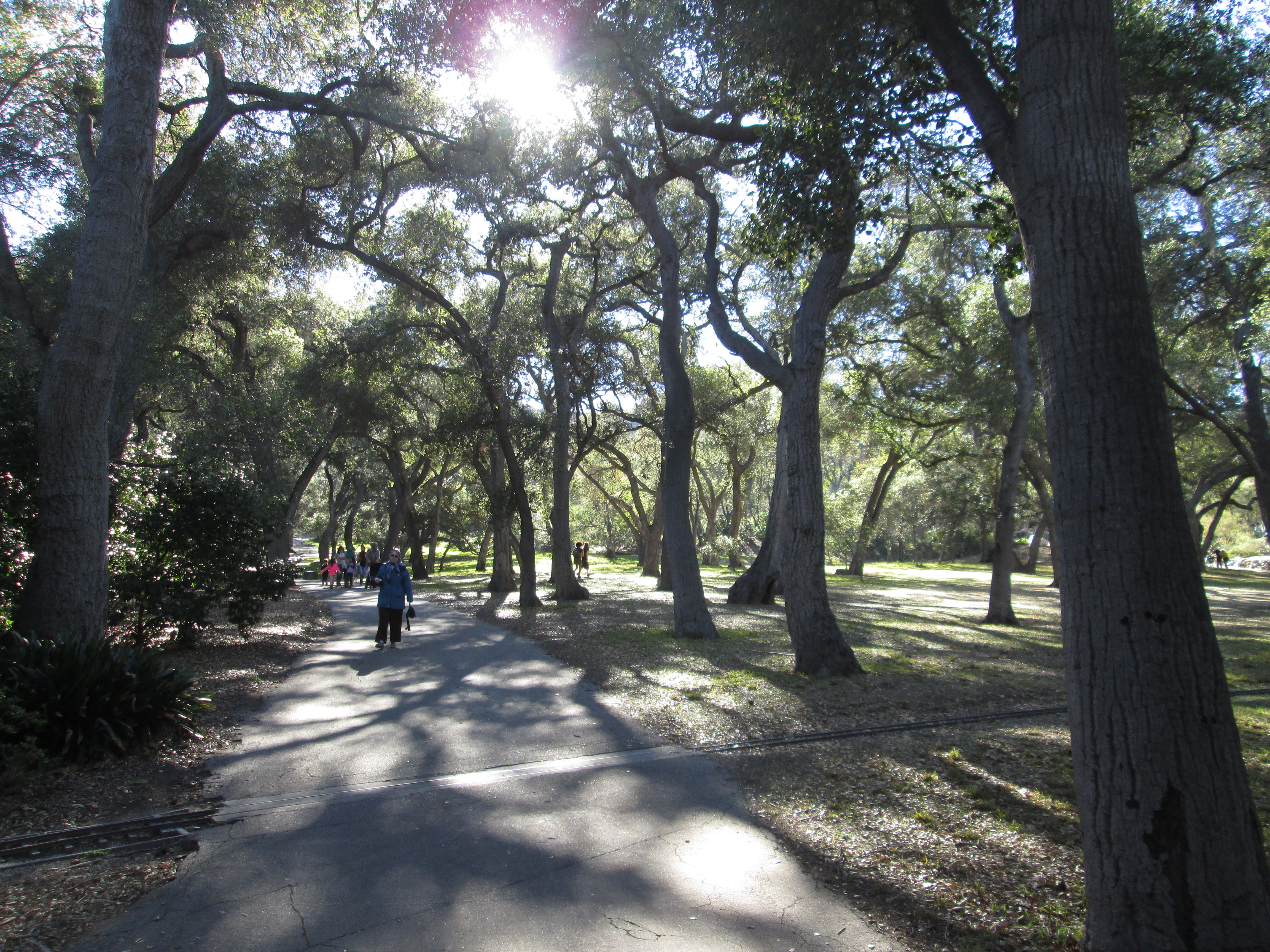
The oak trees at Descanso (below) looked all right, but most are over a century old and will eventually have to be replaced by another type of shade tree to encourage the camellias.

Pacific Coastal Oaks at Descanso

Pacific Coastal Oaks at Descanso


The Best of 2015

I Never Would have Thought It Possible....

I Never Would have Thought It Possible….

A couple of weeks ago, while I was visiting my brother in Palm Desert, the best thing about 2015 hit me right between the eyes. It was a four-month old baby named Oliver Moorman. I normally don’t go goo-goo-eyed over infants, but I have to admit I did this time. Little Ollie’s mother, my niece Hilary, and her husband Joe Moorman have collaborated on a co-production that has radiated hope in the lives of our tight little family. As you may know, I am a terrible pessimist, but little Ollie has given me some glimmerings of hope for the future.

He makes me want to help make this a better world.


Yay! Hooray! Yawn….

Who Celebrates the Passing of Time?

Who Celebrates the Passing of Time?

First of all, don’t make any New Year’s resolutions. It’s a wasted effort, usually leading to broken resolutions before the month of January is over. Sure, everybody wants to be rich, healthy, and thin; but that just may not be your path. (It’s certainly not mine.)

Don’t go to any New Year celebrations. That would only embolden the terrorists. (Come to think of it, is there anything that doesn’t embolden the terrorists?)

It’s not a terribly good idea to get drunk. That’ll make you feel maudlin and resentful, just what you’re trying to avoid, isn’t it? Ditto for recreational drugs. There are no happy dopers.

That doesn’t mean it’s not a good idea to see your friends. Just make sure you show them how much you appreciate them. You may need their help in the coming year.

Remember that time will pass whether you celebrate it or not. As those calendar pages fly off, stick to the things that count, like love. Everything else is pretty much frou-frou.


Tarnmoor’s ABCs: Zsófi, Elek and the Two Boys

Our Family Around 1962

Our Family Around 1962

All the blog posts in this series are based on Czeslaw Milosz’s book Milosz’s ABC’s. There, in the form of a brief and alphabetically-ordered personal encyclopedia, was the story of the life of a Nobel Prize winning poet, of the people, places, and things that meant the most to him.

My own ABCs consist of places I have loved (Iceland, Patagonia, Quebec, Scotland, Yucatán), things I feared (Earthquakes), writers I have admired (Chesterton, Balzac, Proust, Borges, and Shakespeare); locales associated with my past life (Cleveland, Dartmouth College, and UCLA), people who have influenced me (John F. Kennedy), foods I love (Olives and Tea), and things I love to do (Automobiles and Books). This is my last entry in the series, having gone through the entire alphabet from A to Z, including even the difficult letters like J, Q, and X.

I hope you’ve enjoyed the series, which you can review by hitting the tag ABC’s at the bottom of this post.

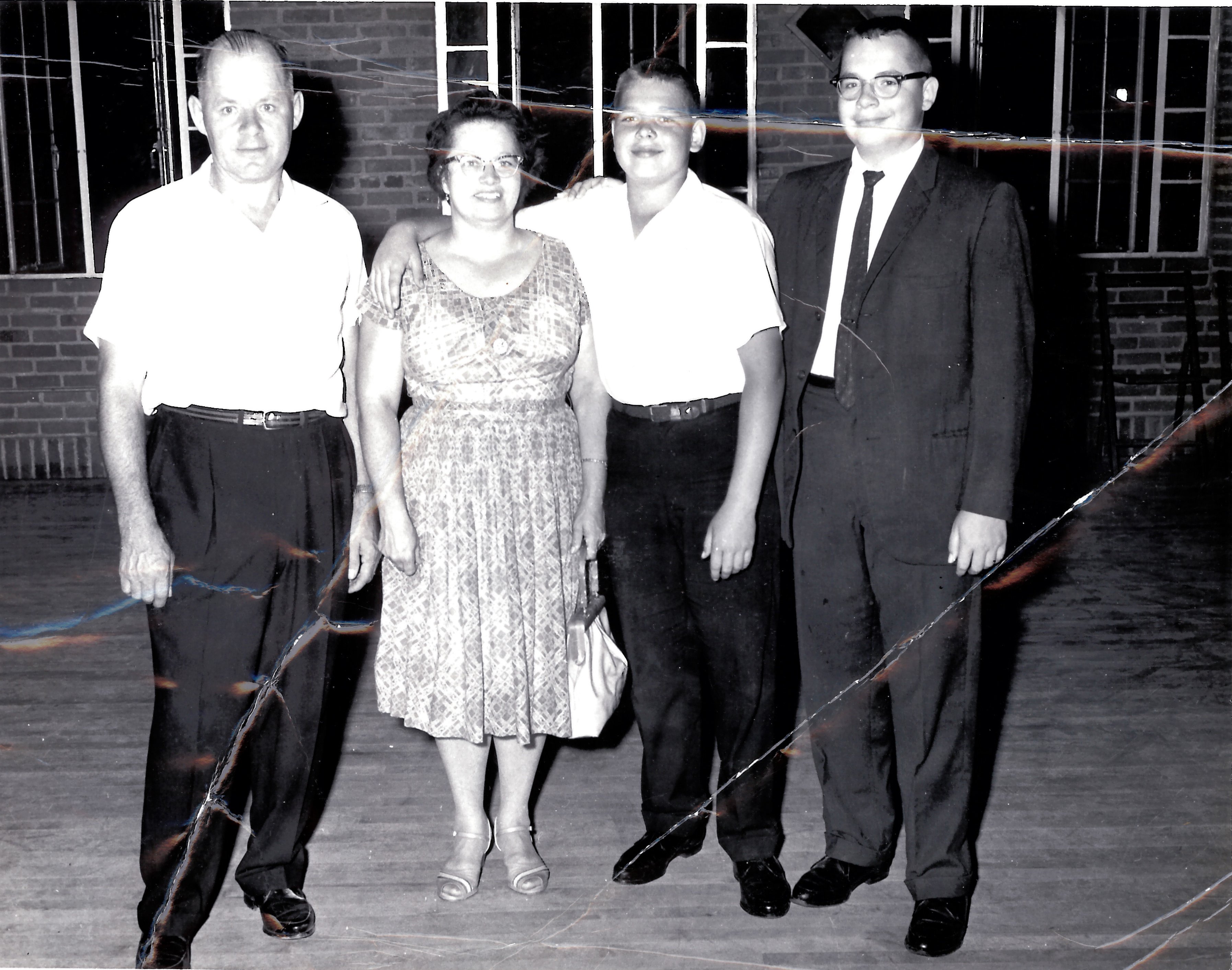
Above you can see a picture of our little family taken around 1962. I was about to enter college, while my brother was in the 6th grade at Saint Henry School on Harvard Avenue in Cleveland, from which I graduated in 1958. My mother is Sophie—Zsófi in Hungarian—and my father is Alex—Elek in Slovak and Hungarian.

This was a difficult time for the family, as my father was under suspicion of conducting an extramarital affair with a married woman. With the tense atmosphere at home, I was eager to attend college in New Hampshire, some 600 miles east, where I would be out of the fray. Although there were some bad times around then, my mother and father stayed together. They loved Dan and me, and in the end that kept them together.

For the next twenty years, Mom had few good words to say about Dad. Except, when Alex died in 1985 at the age of of 74, he became a saint. I went along with that, because all my life I tried to please him.

Dad never understood where I was going in life. I wanted to be a professor of film history in criticism at the university level. One day, I made the mistake of calling the profession “cinematology.” Ever afterward, Dad pronounced it as if I had said “cosmetology.”

Although Dan was more like Dad in being an athlete, Dad was harder on him. When Dan was at Macalaster College in St. Paul, Minnesota, he took some time off to travel around Europe and North Africa, thus delaying getting his college diploma. (He did eventually, but Dad kept riding him for his gap year.)

I like the above picture. It shows a normal family in which all the stresses are carefully kept hidden. But the fold lines over time come out as if they were fault lines along which our family could fracture.

Fortunately, it never did.


Heart’s Desire

My Father’s Side of the Family Around 1918

My Father’s Side of the Family Around 1918

When I visited my brother a week and a half ago, he brought out two boxes of old pictures and papers relating to my past—except it was his past, too. From left to right, the pictures are of:

  • My Uncle Emil (twin of Alex)
  • “Mama” or my paternal grandmother Margit
  • Margitka, my Aunt Margit
  • Stará (Old) M., clearly a member of the family, possibly the same as my Father’s kindly Aunt Valera
  • My Father, various called Ellek, Elek, or Alex (twin of Emil)

Shortly after this picture was taken, Grandma Margit and her husband Emil Sr. abandoned their children in Prešov-Solivar while they went off to the United States. Little Emil, Elek, and Margitka were cared for by Valera. My father tells me stories of picking mushrooms in the Tatra Mountains and hunting for frog legs to feed his brother, sister, and aunt. All three children made it to Cleveland some ten years later.

As a result of fending for himself in the mountains of Slovakia during the postwar famine, my father always had an insatiable craving for meat. When he came to America, he and his brother indulged in that craving—and that’s what killed them. Sometimes it’s best NOT to have your heart’s desire.

I visited Czechoslovakia with my parents in 1977 and met Valera. She was the only Slovak in the family who could still speak Hungarian, so I was able to communicate with her. I would like to think she was the pleasant looking Stará M. in the above photo.