
The Patience of Maigret

Writer Georges Simenon (1903-1989)

Whenever I am looking for a great crime read, my first choice is usually the late Georges Simenon, the creator of Inspector (later Superintendent) Jules Maigret. Like the author, Maigret always had a pipe in his mouth. I cannot help but think that Simenon thought of himself as his hero, but whenever I visualize the French detective, I have a different image in my mind, that of the film comedian Jacques Tati (1907-1982), Simenon’s near contemporary. (See photo below.)

I have just finished reading The Patience of Maigret [La Patience de Maigret] (1965), the 92nd Maigret in a series extending to 103 titles. Although the ones he wrote in the 1930s were brilliant, there was no noticeable falling-off with the later novels.

Maigret is in many ways the anti-Sherlock-Holmes. His cases are not solved as much through ratiocination as by a fanatical thoroughgoing diligence and its hero’s trust in the picture of the crime that emerges as a result. Near the beginning, Simenon describes Maigret going through his paces: “And yet that was how the Superintendent had succeeded with most of his investigations: climbing stairs, sniffing in the corners, having a chat here and there, and asking apparently futile questions, often spending hours in rather shady bistros.”

Comic Jacques Tati in Monsieur Hulot’s Holiday—The Very Image of the Paris Detective

At another point, he writes: “People had a mania about asking him about his methods. Some of them even thought they could analyse them and he would look at them with bantering curiosity because they knew more about it than he, who usually improvised at the whim of his instinct.”

In The Patience of Maigret, everyone is stumped. In fact, the jewel crimes at the heart of them have been going on for over twenty years, but no one could figure out who was cutting the gemstones out of their settings in order to fence the loot. The answer comes at blinding speed in response to a comment made during a phone call to the former mayor of Douai. When that happens, Maigret corrals the guilty parties and ties everything together with giftwrap for the examining magistrates who will do the heavy lifting for the prosecution.


The Zombie Apocalypse Comes to Coronel Pringles

The Zombie Apocalypse Pays a Visit to South America

Who or why or what is Coronel Pringles? Actually, it’s a medium-sized town of no particular distinction in the Province of Buenos Aires, not too far north of Bahía Blanca. It is perhaps best known not only as the birthplace of Argentinian novelist César Aira, but the scene of several of his stories. One of these stories is Dinner (or Cena in Spanish), first published in 2006.

The story starts slowly enough with a penniless bachelor in his sixties who has moved back in with his mother. Together, they visit an unnamed friend of the unnamed narrator and view some of his collections. When they return home, the mother expresses dissatisfaction with the evening; and the son turns on the television … only to learn that the dead of Coronel Pringles are rising from their graves and attacking the living:

This was as improbable as an adolescent fantasy. It was, however, true. The guard who sounded the alarm first heard some rustling sounds that kept getting louder and spreading across the graveyard. He came out of the lodge to take a look and hadn’t even made it across the tiled courtyard to where the first lane of cypeses ended when, in addition to the worrisome rustlings, he began to hear the loud banging of stone and metal, which seconds later spread and combined into a deafening roar that reverberated near and far, from the first wing of the wall of niches to the rows of graves extending for more than a mile.

The Area Around Coronel Pringles

At first the newly risen dead show a lack of coordination, but they begin to pick up speed. “No two were the same, except in how horrible they were, in the conventional way corpses are horrible: shards of greenish skin, bearded skulls, remnants of eyes shining in bony sockets, sullied shrouds.”

What do these undead do? They go for the brains of the living (as expected), but what interests them most are the endorphins contained therein, which they suck out with ghoulish glee. Is there nothing that can stop these delinquent ancestors from decimating all of Coronel Pringles? Well, yes, there is, but you’ll have to read this short (101 pages) but delightful book for yourself to find out. Be prepared for a completely surprising dénouement in Part III.


My Favorite Founding Father

Thomas Jefferson (1743-1826)

My favorite founding father is also the most problematical, namely: Thomas Jefferson. We know him as the Third President of the United States. What was even more interesting was how he saw himself, based on the epitaph he had composed for himself:

HERE WAS BURIED THOMAS JEFFERSON, AUTHOR OF THE DECLARATION OF AMERICAN INDEPENDENCE, OF THE STATUTE OF VIRGINIA FOR RELIGIOUS FREEDOM, AND FATHER OF THE UNIVERSITY OF VIRGINIA.

Note that he doesn’t make any mention of the four years he served as Vice President to John Adams, let alone the two terms as President. The Statute of Virginia for Religious Freedom is interesting, because it removes its author from consideration by religious fundamentalists as a kindred spirit. Jefferson was a Deist, not really a practicing Christian in the religious sense.

And the University of Virginia? The Charlottesville campus was indeed Jefferson’s creation, in terms of its architecture, administration policy, and faculty staffing.

Why did Jefferson not consider his presidency one of this chief accomplishments? For one thing, he was basically a shy person who did not like the whole give and take 0of politics. During the eight years of his Presidency, he gave only two speeches, and they were written by him for his two inaugurations. Not a good speaker, he was, however, a wizard writer, and his Declaration of Independence was indeed a work that will live forever. (Until Trump decides to repeal it.)

I have just finished reading Joseph J. Ellis’s American Sphinx: The Character of Thomas Jefferson (New York: Alfred A Knopf, 2001). A winner of the National Book Award, Ellis’s book examines Jefferson’s tendency to balance contradictory ideas on such issues as slavery (he was against it, yet he owned slaves without emancipating them), states’ rights, the Federal Government, and the Supreme Court.


Reading Russian Poetry in Translation

I Love Russian Poetry, But I Don’t Know Russian

I get a real feeling of inadequacy every time I read Russian poetry in translation. How can one really appreciate a country’s poetry unless one speaks the language? What Russian I know relates only to, of all things, chess. I used to play international correspondence chess in competition, so I had to understand certain terms such as “position drawn” or “resigns” or the names of the pieces in several languages. That doesn’t help me understand what Marina Tsvetaeva meant in the above illustration. I’ve read Tsvetaeva and several of her countrymen in translation. Most recently, I read Arseny Tarkovsky’s collection I Burned at the Feast.

Again and again, I would run into stanzas that seemed to open vistas for me—only to wonder how the poem read in the original language. Here are a few examples:

A word is only a skin,
a thin film of human lots,
and any line in your poem
can sharpen the knife of your fate.

Or this:

Something was leading us.
Built by miracle, whole cities split—
like mirages before our eyes.
And mint bowed beneath our feet,
and birds hovered above our heads,
and fish nosed against the river’s flow,
and the sky unscrolled above the land…

while behind us, fate followed
like a madman with a razor in his hand.

Russians love the poetry of Pushkin, but I have no idea of what he sounds like in the original Russian. Sometime in the next year, I will read Babette Deutsch’s translation of Eugene Onegin. But is it really any good? Some people say it is, but I am at the mercy of whatever translation I select.


The Book Collector

Me in My Library in Palmier Times

Ever since I was very young, I wanted to live surrounded by books. And I did, spending hundreds of dollars a month on books—hardbounds, paperbacks, even e-books. There is a tendency for accumulations to get out of hand. I have known collectors who lived in fear of being crushed under their film collections, movie poster collections, book collections. Collections can grow so out of bounds that they become a kind of illness, related to hoarding. When Martine and I moved from room to room, we had to take prescribed paths, because the floor was piled high with books. It was frequently a bone of contention between us.

Beginning late last year, I started donating books to the Mar Vista Branch of the Los Angeles Public Library. In a twelve-month period, I have given well over a thousand books to the library. Some will be sold by the library at one of their bimonthly sales, some will be sold for a dollar a book at the branch, some (the cheaper ones) will just be given away. Who knows? Perhaps some of them might even be incorporated into he library’s own collection. A lot of them are great titles in prime condition.

If you look at the books behind me in this picture, I would have to say that about 30-40% are no longer in my possession. Twice a week, a put together a box of books for donation, with Martine’s eager cooperation.

Now that I am living on a fixed income, I buy relatively few books, and then only if I intend to read them in the near future. Today, for example, I purchased a nice harbound copy of Paul Theroux’s Sir Vidia’s Shadow, about the author’s decades-long friendship with V. S. Naipaul.

Do I read as much as ever? Of course I do—perhaps even more so. It’s just that I no longer feel I have to own all the books I love. I just have to read them.


Traveling with Mister Thorax

Paul Theroux in 2015

The photograph shows the office of the ultimate travel writer. His first book was The Great Railway Bazaar in 1975. Not coincidentally, that was the first year when the travel bug got me. Its bite was long lasting: I am still suffering from the effects of it. His next travel book was The Old Patagonian Express: By Train Through the Americas (1979). This was the book that set me to thinking about South America, though it was to be almost a quarter century later that I felt I was able to follow in his footsteps.

It was in his 1992 The Happy Isles of Oceania that he was mistakenly called Mr. Thorax by a hotel employee in Australia or New Zealand. I rather like the name.

Below are some of his observations on travel taken from a 2015 Wall Street Journal interview. (Much better, if you can get a copy, is his 2011 book The Tao of Travel.) My own comments on travel are appended in indented text..

I never splurge on: comfort or luxury when I’m traveling alone. I eat in simple restaurants, wandering like a dog rather than taking taxis. Traveling through the Deep South I often stayed at inexpensive chain motels, the ones that serve a free breakfast of weak coffee, Kool Aid and Froot Loops in a Styrofoam bowl.

I’m with Paul—except you won’t find me sharing his breakfast of weak coffee, Kool Aid and Froot Loops.

The difference between travel and tourism: is the difference between walking in the hot sun to meet an angry person who is going to insult me and then tell me his amazing story, and lying in the sun sipping a cool drink and reading, say, “Death in Venice.” The first is more profitable; the second more pleasant. Both are enlightening.

My idea of travel is a combination of the two. During the day, I will be out in the hot sun, ready for anything. At night, I usually read. A lot. Mostly from my Amazon Kindle.

The greatest advantage to being an older traveler: is being invisible, unregarded, ignored. This allows one to eavesdrop and to see much more of a place or a people. There is a detachment, too, in being older: You’re not looking for a new life, not easily tempted. So you see a place clearly. Perfect for writing.

There’s a lot of truth to this. To be in your seventies is to be quite invisible. I would prefer to be totally invisible when confronted by chatty American tourists. (I have been known to answer their questions in Hungarian.)

I am a nightmare to travel with: when I am reporting a book, which is why I always take such trips alone. I seldom think, “Where am I going to eat?” or “Where am I going to sleep?” The true traveler has very little idea of what is coming next.

Here’s where I differ from Paul. Some of the best trips I have taken have been with Martine (Britain, France, Belgium, the Netherlands, Argentina) and my brother Dan (Mexico and Ecuador). I would prefer to travel with someone who is compatible, and I am willing to compromise on destinations providing that I am not absolutely opposed to visiting them.

I never take photographs because: people who take pictures lose their capacity for close observation. Without a camera, you study a thing more carefully and remember it better. Taking a picture is a way of forgetting.

Unlike Paul, I take a lot of pictures, though no selfies and damn few posed pictures in front of famous tourist destinations. I prefer to use my own pictures of the places I visit, though I am not averse to hijacking some off the Internet if I don’t have what I want for my blog postings.


“The Land of Counterpane”

I Remember This Illustration from My Childhood

The first poem I remember was “The Land of Counterpane” from Robert Louis Stevenson’ A Child’s Garden of Verses. I was in grade school and sick with some childhood disease. While Mom and Dad were off at work, and I was being cared for by my great-grandmother Lidia Toth, I was allowed to lie in their bed. Mom had gotten be a library book with this poem in it—and with the above illustration. I don’t know which impressed me more, the words of the poem or the illustration. In any case, the memory has stuck with me through the years. Here’s the words of the poem:

When I was sick and lay a-bed,
I had two pillows at my head,
And all my toys beside me lay,
To keep me happy all the day.

And sometimes for an hour or so
I watched my leaden soldiers go,
With different uniforms and drills,
Among the bed-clothes, through the hills;

And sometimes sent my ships in fleets
All up and down among the sheets;
Or brought my trees and houses out,
And planted cities all about.

I was the giant great and still
That sits upon the pillow-hill,
And sees before him, dale and plain,
The pleasant land of counterpane.

Now, many years later, I am rediscovering RLS, especially his last years in the South Pacific. I wonder if, somehow, my memory over the great gulf of years, has anything to do with my wanting to go back to Stevenson and reacquaint myself with his work. In any case, that’s what I’m doing … and I am enjoying every moment of it.


The Revenger’s Tragedy

Illustration from Thomas Kyd’s Play The Spanish Tragedy (1587)

I have just re-read William Shakespeare’s Hamlet in honor of the Bard’s 455th birthday. Although it has been several decades since my last approach to the play, I was surprised how familiar the language was. Apparently, over the years such expressions as “the dead vast and middle of the night” and “I am but mad north-north-west—when the wind is southerly I know a hawk from a handsaw” have become part of my speech and writing.

This time, however, a new thought struck: The play is not just about Hamlet’s dilatoriness in revenging the death of his father by his uncle (who thereupon married his mother, the queen). It is also about the difficulty of straightforward revenge. And that despite the fact that revenge plays were a popular genre. Even Shakespeare, early in his career, came out with Titus Andronicus (ca 1590), in which there is rape, murder, cannibalism, and oodles of blood. Then, in 1606 came Thomas Middleton’s The Revenger’s Tragedy.

In Hamlet, however, Shakespeare shows that the road to revenge can be rocky. The last scene in Act V begins with the Prince telling his friend Horatio:

Sir, in my heart there was a kind of fighting
That would not let me sleep. Methought I lay
Worse than the mutinies in the bilboes. Rashly,
And prais’d be rashness for it,—let us know,
Our indiscretion sometime serves us well,
When our deep plots do pall; and that should teach us
There’s a divinity that shapes our ends,
Rough-hew them how we will.

The Graveyard Scene from Grigory Kozintsev’s Russian Film of Hamlet (1964)

This realization on Hamlet’s part after his many hesitations earlier on shows that he has learned a lesson from all his agonizing:

HORATIO.
If your mind dislike anything, obey it. I will forestall their repair hither, and say you are not fit.

HAMLET.
Not a whit, we defy augury. There’s a special providence in the fall of a sparrow. If it be now, ’tis not to come; if it be not to come, it will be now; if it be not now, yet it will come. The readiness is all. Since no man has aught of what he leaves, what is’t to leave betimes?

I wonder how many discoveries await me on re-reading Shakespeare’s plays. I think perhaps it’s worth the effort to make the effort.


Did Balzac Ever Go to Java?

Cover of a French Edition of the Voyage

Well, not exactly. But he is known to have drunk approximately fifty cups of Java each day. No doubt that helped inspire him to write this hilarious spoof of voyages to exotic locales. It is not until the last couple of pages that Honoré de Balzac writes:

In truth, soon I will be losing no time in taking the stagecoach once again, travelling back to Paris across the fields of Touraine and Poitou that I thought I should never see again. During my first days back in Paris I had a lot of trouble persuading myself that I had not indeed been to Java, so much had that traveller [M. Grand-Besançon] struck my imagination with his tales.

So in the end it is a delightful hoax. Balzac tells a series of tall tales redolent of earlier (unsubstantiatable) journeys full of tall tales about the flora, fauna, and women of the Far East. Not all of it consists of tall tales, such as this realistic warning to travelers to be alert at all times:

Go inside a shop selling precious cloths; bargain, buy some cashmere or a length of tamava … if you turn your back for a moment while the merchant is rolling up your purchase on the counter, wrapping it and tying it with string, the package flies to the back of the shop and is replaced by another containing inferior goods, that an apprentice has been preparing in the corner of the shop to look exactly like the one you were buying. With no explanation for this miraculous metamorphosis, you return to the shop furious at having been duped by the Chinese everybody had warned you about; but his only response is to laugh at you.

I have read virtually all of Balzac as translated into English, but this is by far the funniest of his works. An English edition entitled My Journey from Paris to Java (Singapore: Editions Didier Millet, 2010) is available.


The End of Tusitala

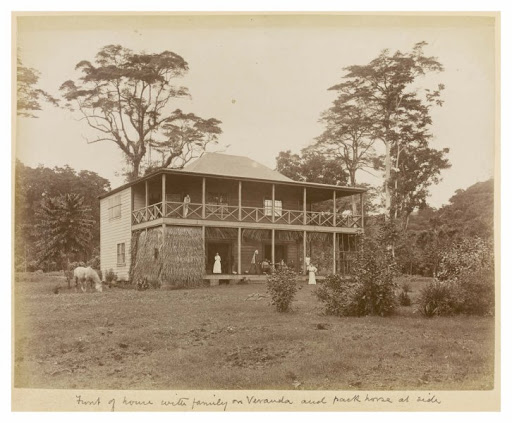
RLS (Seated Center, Rear) and His Household in Samoa

His nickname in Samoa was Tusitala, “The Teller of Tales.” He had gone to Oceania for his health. It is not known what the exact nature of his illness was, but it seemed to be hereditary. His mother died of an apparent stroke at the age of 38. When he died on on December 3, 1894, Robert Louis Stevenson was only 44.

I have just finished reading the letters that RLS wrote to his friend and sometime editor Sidney Colvin between November 1890 and October 1894. They have been published as The Vailima Letters, named after the author’s estate in Samoa. In them, he writes about his frequent illnesses, his involvement in island politics, and his intense efforts to make money by writing novels and stories. In those last four years, he wrote:

  • Catriona (1893), aka David Balfour, a sequel to Kidnapped
  • Island Night’s Entertainments (1893), aka South Sea Tales
  • The Ebb-Tide (1894), co-author Lloyd Osbourne
  • Weir of Hermiston (1896), left unfinished at the author’s death
  • St. Ives: Being the Adventures of a French Prisoner in England (1897)

At times, Stevenson’s letters rise to the level of poetry. In March 1891, he writes:

I said I was tired; it is a mild phrase; my back aches like toothache; when I shut my eyes to sleep, I know I shall see before them—a phenomenon to which both Fanny and I are quite accustomed—endless vivid deeps of grass and weed, each plant particular and distinct, so that I shall lie inert in body, and transact for hours the mental part of my day business, choosing the noxious from the useful. And in my dreams I shall be hauling on recalcitrants, and suffering stings from nettles, stabs from citron thorns, fiery bites from ants, sickening resistances of mud and slime, evasions of slimy roots, dead weight of heat, sudden puffs of air, sudden starts from bird-calls in the contiguous forest—some mimicking my name, some laughter, some the signal of a whistle, and living over again at large the business of my day.

In May1892, this description of clouds appears in the letters:

As I rode down last night about six, I saw a sight I must try to tell you of.  In front of me, right over the top of the forest into which I was descending was a vast cloud.  The front of it accurately represented the somewhat rugged, long-nosed, and beetle-browed profile of a man, crowned by a huge Kalmuck cap; the flesh part was of a heavenly pink, the cap, the moustache, the eyebrows were of a bluish gray; to see this with its childish exactitude of design and colour, and hugeness of scale—it covered at least 25°—held me spellbound.  As I continued to gaze, the expression began to change; he had the exact air of closing one eye, dropping his jaw, and drawing down his nose; had the thing not been so imposing, I could have smiled; and then almost in a moment, a shoulder of leaden-coloured bank drove in front and blotted it.  My attention spread to the rest of the cloud, and it was a thing to worship.  It rose from the horizon, and its top was within thirty degrees of the zenith; the lower parts were like a glacier in shadow, varying from dark indigo to a clouded white in exquisite gradations.  The sky behind, so far as I could see, was all of a blue already enriched and darkened by the night, for the hill had what lingered of the sunset.  But the top of my Titanic cloud flamed in broad sunlight, with the most excellent softness and brightness of fire and jewels, enlightening all the world.  It must have been far higher than Mount Everest, and its glory, as I gazed up at it out of the night, was beyond wonder.  Close by rode the little crescent moon; and right over its western horn, a great planet of about equal lustre with itself.  The dark woods below were shrill with that noisy business of the birds’ evening worship.  When I returned, after eight, the moon was near down; she seemed little brighter than before, but now that the cloud no longer played its part of a nocturnal sun, we could see that sight, so rare with us at home that it was counted a portent, so customary in the tropics, of the dark sphere with its little gilt band upon the belly.  The planet had been setting faster, and was now below the crescent.  They were still of an equal brightness.

I could not resist trying to reproduce this in words, as a specimen of these incredibly beautiful and imposing meteors of the tropic sky that make so much of my pleasure here; though a ship’s deck is the place to enjoy them.  O what awful scenery, from a ship’s deck, in the tropics!  People talk about the Alps, but the clouds of the trade wind are alone for sublimity.

I could easily come up with another half dozen passages that impressed me. And I am all the more impressed becau8se today is my father’s birthday. Were he still alive, he would be 108 years old. But, alas, he died at the age of 74—which, to be precise, is my present age—a fact which makes me ever more conscious of my own mortality.