The day before yesterday, I posted a description of driving back to L.A. from the desert in a big wind. In yesterday’s Los Angeles Times, I discovered just how strong those winds were:
The powerful winds, which included gusts that topped 80 mph in at least one location, toppled big rigs in the Inland Empire [San Bernardino and Riverside Counties] and forced officials to briefly close Ontario International Airport. Don Gregorio, meteorologist for the National Weather Service in San Diego, said gusts at the airport on Monday had clocked in as high as 70 mph.
I was just south of Ontario Airport on Archibald Avenue when I encountered the worst of the winds.
This last weekend, I spent a long weekend with my brother and sister-in-law in Palm Desert. Atypically, the weather was perfect. Dan mentioned that until I arrived, the temperature had risen to over 100° Fahrenheit (38° Celsius) for over 100 days in a row. While I was there, the high was closer to 80° (27° Celsius).
It felt good to see my brother again after 7 months of close quarters in West Los Angeles. We went swimming three days in a row, and even re-visited a couple of local sites.
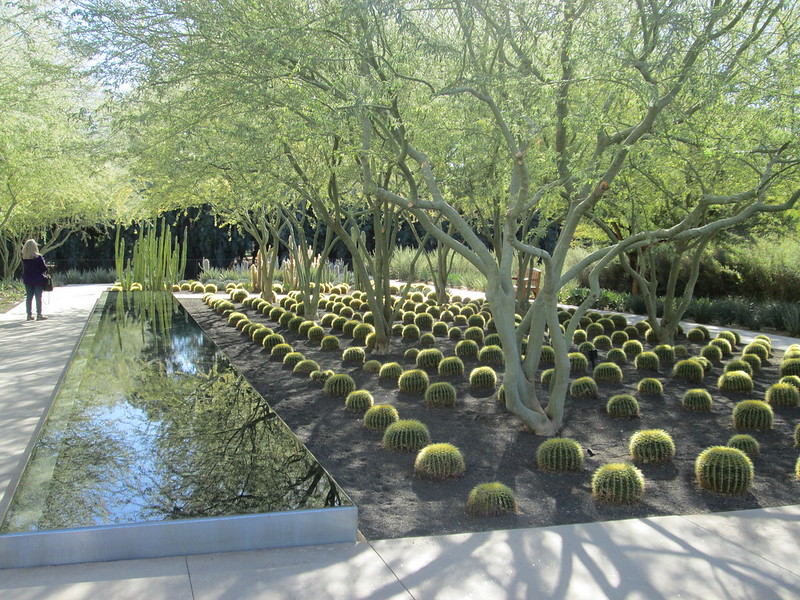
These included the lovely Thousand Palms oasis and the Sunnylands park on the Annenberg Estate in Rancho Mirage.
One of the Cactus Gardens on the Annenberg Estate
Not all the facilities at both locations were open due to the coronavirus outbreak, but seeing anything beautiful these days is a rare pleasure—especially during a particularly ugly election year.
It was L.A. author Joan Didion who said, “The wind shows us how close to the edge we are.”
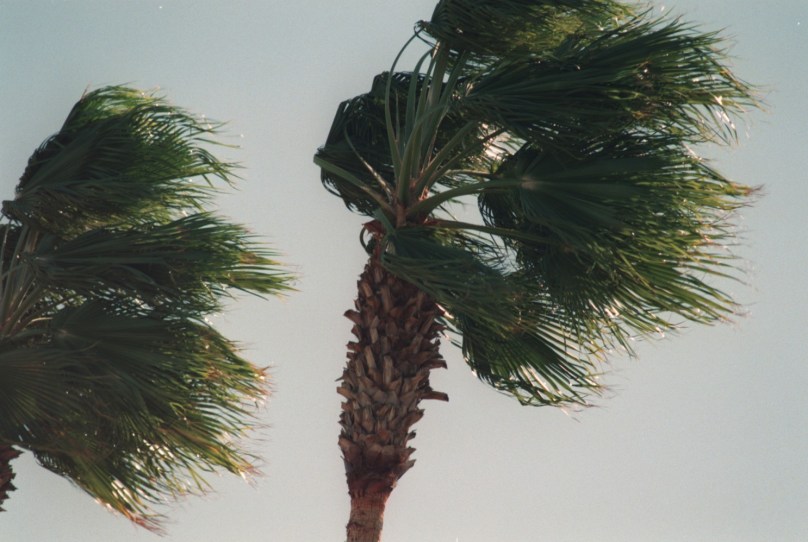
After spending a weekend in the desert with my brother, I drove back to Los Angeles in a veritable windstorm. The worst of it was in Ontario, where I pulled off the freeway to pump gas and use the bathroom, the rest area at Calimesa being closed.
When the wind blows from the north, it whips through Cajon Pass and pummels the communities adjacent to Interstate 15 with an intensity which at times could be frightening.
So it was for me at the Shell Station off California 60 on Archibald Road. I had difficulty opening the driver-side door: It was as if the wind had nailed it shut. I knew better than to try to wear my cap and end up chasing it to San Diego, but little did I suspect that my eyeglasses were in the process of being yanked off my head and sent swirling into the blowing leaves and dust.
As I got back on the road to the freeway on-ramp, I had difficulty keeping my Subaru in my lane, driving as I did between 18-wheelers.
The worst of the wind was there, but it was also pretty wild at Cabazon, which sits on the low pass connecting San Jacinto Peak with Mount San Gorgonio.
My brother made a point of calling me around noon to see whether I was able to navigate the gusts without mishap. He said that it had gotten equally intense in Palm Desert, where he lived.
This next weekend, I will break quarantine for the first time to visit my brother Dan and sister-in-law Lori in Palm Desert, near Palm Springs. It will still be hot as Hades, but for the first time I will have a chance to talk face to face with someone other than just Martine.
She, by the way, will not be coming with me. Having lived and worked for a couple years at Twentynine Palms in the Morongo Valley, about an hour north of Dan, she hates the desert with a passion.
I would not live in the desert, as my brother does, but I enjoy visiting it from time to time—especially when the dead heat of summer begins to let up.
Perhaps I can visit a couple of places that I particularly like, such as the Thousand Palms Oasis or the Indian Canyons south of Palm Springs. More likely, I will be reading some books and taking advantage of Dan’s air conditioning and swimming pool. And, of course, his cooking.
As usual, I will be leaving L.A. before the sun rises. I will stop at Hadley Fruit Orchards In Cabazon to do some shopping before making a beeline to Palm Desert. Right around Cabazon, I will set my car radio dial to MOD-FM 107.3 to listen to their parade of classical 1950s hits with Frank Sinatra, Dean Martin, Sammy Davis, and their ilk.
My last meal in Mérida before returning to the U.S. was at a grungy little seafood dive on Calle 62 called the Blue Marlin (Marlin Azul). It was a raw fish dish called ceviche de pescado that is “cooked” with the addition of fresh lime juice. Also it contains cut-up tomatoes, chiles, and cilantro. It is served cold and is an ideal lunch dish.
In Progreso, a few days earlier, I had a ceviche de pulpo made with the same ingredients, except that octopus replaces the fish. I was in hog heaven.
Actually the seafood dish I ate the most in Yucatán this last trip was filete de pescado veracruzana. It was a grilled filet of fish in a tomato sauce with onions, olives, and capers. I never got tired of it, especially when I was near the sea and knew that the fish was super fresh.
During this awful coronavirus outbreak, I dream of traveling by bus between various seaport cities in Baja California and living on fish tacos and other local specialties.
Baja Style Fish Tacos
When I was growing up in Cleveland, I didn’t think much of fish. Lake Erie, the shallowest of the Great Lakes, was for all intents and purposes a body of water noted for dead fish floating on its surface. I have had some good seafood in Los Angeles, but avoid shrimp and lobster, as I seem to be allergic to them—possibly because of the pollution of the Pacific Ocean around the coast of Southern California.
Traveling to places like Iceland or Mexico where the seafood is so fresh and interesting makes me dream of travel again. Sigh.
Mummified Corpses in Guanajuato’s Museo de las Momias
In this month of Halloween, I thought I would make mention of the most horrific museum I have ever visited, the Museo de las Momias (that is, Mummies) de Guanajuato.
Imagine to yourself a museum consisting of corpses dug up in a Mexican mining town that have been naturally mummified because of the mineral content of the soil. Many were interred during a cholera epidemic which filled the local cemetery to such an extent that the town had to charge a fee for the right to remain buried. According to Wikipedia:
The human bodies appear to have been disinterred between 1870 and 1958. During that time, a local tax was in place requiring a fee to be paid for “perpetual” burial. Some bodies for which the tax was not paid were disinterred, and some—apparently those in the best condition—were stored in a nearby building. The climate of Guanajuato provides an environment which can lead to a type of natural mummification, although scientific studies later revealed that some bodies had been at least partially embalmed. By the 1900s the mummies began attracting tourists. Cemetery workers began charging people a few pesos to enter the building where bones and mummies were stored.
When I visited Guanajuato in the late 1980s, my introduction to the museum was itself grim: A young father was carrying a child’s coffin on his shoulders to be buried, with no one else in the family following him.
Shades of Edgar Allan Poe: The Wikipedia entry continues with this grim fact:
One of the mummies who was buried alive was Ignacia Aguilar. She suffered from a strange sickness that made her heart appear to stop on several occasions. During one of these incidents, her heart appeared to stop for more than a day. Thinking she had died, her relatives decided to bury her. When her body was disinterred, it was noticed that she was facing down, biting her arm, and that there was a lot of blood in her mouth.
The only way I kept the contents of my stomach under control while I was in the museum was the extent to which I busied myself taking pictures. None of these are in this post, as they have yet to be converted to JPEG files from the Kodachrome slides I was then shooting.
Even a writer like Ray Bradbury had trouble seeing the displays of mummies in the museum:
The experience so wounded and terrified me, I could hardly wait to flee Mexico. I had nightmares about dying and having to remain in the halls of the dead with those propped and wired bodies. In order to purge my terror, instantly, I wrote ‘The Next in Line.’ One of the few times that an experience yielded results almost on the spot.
This may sound strange to you, but I am surviving the rigors of self-quarantine because I am good at lying to myself.
The Coronavirus Quarantine Is Sort of Like Jet Lag
I have on occasion taken some longish flights to Europe and South America. The ones to Europe are particularly problematical because I arrive early in the morning after a night that has lasted for only a few hours. I know that if I drop into bed upon check-in at my hotel, I will awake while it is still light; and I won’t be able to go to sleep until the next morning.
So what do I do?
First of all, I pretend to myself during the flight that I am somehow outside of time, and that during the flight, time has no meaning.
Most important, I set my watch to the time zone of my destination. Nobody else I know does this: They insist on holding on to the time zone of their city of origin.
When I arrive, I stay awake until it is a reasonable bedtime in my destination.
When I went to Iceland, for example, I arrived in June—when the sun doesn’t set until the wee hours of the morning. I ate extra meals, went on a walking tour of Reykjavík, and finally collapsed in bed while the sun was still up around midnight. I woke up refreshed at an acceptable time the next morning.
So what does all this have to do with the coronavirus? Fortunately, Martine and I are retired, so I could pretend that this whole period of the outbreak is like a long flight to nowhere.
A Nook of My Library Circa 2002
I have in my apartment several thousand books as well as hundreds of films on DVD. With my subscription to Spectrum Cable, I have access to hundreds of films for no additional cost using their On Demand service. Plus: As a member of Amazon Prime, I have access to thousands of other films.
So on my “flight” to nowhere during this seemingly endless quarantine, I am reading 12-18 books a month as well as seeing 25 or more feature films a month. (And in between reading and film viewing, I do all the cooking and go out for walks.)
I realize I would be in a radically different situation if I had to worry about a job, but fortunately I don’t. I have to worry that that madman in the White House may decide to cancel Social Security or destroy the value of the American dollar, but other than that I am not dependent on the workplace—though I am affected when restaurants are shuttered, museums and libraries closed, and so on.
There is an 1884 novel by a French writer named Joris-Karl Huysmans called Against Nature (in French À Rebours) about a dilettante names Jean des Esseintes who, instead of actually going on a vacation, does an armchair traveler “staycation” and is happy about it. The epigraph to the novel is a quote from the 14th century Flemish mystic Jan van Ruysbroeck:
“I must rejoice beyond the bounds of time…though the world may shudder at my joy, and in its coarseness know not what I mean.”
Hovenweep Isn’t Far As the Crow Flies from Chaco Canyon
One of the things I love about the archaeology of the Southwestern U.S. are the many mysteries relating to the Anasazi, “The Old Ones.” A few days ago, I wrote about Chaco Canyon, which turned my mind to Hovenweep in Southeast Utah, which I visited twice. Hovenweep National Monument is out of the way, so it doesn’t receive as many visitors as Canyon de Chelly, Mesa Verde, or even Chaco Canyon.
The view east from Hovenweep is toward Sleeping Ute Mountain in Colorado. We are very close here to the Four Corners area, where the boundaries of four states come together: Arizona, New Mexico, Utah, and Colorado. Here is the view of Sleeping Ute Mountain:
Sleeping Ute Mountain in Nearby Colorado
I suspect that Hovenweep was at or near the boundary with some other ancient people. Why else would they feel the need to construct towers, which look as if they were intended for self-defense. The ruins are built around a tiny canyon which is crossed by the trail that surrounds the site. Here I suspect was the source of the water they needed in this dry area, though Martine and I did not see any when we were there.
As with most Anasazi ruins, there are a whole lot more questions than answers. (But isn’t that always the case?) The Anasazi left a lot of pictographs but no body of writing—and certainly no explanations. In their time (roughly from 200 BC to AD 1500—just before the Spanish showed up), they built a lot of interesting structures in the San Juan River valley that was their center. What happened to them? They probably became the Pueblo Indians of Arizona and New Mexico. They were probably forced to move from places like Chaco and Hovenweep because the drought that bedeviled them became chronic.
I remember writing in yesterday’s post that I spent three consecutive vacations in New Mexico, where I just happened to fall in love with Hatch chiles. But what did I go to New Mexico to see? The answer could be expressed in two words: Chaco Canyon.
Insofar as I am concerned, the most incredible archaeological site in the United States could be found in Northwest New Mexico at the Chaco Canyon National Historical Park. At one point—between AD 900 and 1150—Chaco Canyon was like the Rome and the Vatican City of the Anasazi world. Within the park, there are literally hundreds of ruins, pictographs, and ceremonial roads within a relatively small area. One could approach it from U.S. 550 between Espanola and Farmington by turning onto a washboarded dirt road around the site of the former Nagheezi Trading Post, or via New Mexico 371 from Thoreau to Crownpoint, and then on New Mexico 9, once again getting on a washboarded dirt road.
The Largest and Most Spectacular Ruin: Pueblo Bonito
For three consecutive years, I camped at Gallo Wash with a large ice chest full of Hatch chiles and other edibles, getting my water from the only source in the park: The National Park Service Visitor Center.
There are other Anasazi ruins in the Southwest: I have been to Mesa Verde, Hovenweep, Navajo National Monument (Betatakin), Aztec, Salmon, Bandelier, and Canyon de Chelly. But it was only at Chaco that there seemed to be a large population, with multiple ruins in easy walking distance of one another. I even climbed the butte above Pueblo Bonito, running into a coiled rattlesnake that was a little discomfited at encountering me. Trust me, the discomfiture was mutual, but both of us managed to avoid harm.
Fajada Butte, Location of the Famed Sun Dagger
Entering the park from the Nagheezi Road, one encounters Fajada Butte (shown above), atop which there is a rock meant to project a downward-pointing dagger at sunrise during the Spring Equinox. I did not venture to climb the butte, as it is probably forbidden anyhow (and dangerous). Nearby to the right is Gallo Wash, where I camped.
If there is one place in the Southwest that I can recommend to tourists interested in archaeology, it would have to be Chaco Canyon.
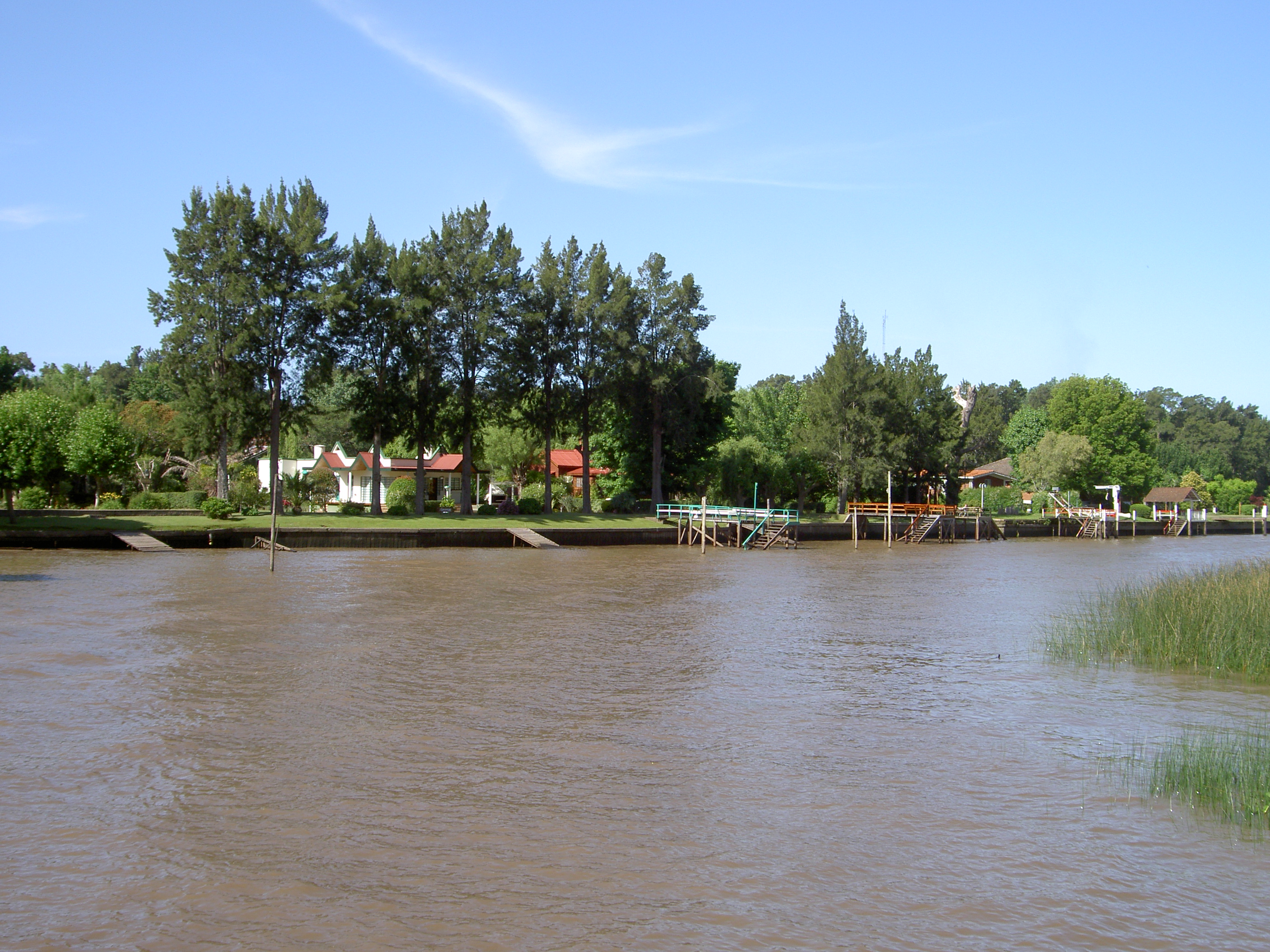
I was talking to my friend Bill Korn a few minutes ago. When he happened to mention that there were massive fires in the delta of the Paraná River, I was shocked. I was familiar with the Paraná Delta, having taken a boat tour of the area in 2006 and 2015. I pulled up an article The Guardian, which described parts of the delta upriver from Tigre, around the city of Rosario: The area with which I was familiar was where the river feeds into the Rio de la Plata. It is an a weekend getaway for the residents of Buenos Aires that is densely vegetated, very pretty, but full of mosquitoes.
The Drainage Area of the River Paraná
The Paraná is the second longest river in South America. Its drainage area includes Argentina, all of Paraguay, and parts of Brazil and Bolivia. As you can see from the above map, Rosario is not far from Rosario, a city I went through on a night bus on the way to Puerto Iguazu, where the boundaries of Brazil, Paraguay, and Argentina meet, The river is some 3,030 miles (4,800 km) long and is navigable for much of its length with several deep water ports along its length. In Puerto Iguazu, I dined on surubi, a fresh water fish caught on the river.
View from a Boat Ride on the Delta
I have been to Argentina three times and fallen in love with the country. I hope that, what with Argentina mired in the coronavirus, they manage to save some of the beautiful places I have seen. It is along the river that much of Argentina’s Yerba Mate crop is grown. I remember from that bus ride passing through almost a hundred miles of fields where the tea leaves are grown.









You must be logged in to post a comment.