
Smoky Nectar of the Gods

Some People Dream of Fine Wines, But Not Me!

Some People Dream of Fine Wines, But Not Me!

I suppose this means I have no right to claim to be sophisticated, or even cosmopolitan. The fact of the matter is that I do not really care that much for wine. I would prefer a fine cognac or a full-bodied dark Jamaican rum—but most of all, I would prefer a fine Islay single malt Scotch.

During Prohibition, one Islay malt called Laphraoig (la-FROIG) was allowed through U.S. customs because it was thought to be a medicine. Oh, it is that to be sure! Like all single malts distilled on the island of Islay (pronounced EYE-lah), it is characterized by a smoky flavor, somewhat like Lapsang Souchong in the world of tea. It owes that smokiness to the peat on the island that is used to in the distilling process. According to Whisky.Com:

The level of smokiness of a whisky is determined by the time the barley grain is exposed to the pungent peat smoke during drying. Damp malt is usually dried for approximately 30 hours. Laphroaig dries its malt over peat fire for about 18 of these 30 hours, while Glengoyne uses only unpeated fire. Thus you get a broad variety ranging from extremely smoky whisky to almost completely smokeless whisky. Malt grains are peculiar in that they lend a hint of smokiness to the whisky even without a peat fire.

By the way, in Scotland, it is always spelled whisky. Only the more inferior products from furriners are referred to as whiskey.

About fifteen years ago, Martine and I spent several days at Bowmore, including a visit to the distillery (pictured above). We had been introduced to Bowmore  (bow-MORE) eight-year-old Scotch by Trader Joe’s stores, which tended to sell it at a steep discount around the holidays. I remember tasting the toasted Bowmore malt and finding it to be so delicious that I thought it would make a great breakfast cereal on its own. We also saw a fantastically aged barrel of the stuff worth thousands of pounds sterling and reserved for H.M. the Queen.

On their website, CBS news has an interesting website about the smoky Scotches of Islay which was started by the late Bob Simon and finished by Steve Kroft. It aired yesterday on “60 Minutes.”

During the early Middle Ages, Islay was the headquarters of the Lords of the Isles, who ruled from a small island on Loch Finlaggan. Their empire stretched across the Hebrides and whatever parts of Ireland and mainland Scotland they could hold. If you are interested in the period, you might try hunting up a copy of Nigel Tranter’s The Lord of the Isles, best enjoyed while sipping a fine Islay single malt whisky.


Oh, No! Not Again!

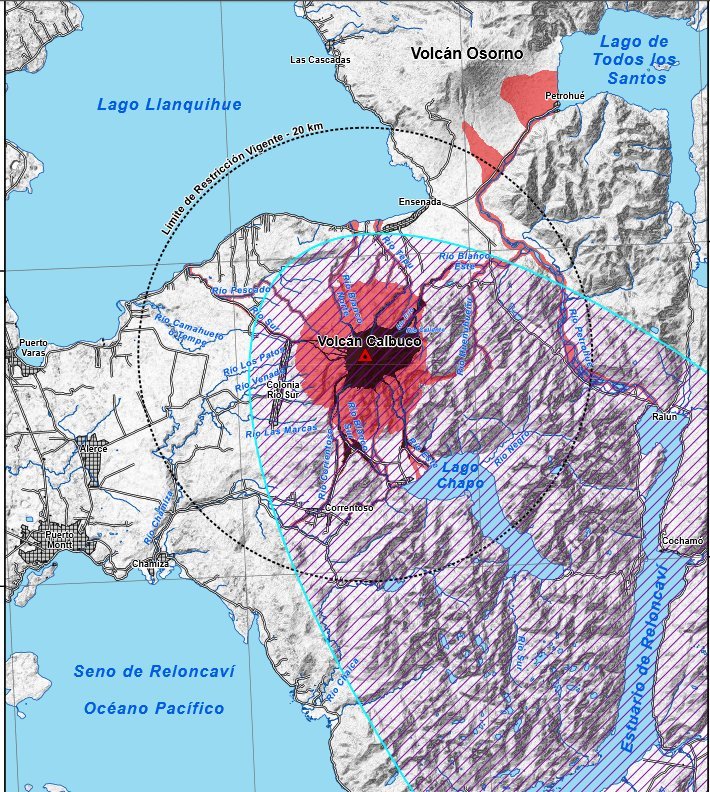
Chile’s Calbuco Volcano in Eruption

Chile’s Calbuco Volcano in Eruption

It’s getting to be downright monotonous. Four years ago, when Martine and I were planning our trip to Argentina, we had originally decided to included San Carlos Bariloche on the eastern slope of the Andes on our itinerary. But then, a Chilean volcano decided to trash the whole area. Here’s what I wrote at that time:

It looks like some sort of ghastly aviation accident, doesn’t it? But no, what you are seeing above [actually below, in this posting] is a grounded aircraft in San Carlos de Bariloche covered in volcanic ash from the eruption of the Puyehue-Cordon Caulle volcanic complex in neighboring Chile. Not only was the airport at Bariloche closed for lack of visibility, but the ash drifted eastward over the South Atlantic by Trelew and Puerto Madryn.

I have just named three of my main destinations for our upcoming trip to Argentina five months from now. No doubt the eruptions will cease soon, if they have not already done so.

One thing we can expect is that there will be a lot more blowing dust and ash given the prevailing winds in Patagonia and the huge amount of ash generated by the eruption.

Our plan is to go to Bariloche via one of the few remaining long-haul passenger railways in Argentina, the Tren Patagonico connecting Viedma with Bariloche. Viedma is five hours north of Puerto Madryn by bus, so we’ll have the opportunity of seeing more of the Atlantic coast between the two cities.

Plane Covered with Ash at Bariloche’s Airport

Plane Covered with Ash at Bariloche’s Airport

Well, the eruptions from Cordon Caulle kept going until several states along the Eastern Andes were declared a disaster zone. So we skipped Bariloche and went to El Calafate instead, which did not disappoint.

Now the Chileans are doing it again to me, with Calbuco in eruption. And, of course, I am planning once again to visit Bariloche in November. I can only hope that this particular event does not last as long as the one four years ago. So far, the only area in Argentina that has been affected is around Neuquén, several hours to the north of where I’ll be.

I just noticed that the ash has already made its way to Buenos Aires, closing all international flights from Ezeiza airport.

The Buenos Aires Herald has included a great video shot by a Chilean tourist at the moment Calbuco blew its top. You can find it by clicking here.

Land of Dinosaurs

Exhibit at Trelew’s Museo Paleontológico Egidio Feruglio

Exhibit at Trelew’s Museo Paleontológico Egidio Feruglio

The first book I ever read about Patagonia was George Gaylord Simpson’s Attending Marvels: A Patagonian Journal, about the paleontologist’s search for dinosaur bones in that windy desert that forms most of Argentina’s South. A sparsely populated country (less than one person per square mile), Patagonia preserves its paleontological heritage better than most populated places.

Near Nequén, there are three active digs that a tourist can visit. In Trelew, there is the attractive Museo Paleontológico Egidio Feruglio. Even the airport at Trelew has dinosaur bones on display.

Last September, CBS announced the discovery of substantial dinosaur remains for Dreadnoughtus schrani, which lived 77 million years ago, measured 85 feet long, and weighed in at 65 tons—heavier than a Boeing 737. (I wonder whether it was a vegetarian.)

I probably will not spend much time digging for fossils on my next trip to Argentina, but it’s always fun to see what others have dug up in that desolate land.


A Visit to the Holy Land

Argentina’s Own Biblical Theme Park: Tierra Santa

Argentina’s Own Biblical Theme Park: Tierra Santa

Both times I have visited Argentina, I stopped in at Buenos Aires’s Tierra Santa, a theme park dedicated to the Bible, particularly the New Testament. It’s relatively easy to get to: Take the commuter train a mere stop or two from Retiro Station to Estación Raúl Scalabrini Ortiz and walk to the northern exit, which takes you almost a mile past a water park along the Rio de la Plata to Argentina’s occasionally tacky and very Catholic version of the Holy Land.

One can easily spend two or three hours seeing the Disneyfied exhibits of the Creation, the Last Supper, and the Sermon on the Mount. There are several Middle Eastern type restaurants, gift shops, and hundreds of full size plaster statues representing figures from the Bible. Above is the Crucifixion, atop a sun-drenched Golgotha you can climb to be in the middle of the action.

It can’t be all that bad, because according to the park’s website, Pope Francis visited it.

If you are really famished after your visit, there was a branch of Siga la Vaca (“Follow the Cow”), an all-you-can-eat parrillada right next door.

Gone Forever: The Cafe Richmond

One of the World’s Great Literary Cafés

One of the World’s Great Literary Cafés

Just before Martine and I flew to Buenos Aires in 2011, one of the world’s greatest literary cafés was turned overnight into a Nike sportswear shop. Where once Jorge Luis Borges sat and wrote his stories, and where Graham Greene hung out (and commemorated) while he was writing The Honorary Consul, and where Antoine de Saint-Exupéry ate near his “charming little apartment” on Calle Florida, you can now buy shoes and other clothing items that are also available in a thousand other nearby outlets.

If I make it to Argentina later this year, I plan to photograph the damage, while urging you to boycott Nike. As far as I’m concerned, they can go and swoosh themselves into oblivion.

There is a charming article in the Argentina Independent about Calle Florida, where the Richmond was located at #468 (near the intersection with Lavalle). You can read more about the Cafe Richmond in The Guardian and The Independent.

Fortunately, Buenos Aires is a city with many great cafés; but, sometimes, when a great one closes, the ripples are felt around the world.

Gabriela Kogan has written a great little book which Martine and I used called The Authentic Bars, Cafés, and Restaurants of Buenos Aires which is available from The Little Bookroom.

Vacation Planning Around Disasters

Wildfires in Argentina’s State of Chubut

Wildfires in Argentina’s State of Chubut

Whenever one is traveling anywhere in the world, one must keep up with the news. When Martine and I went to Argentina in 2011, for example, there was a major Chilean volcanic eruption that spewed ash all over the State of Rio Negro, forcing us to remove San Carlos Bariloche from our itinerary and replace it with El Calafate. This time, there is a huge wildfire near Los Alerces National Park and the town of Cholila. While the eruption of the Puyahue/Cordón Caulle volcano in 2011 lasted for months, I am confident that the Chubut fires will be doused well before November, especially as there will be an intervening rainy season.

Among the Chubut locales I hope to visit are El Maitén, Esquel, and Trevelin.

The Area Around Cholila Before the Fire

The Area Around Cholila Before the Fire


La Trochita

One of the Two Remaining Stretches of Patagonia’s Classic Narrow-Gauge Railway

One of the Two Remaining Segments of Patagonia’s Classic Narrow-Gauge Railway

In the mid-1970s, Paul Theroux wrote the book that first got me interested in South America, The Old Patagonian Express. He traveled by rail starting in Boston and as far south as he could go in the Americas using more or less connected rail routes.That sort of fell apart in Central America, where there is no reliable way to cross Panama’s Darien Gap by rail—or road for that matter. But from Bolivia to Esquel in Argentina’s Northern Patagonia, the rails were still in use.

Now, some forty years later, Argentina has no train between the Bolivian border and Tucumán, between Bahia Blanca and Viedma, and between Ingeniero Jacobacci and Esquel. And the segment from Tucumán to Buenos Aires will probably close soon.

The stretch that interested me most was the one between Ingeniero Jacobacci and Esquel using a narrow-gauge route referred to today as La Trochita (“The Little Narrow Gauge”) or El Trencito (“The Little Train”). Shortly after Theroux wrote his most memorable chapter about the last leg of his trip, La Trochita was no more …

… except in the fond memories of Argentinians who decided to keep a couple of stretches of the steam train active for tourists. One is between El Maitén and Thomae and between Esquel and Nahuel Pan. Being an unregenerate railroad buff, I plan to take both segments. That is to say, if I can schedule it right.

Where Theroux in his typically snarky way wrote about Patagonia that “Nowhere is a place,” I, who am really from Nowhere (Cleveland, Ohio, which was destroyed by Maynard G. Krebs’s mythical The Monster That Devoured Cleveland), think that the eastern range of the Andes in Patagonia is truly beautiful. But then, Theroux was never an aficionado of fine scenery or especially of anything that threatened his comfort. (Hey, I still love his travel books!)

Probably about half or more of my next trip to Argentina will be exploring the town between Bariloche and Trevelin along the eastern slope of the Andes. I might even hop across to the border to Futaleufu in Chile, which is accessible only through Trevelin in Argentina.

The last time I saw a real steam locomotive in use was in 1977 when I was traveling by rail from Budapest to Košice in what was then Czechoslovakia. Near Miskolc in Hungary, the railroad yard was full of steam locomotives shuttling freight cars back and forth.


Tarnmoor’s ABCs: Scotland

The Isle of Skye in the Hebrides

The Isle of Skye in the Hebrides

All the blog posts in this series are based on Czeslaw Milosz’s book Milosz’s ABC’s. There, in the form of a brief and alphabetically-ordered personal encyclopedia, was the story of the life of a Nobel Prize winning poet, of the people, places, and things that meant the most to him.

My own ABCs consist of places I have loved (Iceland, Patagonia, Quebec), things I feared (Earthquakes), writers I have admired (Chesterton, Balzac, Proust, and Borges); locales associated with my past life (Cleveland and Dartmouth College), people who have influenced me (John F. Kennedy), foods I love (Olives), and things I love to do (Automobiles and Books). This blog entry is my own humble attempt to imitate a writer whom I have read on and off for thirty years without having sated my curiosity. Consequently, over the weeks to come, you will see a number of postings under the heading “Tarnmoor’s ABCs” that will attempt to do for my life what Milosz accomplished for his. To see my other entries under this category, hit the tag below marked “ABCs”. I don’t guarantee that I will use up all 26 letters of the alphabet, but I’ll do my best. Today the letter is “S” for Scotland.

When I write about the places I love most, Scotland ranks high on my list. I have been there four times, but have barely scratched the surface. Twice I went with Martine, who liked it as much as I did. To this day, she still wears the Cardigan sweater she bought at a woolen mill near Oban, and I still have two Scottish sweaters I bought almost forty years ago, which I still wear occasionally even though they are starting to pill a bit.

Nowhere else in the British Isles are you likely to get as tasty food as in Scotland. Scots are typically friendlier than the folk south of Hadrian’s Wall—probably because they know so many Americans have Scottish blood flowing in their veins as a result of the Highland Clearances that took place after Culloden.

What really distinguishes the Scots in my mind is their sense of history. There’s not only the rebellion of 1745, in which the Highlands wasted their manpower for the unworthy Bonnie Prince Charles, but going farther back, back to Somerled and the Lords of the Isles, William Wallace and Robert the Bruce, the struggles of the House of Stewart to establish themselves, the great tragedy of Flodden Field, the death of Mary Queen of Scots, the cruelty of Butcher Cumberland, and that brave late 18th century renaissance that brought so many Scottish thinkers and inventors to the fore. As with Hungarians, the Scots live the entire spectrum of their history.

Edinburgh is probably one of my two or three favorite cities in the world, especially that long walk downhill along the Royal Mile from Edinburgh Castle to the Palace of Holyroodhouse, and then the climb of Arthur’s Seat to see “Auld Reekie” in all its glory. But if you really want to see Scotland, go for the isles, for Mull, Iona, Islay, Skye, and the Orkneys. When you walk among the graves by the church at Iona, remember that Macbeth and a score of early Scottish kings are buried there in unmarked graves.

Martine and I have looked for the Loch Ness Monster at Drumnadrochit. (We didn’t see it.) We visited castles, Scotch whisky distilleries, ate haggis and neeps (at least, I did), and enjoyed a bowl of cullen skink.

Then were all those novels by Nigel Tranter and Sir Walter Scott, not to mention the poems of Robert Burns, whose museum I saw at Dumfries.

Och, it’s time to go back!


Roadside Saints

Argentinians Have Made Up Some of Their Own Saints

Argentinians Have Made Up Some of Their Own Saints

This comes from a post on Multiply.Com which I wrote on August 18, 2011. Some changes have been made:

Oh, oh! I’ve been thinking about Argentina again, and that means you’re going to hear about some more really obscure (but, IMHO fascinating) stuff.

To begin with, Argentina is such a Catholic country that it had to create additional saints native to its own soil. Let’s begin with La Difunta Correa, which means, literally, the Dead Correa:

According to popular legend, Deolinda Correa was a woman whose husband was forcibly recruited around the year 1840, during the Argentine civil wars. Becoming sick, he was then abandoned by the Montoneros [partisans]. In an attempt to reach her sick husband, Deolinda took her baby child and followed the tracks of the Montoneros through the desert of San Juan Province. When her supplies ran out, she died. Her body was found days later by gauchos that were driving cattle through, and to their astonishment found the baby still alive, feeding from the deceased woman’s “miraculously” ever-full breast. The men buried the body in present-day Vallecito, and took the baby with them. [from Wikipedia]

All over the country, there are roadside shrines to La Difunta Correa, many surrounded by gifts left by truck drivers and travelers in a hope for a safe journey to their destination. Remember that Argentina is the eighth largest country on earth, and that distances can be farther than one imagines, especially on unpaved ripio roads.

There are two other popular saints with shrines all across the nation: Gauchito Gil (“Little Gaucho Gil”) and El Ángelito Milagroso (“The Little Miraculous Angel”), a.k.a. Miguel Ángel Gaitán.

Gauchito Gil hails from the state of La Rioja near the Bolivian border. A farmworker, Gil was seduced by a wealthy widow. When the police chief, who also had a thing for the widow, and her brothers came after Gil, he joined the army in the War of the Triple Alliance against Paraguay (perhaps the bloodiest war ever fought in the Americas, with the exception of our own Civil War). When he returned home, the Army came after him to join in one of Argentina’s many civil wars. Not to put too fine a point on it, the Gauchito deserted. He was discovered by the police, who wanted to execute him. Whereupon Gil prophesied to the head of the police detail that if he were merciful, the officer’s child, who was gravely ill, would get better. Instead of being shown mercy, Gil was executed.

When he returned home, the police officer found that his son was indeed very ill. So he prayed to Gauchito Gil, and his son got better. It was this police officer who returned to the scene of the execution, gave Gil a proper burial, and built a shrine in his memory. Today there are hundreds of such shrines scattered throughout the country.

By the way, the Gauchito is not the only deserter hero in Argentina’s past. Perhaps the national epic is Martin Fierro by José Hernández, about a gaucho who deserts from the so-called “Conquest of the Desert”—really a war of genocide against the native tribes of the Pampas—and is pursued by the police militia.

The Nineteenth Century in Argentina was unusually bloody, what with civil war, wars against the native peoples, and wars against other countries such as Paraguay and Brazil. So it is not unusual to find deserters as heroes, which is unthinkable in Europe and North America.

Finally, there is another La Rioja “saint” named Miguel Ángel Gaitán, El Ángelito Milagroso, who died at the tender age of one in 1967. When his body didn’t rot, the locals thought that meant it was supposed to be exposed for veneration—and so it was.

Everybody Who Is Anybody

A Lane in Buenos Aires’ Recoleta Cemetery

A Lane in Buenos Aires’ Recoleta Cemetery

In the United States, there is no single cemetery where everybody who is anybody is interred. France has its Père Lachaise and Pantheon, and Argentina has La Recoleta.

There you will find the tombs of Argentina’s presidents, including Bartolomé Mitre, Carlos Pellegrini, Domingo Faustino Sarmiento, Hypólito Yrigoyen, Julio Argentino Roca, Marcelo Torcuato de Alvear, Pedro Eugenio Aramburu, and Raúl Alfonsin. Perhaps its most famous inhabitant is Evita Perón, who is buried here under her maiden name of Duarte. Not here is the only Argentinean president most people are likely to know: Juan Perón. He was buried at Chacarita Cemetery, then moved to a mausoleum some 35 miles outside of Buenos Aires.

Although Jorge Luis Borges—Argentina’s most famous writer—is buried in Europe, here you will find Silvina and Victoria Ocampo and Borges’s collaborator Adolfo Bioy Casares.

Walking through the labyrinthine passageways between the crowded crypts, one finds fabulous wealth (such as that of the Bullriches) side by side with neglected tombs with broken glass and crumbling plaster.

And yet, to pass eternity in this place has a high entrance requirement. Many of the tiny crypt spaces are more expensive than mansions in the more elegant parts of the city. These are the most exclusive fourteen acres in all of South America.

If you find yourself in Argentina, a visit to Recoleta is a must.