A Camus Notebook 1942

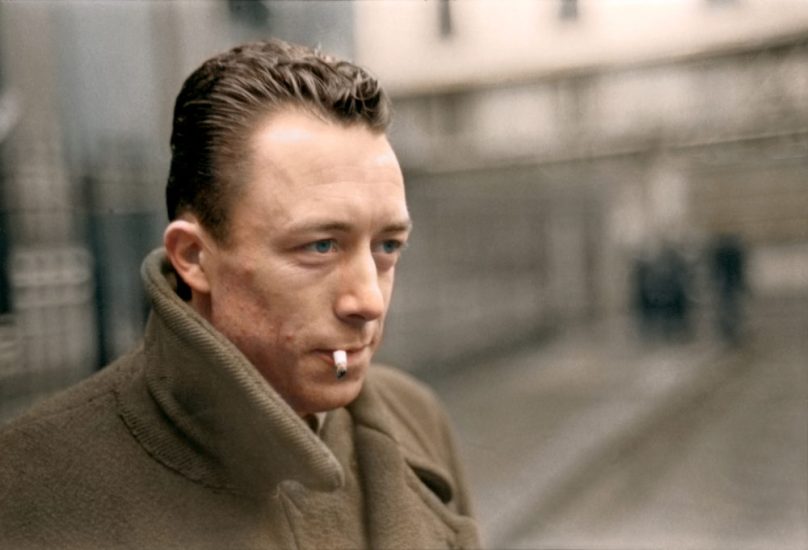
French Existentialist Writer/Philosopher Albert Camus (1913-1960)

I have been Reading Albert Camus’ Notebooks 1942-1951 from which I have excerpted the following selections from the year 1942. Even a fragmentary work by such a great writer is well worth the effort. I keep thinking of Blaise Pascal, whose Pensées have been a major part of my life since high school.

Secret of my universe: Imagining God without human immortality.

Capital punishment. The criminal is killed because the crime has spent all the capacity for living a man has. He has experienced everything if he has killed. He can die. Murder drains a man.

“What am I thinking that is greater than I and that I experience without being able to define it? A sort of arduous progress toward a theory of negation—a heroism without God—man alone, in short.”

Nostalgia for the life of others. This is because, seen from the outside, another’s life forms a unit. Whereas ours, seen from the inside, seems broken up. We are still chasing after an illusion of unity.

Solitary arrivals at night in strange cities—that sensation of stifling, being transcended by an organism a thousand times more complex. It is enough to locate the main street on the morrow, everything falls into place in relation to it, and we settle in. Collect memories of night arrivals in strange cities, live on the power of those unknown hotel rooms.

Novel. Beside the dying body of the woman he loves: “I can’t, I can’t let you die. For I know that I shall forget you. Hence I’ll lose everything and I want to keep you on this side of the world, the only one where I am capable of embracing you, etc., etc.”
She: “Oh, it’s a dreadful thing to die knowing one will be forgotten.”
Always see an express at the same time the two aspects.

Sexual life was given to man to distract him perhaps from his true path. It’s his opium. With it everything falls asleep. Outside it, things resume life. At the same time chastity kills the species, which is perhaps the truth.

Wuthering Heights, one of the greatest love novels because it ends in failure and revolt—I mean in death without hope. The main character is the devil. Such a love can be maintained only through the ultimate failure that is death. It can continue only in hell.

Living with one’s passions amounts to living with one’s sufferings, which are the counterpoise, the corrective, the balance, and the price. When a man has learned—and not on paper—how to remain alone with his suffering, how to overcome his longing to flee, the illusion that others may share, then he has little left to learn.

Serendipity: Marley’s Ghost

Tiny Tim with Scrooge in Dickens’s A Christmas Carol

In honor of Christmas, I will excerpt a brief scene from Charles Dickens’s A Christmas Carol, representing the first moment when Ebenezer Scrooge realizes that something is not quite right. He sees, instead of the usual door knocker, the face of his dead partner Jacob Marley. (I know I was a little hard on Dickens in a post I wrote last week, but I think that this particular story is not only one of his best: It has influenced the way that Christmas is celebrated across the West.)

Now, it is a fact, that there was nothing at all particular about the knocker on the door, except that it was very large. It is also a fact, that Scrooge had seen it, night and morning, during his whole residence in that place; also that Scrooge had as little of what is called fancy about him as any man in the city of London, even including—which is a bold word—the corporation, aldermen, and livery. Let it also be borne in mind that Scrooge had not bestowed one thought on Marley, since his last mention of his seven years’ dead partner that afternoon. And then let any man explain to me, if he can, how it happened that Scrooge, having his key in the lock of the door, saw in the knocker, without its undergoing any intermediate process of change—not a knocker, but Marley’s face.

The Door Knocker Transposed into Marley’s Face

Marley’s face. It was not in impenetrable shadow as the other objects in the yard were, but had a dismal light about it, like a bad lobster in a dark cellar. It was not angry or ferocious, but looked at Scrooge as Marley used to look: with ghostly spectacles turned up on its ghostly forehead. The hair was curiously stirred, as if by breath or hot air; and, though the eyes were wide open, they were perfectly motionless. That, and its livid colour, made it horrible; but its horror seemed to be in spite of the face and beyond its control, rather than a part of its own expression.

As Scrooge looked fixedly at this phenomenon, it was a knocker again.

To say that he was not startled, or that his blood was not conscious of a terrible sensation to which it had been a stranger from infancy, would be untrue. But he put his hand upon the key he had relinquished, turned it sturdily, walked in, and lighted his candle.

He did pause, with a moment’s irresolution, before he shut the door; and he did look cautiously behind it first, as if he half expected to be terrified with the sight of Marley’s pigtail sticking out into the hall. But there was nothing on the back of the door, except the screws and nuts that held the knocker on, so he said “Pooh, pooh!” and closed it with a bang.

A Little Fable

Daunt Books in London

Following is a short short story from Wilkie Collins (1824-1889), while I am still in the clouds after reading his novel No Name. It is called “A Little Fable”:

The other day, two good friends – a lawyer and a mathematician – happened to meet in a remote part of London, in front of a cheap book-shop. The stall outside the shop presented a row of novels, offered at half price.

Having exchanged the customary expressions of pleasure and surprise, and having made the necessary enquiries on the subject of wives and children, the two gentleman relapsed into a momentary silence. Perceiving in his friend signs of mental pre-occupation, the lawyer asked what he was thinking of. The mathematician answered, “I was looking back along the procession of small circumstances, which has led me from the starting-point of my own door to this unexpected meeting in the street.”

Hearing this, it occurred to the lawyer to look back, on his side. He also discovered that a procession of small circumstances had carried him, by devious ways, to the morsel of pavement on which he then stood. “Well,” he said, “and what do you make of it?”

“I have led a serious life,” the mathematician announced, “for forty years.”

“So have I,” the lawyer said.

“And I have just discovered,” the other continued, “that a man in the midst of reality is also, in this strange life of ours, a man in the midst of romance.”

The lawyer pondered a little on that reply. “And what does your discovery amount to?” he asked.

“Only to this. I have been to school; I have been to college; I am sixty years old – and my education is not complete. Good morning.”

They parted. As soon as the lawyer’s back was turned, the mathematician retraced his steps to the book-shop – and bought a novel.

The lawyer looked round at that moment. A strong impression was produced on him. He walked back to his friend. “When you have done with that book,” he said, lend it to me.”

Of Two Minds About Christmas

Christmas Display at L.A.’s Grier-Musser Museum

It is very easy to regard Christmas as both a time of happiness and a major pain in the ass—all at one and the same time. Below are some excerpts from the letters of Victorian novelist Wilkie Collins (1824-1889):

  • “This awful Christmas time! I am using up my cheque-book – and am in daily expectation of fresh demands on it.” to Charles Ward, December 1860-62 (I 286).
  • “at this festive season when the Plague of Plum pudding extends its ravages from end to end of the land, and lays the national digestion prostrate at the feet of Christmas…I had planned to give up eating and drinking until the return of Spring …”  to Miss Frith, 27 December 1870 (II 226).
  • “…are the filthy ‘Christmas festivities’ still an insurmountable obstacle to any proceeding that is not directly connected with the filling of fat bellies, and the exchange of vapid good wishes?” to William Tindell, 29 December 1874 (III 60; B&C II 387).
  • “…there are all sorts of impediments – literary and personal – which keep me in England at the most hateful of all English seasons (to me), the season of Cant and Christmas…But for Christmas-time, I should have read it long ago. I have returned to heaps of unanswered letters, bills, payments to pensioners, stupid and hideous Christmas cards, visits to pay – and every other social nuisance that gets in the way of a rational enjoyment of life…There is no news. Everybody is eating and drinking and exchanging conventional compliments of the season. You are well out of it” to Nina Lehmann, 28 December 1877 (III 180; B&C II 409-410).
  • “I suppose the dreadful Christmas literature is absorbing Mr Kelly’s printers.” to A P Watt 5 November 1883 (III 434).
  • “There is every temptation to die. We have not seen the sun for three weeks, in London – the plague of Christmas Cards is on the increase…Oh, what a miserable world to live in!” to Sebastian Schlesinger, 29 December 1883 (III 452; B&C II 463-465).
  • “Your kind and liberal letter reaches me , at the season devoted to prodigious eating and drinking, universal congratulating and holiday-making, and voluminous appearance of tradesmen’s Christmas bills. ‘Business’ is at a standstill, this year, until Monday next” to Perry Mason & Co, 26 December 1884 (IV 74). 
  • “But there is surely a chance of a change for the better, after the horrors of Christmas are over” To Emily Wynne, 19th December 1885 (IV 139).
  • “The horrid Christmas Day is over -. Let me forget it – and heartily wish you a happy New Year.” to A P Watt, 28 December 1885 (IV 140).
  • “It is a relief to hear that you have got over Christmas Day, and that you have energy enough to confront (I don’t say to eat) that dreadful composition called plum pudding.” to Emily Wynne, 28 December 1885 (IV 141).
  • “I have just discovered a letter of mine dated the 1st of this month – and thanking you for your kind new year’s gifts – huddled away, God knows how, among a mass of Christmas and New years’ cards in my ‘Answered Letters’ basket.” to A P Watt, 5 January 1887 (IV 222).

Despite these feelings Wilkie did keep Christmas. On 18 December 1854 he invited his friend Edward Pigott to his home in Hanover Terrace.

“Don’t talk about having no home to go to – you know you are at home here. Come and eat your Christmas dinner with us – you will find your knife, fork, plate and chair all ready for you. Time six o’clock…Mind you come on Christmas Day.” (I 110; B&C I 129).

I owe the above selections to the Wilkie at Christmas website, which also contains much useful information about this author, whose work I like more the more I read him.

Serendipity: Soviet High Society

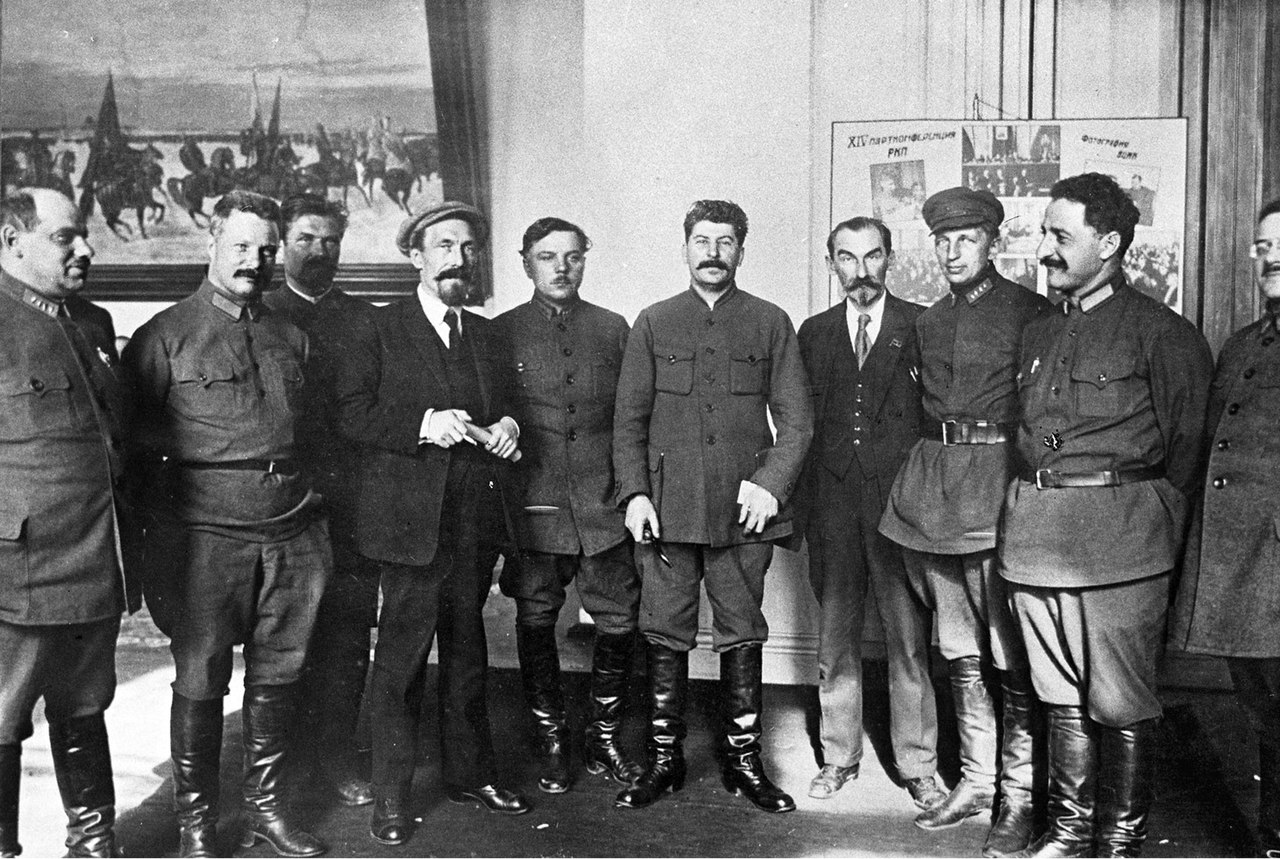
Stalin and Members of the Politburo 1925

I have just finished reading Italian writer Curzio Malaparte’s The Kremlin Ball (Material for a Novel), a book that attempts to cover the high society of the Soviet Union as if it were Marcel Proust’s fin de siècle Paris. It is a strange book, probably because Malaparte was never able to finish it after numerous visits to Russia up to 1957, when he died. It makes it a tricky read, as one is never sure exactly what period the author is talking about in a particular chapter. Still, I loved the following picture of all those figures whose lives depended on the whim of Joseph Stalin.

Of that era’s Soviet high society, corrupt, always thirsty for pleasure, greedy for money, glory, and power, proud and snobbish, capable of any infamy in order to maintain their ephemeral power, ready to betray the people, the Revolution, communism, Russia, to deny their own revolutionary past, in order not to have to renounce the honors and privileges of their position, of that Soviet nobility corrupted by Trotskyism and Bonapartism, almost no one was still alive. L’ancien régime of the Communist Revolution, the new nobility that had emerged from the communism of the war and NEP [the New Economic Plan], made up of men who believed themselves to be Marxists and were actually nothing but krasni burjui, red bourgeois, who believed that they were the guardians of Marxist and Leninist theory but were instead Bonapartists, who believed they were leaders of the proletariat but were really leaders of the Trotskyite counterrevolution, had by then given up their positions to the élites of the Stakhanovites and the Udarniks [shock workers], and to the Stalinist élites who were tough and lean but nevertheless more human and born of the Five Year Plans. Of all the merveilleuses of the communist ancien régime, of all those men corrupted by ambition, hatred, jealousy, comfort, pleasures, and privileges, all that remains is memory: the “snapshots” firing squads caught of them in their supreme, ultimate moment, their pale faces turned toward the rifle barrels, their hands clenched in fists, their eyes widened, their brows enraged, the great wind of death unobstructed in the cold, squalid, magnesium light of the camera flashes that lit up, from some invisible height, the scenes of execution in modern Europe.

NKVD Firing Squad

Serendipity: The Age of Kali

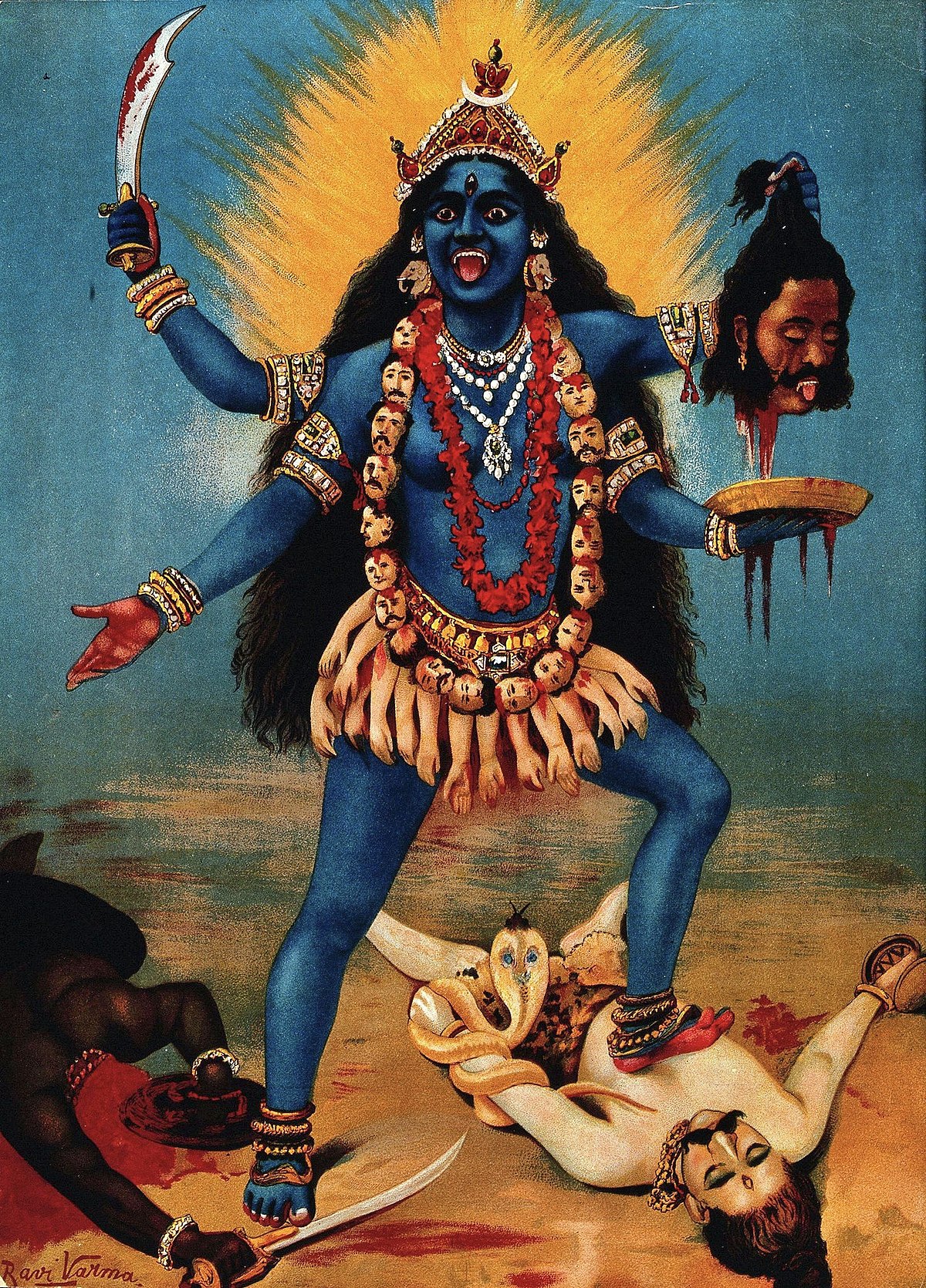
The Goddess Kali Is Not the Most Welcoming of Hindu Deities

I have just started reading William Dalrymple’s The Age of Kali: Indian Travels & Encounters. He uses the story of Kali as a parallel to what is happening in India as of 1998, when the book was published. I find the following paragraphs from the Introduction an interesting warning for Americans in the age of Trump and rampant Republicanism.

The book’s title [The Age of Kali] is a reference to the concept in ancient Hindu cosmology that time is divided into four great epochs. Each age (or yug) is named after one of four throws, from best to worst, in a traditional Indian game of dice; accordingly, each successive age represents a period of increasing moral and social deterioration. The ancient mythological Golden Age, named after the highest throw of the dice, is known as the Krita Yug, or Age of Perfection. As I was told again and again on my travels around the Subcontinent, India is now in the throes of the Kali Yug, the Age of Kali, the lowest possible throw, an epoch of strife, corruption, darkness and disintegration. In the Age of Kali the great gods Vishnu and Shiva are asleep and do not hear the prayers of their devotees. In such an age, normal conversations fall apart: anything is possible. As the seventh-century Vishnu Purana puts it:

The kings of the Kali Yug will be addicted to corruption and will seize the property of their subjects, but will, for the most part, be of limited power, rising and falling rapidly. Then property and wealth alone will confer rank; falsehood will be the only means of success in litigation. Corruption will be the universal means of subsistence. At the end, unable to support their avaricious kings, the people of the Kali Age will take refuge in the chasms between mountains, they will wear ragged garments, and they will have too many children. Thus in the Kali Age shall strife and decay constantly proceed, until the human race approaches annihilation.


Serendipity: A Plea from the Pagans

Winged Victory (Nike) bronze statue against background of Trajan’s Column and dome of Santa Maria di Loreto church. Rome, Italy.

I have always been fascinated by the period of transition from the Paganism of Ancient Rome to the Christianity of the last days of the Western Roman Empire. It was in AD 313 when Constantine declared Christianity to be the official religion of the empire with his Edict of Milan; and it was in AD 476 when the Western empire fell.

Naturally, the transition was not sudden. In AD 375, the Emperor Gratian had the Altar of Victory removed from the Roman Senate, this despite the fact that most of the members of the Senate were still Pagans. On that occasion, Quintus Aurelius Symmachus complained to the emperor: “Grant, I implore you, that we who are old men may leave to posterity that which we received as boys.” He goes on:

All things … are full of God, and no place is safe for perjurers, but the fear of transgression is greatly spurred by the consciousness of the very presence of deity. That altar contains in itself the harmony of the members of our order and the good faith of each of them individually. Nor does anything so much contribute to the authority of the Senate’s decrees, as the fact that one body, sworn to the same oath, has resolved them. Greco-Roman Paganism is to us a ridiculous body of myths, but to the Roman Senators, making sacrifices to the Altar of Victory was not only patriotic but an act of piety.

Symmachus continues:

Let me use my ancestral ceremonies, she says, for I do not repent me of them. Let me live after my own way; for I am free. This was the cult that drove Hannibal from the walls of Rome and the Gauls from the Capitolium. Am I kept for this, to be chastised in my old age?… I do but ask peace for the gods of our fathers, the native gods of Rome. It is right that what all adore should be deemed one. We all look up at the same stars. We have a common sky. A common firmament encompasses us. What matters it by what kind of learned theory each man looketh for the truth? There is no one way that will take us to so mighty a secret. All this is matter of discussion for men of leisure. We offer your majesties not a debate but a plea.

This plea did not sit well with the new Christian orthodoxy of the empire. St. Ambrose wrote the official response, which was essentially that Christianity was replacing the old order of things.

Interestingly, it is now Christianity that seems to be on the defensive … to be replaced by—whatever.


Plague Diary 27: An Irish View

Giorgio De Chirico Landscape with Train in Distance

It was in a survey of impressions of the global coronavirus outbreak tin the April 23, 2020 issue of the New York Review of Books hat I saw this remark by Northern Irish Poet Nick Laird:

The prophecies arrive: hundreds of thousands of dead, trillions of dollars spent, millions and millions losing their jobs, their health care, their homes. Soldiers on the streets. Each graph, each blank statistic. Each talking head. Stick a fork in the ass of civilization, it’s done. Don’t be silly, this is a blip. I don’t think so. In the stream of news the poems sit like stones, lambent under the surface. Auden’s “Gare du Midi,” where the man with his little case alights from the train, and steps out “briskly to infect a city/Whose terrible future may have just arrived.”

And here’s the poem to which Laird refers:

A nondescript express in from the South,
Crowds round the ticket barrier, a face
To welcome which the mayor has not contrived
Bugles or braid: something about the mouth
Distracts the stray look with alarm and pity.
Snow is falling, Clutching a little case,
He walks out briskly to infect a city
Whose terrible future may have just arrived.


Serendipity: That Professional Smile

Why I Could Never Become a Salesman

Watch TV and you will see them by the hundreds: Actors with that professional corporate smile. Everything is fine. There are no negatives. Well, that’s not me. Let me greet you with a suspicious scowl. I don’t know you and I have no reason to send a ray of sunshine up your ass. I was always good at what I did, but I was hopeless as a salesman. (That never bothered me as that was not my intention.) The following is a long footnote from David Foster Wallace’s long essay on taking a Caribbean cruise for the first time, entitled “A Supposedly Fun Thing I’ll Never Do Again.”

This is related to the phenomenon of the Professional Smile, a national pandemic in the service industry; and no place in my experience have I been on the receiving end of as many Professional Smiles as I am on the [cruise ship]: maitre d’s, Chief Stewards, Hotel Managers minions’ , Cruise Director—their P.S.’s all come on like switches at my approach. But also back on land at banks, restaurants, airline ticket counters, on and on. You know this smile—the strenuous contraction of of circumoral fascia w/ incomplete zygomatic involvement—the smile that doesn’t quite reach the smiler’s eyes and that signified nothing more than a calculated attempt to advance the smiler’s own interests by pretending to like the smilee. Why do employers and supervisors force professional service people to broadcast the Professional Smile? Am I the only consumer in whom high doses of such a smile produce despair? Am I the only person who’s sure that the growing number of cases in which totally average-looking people suddenly open up with automatic weapons in shopping malls and insurance offices and medical complexes and McDonaldses is somehow causally related to the fact that these venues are well-known dissemination-loci of the Professional Smile?


Serendipity: Waiting To Be Annihilated

American Writer Herman Melville (1819-1891)

On November 20, 1856, Nathaniel Hawthorne met with Herman Melville in England. In his English Notebooks, Hawthorne describes his friend as having “by way of baggage, the least little bit of a bundle, which, he told me, contained a night-shirt and a tooth-brush…. [H]e is a little heterodox in the matter of clean linen.” He goes on to describe their meeting:

He stayed with us from Tuesday till Thursday; and, on the intervening day, we took a pretty long walk together, and sat down in a hollow among the sand hills (sheltering ourselves from the high, cool wind) and smoked a cigar. Melville, as he always does, began to reason of Providence and futurity, and of everything that lies beyond human ken, and informed me that he had “pretty much made up his mind to be annihilated”; but still he does not seem to rest in that anticipation; and, I think, will never rest in that anticipation; and, I think, will never rest until he gets hold of a definite belief. It is strange how he persists—and has persisted ever since I knew him, and probably long before—in wandering to-and-fro over these deserts, as dismal and monotonous as the sand hills amid which we were sitting. He can neither believe, nor be comfortable in his unbelief; and he is too honest and courageous not to try to do one or the other. If he were a religious man, he would be one of the most truly religious and reverential; he has a very high and noble nature, and better worth immortality than most of us.