Serendipity: The Writer Gives an Interview

Jorge Luis Borges Giving an Interview for Spanish Television in 1967

I was just looking through V. S. Naipaul’s A Turn in the South (1989) when a passage on page 57 suddenly struck my eyes. Toward the end of his life, Jorge Luis Borges was blind. During this time, he gave many interviews which were published (I have at least a dozen of them on my shelves). My guess is that he saw the interviews as an easy replacement for having to write the stories, essays, and poems for which he was famous.

It was something I had worried about that these figures of Atlanta, because they had been so often interviewed, and though they might appear new to the out-of-towner, might in fact have been reduced to a certain number of postures and attitudes, might have become their interviews. Like certain writers—Borges, to give a famous example, who had given so many interviews to journalists and others who, in the manner of interviewers, had wanted absolutely the set interview, the one in the file, had wanted to leave out nothing that had occurred in every other interview, that he, Borges, had finally become nothing more than his interview, a few stories, a few opinions, a potted autobiography, a pocket personality. Which was the way, I had been told, the media created two or three slogans for a politician and reduced him to those easily spoken words.

Fortunately, Borges was wily enough to give a series of varied interviews which, though they had some common elements, especially in the area of “a potted autobiography,” are still capable of entrancing the reader.


Serendipity: Are Oranges Always Orange?

What the Best Oranges Look Like

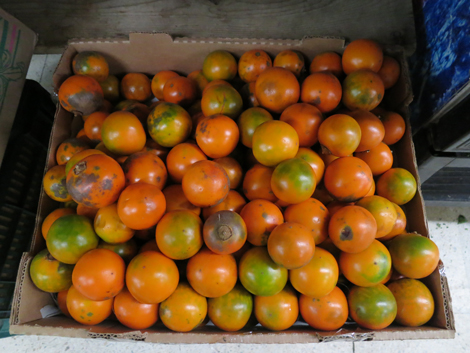
What we usually think oranges should look like are bright orange throughout. We are unlikely to accept oranges that are green with some orange on their rinds. But the best oranges I have eaten, whether in solid form or juiced, are much too ugly to sell in an American supermarket. In his book Beyond the Mexique Bay (1934), Aldous Huxley describes his own discovery along these lines when he visited Trinidad:

The oranges that grow in these tropical islands are particularly juicy and aromatic; but they never appear on any European or North American market. As with so many of us, their faces are their misfortune; they have a complexion which nature has made, not orange, but bright green, irregularly marbled with yellow. Nobody, therefore, outside their countries of origin, will buy them. For fruit, strangely enough, is sold on the strength of its appearance, not of its taste. Every grower knows that his product must appeal first to the eye and only secondarily to the palate. Immense pains have been taken to embellish the skin, but how little does anyone ever trouble to improve the flavour, of our dessert! …

But this is not the whole story. Man looks out on reality through an intervening and only partially transparent medium—his language. He sees real things overlaid by their verbal symbols. Thus, when he looks at oranges, it is as though he looked at them through a stained-glass window representing oranges. If the real oranges correspond with the beau idéal of oranges painted on the window, he feels that everything is all right. But if they don’t correspond, then he becomes suspicious; something must be wrong.


Serendipity: “A Pretty Girl with an Arid Heart”

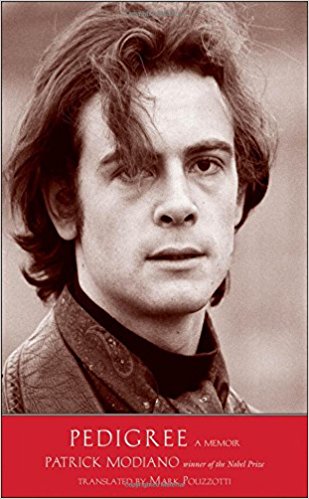
Patrick Modiano in 1968, the Year His First Novel Was Published

I have just finished reading the book whose cover is shown above. It is an autobiographical essay by a Nobel-Prize-winning (2014) author that covers the years from his earliest childhood to the publication of his first book in 1968. I believe I have mentioned elsewhere that Patrick Modiano is by far my favorite living French author. He is approximately the same age as I am, and I feel a unique kinship with him and his work. So far I have read six books by him, and I am just getting started.

His autobiographical essay Pedigree: A Memoir is painful to read. The author was raised—or I should rather say neglected by—two parents who did not particularly care to see him and shunted him off to various boarding schools, the farther apart from Paris the better. Below is a savage description of his mother, who was a small-time actress:

She was a pretty girl with an arid heart. Her fiancé [after her divorce from Patrick’s father] had given her a chow-chow, but she didn’t take care of it and left it with various people, as she would later do with me. The chow-chow killed itself by leaping from a window. The dog appears in two or three photos, and I have to admit he touches me deeply and that I feel a great kinship with him.


Serendipity: Where Did The Maya Go?

Our Picture of the Ancient Maya, But Is It the Only One?

I can still remember the historical pundits of the 1950s and 1960s, with their cockamamie claims that the Egyptians came to the New World and built the pyramids for the Maya, because, naturally, they were too primitive to learn how to pile one stone on top of another. I can hear their voice-overs in dozens of spurious documentaries (imagine Lowell Thomas’s voice): “What happened to these people? Where did they disappear to?”

One answer comes from Christopher Shaw, in his uneven but occasionally brilliant book Sacred Monkey River: A Canoe Trip with the Gods:

If a golden age existed, it included—along with art and writing, highly developed religious and political systems, artificers and scribes, ritual torture and human sacrifice—cayucos [canoes] floating in waterlily beds, canals thick with protein-rich fish, and the finite cosmos reflected in the waters. If it “fell,” as mny scenarios insist it did, the region became crowded and degraded at the denouement of the classical era. Drought came and apocalyptic wars ensued. In their aftermath, people forgot the old ways and connected them to the past. With the cities reeling, merchant nobles from the coast—putun—imposed themselves and took power. Some of them, in their bourgeois, sentimental fashion, tried to maintain the trappings of grandeur. But the thread had been cut. In the great pyramid temples of the centralized state, the gods fell silent, though not in the houses of the campesinos.

The putun—simultaneously “barbarian” intruders and “merchant warriors,” to [archeologists] Linda Schele and David Freidel—apparently tried to keep alive the connections to tradition, dynasty, and place that lay at the root of the classic peple’s success. But the collective consciousness had moved on. The people “turned their backs on the kings to pursue a less complicated way of living,” as Schele and Freidel put it. hey turned to the forest. In the words of the Popol Vuh, the retreated “under the vines under the trees.”

Tomorrow I will return to this subject with a slightly different point of view.

Serendipity: The Lacandon Apocalypse

The Late Chan K’in Viejo, Lacandonian Chief and Elder, in 1933

I have just begun reading Christopher Shaw’s excellent Sacred Monkey River: A Canoe Trip with the Gods, a book about the river waterways used by the ancient Mayans for trading. The Lacandonians are a very traditional Mayan group that live along the Usumacinta River that forms part of the border between Mexico and Guatemala. In 1992, I saw a Lacandonian selling bows and arrows in front of the Casa del Balam Hotel in Merida, Yucatán. The following passage in Shaw’s book caught my eye:

Kayum, one of Chan K’in’s sons, a painter of naïve but arresting jungle scenes with one-man shows from Barcelona to Seattle to his credit, looked up from his ax work and gently scolded Victor [Perera, author of The Last Lords of Palenque] that he must let go of the world. It is creaking and groaning like an old man, he said. Everything prefigured the imminence of xu’tan, he said, the Lacandon apocalypse. The proper attitude of a hach winik [Lacandonian, “real person”] was to welcome it and the new era of creation it anticipated. He spoke with the deep calm and conviction of a believer. Victor never forgot it, though he never accepted it either, Kayum’s willingness to watch and welcome while a thousand generations of accumulated beauty and uncatalogued nonhuman life got traded for the shortest of gains, or in many cases no gains at all.

The Usumacinta River Near Piedras Negras


Serendipity: The Name of God

Lithograph by Frederick Catherwood of the Mayan Ruins at Copán, Honduras

It is with the greatest pleasure that I am re-reading a book I first read in June 1975 in preparation for the first of my travels, to the Yucatán Peninsula in Mexico. The book was Incidents of Travel in Central America, Chiapas and Yucatán by John Lloyd Stephens. The book was published in 1841 in two volumes with illustrations by Frederick Catherwood, who accompanied Stephens on his journeys. At one point, Stephens and Catherwood visit a school in Zacapa in Guatemala, where they set about making a usable dictionary of Mayan Indian words. As Stephens recounts:

We were rather at a loss what to do with ourselves, but in the afternoon our host called in an Indian for the purpose of enabling us to make a vocabulary of Indian words. The first question I asked him was the name of God, to which he answered, Santissima Trinidad. Through our host I explained to him that I did not wish the Spanish, but the Indian name, and he answered as before, Santissima Trinidad or Dios. I shaped my question in a variety of ways, but could get no other answer. He was a tribe called Chinaute, and the inference was, either that they had never known any Great Spirit who governed and directed the universe, or that they had undergone such an entire change in matters of religion, that they had lost their own appellation for the Deity.

The two volumes are still in print from Dover Publications.


Serendipity: Basil II and Trump

Byzantine Emperor Basil II, the Bulgar-Slayer

Today, I was reading Michael Psellus’ Fourteen Byzantine Rulers (aka The Chronographia), written at some point in the 11th Century A.D. We know that the current occupant of the White House has made a practice of erasing every one of his predecessor Barack Obama’s accomplishments. Apparently, this was not the first time this happened. Michael Psellus tells us how the Emperor Basil II decided to erase the work of his long-time advisor, the eunuch Basil Parakoimomenus.

He gave the subject much thought, and it was only after long vacillation that he finally made up his mind. Once the decision was taken, however, he dismissed the parakoimomenus and deposed him at one blow. What made it worse was the fact that this change in the latter’s fortunes was not softened by any sign of respect. In fact, the emperor’s action was incredibly cruel, for he shipped him off into exile.

Nor did this disgrace prove to be the end of Basil’s troubles. Rather was it the prelude to further misfortunes, for the emperor next proceeded to review the events of the reign since he acceded to the throne and the parakoimomenus began to govern the empire. He examined the various measures that had been taken during all that period. Whatever happened to contribute to his own (the emperor’s) welfare, or to the good of the state, was allowed to remain on the statutes. [Trump was not that discriminating.] All those decrees, on the other hand, which referred to the granting of favours or positions of dignity, were now rescinded. The former, the emperor contended, had been approved by himself; of the latter, he knew nothing. In everything he strove to bring about the eunuch’s downfall and disaster. For example, the parakoimomenus had built a magnificent monastery in honour of Basil the Great, a monastery that bore his own name too. It had been constructed on a massive scale, at great cost of labour, and it combined different styles of architecture with beauty. Moreover, the greater part of the material used in its building had been obtained from generous and voluntary contributions. The emperor now wished to raze this edifice to the ground.


Serendipity: Garbage Collection in the Afterlife

Well, What Is It Like Being a Spirit in the Afterlife?

There is a delightful story in Alfred Döblin’s Bright Magic: Stories (New York: New York Review Books, 2016) entitled “Traffic with the Beyond.” The story is about an attempt to solve a murder using a séance. The spirits, however, take a more active role than is expected of them:

With that, the session ended. Incidentally, van Steen’s rage at the beyond is more comprehensible when we realize the job that this man, who so loved life and had lived in such high style here, had on the other side: Garbage collection! That was the usual assignment for a certain kind of new arrival, whose heart still clung to earthly things and who led a wild life on the other (that is, this) side. Conceited bachelors were given that job as well, and famous luminaries such as scientists, painters, tenors, and generals. For there was garbage in the beyond, stemming from the titanic mass of rotten, shriveled, worthless ideas and preferences that everyone brought with them, gradually threw off, and as it were sweated out of their system—things that no longer had or could have any place in the strict, noble, and spiritual other side. This sad latrine duty was assigned to the merry van Steen. He, and others, had to sweep up this daily rubbish and cart it off to be burned. In his affliction he, like many others, simply scattered the stuff back down onto the earth.


Serendipity: How Rat’s Family Got Rich

How to Make the Best of a Bad Lot

This weekend, I read Haruki Murakami’s first novel, Hear the Wind Sing. While it was not quite the level of his more recent work, it had some choice moments. The unnamed narrator has a friend called Rat, who comes from a wealthy family. It was amusing to find out how his family made its fortune:

Rumor had it that Rat’s father had been penniless before the war. On the eve of hostilities, though, he had managed, after much difficulty, to lay his hands on a small chemical factory, where he began producing insect repellent cream. There was considerable doubt as to its effectiveness, but, fortunately for him, the war spread to the South Pacific at that juncture, and the stuff flew off the shelves.

When the war ended, the Rat’s father moved his stock of ointment into warehouses and began marketing a sketchy health tonic; then, toward the end of the Korean War, in an abrupt move, he shifted to household cleaners. Rumor has it that the ingredients were identical in all cases. Not inconceivable.

In other words, the same ointment slathered on the heaped bodies of Japanese soldiers in the jungles of JNew Guinea twenty-five years ago can today be found, with the same trademark, gracing the toilets of the nation as a drain cleaner.

Thus did the Rat’s father join the ranks of the wealthy.


Serendipity: The Existence of Ghosts

My Belief Is: They Exist

The Original Farmer’s Market at 3rd and Fairfax is like a sort of souk for tourists and those L.A. natives who like to sit and reflect while drinking a cup of tea or eating a good lunch. I sat there this morning reading Chris Abani’s The Virgin of Flames, when I ran across this passage:

“Well, yes. Everyone is attended by ghosts,” Iggy said. What matters is whether we begin to attend to them.”

“How do you mean?”

“With some people, the ghosts are transparencies, barely visible as they hover around, sit at the table next to them and so on. They are particularly hard to see in bright sunlight. Sometimes, when memories are revisited, there is a flickering of light and shadow, image and text across them, and for a moment they flare up and then vanish.”

“So are you saying that ghosts are our memories?”

“Ghosts are the things, the shapes we make with our memories,” she said.

“Ah. So if some are light like…”

“Like well-worn lace drapes blowing in the wind.”

Black smiled.

“Yeah, like that. Then what are the other ghosts like? The ones we attend?”

“Like thick black lines drawn in a notebook. They are visible, brooding dark clouds that we drag around with us like reluctant sulky children. We feed them and they grow big and their haunting dominates our lives. We love them and we hate them and we are always measuring them for a coffin, yet we cannot let them die.”

“Why?”

”Madness, my friend. Madness.”