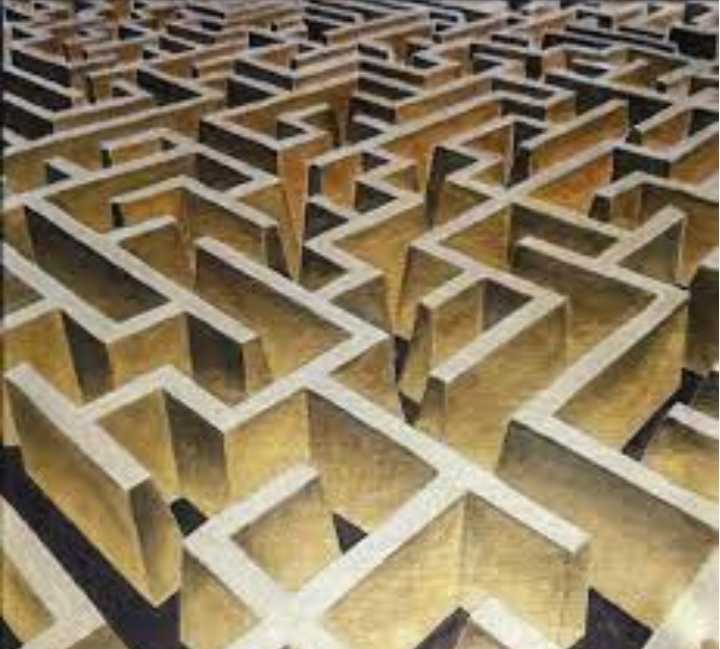
I keep returning to the poems of Jorge Luis Borges in the labyrinthine journey of my life. For over half a century, his writings have shone a strong light on my path forward. Several years after Borges died, John Updike translated his poem “The Labyrinth” and had it published in The New Yorker.
The Labyrinth
Zeus, Zeus himself could not undo these nets
Of stone encircling me. My mind forgets
The persons I have been along the way,
The hated way of monotonous walls,
Which is my fate. The galleries seem straight
But curve furtively, forming secret circles
At the terminus of years. And the parapets
Have been worn smooth by the passage of days.
Here, in the tepid alabaster dust,
Are tracks that frighten me. The hollow air
Of evening sometimes brings a bellowing,
Or the echo, desolate, of bellowing.
I know that hidden in the shadows there
Lurks another, whose task is to exhaust
The loneliness that braids and weaves this hell,
To crave my blood, and fatten on my death.
We seek each other. Oh, if only this
Were the last day of our antithesis!
It was inevitable that I would re-read The Lord of the Rings for the third—or is it the fourth?—time. Too much of my memory of the volumes in the trilogy have been replaced by my memory of the masterful Sir Peter Jackson films. And a good thing, too! I was beginning to forget the Old Forest, Tom Bombadil, and the Barrow Wights, which were not represented in the film version of The Fellowship of the Ring (Volume I of The Lord of the Rings).
I first heard about J. R. R. Tolkien’s fantasy masterpiece from an exhibit at Dartmouth College’s Baker Library. A number of professors were asked to exhibit the books which most influenced them, and there, under glass, were first editions of the three volumes. I was enthralled before I ever read a word of it.
Only when I came to Los Angeles in the late 1960s did I find the trilogy being published in paperback. Naturally, I bought all three volumes and read them. I even read a very funny Harvard Lampoon parody called Bored of the Rings. (Do I still have it in my massive library?)
Now I am reading it in the glorious Folio Society hardbound edition, complete with glorious woodcuts and an Anglo-Saxon motif cover. Amazingly, I find myself being drawn into the story yet again, as if I were encountering it for the first time.
What a master story-teller Tolkien was! I must remember to also read The Silmarillion when I have finished re-reading the trilogy.
Prayer garden at Saint Katherine’s Greek Orthodox Church
It was Greek Festival time in Redondo Beach this weekend at Saint Katherine’s Greek Orthodox Church. Martine and I love attending Greek festivals, even though we realize that they are becoming less and less ethnic each year, as the families of Greek-Americans drift farther and farther away from the authenticity of the older generation.
We enjoyed ourselves nonetheless. Martine particularly loves spanakopita (Greek spinach pie with feta cheese), while I had pastitsio (a lasagna-like dish of baked pasta with béchamel sauce) and fasolakia (Greek green beans). The food was good, but not up to the level of previous years.
Missing were Akrevoe Emmanouilides and Pitsa Captain, whose cooking classes at the festival were a tasty highlight. Alas, Akrevoe is no more; and there are no more cooking classes at the festival..
One thing which did not change were the tours of the church, with a discussion with the priest about some particulars of the Greek Orthodox faith, toward which I have long had some leanings. I was raised in the Roman Catholic faith, but have drifted away due to some disagreements with dogma.
Although the Greek Festivals are becoming less authentically Greek, there were hundreds of people in attendance. The heavy crowds made it difficult to move about the grounds, and led to Martine and I leaving soon after we ate lunch and visited the church.
Originally, the sign was spelled “Hollywoodland,” named after a housing development that was being advertised around 1923. The developers lauded it as a “superb environment without excessive cost on the Hollywood side of the hills.” In 1932, a wannabe actress named Peg Entwistle committed suicide by jumping off the top of the “H.” This was commemorated in a 1972 song by Dory Previn which she called “Mary C. Brown and the Hollywood Sign.” Here is a video of it:
Eventually the sign started looking ratty and falling apart. By the 1940s, it was an eyesore. It was around then that the “land” in “Hollywoodland” was removed and the city took responsibility for it.
There was a major campaign in 1978 to bring the sign up to date, as it had become part of the myth of Hollywood. The campaign was led by none other than Hugh Hefner of Playboy fame. Other donors included Gene Autry, Alice Cooper, Andy Williams, and Warner Brothers Records.
It’s interesting that the sign, which has come to be a major tourist draw, was originally an advertisement. Curiously, you can’t walk up to the sign: There is no convenient trail up Mount Lee, and local residents have done their best to make it difficult to see the sign from up close.
It was bound to happen eventually. We had an unusually cold winter, but now the pendulum has swung to the other extreme. It wasn’t so bad near the ocean, where we live; but Martine spent most of the day downtown, where the temperature was several degrees of Fahrenheit warmer. It was no surprise to me that she took the earlier bus back.
The title of this post is the diametric opposite of the first line of an Ezra Pound satirical poem on the subject of winter, written, of course, in Middle English:
Winter is icumen in,
Lhude sing Goddamm,
Raineth drop and staineth slop,
And how the wind doth ramm!
Sing: Goddamm.
Skiddeth bus and sloppeth us,
An ague hath my ham.
Freezeth river, turneth liver,
Damm you; Sing: Goddamm.

Goddamm, Goddamm, ’tis why I am, Goddamm,
So ’gainst the winter’s balm.
Sing goddamm, damm, sing goddamm,
Sing goddamm, sing goddamm, DAMM.
Typically during this time of year, I turn into a lizard-like reader of books set in warm climates, like India, South and Central America, or the Deep South. I started by re-reading William Faulkner’s Sanctuary (1932) and have started in on Edouard Glissant’s Faulkner, Mississippi (1999).
I will probably try to get up earlier so I can take my walks in the cooler mornings. Once noon has passed, it is no fun to exercise.
William Faulkner (1897-1962) and Ernest Hemingway (1899-1961)
Both of them won the Nobel Prize for Literature, Faulkner in 1949 and Hemingway in 1954. I have been carrying on a running conversation with a friend of mine who is a devotee of Hemingway, mostly on the basis of two short stories, “The Big Two-Hearted River” and “The Snows of Kilimanjaro.” I, on the other hand, hold with Faulkner. I have read many of his short stories and all of his novels. Oh, and I also read most of Hemingway’s novels.
The problem with Hemingway is that he was essentially shallow, a wannabe alpha male who didn’t quite make it. In the end, he blew his brains out for reasons that are discussed in this website. In his last years, Hemingway’s writing was not up to his early standard.
William Faulkner, on the other hand, not only continued to write interesting novels (with a couple of duds, especially The Fable), but he had a distinguished career as a scriptwriter in Hollywood, participating in several film masterpieces directed by Howard Hawks, especially The Big Sleep and (ironically) the film version of Hemingway’s To Have and Have Not.
Currently, I am re-reading Faulkner’s Sanctuary (1932), ostensibly a pot-boiler written to make money, but also a devastating picture of rural and small-town evil that includes a rape, murder, perjury, and a lynching of an innocent man.
In the time that remains to me, I hope to re-read more of Faulkner’s novels and tackle all his short stories. Ever since I was in high school, Faulkner has left a decided imprint on my writing. And Hemingway? Alas, he has not worn well over the years.
The following poem by Adam Zagajewski hits the nail right on the head when describes the very uncinematic and unphotographic life of a poet.
Poets Photographed
Poets photographed,
but never when
they truly see,
poets photographed
against a backdrop of books,
but never in darkness,
never in silence,
at night, in uncertainty,
when they hesitate,
when joy, like phosphorus,
clings to matches.
Poets smiling,
well informed, serene,
Poets photographed
when they’re not poets.
If only we knew
what music is.
If only we understood.
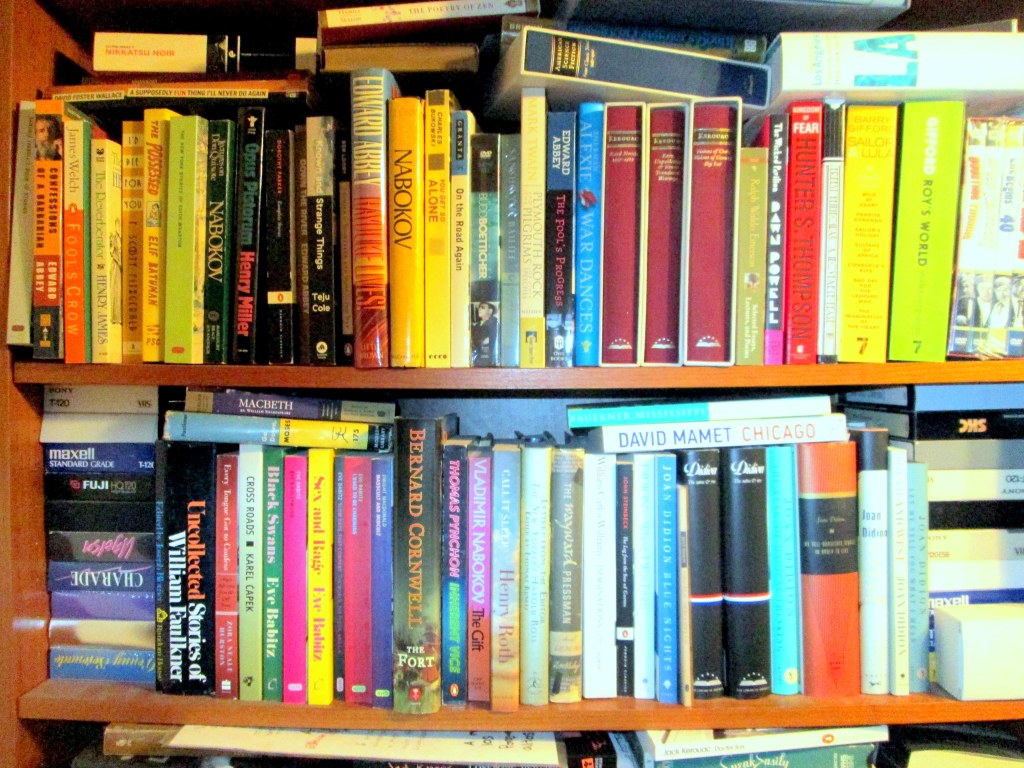
Here I am, in my late 70s and surrounded on all sides by a huge book collection. If my apartment were hit by burglars, my fear is that I would be sued for them because they would get a hernia carrying away my books. In fact, I am in the position of trying to find a home for the books I do not plan to re-read or consult.
What I had been doing is donating books to either a local thrift shop or library, but as the IRS standard deduction keeps increasing, I no longer have to keep records of my donations. All I really want to do is find a home for my discards.
What I have been doing lately is using are the display boxes of the Little Free Library (“Take a Book; Share a Book”), of which there a a number of “free libraries” in my neighborhood. So when I take a walk or go shopping, I usually have three or four books in my bag to donate. How do I make a donation? I simply take the books from my bag and put them on the shelves of the Little Free Library.
How did I ever get in this predicament? Well, to tell the truth, to the extent that I am a fairly happy well-adjusted person, I owe it all to my upbringing (I was lucky with my parents) and to the fact that books were a major form of escape for me—from the age of eight onward.
I remember the time that my little neighbor Patsy Strohmeier got me a hardback of Mark Twain’s The Adventures of Tom Sawyer. While I was reading the book, my cousin Emil came to visit and was angered to see me with my face in a book. He picked up the novel and slammed it hard on the floor, saying “THIS is what I think of your books!” By that time, I was already so hooked that my first reaction was that he was, in effect, saying “THIS is what I think of YOU!” I wasn’t offended because I knew that Emil was a good-hearted person who just didn’t like to read.
Simply put, I became a bookworm because I was a sickly child. In fact, between the ages of 10 and 21, I was walking around with a brain tumor in my pituitary gland that stunted my growth and, in pressing on my optic nerve, caused severe frontal headaches on most days. Even with a headache, I could still read—though I was useless when it came to baseball, football, basketball, and most childhood sporting activities.
Somehow, in the course of time after I had brain surgery in 1966, I became a fairly healthy person. Oh, to be sure, I am a diabetic, have asthma and chronic rhinitis, but I seem to survived surprisingly well. (Bad rice! Bad rice!)
I have been reading a fascinating book of stories by Gavin Lambert about Hollywood as it was in the 1960s. The book is called The Slide Area, after the crumbling cliffs overlooking the ocean from Santa Monica north to Pacific Palisades. It is some of the best writing about Los Angeles as it was then. Lambert, by the way, was also the author of Inside Daisy Clover, which was made into a Robert Mulligan film starring Natalie Wood. Oh, and Lambert also wrote a biography of Natalie.
Following is an excerpt from near the beginning of The Slide Area:
It is only a few miles’ drive to the ocean, but before reaching it I shall be nowhere. Hard to describe the impression of unreality, because it is intangible; almost supernatural; something in the air. (The air … Last night on the weather telecast the commentator, mentioning electric storms near Palm Springs and heavy smog in Los Angeles, described the behaviour of the air as ‘neurotic’. Of course. Like everything else the air must be imported and displaced, like the water driven along huge aqueducts from distant reservoirs, like the palm trees tilting above mortuary signs and laundromats along Sunset Boulevard.) Nothing belongs. Nothing belongs except the desert soil and the gruff eroded-looking mountains to the north. Because the earth is desert, its surface always has that terrible dusty brilliance. Sometimes it looks like the Riviera with a film of neglect over villas and gardens, a veil of fine invisible sand drawn across tropical colours. It is hard to be reminded of any single thing for long. The houses are real because they exist and people use them for eating and sleeping and making love, but they have no style of their own and look as if they had been imported from half a dozen different countries. They are imitation ‘French Provincial’ or ‘new’ Regency or Tudor or Spanish hacienda or Cape Cod, and except for a few crazy mansions seem to have sprung up overnight….
Los Angeles is not a city, but a series of suburban approaches to a city that never materializes.
Tacos come in two basic varieties. There are the hard shell tacos which disintegrate the moment you put your hands on them; and there are the soft shell tacos, usually made with corn tortillas, which you can pinch without having a mess in your lap. I suppose there are soft shell flour tortillas in places like Northwest Mexico, but they are infrequently found across el border.
Today I drove Martine to Lakewood for an appointment with her ophthalmologist. On the way, I noticed there was a King Tacos on Lakewood Boulevard just south of Alondra, and a light suddenly went on in my memory. About twenty or thirty years ago, I attended an L.A. Galaxy professional soccer game at the Rose Bowl. While there, I bought several tacos from the concessionaire, who was King Tacos. I remember really liking them, but I had not been to any of the low rent parts of town where branches of King Tacos tend to congregate … until today.
I had three tacos el pastor with a Diet Pepsi, which I enjoyed mightily. There is something about Mexican antojitos (“little whimsies”) which help make Mexican cuisine one of the great world cuisines—and that’s before even figuring in some regional variants as Oaxácan and Yucatec cuisines.
I shall make it a point to return to King Tacos again. Still great after so many years!









You must be logged in to post a comment.