
Plague Diary 31: At the Library Portals

The Los Angeles Central Library on West 5th Street

The Los Angeles Central Library is an impressive structure. In 1926 the original structure was designed by Bertram Grosvenor Goodhue in a combination ancient Egyptian and Mediterranean Revival style. In 1986, there was an arson fire that destroyed some 400,000 volumes, or 20% of the library’s holdings—as well as causing damage to the structure. Fortunately, the library was rebuilt and restored to much of its original splendor. It was only three years ago that I started going to the library, only after the Expo rail line from Santa Monica to downtown LA was constructed.

Thanks to the coronavirus, however, I cannot go inside the library. But I can put books on hold and make an appointment to pick them up at the 5th Street entrance. This I did, showing up at 11:15 am and calling inside with my cell phone to give my name and library account number, whereupon a librarian came out with the books I ordered in a blue bag, accompanied by a complimentary LA Public Library deck of cards.

Unfortunately, one of the books I had put on hold, Dora Bruder by Patrick Modiano, was in the original French. I put a hold on the French edition by mistake. The book’s name is the same in English and French, so it was an easy mistake to make.

The big problem with going downtown during the plague is twofold:

  • Finding a place to eat
  • Finding a rest room

Thanks to one of the library cops (yes, they have their own police force), I found out that I could go across the street to the City National Plaza (formerly the Atlantic Richfield Plaza), eat at one of the few restaurants still open on the ground floor (Lemonade is pretty good), and get a free token to use the public restroom.


“Resurrection”

Lake Balatón with Tihany Abbey, Burial Place of Magyar Kings

In 1977, I went to Hungary and Czechoslovakia (before it was split into two countries) with my mother and father. We spent a couple of days in a hostel on the shores of Lake Balatón, one of the largest in Europe. I remember it as a large but shallow lake in which one could walk out a half mile before getting in over your head. The average depth of the lake is only about 3 meters. The cafés around the lake served a kind of carp called, in Hungarian, ponty (that’s only a single syllable, which can be pronounced only by Hungarians).

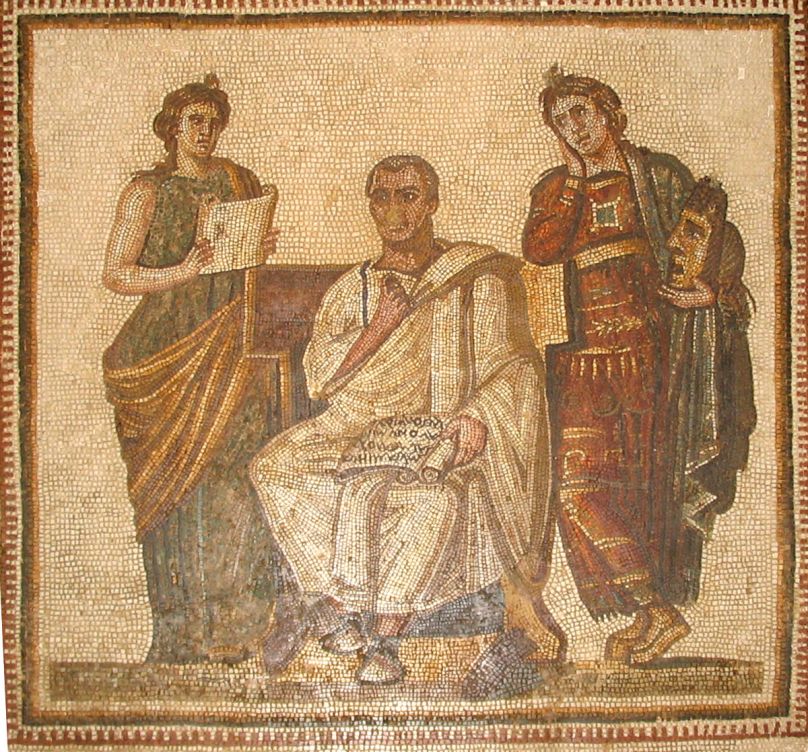
I was delighted to find this poem by the Chilean novelist and poet Roberto Bolaño, which mentions the lake:

Resurrection

Poetry slips into dreams
like a diver in a lake.
Poetry, braver than anyone,
slips in and sinks
like lead
through a lake infinite as Loch Ness
or tragic and turbid as Lake Balatón.
Consider it from below:
a diver
innocent
covered in feathers
of will.
Poetry slips into dreams
like a diver who’s dead
in the eyes of God.

Those last few lines pack a punch, which I am still trying to figure out. Maybe the original Spanish will help:

un buzo
inocente
envuelto en las plumas
de la voluntad.
La poesía entra en el sueño
como un buzo muerto
en el ojo de Dios.

Or maybe it won’t help. But that’s what poetry is all about. Coming back to it again and again until everything seems to click into place.

Surviving Hell

The Best Way to Beat the Heat: Iced Tea

Every morning, I make a full pot of tea in my little 1.5 liter metal Japanese teapot. Because it has a perforated insert into which I can spoon whole tea leaves without worrying about having to eat them as I drink the tea, I can dispense with tea bags altogether. I buy mostly Indian loose black teas (Darjeeling, Ceylon, Assam) by the pound. The general rule of thumb is that one pound (0.45 kilograms) brews some 240 cups of tea. Compare that with the Specialty Coffee Association’s estimate of 48 cups of coffee from one pound of beans.

In a heat wave such as we are now experiencing in Southern California—especially during the coronavirus quarantine—I become positively lizard-like. What keeps me from going reptile all the way is the iced tea I drink. As of 10 pm, there are only a few thimblefuls of tea left in my pot. While I was sitting in my library reading Marie NDiaye’s La Cheffe, I was cooled not only by the iced tea, but by the condensation from the glass sending icy droplets onto the hairs of my bare stomach (as I am not wearing a shirt while inside).

My Indian tea of choice lately has been the Ahmad of London brand, which is popular in the Indian and Iranian food stores in my part of town. At present, I am drinking their Darjeeling tea, which I find to be the best. It also happens to be the most expensive (600 grams for US$36).

I am particularly conscious of the heat because the apartment building in which I live was built in 1945, when insulation was not commonly used. That was before global warming. Now I feel as if I am living in one of those punishment hotboxes from Bridge on the River Kwai or Cool Hand Luke.

If you want to make your iced tea taste particularly good, add a splash of good dark rum, such as Myers’s Original Dark Rum from Jamaica. I also add the juice of a fresh lemon and some Splenda (as I am diabetic).


Escaping the Heat

Deep Shade, Ocean Breezes, and Boats

Burton W. Chace Park in Marina Del Rey is no longer a secret. Many people have discovered that, even when the rest of Los Angeles is searingly hot, there is always a cool breeze blowing on the peninsula that sticks out into the Marina. So I took the #16 Santa Monica bus (to avoid the stiff parking fees) to Lincoln and Mindanao Way and walked the half mile from the bus stop to the park. On the way is a handy Trader Joe store where I buy a healthy picnic lunch to take with me.

While there, I read Kaouther Adimi’s delightful book about an Algerian Bookshop that also served as Albert Camus’s first publisher. In the sun, the temperature easily reached the 90s, but in the shade I was comfortable. Martine stayed home resting.

One of the Massive Shade Trees at the Park

The park is so excellent that I am surprised that Donald Trump has not tried to bulldoze it and turn it into a tasteless high rise hotel with gold plumbing fixtures.

Curiously, the predominant language of the park visitors is Russian. They seem to know how to enjoy themselves. Good!

At home, I prepared another vegetarian curry for myself made with potatoes, tomatoes, and peas with rice—and a combination of Serrano and Hatch chiles that challenged this chile-head. All the while, Martine, who is suffering from Irritable Bowel Syndrome looked on ruefully while I ate something that would have exploded her intestines. All she could eat was a banana and a can of Progresso Chicken and Wild Rice soup. She has been suffering with this condition for two weeks now. Tomorrow, I’ll drive her to see the doctor.


The Great American Novel

It Has Already Been Written—In 1851

All the time I was growing up, I kept hearing of writers wishing to write the Great American Novel—as if it were hovering in our future. It actually became something of an obsession with many. Sorry to disappoint, but I think the Great American Novel was written in 1851 by Herman Melville. It is called Moby-Dick, or The Whale. To date, I have read it three times, and each time was a revelation to me.

Unlike Tolstoy, Dostoyevsky, Balzac, Proust, and Jane Austen, Melville was a highly inconsistent author. If you read Mardi: and a Voyage Thither (1849) or The Confidence-Man, His Masquerade (1857), you are dealing with a folk philosopher who is interested only in somewhat uninteresting bon mots. He did write some great short fiction, such as “Bartleby, the Scrivener” (1853); “The Encantadas, or Enchanted Isles” (1854); “Benito Cereno” (1855); and finally “Billy Budd, Sailor (An Inside Narrative)” (1892). Of the other works I have read, they run the gamut from interesting to “Why Was This Written?”

His Novel Is Still as Relevant as Tomorrow’s News

On the occasion of the 200th anniversary of his birth in 1819, Philip Hoare wrote a fascinating article for The Guardian entitled “Subversive, Queer and Terrifyingly Relevant: Six Reasons Why Moby-Dick Is the Novel for Our Times.” You can find it here.

There have been many other American novelists whose work is near great. I am thinking of Nathaniel Hawthorne, Edgar Allan Poe (though he wrote only one unfinished magnificent novel in The Narrative of A. Gordon Pym), Henry James, and William Faulkner.

I am not trying to discourage my fellow countrymen from trying their own hand at the Great American Novel, but I think that before long the medium of the novel will no longer be as important as it once was. And then, a major consideration, who will still be around to read it?


Heat Wave

A Heat Wave with No Place to Go

I thought that somehow, in this first year of the coronavirus outbreak, that somehow me might be spared extremes of heat. Well, it was not to be. As I sit here at my computer, I feel stuck to my chair with the sticky heat. In addition, Martine is suffering from an attack of Irritable Bowel Syndrome, making it impossible to eat almost anything without suffering in consequence.

Usually we get this type of Mexican Monsoon heat in July, but I guess we can’t rely on data from past years. The earth is sufering. The United States is suffering. I am suffering.


Strange Days

There Is a Late Roman Empire Feeling in the Air

VIGGO: What happened, John? We were professionals.
JOHN WICK: Do I look civilized to you?

John Wick Chapter 1

I get a very bad feeling about what is happening to our country right now. We have a president who is actively dismantling our country, even to the extent of deliberately destroying the mail system that was set up by our first Postmaster-General, Benjamin Franklin, just because he thinks it would stop mail-in balloting. (It would also destroy billions, possibly trillions of dollars worth of commerce.)

It is as if we are living in the days of the late Roman Empire as depicted by such historians as Ammianus Marcellinus and Gregory of Tours. Our “Emperor” is little better than Elagabalus AD 204-222). According to the Ancient History Encyclopedia:

It did not take long for his family, as well as others throughout the empire, to realize that Elagabalus was completely unsuited for the imperial title, spending more time dancing around the altar of the temple and purchasing gold chamber pots and exotic foods than attending to the matters of the empire. Uprisings within the army occurred throughout the provinces, and there was even a failed attempt to replace him on the throne.

The whole world is weakened by the coronavirus outbreak, else our weak leadership would invite attempts by other countries or stateless terrorist groups to wreak havoc. The only reason a coup d’état has not been attempted is that the Democrats are afraid of the gun-toting rednecks. No worries there, those cowardly mofos are actually more likely to shoot their dicks off than organize any real resistance. In any case, if Trump loses the election—if there is an election—we just have to be prepared to escort him and his family someplace where they can’t do any harm. Perhaps Somalia.


Mount Trumpmore

Oh Great, That’s All We Needed!

If our current president were to get his face of Mount Rushmore, as he has urged, it would be tantamount to painting over the Sistine Chapel with a convocation of demons.

It is the opinion of most right-thinking Americans that Trump deserves no more than a footnote in the history books, similar to the contribution of Aaron Burr (who actually made it to the vice presidency in Thomas Jefferson’s first term) and Benedict Arnold and perhaps the fictional Man Without a Country. Will there be a Trump presidential library? (If there were, it would consist mostly of Tweets and executive statements of dubious legality.) When George W. Bush was in office, I mused that his Prezidenchul Lie-Berry wouldn’t amount to much. Trump’s would be even more laughable.

Think about it: What would be the legacy of Trump? Once you get past the corruption, the braggadocio, the conspiracy theories, and the outright lies, there wouldn’t be much else left. So sad.

When the Emperor Nero was forced to commit suicide by his enemies, he is said by Suetonius to have exclaimed “Oh what an artist dies in me!” I cannot help but think that sounds like our man in Washington, or is it Mar-a-Lago?


Serendipity: The Age of Kali

The Goddess Kali Is Not the Most Welcoming of Hindu Deities

I have just started reading William Dalrymple’s The Age of Kali: Indian Travels & Encounters. He uses the story of Kali as a parallel to what is happening in India as of 1998, when the book was published. I find the following paragraphs from the Introduction an interesting warning for Americans in the age of Trump and rampant Republicanism.

The book’s title [The Age of Kali] is a reference to the concept in ancient Hindu cosmology that time is divided into four great epochs. Each age (or yug) is named after one of four throws, from best to worst, in a traditional Indian game of dice; accordingly, each successive age represents a period of increasing moral and social deterioration. The ancient mythological Golden Age, named after the highest throw of the dice, is known as the Krita Yug, or Age of Perfection. As I was told again and again on my travels around the Subcontinent, India is now in the throes of the Kali Yug, the Age of Kali, the lowest possible throw, an epoch of strife, corruption, darkness and disintegration. In the Age of Kali the great gods Vishnu and Shiva are asleep and do not hear the prayers of their devotees. In such an age, normal conversations fall apart: anything is possible. As the seventh-century Vishnu Purana puts it:

The kings of the Kali Yug will be addicted to corruption and will seize the property of their subjects, but will, for the most part, be of limited power, rising and falling rapidly. Then property and wealth alone will confer rank; falsehood will be the only means of success in litigation. Corruption will be the universal means of subsistence. At the end, unable to support their avaricious kings, the people of the Kali Age will take refuge in the chasms between mountains, they will wear ragged garments, and they will have too many children. Thus in the Kali Age shall strife and decay constantly proceed, until the human race approaches annihilation.


America Subterranean

This Is a Book That Got Me Thinking

I have just finished reading a book recommended to me by my friend Suzanne: Tara Westover’s Educated. Ever since 2016, I have been pondering what it is about the United States of America that gives rise to all these anti-governmental splinter groups that are directly or indirectly associated with Trump’s base.

Tara is an attractive young woman who was raised in a small town in Franklin County, Idaho, of a Mormon survivalist parents. Her father ran a junkyard; and her mother, starting out as a midwife, became a producer of essential oils called Butterfly Express. What the author describes is almost an archetypal experience of a religiously conservative familial craziness:

  • The father is a staunch survivalist who collects guns, including one that could shoot down helicopters such as those involved in Ruby Ridge.
  • Insists that all the children be home-schooled and work in the family junkyard and essential oil business.
  • Doctors and hospitals were to be avoided. Instead, Mrs Westover effected all cures using natural remedies.
  • There was an emphasis on the Old Testament (and, in Tara’s case, The Book of Mormon).
  • Women were expected to dress modestly lest they be considered sluts.
  • There was no involvement with government. Tara did not get her birth certificate until she was nine. (She was born at home.)
  • The males in the family tend to be bullies that enforce compliance with their fringe beliefs.

Tara Was Not Only Smart, But Tough As Nails

Somehow, Tara showed that she had the brains despite her desultory home schooling to get into Brigham Young University, and then Cambridge University in England and Harvard, where she got her PhD.

I don’t normally read best sellers, but Educated was an exception that was definitely worth reading. There was something about her upbringing which was truly horrifying, such as the repeated life-threatening auto and junkyard accidents that had to be dealt with using only the mother’s natural remedies. Today, Tara Westover is no longer in touch with her parents. She, for one, managed to escape.